
What Motor Is Used in a Handheld Cordless Floor Scrubber?
Quick Answer. A handheld cordless floor scrubber is not a single motor — it is a small micro motor system. The rotating brush/agitator roller is driven by a geared micro motor: a PMDC (brushed) or BLDC motor packaged behind a planetary gear reducer for low speed and high torque. The wet-dry vacuum function uses a separate high-speed BLDC blower (often 50,000–80,000 rpm) for suction, and some units add a tiny pump for the clean-water spray. For battery life and service life, BLDC + planetary reducer is the modern default for the brush; brushed PMDC remains the lowest-cost option where the bill of materials dominates.
In this guide:
- What Is a Floor Scrubber Motor?
- How a Cordless Scrubber Motor Works
- Motor Types for a Floor Scrubber: Feature Comparison
- Engineering Data: Efficiency, Temperature, and Torque
- Best Applications for Floor Scrubber Motors
- Step-by-Step Selection of a Floor Scrubber Motor
- Common Engineering Mistakes
- Troubleshooting: Problem → Cause → Solution
- Frequently Asked Questions
- Why Choose Greensky Power for Floor Scrubber Motors
What Is a Floor Scrubber Motor?
A “floor scrubber motor” in a handheld cordless unit most often refers to the brush-roller drive motor — the actuator that spins the agitator roller to scrub the floor. But a complete cordless scrubber is a multi-motor appliance:
- Brush/agitator roller motor — the primary floor-scrubbing drive; low speed (200–400 rpm), high torque, quiet, long-life. This is the geared micro motor.
- Suction / blower motor — a high-speed BLDC that creates the vacuum for the wet-dry pickup; tiny torque, very high rpm.
- Spray / water-pump motor — a small DC pump (often 3–12 V) that meters clean water onto the floor ahead of the roller. Present only on spray models.
- Self-propelled drive motor (premium) — a BLDC + reducer that pulls the unit forward; absent on most handheld units, common on walk-behind machines.
Because the brush roller decides cleaning force and the battery decides runtime, the brush-roller geared motor is the component engineers argue about — and the one this guide focuses on. See our DC motor fundamentals for the underlying machine types.
How a Cordless Scrubber Motor Works
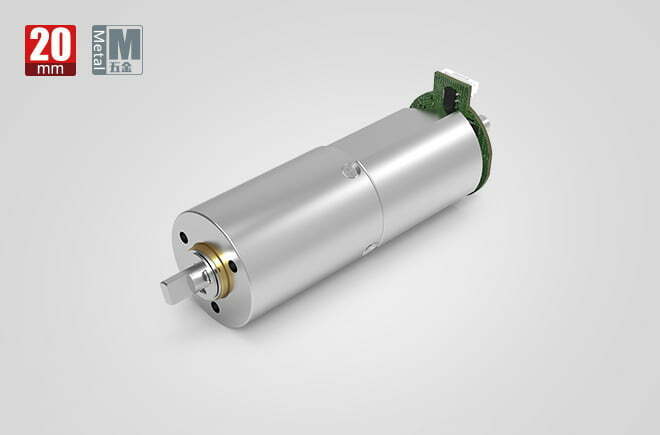
The brush-roller drive is a geared micro motor: a small electric motor coupled to a reduction gearbox (almost always planetary for this size) and an output shaft that carries the roller. The control loop is simple:
- The lithium pack (12/18/22.2/25.9 V) feeds a driver — a simple PWM H-bridge for brushed, or a 3-phase inverter with rotor-position sensing for BLDC.
- The motor spins at thousands of rpm (e.g. 3000–8000 rpm for the bare motor).
- The planetary reducer multiplies torque and cuts speed: a 10:1–15:1 stage turns 3000 rpm into ~250 rpm at the roller while multiplying motor torque by the ratio (minus losses). See how a planetary gearbox works for the ratio math.
- The roller agitates the floor; drag torque reacts back through the gearbox to the motor, which the driver holds at the commanded speed.
- On a BLDC unit, position/back-EMF sensing lets the controller keep speed constant even as the pack sags — a brushed unit just slows down as voltage drops.
For the suction path, the high-speed BLDC spins an impeller; centrifugal pressure rise scales with tip speed squared, so the blower is deliberately run at tens of thousands of rpm where torque is only a few millinewton-metres.
Motor Types for a Floor Scrubber: Feature Comparison
| Motor type | Efficiency | Brush / commutation life | Relative cost | Best fit in a scrubber |
|---|---|---|---|---|
| PMDC (brushed DC) | 60–75% | 500–2000 h (brush wear) | Low | Cost-sensitive brush roller; simplest driver |
| BLDC (brushless DC) | 80–90% | 10,000+ h (no brushes) | Medium–High | Premium cordless brush roller & suction blower; best runtime |
| Hollow-cup (coreless) DC | 70–85% | 1000–3000 h | Medium | Compact, low-vibration actuators where inertia matters |
| Stepper motor | 40–60% | 10,000+ h | Medium | Rare in scrubbers; only for indexed positioning, not continuous scrubbing |
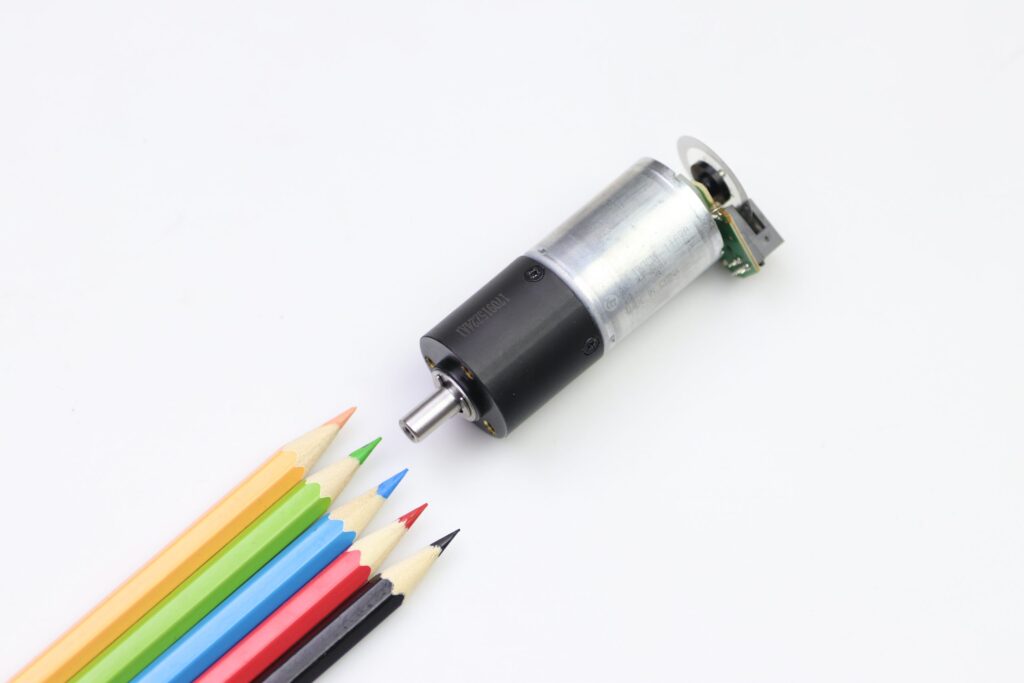
The practical split is simple: brushed PMDC for the lowest bill of materials, BLDC for the longest runtime and life on the same battery. Because a cordless appliance is battery-limited, the BLDC efficiency advantage is worth more here than in a mains-powered tool. See our servo vs stepper and motor features hub for the type-level trade-offs.
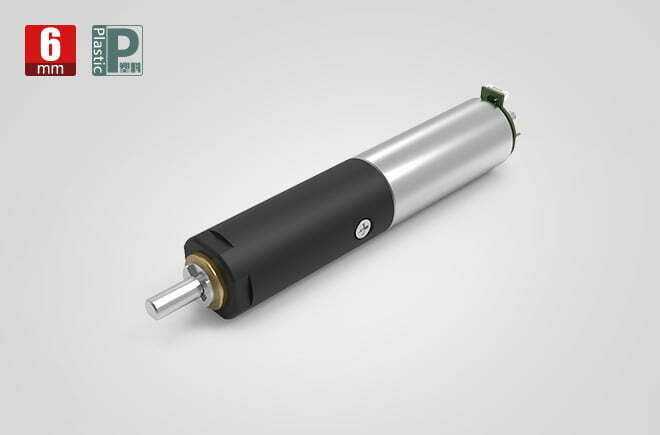
Which subsystem uses which motor?
| Subsystem | Motor type | Why this type | Typical spec |
|---|---|---|---|
| Brush / agitator roller | PMDC or BLDC + planetary | Needs low speed, high torque, quiet running | 12–25.9 V; 0.2–0.5 N·m motor; 5–15:1 |
| Suction / vacuum blower | High-speed BLDC | Airflow needs tip speed, so high rpm | 12–25.9 V; 50k–80k rpm; 55–90 W |
| Water spray pump | Small BLDC / PMDC | Low-flow fluid transfer | 3–12 V; low torque |
| Self-propelled drive | BLDC + reducer | Traction with torque multiplication | 12–25.9 V; geared down |

Engineering Data: Efficiency, Temperature, and Torque
Efficiency and thermal limits
| Parameter | PMDC (brushed) | BLDC | Standard / note |
|---|---|---|---|
| Rated efficiency | 60–75% | 80–90% | Loss = heat = shorter battery life |
| Operating temperature | −20 to +85 °C | −20 to +85 °C | From typical 20–24 mm geared-motor specs |
| Insulation class | B (130 °C) / F (155 °C) | B / F | IEC 60034-1 thermal class |
| Noise | Higher (brush + gear mesh) | Lower | Target < 75 dB at the handle |
| Pack voltage | 12 / 18 / 22.2 / 25.9 V | same | Lithium-ion cell count (3S–7S) |
| Ingress protection | Sealed bearings, IP-rated | Sealed bearings, IP-rated | Wet-dry use; no open commutator near spray |
Torque and power formulas
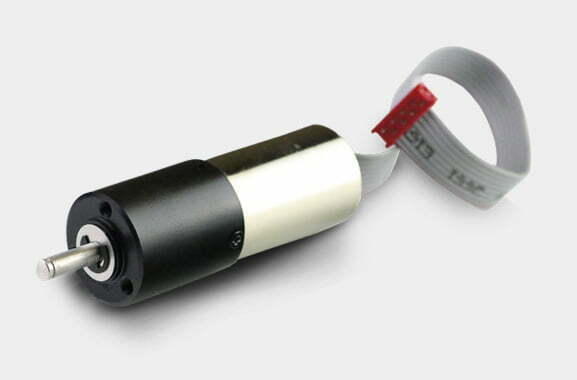
The two equations that size every scrubber motor:
- Output torque after the gearbox:
Tout = Tmotor × i × η— whereiis the reduction ratio andηthe gearbox efficiency (~0.80–0.90 for a planetary stage). - Mechanical power ↔ torque & speed:
P = T × ω = T × 2πn / 60, so for a small motorT(N·m) = P(W) × 9.5493 / n(rpm).
The brush roller is a torque problem (you need N·m at a few hundred rpm); the suction blower is a speed problem (you need tens of thousands of rpm, torque is negligible). That single distinction decides the motor type.
Best Applications for Floor Scrubber Motors
- Handheld cordless scrubbers / wet-dry vacuum mops — the core use; BLDC + planetary for the roller, high-speed BLDC for suction.
- Robotic floor washers — multiple BLDC drives (rollers, side brushes, suction, navigation wheels) on one pack.
- Stick vacuums with a powered brush bar — same geared-motor architecture, often a 2-stage reducer for very low roller rpm.
- Walk-behind and ride-on scrubbers — larger geared BLDC motors; see our precision planetary gearbox applications guide for the industrial side.
- Car-detailing and upholstery scrubbers — compact PMDC or BLDC geared motors where size and weight dominate.
Headlamp and other micro-actuator uses are covered separately in our micro motor application guides.
What real cordless scrubbers actually ship with
| Metric | Typical handheld unit | Implication for the motor |
|---|---|---|
| Pack voltage | 22.2 V (6S) or 25.9 V (7S); some 18 V | Size motors for ~9–10 V sag under stall |
| Total rated power | 120–177 W | Split between roller, suction, and pump |
| Suction motor | BLDC, 55–90 W, 50,000–80,000 rpm | High-speed blower, negligible torque |
| Brush roller | Geared micro motor, low speed | PMDC (cost) or BLDC (runtime) |
| Brush width | 250–400 mm | Wider bar → more drag torque to size for |
| Runtime | 35–50 min (high speed) | Drives the BLDC-vs-brushed decision |
| Noise | ≤ 75 dB at the handle | Favors BLDC + quiet planetary |
Step-by-Step Selection of a Floor Scrubber Motor
- Define the subsystem. Brush roller, suction blower, or pump — each needs a different motor type (torque vs speed).
- Estimate the load. For the roller, estimate drag torque from floor type and roller diameter; for the blower, estimate required airflow and thus rpm.
- Choose the motor + ratio. Pick a bare motor torque/speed, then a planetary ratio so
Tout = Tmotor × i × ηclears the load with a 1.3–1.5× margin. - Check the sagged voltage. Size for pack voltage under load, not nominal — a 12 V pack can sag to ~9 V at stall.
- Verify thermal and IP rating. Confirm −20 to +85 °C operation and sealed bearings for the wet environment.
- Trade brushed vs BLDC on battery life. Compute runtime from efficiency; the BLDC premium usually pays back in fewer battery cycles.
Worked example — brush-roller motor for a handheld scrubber
Suppose the roller must deliver 2.0 N·m at 250 rpm to agitate a medium carpet. Pick a 12 V BLDC rated 0.25 N·m at 3000 rpm (its power is 0.25 × 2π × 3000 / 60 ≈ 78.5 W, a realistic 80 W micro motor). Behind a 12:1 planetary with η = 0.85:
- Output torque:
Tout = 0.25 × 12 × 0.85 = 2.55 N·mat the roller. - Output speed:
nout = 3000 / 12 = 250 rpm— exactly the target. - Margin: 2.55 / 2.0 = 1.28× — acceptable; drop to a 10:1 for more speed headroom or a 15:1 for more torque margin.
- Battery cost: at ~80 W and 85% system efficiency, the roller draws ~94 W; on a 22.2 V (7S) pack that is ~4.2 A — a 2.6 Ah pack gives roughly 35–40 min of continuous scrubbing, matching real product specs.
Counter-intuitive takeaway: a brushed PMDC at 70% efficiency would need ~113 W for the same output, so it pulls ~30% more current from the same pack — meaning noticeably shorter runtime and more heat in a sealed, poorly-ventilated handle. On a cordless appliance the BLDC premium is not a luxury; it is the difference between a product that lasts 40 minutes and one that dies in 28.
Worked example — suction blower
A wet-dry scrubber needs a blower at 60,000 rpm drawing 60 W from 12 V. The motor torque is T = 60 × 9.5493 / 60000 ≈ 9.5 mN·m — tiny, but correct for a high-speed BLDC impeller. This is why the suction motor is a fundamentally different (high-speed, low-torque) machine from the geared brushroller motor.
Common Engineering Mistakes
- Sizing by power alone. A 120 W rating says nothing about whether the roller delivers 2 N·m at 250 rpm. Always check torque after the gearbox.
- Ignoring pack voltage sag. Specifying the motor at nominal 12 V, then watching it brown out at 9 V on a dirty carpet. Size for the sagged voltage.
- Over- or under-specifying BLDC. Paying for BLDC on a light-duty unit, or saving pennies on brushed and shipping a product with half the runtime. Match the motor to the duty cycle.
- Forgetting the wet environment. An open commutator or non-sealed bearing near spray fails fast. Use sealed bearings and an IP-rated housing; BLDC has no brushes to corrode — a real advantage here.
- Underestimating gearbox wear. The reducer, not the motor, often sets life. Pair with our micro-motor gear reducer troubleshooting notes.
- EMI into the control electronics. Brush commutation and fast BLDC switching can couple into the sensor board; keep spacing and filtering, especially on the brushed option.
Troubleshooting: Problem → Cause → Solution
| Problem | Likely cause | Solution |
|---|---|---|
| Brush roller won’t spin / very weak | Low pack voltage, stalled gearbox, or worn brushes (PMDC) | Measure pack under load; clear/relubricate or replace gearbox; replace motor if brushes are gone |
| Motor overheats in the handle | Overload, poor ventilation in sealed housing, wrong duty cycle | Re-size with more torque margin, add vent path away from tanks, lower continuous load |
| Excessive noise / whine | Worn gears, dry bearing, roller imbalance | Relubricate, replace gearbox, balance the roller; switch to BLDC for lower acoustic noise |
| Short runtime vs spec | Low motor efficiency (brushed), high current draw, aged pack | Move to BLDC, check pack health, reduce drag torque at the roller |
| Failure after water exposure | Seal failure, corrosion at commutator / bearings | Use sealed bearings and IP-rated motor; prefer BLDC (no brush to corrode); keep vent away from spray |
| Brush sparking / intermittent | Worn commutator, overload, wrong motor for duty | Replace motor; re-size; consider BLDC to eliminate commutation entirely |
For motor-side diagnostics beyond the actuator, use our DC motor troubleshooting guide and why DC motors lose torque.
Frequently Asked Questions
Is the floor scrubber motor brushed or brushless?
It depends on the model and the subsystem. The brush roller is a PMDC (brushed) motor on cost-sensitive units and a BLDC motor on premium cordless units; the suction blower is almost always a high-speed BLDC. For battery life, BLDC is the modern default.
Can I use a stepper motor for the brush roller?
Not usually. A stepper is built for indexed positioning, not continuous high-torque scrubbing, and runs at 40–60% efficiency. A geared PMDC or BLDC is the right tool. See our servo vs stepper comparison for the control-law trade-offs.
What gearbox ratio do I need for the roller?
Most handheld rollers want 5:1 to 15:1 behind a small motor spinning 3000–8000 rpm, landing the roller at 200–400 rpm. Use the formula Tout = Tmotor × i × η and pick the smallest ratio that still clears the load with margin — more ratio means more gearbox loss and size.
Why does my scrubber die faster than the rated runtime?
Two usual culprits: a brushed motor wasting ~30% of energy as heat, and voltage sag stalling the motor on load so it draws more current. A BLDC sized for the sagged voltage, with a correctly chosen gear ratio, recovers most of that lost runtime.
Do I need a planetary or can I use a spur reducer?
At this size, planetary is the norm because it shares load across three planets (compact, high torque density, low backlash) — see gearbox vs gear motor and planetary gearbox working. A spur reducer is cheaper but larger and noisier for the same ratio.
Why Choose Greensky Power for Floor Scrubber Motors
Greensky Power develops IEC 60034 / NEMA MG 1-compliant micro geared motors for cordless appliance makers — PMDC and BLDC motors from 6 mm to 38 mm, paired with custom planetary reducers (ratios 5:1 to 1500:1, output torque up to ~80 kgf·cm) and sealed, water-resistant builds for wet-dry use. We support:
- Low-MOQ OEM/ODM with custom voltage, ratio, shaft, and flange (ISO 9409) to drop into your roller or blower — see our custom electric motor solutions and manufacturing capabilities.
- BLDC or brushed, your call — we will size both and show you the runtime/bill-of-materials trade-off rather than pushing the expensive option.
- Engineering support for pack-voltage sag, thermal, and IP rating so the motor survives the handle, not just the datasheet.
Pair the actuator with the right motor type using our brushless DC motor guide and brushed DC motor guide.
Related Resources
- Micro-motor gear reducer problems — troubleshooting
- Brushless DC motor guide — when BLDC earns its cost
- Brushed DC motor guide — lowest BOM cost option
- What is a DC motor? — types and formulas
- How a planetary gearbox works — ratio and torque math
- Worm gear reducer explained — self-locking alternative
- Gearbox vs gear motor — what to specify
- Motor flange guide — ISO 9409 mounting
- Servo vs stepper motor — control-law trade-offs
- Precision planetary gearbox applications — industrial uses
- Micro motor application guides — other “which motor for X” answers
- Motor features hub — all motor types at a glance
- Why speed reducers matter — torque-multiplication logic
References
The following standards and manufacturer documents informed the engineering data above. Links were last verified against publisher pages; some manufacturer download portals block automated requests (HTTP 403) but are reachable in a normal browser.
- IEC 60034-1:2022 — Rotating electrical machines, Part 1: Rating and performance. webstore.iec.ch/publication/64888
- IEC 60034-30-1 — Efficiency classes for rotating electrical machines (IE1–IE5). webstore.iec.ch/publication/67563
- NEMA MG 1-2024 — Motors and Generators. nema.org/standards/view/Motors-and-Generators
- IEEE 112 — Test Procedure for Polyphase Induction & DC Motors. standards.ieee.org/ieee/112/4703
- IEEE 43-2013 — Insulation Resistance Testing of Rotating Machinery. standards.ieee.org/ieee/43/4385
- U.S. DOE — Motor & Drive Systems Efficiency. energy.gov/eere/motors
- SKF — Bearing life calculation (L10) for gear applications. skf.com/group/technical-insights/bearings
- Siemens — SIMOGEAR geared motors technical catalog. assets.new.siemens.com/…/simogear
- AGMA — Gear rating and enclosed gear unit practice. agma.org/standards
- maxon — Gear Technology (download). maxongroup.com/…/gear-download
- FAULHABER — Drive technology know-how. faulhaber.com/en/know-how
- Yaskawa — Motor & drive technical documents. yaskawa.com/downloads
This article was prepared by the Greensky Power engineering team as a technical reference for appliance designers. Specific pack, torque, and IP requirements should be validated against your own test data and the applicable IEC/NEMA standards before production.
