
Which Micro Motor Is Used for an Automotive Headlight Dimming Driver?
Quick Answer. An automotive headlight dimming/leveling driver is a small geared micro motor packaged with a gearbox and a lead screw or sector. The right type depends on the function:
A small DC geared motor is the lowest-cost choice for simple automatic vertical leveling (load compensation).
A coreless (hollow-cup) DC motor is used where fast response and low inertia matter.
A brushless DC (BLDC) motor is chosen for premium quiet/long-life units.
And a stepper motor — typically driven with microstepping — is the standard for adaptive front-lighting (AFS) and adaptive driving beam (ADB) where the beam must hold and re-position precisely. In all cases the motor is de-rated to automotive temperature (−40 °C to +85 °C), low EMC, and a long cycle life.
[ez-toc]
What Is an Automotive Headlight Dimming Driver?
Strictly, “dimming driver” is loose wording for the headlamp leveling / aiming actuator — the motorized mechanism that changes the headlight’s aim angle. Three distinct functions fall under this umbrella, and they do not all use the same motor:
- Manual / automatic vertical leveling. Compensates for vehicle load (passengers, trailer, boot weight) so the beam does not blind oncoming traffic. The lamp tilts up/down a few degrees. This is the most common “dimming driver” and is usually a slow two-position or continuous sweep.
- Adaptive Front-lighting (AFS). Swivels or raises the beam with steering angle and speed for corners and slopes. Requires indexed, repeatable multi-position control.
- Adaptive Driving Beam (ADB) / matrix LED. Shutters, flaps, or lens elements mask portions of the beam around other road users in real time. Requires precise, frequent, low-noise positioning.
The actuator converts motor rotation into a small linear or angular displacement of the lamp, reflector, or shutter. A typical unit moves a push–pull rod about 4.5 mm with a force of 40 N or more, at a speed near 0.5–0.7 mm/s, on a 12 V supply. The core of the device is always motor + gearbox: the gearbox trades the motor’s high speed for the high torque and slow, controlled motion the mechanism needs. For the gearbox kinematics behind this, see our planetary gearbox and worm gear reducer guides.
How a Headlight Actuator Works (Step by Step)
- Command. A body controller (or suspension-height sensor for leveling, or a camera/steering signal for AFS/ADB) sends a target position.
- Drive. The micro motor spins at thousands of rpm — far too fast and too weak to move the lamp directly.
- Reduction. A planetary or worm gearbox steps the speed down (typically 5:1 to 1500:1) and multiplies torque, using the relation Tout = Tmotor × i × η where i is the ratio and η the gear efficiency.
- Conversion. The gearbox output turns a lead screw, rack, or gear sector that swings the lamp or slides a shutter. Linear speed v = p × nout / 60 where p is screw pitch (mm/rev) and nout the gear output speed (rpm).
- Hold. The motor either coasts (spring holds the lamp for simple leveling) or actively holds current (stepper/BLDC) to keep the beam on target against vibration and gravity.
Because the motion is small, slow, and force-limited, the gearbox — not the bare motor — is the component that decides noise, backlash, and life. See our micro-motor gear reducer troubleshooting notes for the failure modes this introduces.
Which Micro Motor Type? (Comparison Table)
Greensky and other headlamp-actuator suppliers typically offer four motor bases behind the same gearbox. They are not interchangeable — pick by the control requirement, not by habit.
| Motor base | Relative cost | Positioning | Life | EMC | Best fit in headlights |
|---|---|---|---|---|---|
| DC brushed geared | Low | Open-loop, 2-pos / slow sweep | 1k–3k h (commutator) | Poor (brush noise) | Basic automatic vertical leveling |
| Coreless (hollow-cup) DC | Medium | Open-loop, very fast response | 3k–5k+ h | Poor | Fast-response leveling, low inertia |
| Brushless DC (BLDC) geared | Medium–High | Closed-loop capable | 10k–30k+ h | Good (if filtered) | Premium, quiet, long-life units |
| Stepper (microstepping) | Medium | Indexed, multi-position hold | 10k+ h (no brushes) | Good (no spark) | AFS / ADB beam positioning |
Why stepper motors dominate adaptive systems
For AFS and ADB the actuator must not just move — it must hold a commanded angle against road shock and report no drift. A stepper indexes in discrete, repeatable steps and, with a microstepping driver, subdivides each step into fine increments for smooth, silent motion. onsemi’s automotive lighting documentation explicitly specifies microstepping drivers (e.g. AMIS-30623, NCV70521/522) for headlamp horizontal adjustment and deflection, with integrated stall detection — the exact capability a leveling actuator needs. A brushed DC motor can only “run until a stop or a timer expires,” which is adequate for crude leveling but not for beam shaping. For the open-loop-vs-closed-loop control nuance, see our servo vs stepper comparison.
Typical specifications by motor type
| Motor base | Typical voltage | No-load speed | Ratio range | Temp range |
|---|---|---|---|---|
| DC brushed geared | 4.2–12 V | 19–1228 rpm (geared) | 13:1–809:1 | −20 to +85 °C |
| Coreless DC geared | 3–12 V | high (low inertia) | 5:1–625:1 | −40 to +85 °C |
| BLDC geared | 12–24 V | 15000–30000 rpm (bare) | 5:1–625:1 | −40 to +85 °C |
| Stepper (microstep) | 5–12 V | indexed (1.8°/step) | up to ~100:1 | −20 to +85 °C |
Note the same gearbox envelope (e.g. a 6–8 mm diameter planetary) is shared across all four bases — the differentiation is the motor, not the reducer. That is why suppliers list “customizable” voltage, ratio, and current: the gearbox is the constant, the motor is the variable.
Engineering Data: Efficiency, Temperature, Torque
The numbers below are typical for production headlamp-leveling actuators and the micro motors that drive them. They are the data the SERP’s thin manufacturer pages omit.
| Parameter | Typical value | Basis / standard |
|---|---|---|
| Supply voltage | 12 V nominal (24 V trucks) | Road-vehicle electrical, ISO 16750 |
| Operating temperature | −40 °C to +85 °C | ISO 16750-4 (lamp-module environment) |
| No-load / load current | 95–220 mA / ≤400 mA | OEM actuator spec (e.g. 8 mm units) |
| Output speed | 0.5–0.7 mm/s (linear) | Lead-screw conversion |
| Push–pull force | ≥40 N | Overcomes lamp moment + friction |
| Travel | 4.5 ± 0.5 mm | OEM geometry |
| Gearbox backlash | ≤3° (precision ≤1°) | Positioning repeatability |
| Reduction ratio | 13:1 to 809:1 (custom) | Matched to motor & load |
| Motor efficiency | Brushed ~40–60%; BLDC ~70–90% | IEC 60034-30-1 classes |
| Cycle life | ≥10,000 cycles (premium 30k+) | OEM durability |
| EMC | CISPR 25 compliant | Vehicle radiated limits |
| Functional safety (ADB) | ISO 26262 ASIL-rated path | Safety-relevant lighting |
Torque and temperature math you can reproduce
The output torque the lamp demands sets the motor/ratio. For a lamp of mass m with its center of gravity at radius r from the pivot, the gravitational moment is M = m × g × r. With a safety factor S and gear efficiency η, the required motor torque is Tmotor = (S × M) / (i × η). Temperature enters twice: the insulation class (IEC 60034-1) sets the winding limit, and the grease must not stiffen at −40 °C or the cold-start current spike can stall a brushed motor. We size the ratio so the motor runs well below its stall point at both ends of the temperature range.
Best Applications for Each Motor Type
| Application | Recommended motor | Why |
|---|---|---|
| Automatic vertical leveling (load comp.) | DC brushed geared | Cheapest; motion is a slow sweep, no fine hold needed |
| Fast leveling, low-inertia flaps | Coreless DC geared | Low rotor inertia → snappy response, no overshoot |
| AFS cornering / swivel | Stepper (microstepping) | Indexed multi-position hold, no encoder |
| ADB / matrix-LED shutter & mask | Stepper (microstepping) or BLDC | Precise, frequent, silent positioning |
| Premium silent long-life unit | BLDC geared | Quiet, 10k–30k h, EMC-clean |
| Heavy gravity-loaded axis, no spring | Worm-gear + motor | Self-locking hold without continuous current |
Headlamp actuators are one row in our broader precision planetary gearbox applications guide, which maps micro reducers across robotics, medical, and automotive uses.
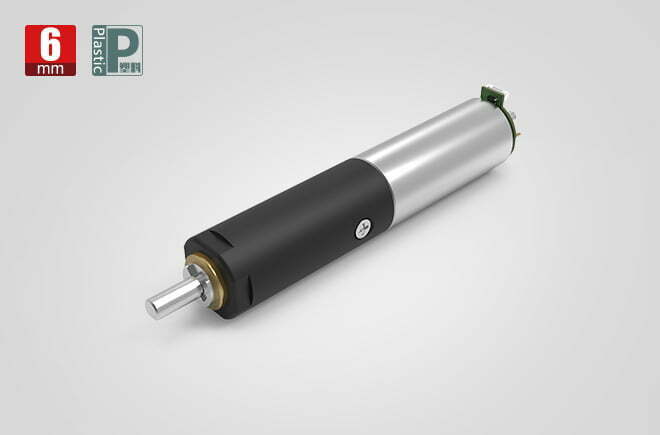
I. Miniature DC geared motor
Outer diameter: 6mm
Material: plastic
Rotation direction: cw&ccw
Gearbox return difference: ≤3°
Bearing:oil bearing;rolling bearing
Axial runout:≤0.3mm(oil bearing);≤0.2mm(rolling bearing)
Output shaft radial load: ≤ 0.3N (oil bearing); ≤ 4N (rolling bearing)
Drive motor: DC brush motor, DC brushless motor
Gear box: planetary gear box
Second, brush geared motor
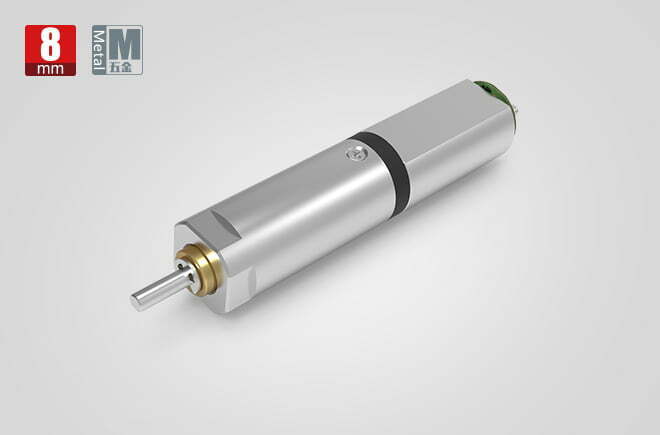
Product specification: Φ8MM products
Voltage:4.2V
No-load speed:19-1228rpm(customizable)
No-load current:95-100mA (customizable)
Load speed:15-935rpm(customizable)
Load current: 155-160mA (customizable)
Speed ratio: 13-809.1 (customizable)
Drive motor: DC brush motor
Gearbox: planetary gearbox
Product advantages: simple structure, smooth operation, good starting and braking effect, fast response, high starting torque and high control accuracy.
Product disadvantages: large friction, high loss, heat, short life, spark, interference, low efficiency, low output power.
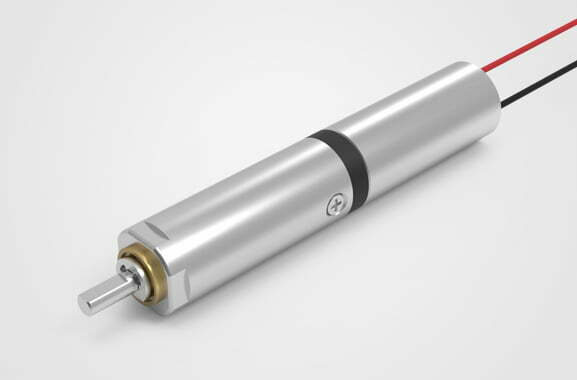
Third, miniature stepper motor
Outer diameter: 6mm
Material: hardware
Rotation direction: cw & ccw
Gearbox return difference: ≤ 3 °
Bearing: oil bearing; rolling bearing
Axial runout: ≤0.3mm (oil bearing); ≤0.2mm (rolling bearing)
Output shaft radial load: ≤ 0.5N (oil bearing); ≤ 5N (rolling bearing)
Working temperature: -20……+85℃
Four, miniature brushless motor
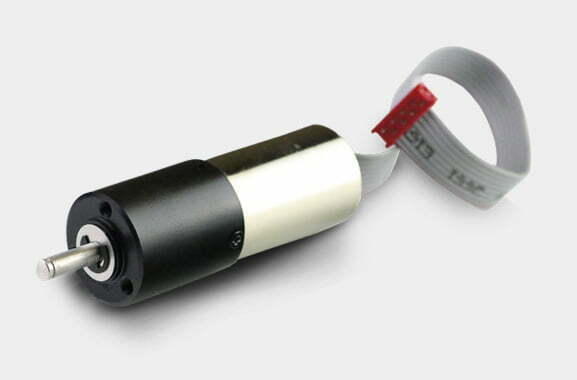
Product specification:Φ20MM products
Voltage:12V
No-load speed: 15000-30000rpm (can be customized)
No-load current:220 mA (customizable)
Load speed:2.4-1000 rpm(customizable)
Reduction ratio: 5/25/125/625:1 (customizable)
Drive motor: Brushless motor
Gearbox: planetary gearbox (customizable)
The drive motor of the car headlight dimming driver is customizable and developed according to demand, with custom parameters ranging from, diameter 3.4mm-38mm, power: 0.01-40W, output speed 5-2000rpm, reduction ratio 5-1500, output torque 1gf.cm to 80Kgf.cm.
Step-by-Step Selection (with Worked Examples)
Example A — Vertical leveling, DC geared motor
- Define the load. Lamp assembly 0.9 kg, CG 35 mm from pivot → moment M = 0.9 × 9.81 × 0.035 = 0.31 N·m.
- Add margin. Use S = 1.5 → required output torque = 0.46 N·m.
- Pick the motor. A 6 mm coreless motor rated Tmotor = 5 mN·m, gear efficiency η = 0.60.
- Solve the ratio. i ≥ 0.46 / (0.005 × 0.60) = 153 → choose standard 160:1.
- Check speed. Motor 18,000 rpm → output 112 rpm. For 0.5 mm/s linear with lead screw, pitch p = 0.5 × 60 / 112 = 0.27 mm/rev — a fine, achievable screw. Full 4.5 mm travel in ~9 s, acceptable for leveling.
Verdict: a 6 mm coreless motor behind a 160:1 planetary meets the load with ~10% torque margin and a sensible speed. A brushed unit of the same size works too at lower cost if EMC is filtered.
Example B — AFS swivel, stepper motor
- Define resolution. Need ±0.1° repeatability over a ±15° swivel.
- Pick the stepper. Hybrid stepper, 1.8°/step, driven at 1/16 microstep → 0.1125°/microstep.
- Gear it. A 15:1 planetary gives 0.0075°/microstep at the output — far finer than required.
- Check hold torque. 6 mm stepper holding torque ~2 mN·m × 15 × 0.6 = 0.018 N·m at output; adequate for a low-inertia reflector. Use a driver with stall detection (onsemi AMIS-30623 class) so potholes do not cost steps.
Counter-intuitive takeaway: the stepper is not “more precise” because of the motor — it is precise because the microstepping driver holds and subdivides position. A brushed DC motor of identical size cannot match it for indexed aiming without adding an encoder and a closed loop, which costs more than the stepper did.
Common Engineering Mistakes
- Treating leveling and adaptive aiming as one actuator. A two-position DC motor cannot do AFS/ADB. Specify the control type first, then the motor.
- Undersizing for the lamp moment. Forgetting the 1.5× safety factor leaves no margin after grease drag and cold thickening, so the motor stalls at −40 °C.
- Ignoring cold-start grease. Standard grease stiffens below −20 °C; at −40 °C it can multiply start torque and trip the over-current limit. Specify low-temperature grease.
- Forgetting EMC. A brushed commutator throws broadband noise that fails CISPR 25. Either filter it, shield it, or move to BLDC/stepper.
- Open-loop stepper with no stall detection. Shock or overload drops steps with no error flag, so the beam aims wrong. Use a driver that reports stall, or home periodically.
- Over-specifying precision. Ultra-low-backlash gearing is unnecessary for simple vertical leveling and wastes budget; reserve it for AFS/ADB.
Troubleshooting: Problem → Cause → Solution
| Problem | Cause | Solution |
|---|---|---|
| Headlight will not return to level; motor stalls | Lamp moment > motor torque (undersized) | Increase ratio or motor torque; verify 1.5× margin |
| Stepper aims off after bumps | Lost steps, no feedback | Use driver with stall detection (AMIS-30623 class) or periodic homing |
| EMC / CISPR 25 test failure | Brushed commutation noise | Switch to BLDC/stepper, add LC filter and shield |
| Sluggish or stalls in winter | Grease too viscous at −40 °C | Use low-temperature grease; re-check cold start torque |
| Position drifts over time | Gear backlash and wear | Preloaded gear or stepper microstep hold |
| Audible whine | High step rate or poorly tuned drive | Lower microstep rate or use sinusoidal BLDC drive |
For motor-side diagnostics beyond the actuator, use our DC motor troubleshooting guide and why DC motors lose torque.
Frequently Asked Questions
Which motor is best for a headlight leveling actuator?
For basic automatic vertical leveling, a small DC geared motor is the lowest-cost fit. For AFS/ADB beam positioning, a stepper with a microstepping driver is preferred because it indexes and holds position without a separate encoder.
Can a stepper motor be used for headlight leveling?
Yes — steppers are widely used for AFS/ADB and, with a microstepping driver, for precise leveling. The risk is an open-loop stepper losing steps under shock; the driver must include stall detection or the system must home periodically.
Why not just use a brushless DC (BLDC) motor?
BLDC is quieter, longer-lived, and EMC-clean, but needs rotor-position feedback and costs more. For a single slow vertical adjust it is over-engineered; it pays off only with frequent duty, silent operation, or very high cycle counts.
What voltage and temperature range must the motor meet?
Nominally 12 V (24 V on trucks), operating from about −40 °C to +85 °C at the lamp module, per road-vehicle environmental standards such as ISO 16750. Grease, bearings, and commutation must all survive cold-start.
How much torque does a headlight leveling motor need?
It is set by the lamp moment about its pivot plus friction and a safety margin. A 0.9 kg lamp at 35 mm radius needs ~0.31 N·m; sizing with 1.5× margin calls for ~0.46 N·m at the output, which a 6 mm coreless motor behind ~160:1 planetary can deliver.
Does the actuator need to be self-locking?
Usually not — a planetary/spur reducer back-drives, but the lamp is held by a return spring. If it must hold a heavy gravity-loaded axis with no spring, use a self-locking worm gear reducer or add a brake.
Why Choose Greensky for Headlight Actuator Motors
Greensky Power is a China-based micro motor and precision gear-motor manufacturer supplying automotive-tier actuators. For headlamp dimming/leveling drivers we provide:
- All four motor bases — brushed DC, coreless, BLDC, and stepper — behind custom planetary or worm reducers, so the control architecture is your choice, not our catalog’s limit.
- Automotive-grade build — −40 °C to +85 °C operation, low-temperature grease options, and CISPR 25-aware commutation/filtering.
- Custom geometry — diameters from 3.4 mm to 38 mm, 0.01–40 W, ratios 5:1 to 1500:1, output torque from 1 gf·cm to 80 kgf·cm, built to your flange and lead-screw spec.
- Low-MOQ OEM/ODM with IATF 16949-aware process controls for automotive programs — see our custom electric motor solutions and manufacturing capabilities.
Pair the actuator with the right motor type using our motor features hub and brushless DC motor guide.
Related Resources
- Stepper motor fundamentals — step angle, holding torque, microstepping
- Brushless DC motor guide — when BLDC earns its cost
- Servo vs stepper motor — open-loop vs closed-loop control
- Micro-motor gear reducer problems — troubleshooting
- How a planetary gearbox works — ratio and torque math
- Worm gear reducer explained — self-locking alternative
- Gearbox vs gear motor — what to specify
- Motor flange guide — ISO 9409 mounting
- What is a DC motor? — types and formulas
- Why speed reducers matter — torque-multiplication logic
References
- IEC 60034-1:2022 — Rotating electrical machines, Part 1: Rating and performance. webstore.iec.ch/publication/64888
- IEC 60034-30-1 — Efficiency classes for rotating electrical machines (IE1–IE5). webstore.iec.ch/publication/67563
- NEMA MG 1-2024 — Motors and Generators. nema.org/standards/view/Motors-and-Generators
- IEEE 112 — Test Procedure for Polyphase Induction & DC Motors. standards.ieee.org/ieee/112/4703
- IEEE 43-2013 — Insulation Resistance Testing of Rotating Machinery. standards.ieee.org/ieee/43/4385
- U.S. DOE — Motor & Drive Systems Efficiency. energy.gov/eere/motors
- SKF — Bearing life calculation (L10) for gear applications. skf.com/group/technical-insights/bearings
- Siemens — SIMOGEAR geared motors technical catalog. assets.new.siemens.com/…/simogear
- AGMA — Gear rating and enclosed gear unit practice. agma.org/standards
- onsemi — AMIS-30623 single-chip microstepping motor driver for headlamp leveling (datasheet / app note). onsemi.com/pdf/datasheet/amis-30623-d.pdf
- maxon — Gear Technology (download). maxongroup.com/…/gear-download
- FAULHABER — Drive technology know-how. faulhaber.com/en/know-how
- Yaskawa — Motor & drive technical documents. yaskawa.com/downloads
This article was prepared by Greensky Power’s motor engineering team. Standards and datasheet links were current at publication; verify the exact edition and URL before specifying. onsemi AMIS-30623 is cited as a representative automotive microstepping driver — confirm the active part number with the vendor.
