
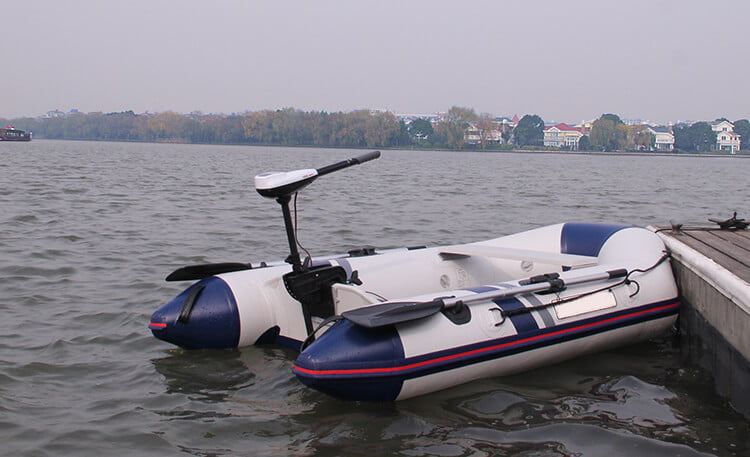
Outboard Electric Motor for Motorized Fishing Kayak
Quick Answer
An outboard electric motor for a motorized fishing kayak is a battery-powered brushless DC (BLDC) drive that turns a submerged propeller to push the hull quietly. The motor is sized by thrust (force at the prop), not horsepower: a typical 55 lb kayak motor is about a 550-660 W BLDC unit on a 12V battery. Selection comes down to loaded kayak weight (roughly 2 lb thrust per 100 lb), voltage (12V/24V/36V), shaft length, and battery capacity, which determines runtime.
Contents
- What Is an Outboard Electric Motor for a Fishing Kayak?
- How an Electric Kayak Outboard Works
- BLDC vs Brushed Trolling Motors
- 12V vs 24V vs 36V Systems
- Engineering Data: Thrust, Power, Efficiency & Temperature
- Best Applications for Kayak Outboard Motors
- How to Select an Outboard Motor for Your Fishing Kayak
- Common Engineering Mistakes
- Troubleshooting Table
- Why Choose Greensky Power for Kayak Outboard Motors?
- Related Resources
- References
- FAQ
What Is an Outboard Electric Motor for a Fishing Kayak?
An outboard electric motor for a fishing kayak is a self-contained, battery-powered propulsion unit clamped to the transom (stern) or mounted on the bow of a kayak. Unlike a gasoline outboard, it produces no exhaust, runs at a whisper level well under 60 dB, and is controlled by a tiller, foot pedal, or wireless remote. The drive core is almost always a brushless DC motor (BLDC) paired with an electronic speed controller (ESC) and a reduction gear that spins a small propeller.
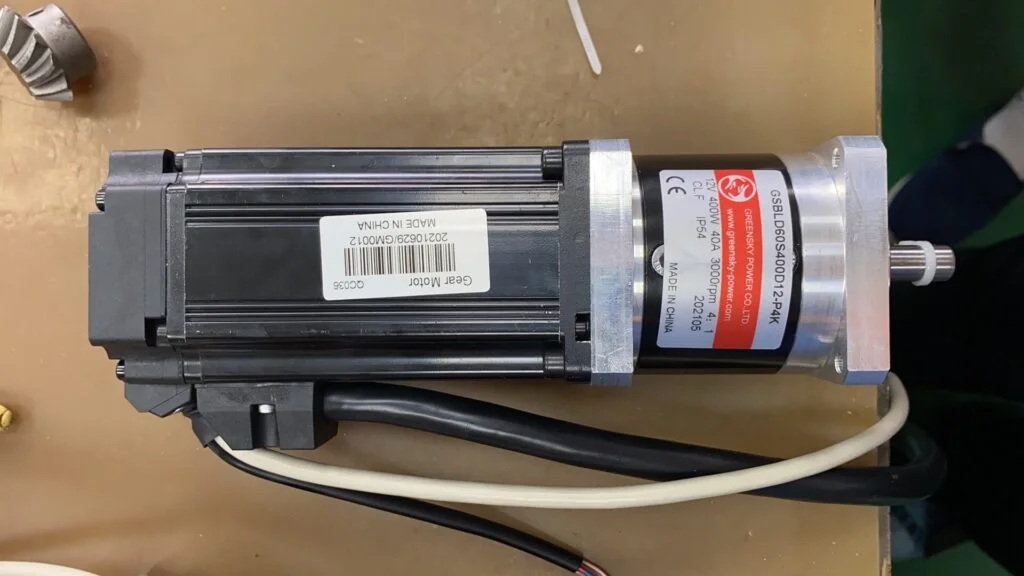
The term is used loosely. A trolling motor is a low-speed electric unit built for quiet positioning; an electric outboard is a higher-power transom unit that mimics a gasoline outboard’s form factor but runs on batteries. For kayaks, both are electric, transom- or bow-mounted, and differentiated mainly by thrust class and voltage. A planetary gear BLDC motor is the usual drive because it delivers the high starting torque a prop needs from a standing start in water.
Terminology guard. “HP equivalent” printed on a 3 HP electric outboard is a marketing number tied to peak thrust at zero speed, not a continuous shaft-power rating. Real shaft power is P = F × v (force × velocity). We return to this in the engineering section because it changes how you size the battery.
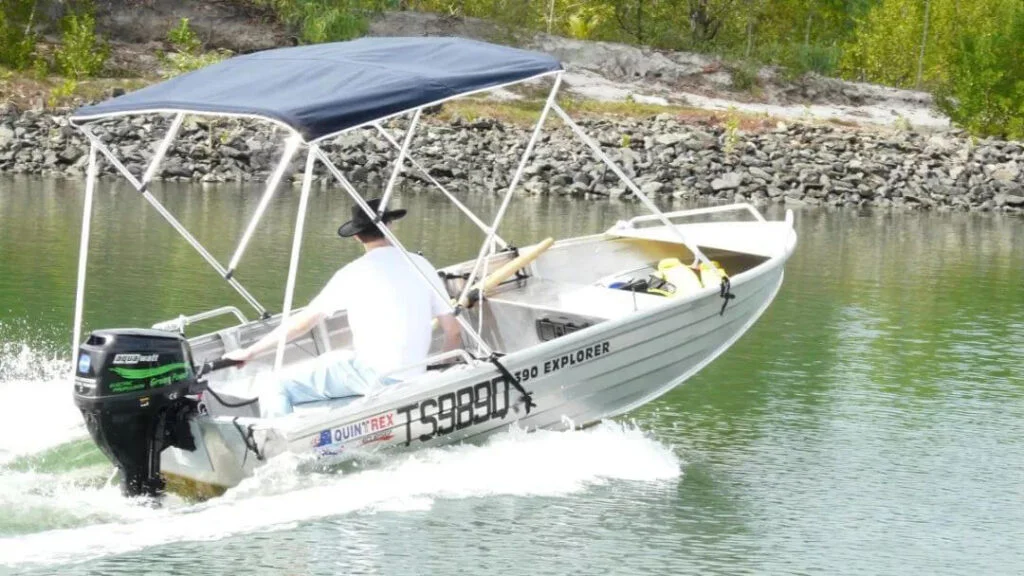
How an Electric Kayak Outboard Works
The energy path is a simple chain: battery → controller → BLDC motor → gear reduction → propeller → thrust. Each stage loses a little power, and the product of those efficiencies is what reaches the water.
Battery and Power Stage
The battery is a 12V, 24V, or 36V pack, usually lead-acid (deep-cycle) on budget rigs or LiFePO4 (lithium) on serious builds. The pack stores energy in watt-hours: Wh = V × Ah. A 12V 100 Ah lithium pack holds 1,200 Wh. The controller draws from this pack and chops DC into three-phase current for the motor.
The BLDC Drive and Electronic Commutation
Inside the sealed lower unit, a BLDC motor spins a rotor of permanent magnets past stationary windings. Instead of mechanical brushes, the controller commutates electronically using rotor-position feedback (Hall sensors or sensorless FOC). This is why a BLDC drive can be fully sealed: there is no brush gap that lets water and salt in. Per maxon’s EC technology notes, electronic commutation removes the brush-wear and sparking failure modes that dominate brushed marine motors.
Gear Reduction and the Propeller
The motor turns fast (often 2,000-4,000 rpm at the water); the propeller needs slow, high-torque rotation. A geared DC motor with a planetary or spur reduction steps the speed down. A three-blade composite, weedless propeller then converts that torque into thrust. Propeller efficiency for small kayak props runs about 0.45-0.55, which is the single biggest loss in the chain and the reason a “55 lb” motor needs a ~600 W electrical input.
BLDC vs Brushed Trolling Motors
Both drive a kayak, but the motor technology decides efficiency, lifespan, and how it survives a damp transom. This is the comparison anglers actually argue about.
| Aspect | BLDC (brushless) | Brushed DC |
|---|---|---|
| Motor efficiency | 85-92% | 75-85% |
| Overall drive efficiency (motor × controller) | ~86% | ~68-75% |
| Sealing | Fully sealable (no brush gap) | Brush openings invite water |
| Wear parts | None in the motor | Brushes & commutator |
| Acoustic noise | Low, no commutation spark | Higher, brush whine |
| Thermal rise at same output | Lower (I²R losses smaller) | Higher |
| Cost | Higher upfront | Lower upfront |
| Best fit for kayak | Yes — sealed, long-life | Budget / spare-only |
The efficiency gap matters on the water: at the same thrust, a BLDC unit pulls less current, so the battery lasts longer and the cables stay cooler. For a deeper look at the trade-offs, see brushless vs brushed DC motors and the limits of BLDC.
12V vs 24V vs 36V Systems
Voltage sets how much current the wiring must carry for a given power. For the same 600 W, 12V draws 50 A, 24V draws 25 A, and 36V draws 17 A. Higher voltage means thinner, cheaper, cooler cables — at the cost of a larger or series-connected pack.
| System | Typical thrust | Current at ~600 W | Best use |
|---|---|---|---|
| 12V | 26-55 lb | ~50 A | Most single kayaks; one battery |
| 24V | 55-86 lb | ~25 A | Tandem / loaded rigs; longer range |
| 36V | 100+ lb (3 HP eq.) | ~17 A | High-speed outboards, 6+ mph |
Choose the lowest voltage that meets your thrust need; it keeps the pack simple. If you exceed 55 lb thrust or want all-day range, move to 24V. The 24V BLDC platform is the common step-up for kayak OEMs.
Engineering Data: Thrust, Power, Efficiency & Temperature
This is where most consumer reviews stay vague and where an engineer sizes a real drive.
Thrust Is a Force, Not a Power Rating
Thrust is measured in pounds-force (or newtons): it is the static push the prop makes against the water. Shaft power is P = F × v, where v is boat speed. At a 2.5 mph troll (1.12 m/s) a 55 lb (245 N) motor needs only:
P_mech = 245 N × 1.12 m/s ≈ 274 W
Dividing by prop efficiency (~0.50) and adding ~10% controller/cable loss gives ~600 W electrical input. That is exactly why SERP-listed 55 lb motors are rated ~660 W. The lesson: a “55 lb” motor is a ~0.6 kW BLDC, and the HP-equivalent label is not a power spec.
The 2 lb-per-100 lb Loaded-Weight Rule
A widely used kayak guideline is 2 lb of thrust per 100 lb of loaded weight (kayak + angler + gear + battery). A 400 lb loaded single kayak → ~55 lb motor; a 600 lb+ tandem → 86 lb (24V). Always add margin for wind and current, which can double the force needed to hold position.
Efficiency Chain and Thermal Limits
| Parameter | BLDC kayak drive | Basis |
|---|---|---|
| Motor efficiency | 85-92% | IE4-class permanent magnet, IEC 60034-30-1 |
| ESC (FOC) efficiency | 95-98% | Three-phase controller |
| Propeller efficiency | 0.45-0.55 | Small composite prop |
| Overall drive efficiency | ~86% | Product of the above |
| Insulation class | Class F (155°C) | IEC 60034-1 |
| Ingress protection | IP67 / IP68 | IEC 60529 |
Per IEC 60034-1:2022, Class F insulation allows a 155°C winding limit; a sealed lower unit runs hotter than an open one, so thermal cutoff and a conservative duty cycle matter. Ingress protection follows IEC 60529: a transom drive should be IP67 (temporary immersion) at minimum. Marine wiring practice is governed by ABYC E-11.
Battery Runtime Math
Runtime is battery-limited. For a 600 W draw on a 12V pack, current is I = 600 / 12 = 50 A. A 50 Ah lead-acid used to 50% gives 25 Ah → ~0.5 h at full throttle. A 100 Ah LiFePO4 used to 80% gives 80 Ah → ~1.6 h at full, and 4-6 h at trolling partial throttle. The counterintuitive insight: a 55 lb motor sounds tiny, but at full throttle it empties a small battery in under 30 minutes. Always size the pack, not just the motor.
Best Applications for Kayak Outboard Motors
- Stealth freshwater fishing — lakes and slow rivers where quiet positioning beats speed; a 30-55 lb 12V unit is enough.
- Saltwater flats and bays — longer shafts (30-42 in transom, 36-54 in bow) and corrosion-resistant hardware; rinse after every trip.
- Station-keeping with current — holding a spot against wind or tide; here the 2 lb/100 lb rule needs upward margin.
- Long-range exploration — 24V/36V builds with lithium packs for all-day range.
- OEM and private-label builds — integrators who mount a custom BLDC drive into their own hull and housing.
Kayak propulsion is one of many planetary gear motor applications; the same drive logic appears in electric-vehicle motors and high-torque gate motors.
How to Select an Outboard Motor for Your Fishing Kayak
Use this step-by-step method, then confirm with the worked example.
- Weigh the loaded kayak (hull + angler + gear + battery).
- Apply the 2 lb/100 lb rule to get minimum thrust; add 20-40% for wind/current.
- Pick voltage: 12V for ≤55 lb, 24V for 55-86 lb, 36V for 100+ lb.
- Pick shaft length: prop should sit 4-6 in below the waterline. Transom kayaks use 24-42 in; bow units 36-54 in.
- Size the battery: compute continuous draw (
W / V), then choose Ah so runtime meets your trip, keeping lead-acid to 50% depth and lithium to 80%. - Confirm mount and IP rating: rated transom or manufacturer mount, IP67+ sealing, corrosion-resistant hardware.
Worked Example: Specifying a 55 lb 12V Kayak Motor
A 400 lb loaded single kayak, freshwater, occasional current. Step 2 gives 55 lb thrust (400 × 2 / 100). Add 30% margin → still served by a 55 lb class. Step 3: 12V. Step 4: 30 in transom shaft. Step 5: at 600 W draw, I = 600 / 12 = 50 A. For a 3 h trolling trip at ~200 W average (≈17 A), a 100 Ah LiFePO4 (80 Ah usable) gives 80 / 17 ≈ 4.7 h — comfortable. Step 6: IP67 sealed BLDC with a matching ESC.
The trap: a buyer sees “55 lb” and assumes big power, then fits a 50 Ah lead-acid and gets 25 minutes at full throttle. The motor was never the limit — the battery was. Size the pack from the watts, not the pounds.
Common Engineering Mistakes
- Sizing from thrust alone. Thrust is force; you must also size the battery from watts and runtime.
- Shaft too short. The prop ventilates (breathes air), loses thrust, and the motor loads unevenly. Measure loaded waterline to prop.
- Ignoring voltage sag. Under a 50 A draw a weak pack sags below ESC cutoff, tripping the motor. Size cables and BMS for peak current.
- Skipping corrosion protection. Saltwater without rinse and zinc/anode hardware destroys fittings in a season.
- Sealing a brushed motor. Brush motors need a gap; forced sealing traps heat. Use BLDC for sealed transom drives.
- No thermal headroom. A sealed lower unit at continuous full throttle hits Class F limits; add duty-cycle margin.
Troubleshooting Table
| Problem | Likely cause | Solution |
|---|---|---|
| Loss of thrust at speed | Prop ventilating (short shaft) or weed-wrapped | Lengthen shaft 4-6 in below waterline; clear prop |
| Motor cuts out under load | Battery voltage sag below ESC cutoff | Use larger Ah / higher C-rate pack; check cable gauge |
| Overheating / thermal trip | Continuous full throttle in sealed unit | Reduce duty cycle; verify Class F headroom (IEC 60034-1) |
| Slow runtime vs spec | Lead-acid used past 50% DoD | Move to LiFePO4; respect depth-of-discharge |
| Excess noise / vibration | Prop imbalance or bent shaft | Inspect and replace prop; check shaft runout |
| Corrosion after saltwater | No rinse, no anodes | Fresh-water rinse; fit zinc/anode hardware (ABYC E-11) |
Why Choose Greensky Power for Kayak Outboard Motors?
Greensky Power is a vertically integrated BLDC motor manufacturer that supplies the drive core — the high-efficiency brushless DC motor, planetary gear reduction, and matched controller — that OEMs build into kayak outboards. Our drives are specified to IEC 60034-1 insulation classes and IEC 60529 sealing, run at IE4-class efficiency, and are available as OEM and custom-tuned modules for 12V, 24V, and 36V platforms. See our motor feature overview and the BLDC product line.
Related Resources
- How Brushless DC Electric Motors Work
- BLDC Motor Basics
- Brushless vs Brushed DC Motors
- Disadvantages of Brushless DC Motors
- BLDC Planetary Gear Motors
- Motor Controllers (ESC)
- 24V Brushless DC Motors
- High-Efficiency BLDC Motors
- Electric Motor Basics
- AC vs DC Motors
- Custom BLDC Motors
- OEM Motor Program
References
- IEC 60034-1:2022 — Rotating electrical machines, Part 1: Rating and performance (insulation temperature classes B/F/H). webstore.iec.ch/en/publication/65446
- IEC 60034-30-1 — Efficiency classes of line-operated AC motors (IE3/IE4). webstore.iec.ch/publication/91195
- ANSI/NEMA MG 1 — Motors and Generators standard. webstore.ansi.org/standards/nema/ansinemamg2021
- NEMA — Motor and Generator product standards. nema.org/products/pages/motor-and-generator.aspx
- U.S. DOE — Motor Systems: Energy Efficiency Reference. energy.gov/sites/prod/files/2014/04/f15/10097517.pdf
- IEA — Electric Motors (energy-system efficiency). iea.org/energy-system/industry/electric-motors
- SKF — Bearing failures and their causes (shaft/gear reliability). skf.com/group/support/bearing-failures-and-their-causes
- Siemens — SIMOTICS electric motors. siemens.com/global/en/products/drives/electric-motors.html
- IEEE Xplore — Brushless DC motor control and design paper. ieeexplore.ieee.org/document/6342334
- maxon — EC (electronically commutated) motor technology. maxongroup.com/maxon/view/content/ec-technology
- FAULHABER — Drive system know-how (micro/BLDC). faulhaber.com/en/know-how
- Yaskawa — Motion and inverter/BLDC technical downloads. yaskawa.com/downloads/search-index
- Tsubaki — Power transmission selection technical data. en.tt-net.tsubakimoto.co.jp/tecs/engd/gen/engd_gen_ggm_sry.asp
- ABYC — American Boat & Yacht Council, marine electrical standards (E-11). abycinc.org
Content reviewed by the Greensky Power engineering team. Figures are typical industry values; verify against your specific battery, hull, and local regulations before build.
FAQ
1. What size outboard motor do I need for my fishing kayak?
Use the 2 lb of thrust per 100 lb of loaded kayak weight rule. A 400 lb loaded single kayak needs about a 55 lb thrust motor; a tandem or loaded rig over 600 lb should move to 86 lb (24V). The rating is static thrust at the propeller, not continuous power, so always size from total weight plus wind and current margin.
2. Is a brushless (BLDC) or brushed trolling motor better for a kayak?
BLDC is better for kayaks. A sealed BLDC drive reaches 85-92% motor efficiency and 86% overall drive efficiency versus 68-75% for a brushed motor, runs cooler, has no brushes to wear or spark, and tolerates the damp, sealed environment of a transom mount. Brushed units are cheaper but shorter-lived in marine use.
3. How long will a 12V battery run a 55 lb trolling motor?
A 55 lb motor draws about 50 A at full throttle. A 50 Ah lead-acid battery (50% usable) gives roughly 0.5 h at full power; a 100 Ah LiFePO4 (80% usable) gives about 1.6 h at full and 4-6 h at trolling speeds. Runtime is battery-limited, not motor-limited.
4. Can I convert my kayak to an electric outboard myself?
Yes, if your hull has a rated transom or a manufacturer-approved motor mount and you follow marine electrical practice. Use a fused, corrosion-resistant circuit, secure the battery low and centered, and rinse with fresh water after every saltwater trip. For OEM batches, a BLDC drive module with matched controller simplifies the build.
5. What voltage should I choose: 12V, 24V, or 36V?
12V covers most kayaks up to 55 lb thrust with a single battery. Choose 24V for 55-86 lb thrust or longer range, and 36V for 3 HP-equivalent outboards (100+ lb thrust, 6+ mph). Higher voltage lowers current for the same power, reducing cable size and voltage sag.
6. Why is my trolling motor losing thrust or overheating?
The usual causes are a ventilated (air-breathing) propeller from a too-short shaft, a fouled or weed-wrapped prop, battery voltage sag under load, or thermal cutoff from a sealed housing running at continuous full throttle. Confirm shaft submersion, clear the prop, and check resting battery voltage under load.
