
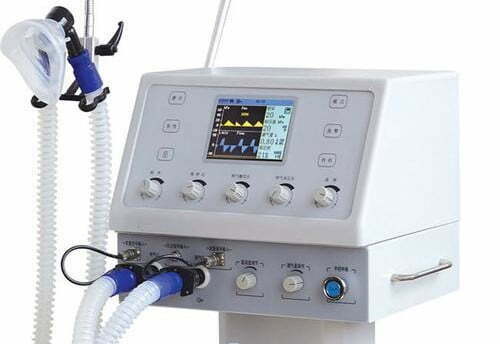
Motor Application for Breath Ventilator Motor
Quick Answer: A breath ventilator runs on brushless DC (BLDC) motors: a high-speed centrifugal blower motor (30,000–60,000 rpm) that generates the airflow, and small stepper or servo motors that position valves and flow controls. The blower must be silent (<30 dBA for home use), precise (±0.2 cmH2O), fast-responding (≤5 ms) and reliable (15,000+ hours), on a safe 12–24 V supply. Turbine-driven BLDC ventilators match or beat compressor-based ICU machines while being compact enough to be portable — which is why they now span ICU, home CPAP/BiPAP, transport, anesthesia and neonatal care.
Contents
- What Is a Ventilator Motor?
- How a Ventilator Drive Works
- Motor Type Comparison
- Engineering Data: Speed, Noise, Accuracy, Life
- Worked Example: Sizing a Portable Blower
- Best Applications
- How to Select a Ventilator Motor
- Common Engineering Mistakes
- Troubleshooting
- FAQ
- Why Choose Greensky Power?
What Is a Ventilator Motor?
A ventilator motor is the miniature drive that generates and regulates the pressurized airflow a patient breathes. In modern designs it is almost always a brushless DC motor driving a centrifugal (radial) blower impeller, plus smaller actuation motors for valves and flow control. The blower motor is the heart of the machine: its pressure accuracy, noise floor, response time and reliability directly set the safety and comfort of therapy.
The same core blower serves a wide device landscape — ICU ventilators, home CPAP and BiPAP machines, anesthesia ventilators, transport and emergency resuscitators, and neonatal or high-flow therapy — with each class shifting the emphasis among noise, accuracy, response and environmental survival. That is why “ventilator motor” is one category with several distinct specification profiles, not a single part number.
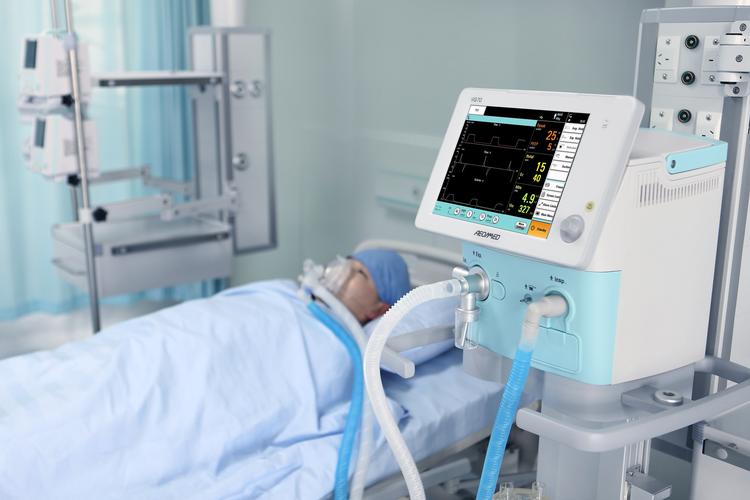
Why It Is a Blower, Not a Fan
Respiratory circuits present back-pressures of roughly 5–50 cmH2O across a variable flow. An axial fan’s pressure-flow curve collapses under that load, so it cannot hold a stable pressure waveform. A centrifugal blower produces the high static pressure a ventilator needs, controlled in real time by PWM speed regulation with tachometer feedback. This one topology decision — centrifugal, not axial — is the foundation of every ventilator drive.
Why the Drive Must Be Brushless
Brushless DC is non-negotiable in the airflow path for three reasons. A brushed motor sheds carbon dust from brush wear, which would contaminate a patient airway and the cleanroom environment. Brushes also cap service life at a few thousand hours — unacceptable for a life-support device. And brushed commutation sparking and noise defeat the silent operation patients need while sleeping. Brushless commutation removes all three problems at once, which is why every medical respiratory device specifies BLDC exclusively.
How a Ventilator Drive Works
A turbine-driven ventilator delivers breath in a closed loop, in four steps:
- The BLDC motor spins the impeller. A slotless BLDC rotor turns at 30,000–60,000 rpm with low inertia, so it can change speed almost instantly.
- The centrifugal impeller pressurizes air. The fast-spinning impeller converts rotational energy into a controlled pressure-and-flow output.
- The controller closes the loop. A motor controller reads a tachometer (and often a pressure/flow sensor) and adjusts PWM speed thousands of times a second to track the prescribed waveform — inspiration pressure, PEEP, flow and breath rate.
- Valve motors shape the waveform. Small stepper or servo motors position proportional valves and mixers for precise oxygen and pressure delivery.
Field-oriented control (FOC) with a high PWM switching frequency keeps the blower smooth and inaudible while holding tight speed accuracy — the key to both patient comfort and precise therapy.
Compressor vs Turbine: Why BLDC Won
Older ICU ventilators used compressed-air sources and piston or bellows mechanisms — heavy, wall-supply-dependent and hard to make portable. Turbine-driven designs replaced them with a single high-speed BLDC blower, and for good reason: the turbine’s pneumatic performance meets or beats compressor-based machines, its compact packaging shrinks the footprint and lets batteries be downsized, and independent pressure and flow control enables true portability across the ICU, transport and home. The cost of that freedom is a motor that must spin reliably at 30,000–60,000 rpm in near silence — which is exactly what slotless BLDC technology delivers.
CPAP vs BiPAP: The Same Motor, Different Control
CPAP holds one fixed pressure through both inhale and exhale; BiPAP alternates between a higher inspiratory (IPAP) and lower expiratory (EPAP) pressure and must respond to a patient-triggered breath transition in under 100 ms. Both use the same blower hardware — the difference is the controller’s bandwidth and algorithm. That is why response time, not just top speed, is a first-order blower specification: a motor that cannot change speed in single-digit milliseconds will fight the patient’s own breathing rhythm instead of following it.
Motor Type Comparison
| Role | Motor type | Why |
|---|---|---|
| Blower / turbine drive | Slotless BLDC, 30k–60k rpm | High speed, silent, efficient, long life |
| Proportional valve | Micro stepper or servo | Precise, repeatable angular position |
| Oxygen / gas mixer | Small stepper | Fine, stable flow adjustment |
| Legacy / cost-limited | Brushed DC (rare) | Wear debris and shorter life disqualify it |
BLDC vs Brushed for Medical Duty
| Attribute | BLDC (used) | Brushed (avoided) |
|---|---|---|
| Wear debris | None (no brushes) | Carbon dust contaminates airflow |
| Life | 15,000–50,000 h | 1,000–3,000 h |
| Noise | <30–45 dBA | Higher (brush + commutator) |
| Speed | Up to 60,000 rpm | Lower, sparking limits |
Engineering Data: Speed, Noise, Accuracy, Life
Key Specifications
| Parameter | Typical ventilator value |
|---|---|
| Blower speed | 30,000–60,000 rpm |
| Pressure range | 0–30 cmH2O continuous, 50 cmH2O peak |
| Pressure accuracy | ±0.2 cmH2O |
| Flow stability | ≤1% |
| Response time | ≤5 ms (BiPAP transition <100 ms) |
| Noise | <30 dBA (home) / 35–45 dBA (ICU) |
| Life | 15,000–50,000 h |
| Supply | 12 V / 24 V DC |
Speed, Torque and Efficiency
The blower’s job is high speed, not high torque. A slotless BLDC rotor keeps inertia low for a ≤5 ms step response, while electronic commutation and low iron losses hold efficiency high and heat low — important because waste heat raises the oxygen-rich environment’s risk of bearing-lubricant oxidation.
Noise and Vibration
Quietness is a clinical requirement, not a nicety: a home CPAP user sleeps within arm’s reach of the blower, so <30 dBA at continuous pressure is the target, while ICU and anesthesia devices hold 35–45 dBA. Three design choices deliver it — brushless commutation (no brush or commutator noise), a PWM switching frequency above the audible band, and an aerodynamically optimized impeller. Vibration amplitude is held to a fraction of a degree so the blower runs steady over a full night of therapy.
Power and Voltage
Ventilator blowers run on safe low voltage — 12 V or 24 V DC — with rated power typically 20–400 W depending on the device class. Home and transport units lean on battery power, so blower efficiency is directly proportional to runtime and portability. A 20 W-class 24 V blower can support a portable ventilator, while larger ICU and high-flow machines draw more. In every case, the low-voltage BLDC choice also simplifies electrical-safety isolation under IEC 60601-1.
Reliability and Lifetime
Electronic commutation and durable ball bearings push ventilator blower life to 15,000–50,000 hours — often meeting or exceeding the device’s own service life. That matters because the motor is not a serviceable part in the field: a failed blower is a failed life-support device. Reliability here is a function of three things: the brushless design, low iron losses that keep heat (and lubricant oxidation) down, and an integrated thermistor that lets the controller monitor temperature and derate before damage.
Environment: Oxygen, Sterilization, Temperature
- High oxygen: oxidizes bearing lubricant over time; low-iron-loss rotors and a thermistor reduce the risk.
- Sterilization: anesthesia blowers must survive 200+ autoclave cycles at 100% humidity and ~135 °C.
- Safety standards: the motor must support IEC 60601-1 medical electrical safety, ISO 13485 quality and ISO 10993 biocompatible materials for the airflow path.
Compliance and Documentation
A ventilator blower is only as good as the paperwork behind it. The motor supplier must provide the documentation and traceability that support the device maker’s FDA 510(k) or CE MDR submission: material declarations for the airflow path (ISO 10993 biocompatibility), RoHS/REACH, end-of-line test records for speed, current, vibration and noise, and EMC-friendly shielding. For a medical OEM, a motor without this package is effectively unmarketable — which is why compliance documentation is a selection criterion on equal footing with the torque and speed numbers.
Worked Example: Sizing a Portable Blower
A portable ventilator must deliver 120 L/min at a peak pressure of 50 cmH2O. The hydraulic power is pressure times flow:
Q = 120 L/min = 0.002 m³/s and P = 50 cmH2O ≈ 4,903 Pa
Phydraulic = P × Q = 4,903 × 0.002 ≈ 9.8 W
With a combined blower-and-motor efficiency of ~50% at high speed, the required electrical input is about 20 W — a 24 V BLDC blower motor running ~40,000 rpm comfortably delivers it.
Counter-intuitive insight: a ventilator that supports a human life runs on a motor no bigger than a golf ball, consuming ~20 W. The trick is speed, not torque — spinning a small impeller at 40,000–60,000 rpm generates medical-grade pressure in a pocket-sized package, while slotless BLDC construction makes that speed silent and instant. Engineers who over-spec for torque miss the point: in a turbine ventilator, speed and low inertia are the performance.
The arithmetic is the same for any device class — ICU, home or transport. You compute hydraulic power from the worst-case pressure and flow, divide by the blower-and-motor efficiency to get electrical input, then pick the speed class whose impeller reaches that pressure compactly. The 50% combined efficiency is a conservative planning figure for a small high-speed blower; a well-matched slotless BLDC stage can do better, which simply leaves margin in the design.
Best Applications for Ventilator Motors
Where a given blower motor is the right fit turns on the clinical environment, not just the pressure-flow numbers. A device meant to run beside a sleeping patient optimizes for silence; one meant to be wheeled between wards optimizes for battery life; one that is autoclaved optimizes for material survival. The applications below map each priority to the drive that serves it best.
- ICU ventilators — continuous, high-accuracy invasive support.
- Home CPAP / BiPAP — sub-30 dBA quiet for sleep; BiPAP adds <100 ms breath-transition response.
- Anesthesia ventilators — autoclave and high-oxygen survival (200+ cycles, 100% O2).
- Transport & emergency ventilators — battery-powered portability.
- Neonatal & high-flow therapy — fine flow control at low tidal volumes.
Device Class by Requirements
| Device | Blower requirement | Why it differs |
|---|---|---|
| ICU ventilator | High accuracy, continuous duty | Life-support, 24/7 operation |
| Home CPAP / BiPAP | <30 dBA, <100 ms response | Sleep quality, breath synchrony |
| Anesthesia ventilator | Autoclave + 100% O2 survival | Sterilization, oxidation |
| Transport / emergency | Battery efficiency, light weight | Portability, off-grid power |
| Neonatal / high-flow | Fine low-flow control | Small tidal volumes |
How to Select a Ventilator Motor
Selection follows the device class, not the motor catalog. Start from the prescribed pressure-flow curve and the clinical environment — a home CPAP blower is specified differently from an anesthesia blower, even though both are “ventilator motors.” The six steps below walk the cascade from physics to compliance, so the blower you choose is one that clears submission and keeps running quietly for the device’s whole life.
- Define the pressure-flow curve. Map the required pressure and flow across the breath cycle.
- Size the blower motor. Compute hydraulic power (P × Q) and pick a BLDC speed class (30k–60k rpm) that hits it.
- Specify the control interface. PWM (25 kHz) with tachometer feedback, plus an encoder where closed-loop pressure is required.
- Set the noise budget. <30 dBA for home; 35–45 dBA for ICU.
- Confirm the environment. Autoclave cycles, oxygen exposure, temperature and humidity for the target device class.
- Verify compliance. Motor documentation to support IEC 60601-1, ISO 13485 and ISO 10993 device submission.
Run the cascade once and the shortlist is short — usually a handful of slotless BLDC blowers plus a stepper or two for the valves. That is the whole point: a ventilator motor is not chosen for its datasheet headline but for how quietly and precisely it tracks a breathing waveform for a decade, so the selection process is really a process of eliminating anything that cannot prove that.
Common Engineering Mistakes
- Specifying an axial fan. Its pressure-flow curve collapses at circuit back-pressure, so therapy becomes unstable.
- Choosing a brushed motor. Brush wear debris and a short life make it unsafe for a life-support device.
- Ignoring noise. A blower above ~30 dBA is unacceptable for home CPAP users sleeping next to it.
- Overlooking the oxygen environment. Bearing lubricant oxidizes in 100% O2; low-iron-loss rotors and thermistors matter.
- Too slow a control loop. BiPAP must react to a breath trigger in under 100 ms; a sluggish drive defeats patient synchrony.
- Missing compliance documentation. Without IEC 60601-1 / ISO 13485 traceability, the device cannot clear FDA or CE MDR.
The common thread is that a ventilator motor is a safety-critical component, judged by how quietly and precisely it fails to fail. Each of these mistakes is cheap to avoid at specification time and catastrophic to discover after regulatory submission or in the field. If you carry only one rule away, it is this: specify the blower against the clinical waveform and the environment first, then let the motor follow — never the reverse.
Troubleshooting — Problem, Cause, Solution
| Problem | Likely cause | Solution |
|---|---|---|
| Pressure waveform unstable | Axial fan or sluggish control loop | Use centrifugal blower; raise PWM bandwidth + feedback |
| Excess noise at night | High switching freq / impeller design | Raise PWM carrier; optimize impeller (noise guide) |
| Bearing failure in oxygen | Lubricant oxidation / heat | Low-iron-loss rotor, thermistor, sealed bearings (SKF) |
| Fails after sterilization | Not autoclave-rated | Spec 200+ autoclave-cycle blower for anesthesia |
| Flow drifts over time | Open-loop speed control | Add tachometer/encoder closed-loop feedback |
| Overheats in continuous duty | Iron losses at high speed | Slotless BLDC; verify thermal rating under load |
Why Choose Greensky Power?
Greensky Power designs and manufactures custom BLDC and stepper motors and complete OEM actuator assemblies for medical devices, engineered to the speed, noise and reliability a ventilator demands. For your device program we supply:
- High-speed slotless BLDC and 24 V BLDC blower motors with low vibration and <30–45 dBA operation.
- Micro stepper and servo motors for precise valve and flow control.
- Engineering support for torque and power calculation, control integration, and IEC 60601-1 / ISO 13485 documentation.
Because we build the blower, the valve motors and the control interface as one matched, documentation-backed medical drive system, you can specify the clinical waveform and the environment and let the engineering follow — with the speed, noise, response and compliance documentation already in place for submission.
Related Resources
- Electric motor basics (pillar page)
- Brushless DC motor (BLDC) basics
- 24 V brushless DC motor
- Micro stepper motor guide
- Servo motor fundamentals
- DC motor for medical and rehab devices
- How to reduce electric motor noise
- Motor controller guide
- DC motors category
References
- IEC 60601-1 — Medical electrical equipment, general requirements for basic safety. webstore.iec.ch/en/publication/67497
- IEC 60034-1:2022 — Rotating electrical machines, general requirements. webstore.iec.ch/en/publication/65446
- IEC 60034-30-1 — Efficiency classes of line-operated AC motors. webstore.iec.ch/publication/91195
- ANSI/NEMA MG 1-2021 — Motors and Generators. webstore.ansi.org/standards/nema/ansinemamg2021
- NEMA — Motor and generator product guidance. nema.org/products/pages/motor-and-generator.aspx
- U.S. DOE — Motor systems efficiency and load guidance. energy.gov — 10097517.pdf
- IEA — Electric motors and industrial efficiency. iea.org/energy-system/industry/electric-motors
- SKF — Bearing failures and their causes. skf.com — bearing failures
- Siemens — SIMOTICS electric motors product range. siemens.com — electric motors
- IEEE Xplore — Peer-reviewed motor / actuator design paper. ieeexplore.ieee.org/document/6342334
- IEEE Transactions on Industry Applications — Zhou & Shen, “Rotor Notching for Electromagnetic Noise Reduction of Induction Motors”, DOI 10.1109/TIA.2017.2681969. doi.org/10.1109/TIA.2017.2681969
- maxon — EC technology and gearhead selection. maxongroup.com — ec-technology
- FAULHABER — Brushless DC motors and micro-drive know-how. faulhaber.com — brushless DC motors
- Yaskawa — Motion and servo system technical downloads. yaskawa.com/downloads/search-index
- Tsubaki — Gearmotor selection technical reference (service-factor method). tsubakimoto.co.jp — selection reference
Technical content reviewed by the Greensky Power engineering team. Speed, noise, pressure and life figures are representative medical-device values; confirm the exact ratings and compliance documentation for your device class and submission with the supplier.
FAQ
What kind of motor is used in a ventilator?
A brushless DC (BLDC) centrifugal blower motor for air delivery, plus small stepper or servo motors for valves and flow control. The blower is a high-speed turbine (30,000–60,000 rpm) driven by a slotless BLDC motor for rapid response.
Why do ventilators use brushless DC motors?
BLDC motors produce no brush wear debris, run quietly (below 30–45 dBA), reach very high speed with high efficiency, and last 15,000+ hours with electronic commutation — all essential for a silent, reliable, portable life-support device.
How fast does a ventilator blower motor spin?
Turbine-driven ventilators use high-speed blowers spinning from about 30,000 to 60,000 rpm. The high speed lets a compact centrifugal blower generate the medical-grade pressure (5–50 cmH2O) a ventilator needs without a bulky compressor.
How quiet must a ventilator motor be?
Home CPAP and ventilators should stay below about 30 dBA at continuous pressure so patients can sleep; ICU and anesthesia devices are typically 35–45 dBA. Quietness comes from BLDC commutation, high PWM switching frequency and aerodynamic impeller design.
What pressure accuracy does a ventilator motor need?
Medical blower motors deliver pressure accuracy around ±0.2 cmH2O with flow stability within 1% and speed resolution of 0.1%, using closed-loop PWM control with tachometer feedback so the device tracks the prescribed breathing waveform.
Can a ventilator motor survive sterilization and high oxygen?
Anesthesia ventilators need motors that withstand 200+ autoclave cycles, 100% humidity and 100% oxygen. High oxygen can oxidize bearing lubricant, so the motor needs low iron losses to limit heat and a thermistor for temperature monitoring.
