
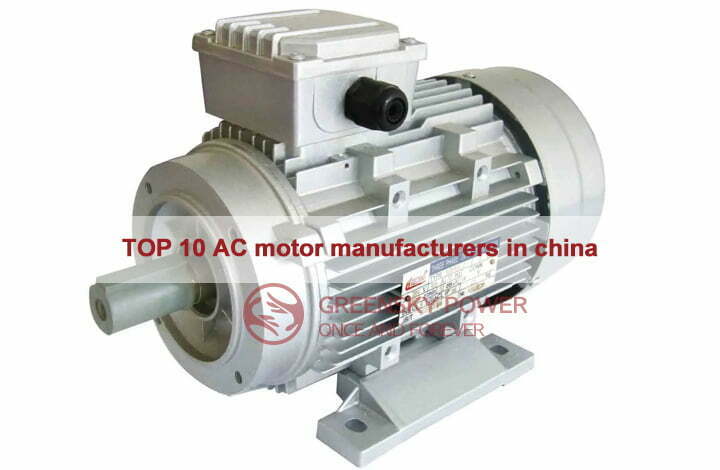
Top 10 AC Motor Manufacturers in China
Quick Answer
Contents
- What Is an AC Motor Manufacturer?
- How AC Motors Work
- The Top 10 AC Motor Manufacturers in China
- Manufacturer Comparison Table
- Engineering Data: Efficiency, Temperature, Torque
- Best Applications for Chinese AC Motors
- How to Select a Manufacturer
- Common Sourcing Mistakes
- Troubleshooting
- FAQ
- Why Choose Greensky Power?
What Is an AC Motor Manufacturer?
An AC motor manufacturer designs and produces rotating machines that convert alternating current into mechanical torque — principally induction (asynchronous) motors and synchronous motors. In China the term covers a wide spectrum: a giant like Wolong making thousands of standard frames a year, and a specialist like Greensky Power building custom three-phase and single-phase motors plus geared assemblies for export. “Top” is not a single number — it depends on whether you rank by revenue, output volume, export value or a specific segment like explosion-proof or servo.
That is why a useful “top 10” list must state its criteria. This one ranks by scale, export footprint and segment leadership, not by any single metric, and it is editorial — not a paid placement.
What Counts as a “Top” Manufacturer?
For a buyer, “top” should be measured against five concrete tests: (1) segment leadership in your exact motor type, (2) efficiency-class capability (can they prove IE3/IE4 performance?), (3) certification coverage (CE/UL/CCC plus ISO 9001), (4) export track record in your market, and (5) production capacity and lead time. A manufacturer can be enormous in one segment and irrelevant in another, so rank the criteria against your own specification before ranking the suppliers.
How AC Motors Work
An induction motor turns AC into motion in three steps:
- The stator creates a rotating field. Three-phase (or, in a single-phase motor, a split-phase/capacitor arrangement) windings in the stator produce a magnetic field that rotates at synchronous speed
ns = 120f / p, wherefis the supply frequency andpthe number of poles. At 50 Hz a 4-pole motor runs 1,500 r/min; at 60 Hz it runs 1,800 r/min. - The rotor chases the field. The rotating field induces current in the squirrel-cage rotor, which then produces its own field. The rotor accelerates toward synchronous speed but never reaches it.
- Slip produces torque. The small difference between field speed and rotor speed is called slip (
s = (ns − n)/ns, typically 2–5% at full load). That slip is what generates rotor current and torque — see the torque formula in the engineering data section below.
Induction vs Synchronous AC Motor
| Attribute | Induction (asynchronous) | Synchronous |
|---|---|---|
| Rotor | Squirrel-cage, no external supply | Permanent magnet or wound field |
| Slip | 2–5% at full load | Zero (locks to field speed) |
| Speed control | Open-loop or VFD | Exact speed, needs drive for PM types |
| Cost / complexity | Lower, rugged | Higher for PM; line-start possible |
| Best for | Pumps, fans, conveyors | Precision timing, exact speed |
A synchronous AC motor locks its rotor to the field speed with zero slip — used where exact speed matters. The difference between synchronous and induction motors is covered in more depth on our sister page.
The Top 10 AC Motor Manufacturers in China
These ten companies are the names international buyers encounter most often, each leading a distinct segment. (Rankings are editorial, based on publicly reported scale and export reach as of 2026; verify current status with each supplier.)
- Wolong Electric Group — Zhejiang. China’s largest industrial motor maker and a global top-three supplier; full range from standard induction to explosion-proof and servo. Acquired Austria’s ATB Group and holds deep IEC IE3/IE4 experience.
- Broad-Ocean Motor — Zhongshan, Guangdong. A listed micro/AC motor giant and the leading maker of HVAC fan-load and appliance motors, with very large production capacity.
- Shanghai Electric Group — Shanghai. State-backed producer of large and high-voltage AC motors, generators and complete power equipment.
- Xiangtan Electric Manufacturing (XEMC) — Hunan. Large industrial, traction, wind and explosion-proof motors; strong in power, marine and heavy industry.
- Harbin Electric / Jiamusi Electric Machine — Heilongjiang. One of China’s oldest motor groups, making large motors and generators for power stations and pumps.
- Jiangte Motor (JSMC) — Jiangxi. Special and traction motors; a technical benchmark in metallurgy, nuclear and military drives with unusually high R&D spend.
- Anhui Wannan Motor — Anhui. Medium and small high-efficiency AC motors (YE2/YE3/YE4 series) for pumps, fans and general machinery.
- Jiangsu Dazhong Motor — Jiangsu. The largest exporter of small/medium industrial motors (annual exports above US$300M) with UL, CE and SAA certification.
- Inovance Technology — Shenzhen. A listed leader in high-performance servo AC motors and drives for automation and new-energy equipment.
- Nanyang Explosion-Proof Group (CNE) — Henan. China’s largest dedicated explosion-proof motor base for oil, gas, mining and chemical plants.
Manufacturer Comparison Table
| Manufacturer | Headquarters | Primary AC motor strength | Typical buyer |
|---|---|---|---|
| Wolong Electric | Zhejiang | Full-range industrial, IE3/IE4, explosion-proof, servo | OEMs, distributors, utilities |
| Broad-Ocean | Zhongshan, Guangdong | HVAC & appliance fan-load, micro AC | Appliance & HVAC brands |
| Shanghai Electric | Shanghai | Large / high-voltage machines | Power & heavy industry |
| XEMC | Hunan | Large industrial, traction, wind | Marine, mining, energy |
| Harbin Electric / Jiamusi | Heilongjiang | Large motors & generators | Power plants, pumps |
| Jiangte (JSMC) | Jiangxi | Special & traction motors | Metallurgy, nuclear, military |
| Anhui Wannan | Anhui | Mid/small high-efficiency (YE2/YE3/YE4) | Pump & fan OEMs |
| Jiangsu Dazhong | Jiangsu | Small/medium industrial export | Global distributors |
| Inovance | Shenzhen | Servo AC motors + drives | Automation & new energy |
| Nanyang Explosion-Proof | Henan | Explosion-proof motors | Oil, gas, chemical, mining |
Engineering Data: Efficiency, Temperature, Torque
When you compare manufacturers, the numbers that actually matter are the efficiency class, the thermal class and the torque. These are defined by IEC 60034-1 and IEC 60034-30-1.
Efficiency Classes (IEC 60034-30-1)
| Class | Label | Typical efficiency (7.5 kW, 4-pole, 50 Hz) | Positioning |
|---|---|---|---|
| IE1 | Standard | 86.0% | Legacy / low initial cost |
| IE2 | High | 88.1% | Minimum common in export |
| IE3 | Premium | 90.4% | Required in many markets (EU MEPS, US) |
| IE4 | Super Premium | 92.1% | Premium / line-start PM options |
Thermal Class & Temperature (IEC 60034-1)
- Class B = 130 °C hotspot, 80 K rise; Class F = 155 °C, 105 K rise; Class H = 180 °C, 125 K rise (at 40 °C ambient).
- Most export industrial motors are wound Class F and operated to Class B limits for thermal margin — ask the supplier which class the windings actually carry.
Voltage & Frequency: 50 Hz vs 60 Hz
| Supply | 4-pole synchronous speed | Typical full-load speed | Where it matters |
|---|---|---|---|
| 50 Hz (IEC regions) | 1,500 r/min | ~1,450 r/min | Europe, China, most of Asia |
| 60 Hz (NEMA regions) | 1,800 r/min | ~1,750 r/min | North America, some of Asia |
A 50 Hz motor run on 60 Hz turns ~20% faster and may draw more current or overheat — a leading cause of field failures in imported equipment. Always confirm the supply frequency and voltage with the manufacturer before ordering.
Torque Formula
Full-load torque in N·m is T = 9550 · P(kW) / n(r/min). A 7.5 kW 4-pole motor at 1,450 r/min develops T = 9550 × 7.5 / 1450 ≈ 49.4 N·m. Use the equivalent T = 9.55 · P(W) / n if power is in watts. For a deeper walk-through see how to calculate motor torque.
Worked Example: The Real Cost of an Inefficient Motor
A buyer chooses between an IE1 and an IE3 motor for a 7.5 kW pump running 6,000 hours a year at US$0.12/kWh. The IE1 motor draws 7.5 / 0.860 = 8.72 kW; the IE3 draws 7.5 / 0.904 = 8.30 kW. The 0.42 kW difference saves about 2,520 kWh and roughly US$300 every year — over a 5-year life the IE3 pays for its own premium several times over.
Best Applications for Chinese AC Motors
- Pumps, fans and HVAC — the classic three-phase induction and Broad-Ocean-style fan-load motors; IE3/IE4 preferred for continuous duty.
- Conveyors & general machinery — standard IEC-frame motors from Wolong, Wannan or Jiangsu Dazhong.
- Home appliances & small tools — single-phase and micro AC motors.
- Woodworking & material processing — see woodworking motor applications.
- Oil, gas & chemical — explosion-proof machines from Nanyang Explosion-Proof.
- Automation & robotics — servo AC motors and drives from Inovance; for a brushless comparison see BLDC vs induction motor.
Application-by-Application Motor Type
| Application | Recommended motor type | Why |
|---|---|---|
| Centrifugal pump / fan | IE3/IE4 three-phase induction | Continuous duty, efficiency pays back |
| Conveyor / mixer | Standard IEC-frame induction | Rugged, low cost, VFD-ready |
| Home appliance | Single-phase / micro AC | Line supply, compact, quiet |
| Woodworking spindle | High-speed induction or spindle motor | High speed and precision |
| Precision positioning | Servo AC + drive | Closed-loop torque and speed |
| Hazardous area | Explosion-proof induction | ATEX/IECEx-compliant enclosure |
How to Select an AC Motor Manufacturer
Use this five-step framework rather than trusting a ranking outright:
- Fix the specification. Define power, speed, poles, voltage/frequency (50 vs 60 Hz), frame size, mounting, duty cycle and required efficiency class.
- Match the segment. A pump OEM does not need a servo specialist; a petrochemical plant must use an explosion-proof specialist. Use the comparison table to shortlist by segment.
- Verify compliance. Demand IEC 60034 / NEMA MG 1 type-test reports, CE/UL/CCC certificates and ISO 9001 — not just a quotation.
- Audit capacity & export record. Confirm production capacity, lead time, MOQ and existing export history in your target market.
- Start small. A sample order and a factory audit reveal more than any marketing page. For custom programs, work with an OEM specialist like custom electric motors.
How to Read a Manufacturer’s Test Report
A credible report, not the sales brochure, is what separates suppliers. When you receive one, check that it states: the tested efficiency at rated load (not the catalog maximum), the temperature rise and thermal class (Class F vs B), the no-load and locked-rotor currents, and the standard it was tested to (IEC 60034-1 or NEMA MG 1). If the report omits the standard or the tested load point, ask for a retest before you commit.
Common Sourcing Mistakes
- Buying on list price alone. Ignoring efficiency turns a “cheap” motor into an expensive one (see the worked example).
- Confusing 50 Hz and 60 Hz. A 50 Hz motor run on 60 Hz spins ~20% faster and may overheat or overload; specify the supply frequency up front.
- Ignoring the thermal class. A Class B winding pushed to Class F limits loses insulation life. Verify what the windings are actually rated for.
- Skipping certification. A motor without CE or UL can be rejected at the border of your target market.
- Trusting self-ranked lists. Many “top 10” pages are vendor marketing that put the publisher first; cross-check with export data and audits.
- Forgetting the duty cycle. Sizing a motor for peak torque but S1 continuous rating mismatch shortens life on fans and pumps.
Red Flags to Watch
Be wary of suppliers who cannot produce a type-test report, quote a price far below the market for the same efficiency class, refuse a factory visit, or list certifications they will not send as documents. A motor “equivalent to IE3” is not an IE3 motor — insist on the IEC 60034-30-1 test data rather than a marketing claim.
Troubleshooting — Problem, Cause, Solution
| Problem | Likely cause | Solution |
|---|---|---|
| Motor fails on arrival | Wrong voltage/frequency or damaged in transit | Reconfirm nameplate vs supply; request factory test report before shipment |
| Runs hot / trips | Efficiency or thermal class below spec | Verify IE class and winding Class F/H; derate or replace |
| Excess noise & vibration | Poor bearing grade or balance | Spec low-noise bearings; check balance class (SKF) |
| Shipment delayed | Custom design scope creep or capacity | Agree lead time and penalty clause; confirm capacity before PO |
| Certification rejected | Wrong regional mark (CE vs UL vs CCC) | Confirm the exact mark required for the destination market |
| Early bearing failure | Grease or seal quality / contamination | Specify greased-for-life sealed bearings and storage conditions |
| Price quoted vs landed cost gap | Duty, freight and currency omitted | Ask for EXW/FOB/CIF breakdown and total landed cost |
FAQ
Who is the largest AC motor manufacturer in China?
Wolong Electric Group (Zhejiang) is generally considered China’s largest industrial motor manufacturer, with a full range including induction, explosion-proof and servo motors and a global footprint through its ATB acquisition. Broad-Ocean Motor leads the HVAC/appliance AC segment.
What is the difference between IE3 and IE4 motor efficiency?
IE3 (Premium) and IE4 (Super Premium) are IEC 60034-30-1 classes. At 7.5 kW 4-pole, IE3 ≈ 90.4% and IE4 ≈ 92.1%. IE4 is ~1.5–2 points more efficient, lowering running cost but costing more up front.
How do I verify a Chinese AC motor manufacturer is legitimate?
Check the business license, ISO 9001/14001, IEC 60034 or NEMA MG 1 type-test reports, and export certificates (CE/UL/CCC). A factory audit, sample order and export-history check are the most reliable due diligence.
What certifications should an AC motor have for export?
CE for Europe, UL/cUL for North America, CCC for domestic China, plus ISO 9001. Verify performance against IEC 60034 (international) or NEMA MG 1 (North America), and ask for IEC 60034-30-1 efficiency test data.
What is a typical MOQ and lead time from a Chinese AC motor manufacturer?
Standard frame motors are often available from stock or a low MOQ (1–50 units); custom OEM motors usually need 500–2,000 units. Lead times run roughly 15–45 days depending on standard vs custom.
Are Chinese AC motors reliable compared to international brands?
Tier-1 makers like Wolong, XEMC and Jiangsu Dazhong serve the same export markets as international brands and meet IEC/NEMA test requirements. Reliability varies by tier, so verify efficiency class, bearings, insulation and test reports rather than relying on brand name alone.
Why Choose Greensky Power?
Greensky Power is a Chinese B2B motor manufacturer that competes on custom OEM AC and geared motors for export, not on raw volume. Where the giants sell standard catalog frames, we engineer matched motor-and-gearbox systems to your exact specification. For your program we supply:
- Standard and custom three-phase, single-phase and micro AC motors with IEC frames and verified shaft dimensions.
- AC induction geared motors and synchronous motors with matched reductions and documented efficiency data.
- Engineering support for industrial motor selection, torque calculation and IE3/IE4 compliance.
- Complete OEM actuator assemblies with export documentation (CE, UL where required) and factory-audit support.
Related Resources
- Top 30 electric motor manufacturers in China
- Top 10 Chinese BLDC motor manufacturers
- Top 10 Chinese helical gear motor manufacturers
- Electric motor basics (pillar page)
- Three-phase motor overview
- Single-phase motor overview
- Ultra-efficient asynchronous motors
- Synchronous vs induction motor
- BLDC vs induction motor
- How to maintain a three-phase asynchronous motor
- DC motors category
References
- IEC 60034-1:2022 — Rotating electrical machines, general requirements (thermal classes, mounting). webstore.iec.ch/en/publication/65446
- IEC 60034-30-1 — Efficiency classes of line-operated AC motors (IE1–IE4). webstore.iec.ch/publication/91195
- ANSI/NEMA MG 1-2021 — Motors and Generators (ratings, performance). webstore.ansi.org/standards/nema/ansinemamg2021
- NEMA — Motor and generator product guidance. nema.org/products/pages/motor-and-generator.aspx
- U.S. DOE — Motor systems efficiency and load guidance. energy.gov — 10097517.pdf
- IEA — Electric motors and industrial efficiency. iea.org/energy-system/industry/electric-motors
- SKF — Bearing failures and their causes. skf.com — bearing failures
- Siemens — SIMOTICS electric motors product range. siemens.com — electric motors
- IEEE Xplore — Peer-reviewed motor / actuator design paper. ieeexplore.ieee.org/document/6342334
- IEEE Transactions on Industry Applications — Zhou & Shen, “Rotor Notching for Electromagnetic Noise Reduction of Induction Motors”, DOI 10.1109/TIA.2017.2681969. doi.org/10.1109/TIA.2017.2681969
- maxon — EC technology and gearhead selection. maxongroup.com — ec-technology
- FAULHABER — Brushless DC motors and micro-drive know-how. faulhaber.com — brushless DC motors
- Yaskawa — Motion and servo system technical downloads. yaskawa.com/downloads/search-index
- Tsubaki — Gearmotor selection technical reference (service-factor method). tsubakimoto.co.jp — selection reference
This list is editorial and based on publicly reported scale and export reach as of August 2026. It is not an endorsement of any supplier; verify current certifications and performance with each manufacturer before purchasing. Technical data follows the standards editions cited above.
