
6 Factors To Consider To Choose a DC Stepper Motor Gearbox
Quick Answer: Choosing a DC stepper motor gearbox comes down to six factors, evaluated in order: (1) torque — output torque equals motor torque × ratio × efficiency, plus a 20–30% service factor; (2) gear ratio and step resolution — a 1.8° motor (200 steps/rev) through a 20:1 box gives 0.09° per step; (3) backlash — keep it under ~3 arcmin for positioning, because an open-loop stepper cannot correct it; (4) gearbox type — planetary, spur, or worm; (5) inertia matching — reflected inertia falls by the ratio squared, so keep the reflected-to-rotor ratio below ~10:1; and (6) duty cycle and mounting. Skip the inertia or thermal check and a motor that works on the bench will fail in service.
Contents
- What Is a Stepper Motor Gearbox?
- How to Choose: The 6 Factors in Order
- Factor 1 — Torque & Service Factor
- Factor 2 — Gear Ratio & Step Resolution
- Factor 3 — Backlash
- Factor 4 — Gearbox Type: Planetary, Spur, Worm
- Factor 5 — Inertia Matching
- Factor 6 — Duty Cycle, Thermal & Mounting
- Best Applications by Gearbox Type
- Selection Worked Example
- Common Mistakes
- Why Choose Greensky Power?
- FAQ
What Is a Stepper Motor Gearbox?
A stepper motor gearbox is a speed reducer mated to a stepper motor to multiply its torque, divide its speed, and increase its angular resolution. Because a stepper moves in discrete steps (1.8° or 200 steps per revolution is standard), a gearbox does three useful things at once: it raises output torque, it subdivides the step angle for finer positioning, and it reduces the load inertia the motor must accelerate. The result is a low-cost, open-loop drive that can hold position and index loads precisely—the workhorse of gear motors in automation.
A stepper is not a servo: it has no feedback to correct lost steps, and its torque falls off as speed rises. Those two facts shape every one of the six selection factors below. For the broader servo-vs-stepper decision, see our servo vs. stepper motor comparison.
How to Choose: The 6 Factors in Order
Selection is a sequence, not a checklist you can shuffle. Each factor feeds the next, and skipping the inertia or thermal step is how a motor that runs on the bench fails on the machine.
- Define the load — required output torque, speed, and the motion profile (accel/cruise/decel).
- Pick the ratio —
i = motor speed / output speed, keeping the motor in its 200–600 rpm band. - Verify torque —
Tₙ = Tₔ × i × ηplus a service factor. - Check backlash — under ~3 arcmin for bidirectional positioning.
- Check inertia — keep reflected-to-rotor inertia below ~10:1.
- Confirm duty and mounting — thermal rating, NEMA frame, shaft, and load limits.
Factor 1 — Torque & Service Factor
Torque is the first and most obvious number, but it is also the one most often misread. The output torque of a geared stepper is:
- Output torque:
Tₙ = Tₔ × i × η(motor torque × ratio × gearbox efficiency)
A 0.5 N·m stepper through a 10:1 planetary at 95% gives 0.5 × 10 × 0.95 = 4.75 N·m. Two caveats follow. First, a stepper’s torque is its holding torque at standstill; dynamic torque falls off as speed rises, so size for the torque available at your operating speed, not the catalogue’s standstill figure. Second, steppers cannot tolerate overload—even a momentary overload causes lost steps—so apply a generous service factor: 20–30% for smooth loads, and up to 50–100% for shock or reversing loads.
Factor 2 — Gear Ratio & Step Resolution
The ratio is chosen to put the motor in its usable speed band and to subdivide the step angle. A standard hybrid stepper moves 1.8° per step (200 steps/rev); a 0.9° motor gives 400 steps/rev; five-phase units reach 0.36°/0.72°. The gearbox then divides the step angle by the ratio:
| Step angle | Steps / rev | Through 10:1 | Through 50:1 |
|---|---|---|---|
| 1.8° | 200 | 0.18° / 2,000 steps | 0.036° / 10,000 steps |
| 0.9° | 400 | 0.09° / 4,000 steps | 0.018° / 20,000 steps |
Microstepping (1/2, 1/4, 1/16, up to 1/256) subdivides each step further, but microsteps are not guaranteed-position increments under load—only full-step resolution is guaranteed. Keep the motor in its 200–600 rpm band where its torque–speed curve is still flat; below ~100 rpm steppers enter a resonance-prone zone that is better avoided by gearing down from a higher motor speed. For how microstepping works, see how to set stepper driver subdivision.
Factor 3 — Backlash
Backlash is the angular play when the output reverses direction. It matters more for a stepper than for a servo, because an open-loop stepper has no feedback to compensate for it—the controller simply assumes the shaft moved. If the application always rotates one way (a dispensing pump, a one-direction conveyor), backlash is irrelevant; if it reverses to position, backlash directly caps repeatability.
| Backlash grade | Typical value | Best for |
|---|---|---|
| Economy planetary | ~50 arcmin | One-direction, coarse motion |
| Precision planetary | ~15 arcmin | General positioning |
| High-precision planetary | ≤3 arcmin | CNC, rotary tables, optics |
Specify the tightest grade you genuinely need—not the tightest available—because precision carries a real cost premium. Note that a high ratio improves resolution but does not improve backlash; the reverse clearance remains the precision ceiling no matter how many steps you subdivide.
Factor 4 — Gearbox Type: Planetary, Spur, Worm
| Criteria | Planetary | Spur | Worm |
|---|---|---|---|
| Typical backlash | 1–5 arcmin (precision) | 3–10° (multi-stage) | Low–moderate |
| Efficiency | 90–97% | 85–95% | 40–80% |
| Torque density | Very high | Moderate | Moderate |
| Back-drivable | Yes | Yes | Self-locking (high ratio) |
| Shaft orientation | Coaxial (inline) | Coaxial or offset | 90° right-angle |
| Cost | Medium–high | Low–medium | Low–medium |
Planetary (Default)
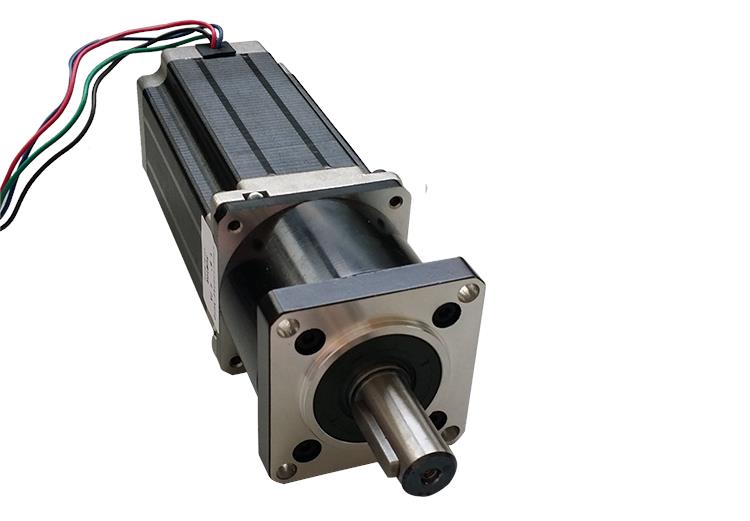
The default for steppers: low backlash, high efficiency (90–97%), coaxial mounting straight onto the motor faceplate, and a wide ratio range. For the deep-dive, see how a planetary gearbox works.
Spur
Cheaper than planetary, but looser (3–10° backlash multi-stage) and noisier—fine for one-direction, cost-sensitive duty.
Worm
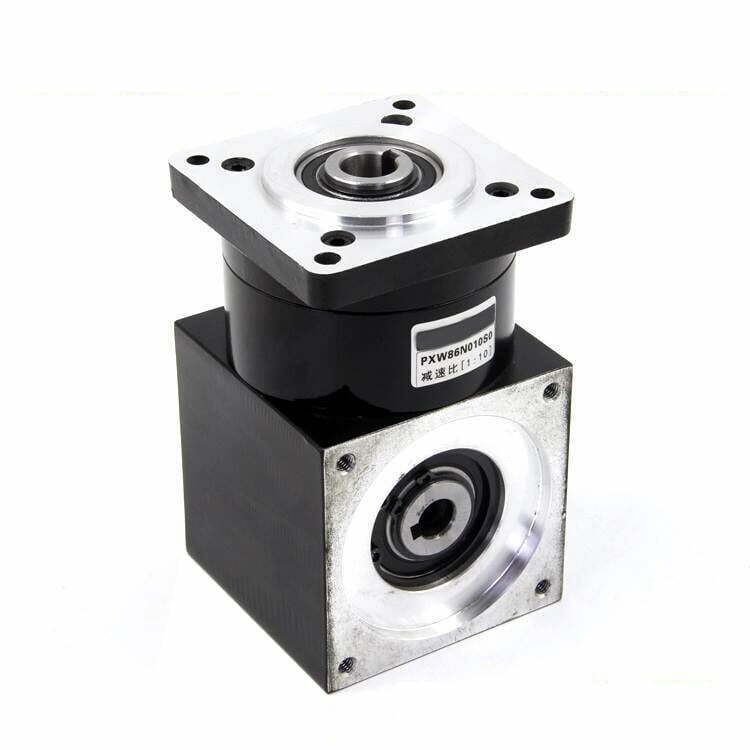
The choice when you need a right-angle output or self-locking (typically above ~20:1) so the load cannot back-drive when the motor is de-energized—at the cost of 40–80% efficiency and heat. See the worm gearbox guide for the trade-off.
Factor 5 — Inertia Matching
The most frequently skipped check is also the one that most often causes a stepper to stall or lose steps. A gearbox reduces the load inertia seen by the motor by the square of the ratio:
- Reflected inertia:
Jₙ = Jₚ / i²
A 100 kg·cm² load through a 10:1 box appears to the motor as 1 kg·cm². Steppers are most stable when the reflected load inertia is close to the rotor inertia:
| Drive type | Max recommended Jₚ / Jₙ ratio |
|---|---|
| Open-loop stepper | 5:1 to 10:1 |
| Closed-loop stepper (with encoder) | up to 30:1 |
If the ratio is too high, increase the gear ratio or pick a motor with larger rotor inertia. A closed-loop stepper tolerates a higher ratio because the controller can detect and correct lost steps—an open-loop one cannot.
Factor 6 — Duty Cycle, Thermal & Mounting
The last factor is about survival over time. Confirm three things: the duty cycle (a worm gearbox at 40–80% efficiency dumps the difference as heat, limiting it to intermittent duty), the thermal rating (winding temperature must stay within its IEC 60034-1 insulation class), and the mechanical interface (NEMA frame, output shaft diameter and keyway, and maximum radial/axial load). Exceeding the radial load rating—for example, hanging a pinion or belt pulley directly on the output shaft—accelerates bearing wear regardless of the other five factors being correct. See how to select a motor for industrial use for the full sizing path.
Best Applications by Gearbox Type
| Application | Recommended gearbox | Why |
|---|---|---|
| CNC rotary tables, optics | High-precision planetary (≤3 arcmin) | Bidirectional positioning, low backlash |
| Dispensing pumps, 3D printers | Economy planetary or spur | One-direction, cost-sensitive |
| Gates, valves, vertical lifts | Worm (self-locking) | Holds position without holding current |
| Conveyors, material handling | Multi-stage planetary or spur | High torque, high ratio |
| Compact instruments | Planetary, coaxial | Small size, mounts to motor faceplate |
Selection Worked Example
Requirement: a rotary indexing table needs 12 N·m at 60 rpm, with ≤0.1° repeatability, load inertia 5 kg·cm², bidirectional.
| Step | Calculation | Result |
|---|---|---|
| Ratio for speed | i = 1200 / 60 (motor at 1,200 rpm) | 20:1 |
| Output torque | T = 0.8 × 20 × 0.90 (0.8 N·m motor, η=90%) | 14.4 N·m ≥ 12 N·m ✓ |
| Step resolution | 1.8° / 20 | 0.09°/step (4,000 steps/rev) ≤ 0.1° ✓ |
| Backlash | Precision planetary | ≤3 arcmin (0.05°) ✓ |
| Reflected inertia | J = 5 / 20² | 0.0125 kg·cm² (rotor 0.1 → ratio 0.13:1) ✓ |
| Type | Planetary, coaxial | Low backlash, faceplate mount ✓ |
Counterintuitive insight: A bigger ratio does not always mean more usable torque—the gearbox’s rated torque is the ceiling. A 50 N·m theoretical output will strip a gearbox rated for 12 N·m. Likewise, a higher ratio subdivides the step angle but does not improve backlash: the reverse clearance is the true precision limit, and no amount of microstepping recovers it on an open-loop stepper. Finally, run the stepper at 200–600 rpm rather than near stall—its torque collapses at high speed and it resonates below ~100 rpm.
Common Mistakes
- Using holding torque as running torque. Dynamic torque falls off with speed; size for the operating point.
- Skipping the inertia check. A reflected-to-rotor ratio above ~10:1 causes stall and lost steps.
- Assuming more ratio = more torque. The gearbox rated torque is the hard limit.
- Ignoring backlash on a reversing axis. An open-loop stepper cannot correct it; specify ≤3 arcmin for positioning.
- Choosing worm for continuous duty. 40–80% efficiency turns into heat; reserve worm for self-locking or right-angle needs.
- Forgetting the mechanical interface. Radial/axial load limits and NEMA flange compatibility matter as much as the numbers.
Why Choose Greensky Power?
Greensky Power is a China-based manufacturer of gear reducers, custom motors, and integrated gear motors serving global OEMs since 2010. We pair steppers with planetary, spur, and worm gearboxes and specify the torque, ratio, backlash, inertia ratio, and duty cycle from your load data rather than shipping a catalogue default. Every unit is tested for torque, efficiency, backlash, noise, and temperature against IEC 60034 and NEMA MG 1 before shipment, with OEM/ODM customization of ratio, flange, and shaft. Start with the speed-reducer motor selection guide or browse the DC motors category.
Related Resources
- Gearbox overview (pillar page)
- Servo vs. stepper motor
- How to set stepper driver subdivision
- Stepper subdivision vs non-subdivision
- How a planetary gearbox works
- Harmonic drive vs. planetary gear
- Worm gearbox selection guide
- Gear-motor manufacturers in China
- Speed-reducer motor selection guide
- How to select a motor for industrial use
- How to calculate motor torque
- OEM / ODM customization
- DC motors category
References
- IEC 60034-1:2022 — Rotating electrical machines, general requirements (insulation & temperature classes). webstore.iec.ch/en/publication/65446
- IEC 60034-30-1 — Efficiency classes of line-operated AC motors (IE1–IE5). webstore.iec.ch/publication/91195
- ANSI/NEMA MG 1-2021 — Motors and Generators standard. webstore.ansi.org/standards/nema/ansinemamg2021
- NEMA — Motor and Generator product resources. nema.org/products/pages/motor-and-generator.aspx
- U.S. DOE — Motor load and efficiency reference. energy.gov/sites/prod/files/2014/04/f15/10097517.pdf
- IEA — Electric motors and energy efficiency. iea.org/energy-system/industry/electric-motors
- SKF — Bearing failures and their causes. skf.com/group/support/bearing-failures-and-their-causes
- Siemens — SIMOTICS electric motors. siemens.com/global/en/products/drives/electric-motors.html
- IEEE Xplore — Peer-reviewed electric machine design paper. ieeexplore.ieee.org/document/6342334
- maxon — EC motor and gearhead technology. maxongroup.com/maxon/view/content/ec-technology
- FAULHABER — Brushless DC motor know-how. faulhaber.com/en/know-how
- Yaskawa — Motion and motor technical downloads. yaskawa.com/downloads/search-index
- Tsubaki — Gear motor selection technical data (service factors). en.tt-net.tsubakimoto.co.jp/tecs/engd/gen/engd_gen_ggm_sry.asp
- AGMA — Gear rating and accuracy standards. agma.org
Technical content reviewed by Greensky Power applications engineering. Figures are typical industry ranges; final specification requires verification against the selected motor and duty cycle.
FAQ
What are the 6 factors for choosing a stepper motor gearbox?
Torque (with service factor), gear ratio and step resolution, backlash, gearbox type (planetary/spur/worm), inertia matching, and duty cycle plus mounting. Evaluate them in that order, because each feeds the next.
How does a gearbox improve stepper resolution?
It divides the step angle by the ratio. A 1.8° motor (200 steps/rev) through a 20:1 box gives 0.09° per step, or 4,000 steps per output revolution—finer positioning without microstepping or servo feedback.
Why does backlash matter more for a stepper than a servo?
An open-loop stepper has no feedback to correct the angular play on reversal—the controller assumes the shaft moved. A servo can measure and correct position. For bidirectional positioning, keep backlash under ~3 arcmin.
What gearbox type is best for a stepper motor?
Planetary is the default: low backlash (1–5 arcmin precision), high efficiency (90–97%), and coaxial mounting onto the motor faceplate. Spur is cheaper but looser; worm is for right-angle or self-locking needs at 40–80% efficiency.
What inertia ratio should I keep for a stepper?
Keep the reflected-to-rotor inertia ratio below about 10:1 for open-loop steppers, and up to 30:1 for closed-loop steppers with an encoder. Reflected inertia equals load inertia divided by the ratio squared.
Does a higher gear ratio always give more output torque?
No. Output torque rises with ratio until you hit the gearbox’s rated torque—that rated value is the ceiling, and exceeding it damages the gearbox. Also, stepper torque falls off as motor speed rises, so torque is not constant across the range.
