

Running a 12V DC motor on 120V AC
Quick Answer
A 12V DC motor cannot connect directly to a 120V AC outlet. It needs a regulated AC-to-DC power supply that provides 12V DC. An inverter changes DC to AC, so it performs the opposite conversion. Size the supply for the motor’s running and starting current; stall current can be several times the running current.
Short answer: use an AC-to-DC supply
A 12V DC motor can run from a 120V AC outlet if an AC-to-DC supply converts the mains to regulated 12V DC. The supply, wiring, and protection must all suit the motor’s current requirements.
The terms used for AC/DC conversion can be confusing. These four devices perform different functions:
| Device | Converts | Relevant here? |
|---|---|---|
| Inverter | DC → AC | No. It makes mains from a battery. Nothing to do with this task. |
| Rectifier | AC → DC, unsmoothed | It is one stage inside a power supply, not a finished product. |
| AC-to-DC power supply | 120V AC → regulated 12V DC | Yes. This is the device you need. |
| Motor driver / controller | DC → variable DC (PWM) | Optional, and only on the DC side, for speed or direction. |
An inverter takes DC in and produces AC. Connecting a motor to an inverter’s 120V AC output would expose it to the wrong voltage and current type. For this application, the conversion must go from 120V AC to regulated 12V DC.
Why 120V AC will not run a 12V DC motor
What 120V AC means
The 120V rating is an RMS value. At 60 Hz, the waveform reaches about 170V peak in each direction, reversing polarity 120 times per second. A 12V DC motor connected directly to the mains would therefore see a much higher voltage that repeatedly changes polarity.
| Quantity | 120V AC mains | 12V DC motor supply |
|---|---|---|
| Voltage, RMS | 120V | 12V (and constant) |
| Voltage, peak | About 170V, both polarities | 12V |
| Direction of current | Reverses 120 times per second | One direction |
| What the armature sees | Alternating current through a fixed magnetic field | Steady current through a fixed magnetic field |
| Net torque in a permanent-magnet motor | Zero, with vibration at twice line frequency | Proportional to current |
What happens if you connect the motor directly
A permanent-magnet DC motor has a fixed magnetic field. If AC reverses current through the armature, the torque also reverses, so the motor produces no steady rotation. It may buzz at twice the line frequency, while current through the winding resistance generates heat without rotation to carry that heat away.
A brushless motor labeled 12V usually relies on an electronic controller. Its input stage is designed for 12V DC; applying mains voltage can destroy the capacitors and switching devices and may cause fire.
Choosing an AC-to-DC power supply
Use a regulated 12V DC supply designed for 120V AC input. Depending on the market and application, these products may be sold as power supplies, adapters, drivers, or converters. In North American RV and lighting markets, “converter” is also a common name. Four common types differ in how they handle motor loads.
| Type | How it works | Good for | Watch out for |
|---|---|---|---|
| Sealed switch-mode supply (SMPS) | Rectifies, switches at high frequency, regulates | Most motor loads; 85–90% efficient | Current limit behaviour varies; some hiccup, some fold back, some shut down |
| Open-frame industrial supply | Same, in a chassis for panel mounting | Permanent installations | Terminals are exposed; needs an enclosure |
| Transformer + rectifier + linear regulator | Steps down, rectifies, burns the excess as heat | Very low noise, simple, robust | 50–60% efficient at 12V; heavy; large |
| Bench / lab supply | Adjustable, with metering and a settable current limit | Testing and one-off builds | Not for permanent installation |
A sealed switch-mode supply is a common fixed-installation choice because it is compact, relatively inexpensive, and efficient. Listed models are available for permanent installations. Check overload behavior before purchase: some units hiccup, fold back current, or shut down when a motor demands more than the supply can provide.

Sizing the supply for motor current
Why rated watts are not enough
A supply selected only by the motor’s rated wattage may fail to start the motor. Motor current depends on the supply voltage and the back-EMF generated as the motor spins. At standstill, back-EMF is absent, so current is limited mainly by winding resistance and can be several times higher than the running current.
For example, a 12V, 100W motor draws about 8.3A at rated load. If its winding resistance is 0.15 to 0.3 ohms, a simple 12V/R estimate gives a stall current of about 40 to 80A. The actual value depends on the specific motor. Starting against a load can create that surge for a fraction of a second, and a jam can hold the motor at stall until protection shuts it down.
| Condition | Current | Duration | What the supply must do |
|---|---|---|---|
| Running at rated load | About 8.3A | Continuous | Supply its rated output indefinitely without overheating |
| Starting against load | 40–80A | 0.1–2 seconds | Deliver the surge, or current-limit in a controlled way |
| Stalled or jammed | 40–80A | Until something stops it | Fold back or shut down before the motor or the wiring overheats |
Ask for the motor’s current ratings
Ask the motor supplier for its rated current and stall current, then check the supply’s published current-limit behavior. Those values help determine whether the motor will start and whether the system can handle a jam. If stall current is unavailable, a qualified technician can estimate it from winding resistance using a meter suitable for low-resistance measurements; treat the result as approximate.
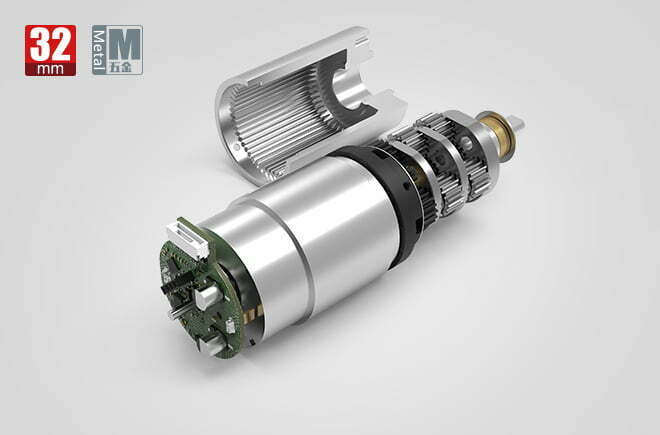
A useful 12 V DC gearmotor specification lists rated torque, rated current, and rated speed. Those values help size the supply.
There are two common approaches. Choose a supply whose surge rating covers stall current for the required duration; many industrial supplies publish continuous and peak ratings. Or use a supply rated for the running current with a suitable current limit and a driver that ramps the motor up. The second approach is common in commercial equipment and may cost less, but check both datasheets to confirm compatibility.
Speed control on the DC side
For variable speed, use a DC motor driver between the 12V supply and the motor. The driver typically uses pulse-width modulation (PWM) to control the voltage delivered to the motor.
A standard power supply provides a fixed 12V output. Speed control is handled by a separate DC-side device. For a permanent-magnet motor, PWM switches the DC on and off rapidly; changing the duty cycle changes the average voltage and speed. The motor’s torque constant remains the same, while delivered torque depends on current and load.
- Voltage control only: the least expensive option, adequate for a fan or pump where load falls with speed.
- PWM driver with current limit: a common choice that can protect both motor and supply.
- Closed-loop speed control: requires shaft feedback and is useful when speed must remain steady as load changes.
When replacing a motor, start with the torque required at the operating speed. The relationship between torque, speed, and power is explained in how to calculate motor torque.
To reverse a permanent-magnet DC motor, reverse its polarity with a suitable H-bridge. Brushless motors need a controller designed for electronic commutation; see how a BLDC motor works and the BLDC controller guide.
Five workarounds that do not work
These approaches may look like shortcuts, but each has a different limitation:
| Approach | What you actually get | Why it fails |
|---|---|---|
| Series resistor | A voltage drop that changes with current | A motor’s current varies several-fold between no load and stall, so no single value works. Dropping 158V at 8A dissipates over 1.2kW in the resistor. |
| Single diode | Half-wave rectified DC: about 54V average, 170V peak | Still four to five times the motor rating, and the ripple is enormous. The motor overheats rather than runs. |
| Light dimmer or triac | Reduced RMS alternating current | Still AC, so still no net torque. Dimmers are also not rated for inductive motor loads. |
| Transformer alone | 12V AC | Right voltage, wrong kind of current. Needs a rectifier and smoothing to become DC. |
| Variac / autotransformer | Adjustable AC, no isolation | Still AC, and it removes the isolation that makes a transformer safe to touch on the secondary. |
A device labeled “12V” may still plug into a wall outlet because it contains an AC-to-DC supply, or because it uses a universal motor. The label describes its output or operating voltage; it does not mean the motor itself can connect directly to mains AC.
Three alternatives to compare
A 120V AC to 12V DC supply is one option. Depending on the machine, replacing the motor, using a battery, or selecting a different drive system may be simpler or less expensive.
| Option | What it removes | When it is the better answer |
|---|---|---|
| Replace the motor with a 120V AC gearmotor | The power supply, the high-current DC wiring, one failure mode | Machine is stationary and mains is available; speed is fixed |
| Three-phase motor with a VFD | The DC supply, and adds real speed control | Variable speed is needed and three-phase power or a single-to-three-phase drive is acceptable |
| Keep 12V and use a battery with a charger | The mains connection at the motor entirely | The machine moves, or has to run where there is no outlet |
Replace the motor
If the machine is stationary and does not need variable speed, a 120V AC gearmotor may simplify the design by removing the DC supply and high-current low-voltage wiring. Check torque, speed, mounting, and protection requirements. See general purpose motor, high-torque AC gear motors, and AC gear motors with speed control. BLDC versus induction motor compares the motor families.
Keep 12V and use a battery
A 12V motor may be attractive because it is compact, geared, and provides useful torque for its size and cost. The battery can power the motor while a suitable charger recharges it, keeping mains wiring away from the motor. This may suit equipment that moves or operates away from an outlet.
Safety
For a permanent installation, follow the supply manufacturer’s instructions and applicable electrical code. These precautions address common hazards:
Four rules
- Use an appropriately certified supply. Check the exact model and certification scope for the target country and application. Do not assume an unmarked module is approved. The applicable product standard depends on how the supply will be used; IEC 62368-1 covers audio/video, ICT, and business/office equipment, so it may not apply to a general motor installation.
- Ground and protect the installation. Bond metal enclosures as required, use overcurrent protection selected for the circuit and equipment, and enclose open-frame supplies so hazardous terminals are not exposed. Follow the product instructions and local code.
- Keep mains and DC wiring separated. Use suitable routing, compartments, and strain relief so pulling one cable cannot bring conductors into contact.
- Protect the DC side too. A 12V supply can deliver enough current to overheat wiring, cause burns, or start a fire. At 60A, a tool across the terminals can weld in place. Fit output protection and choose conductors according to the supply rating and installation requirements.
Do not use a light dimmer to control this motor unless the device is specifically rated for the load and application. Do not use lamp cord or an extension lead as permanent building wiring. Motor ratings and tolerances are covered by IEC 60034-1; enclosure protection for dusty or wet locations is described in IEC 60529.
Procedure
Once the motor and supply are correctly matched, the remaining checks are straightforward. The first two steps determine the supply and cable requirements:
- Read the motor’s label. You want the rated voltage, the rated current and, if it is printed, the rated power. If the motor has an integrated controller, note that the supply feeds the controller, not the windings.
- Determine the stall current. Ask the supplier, or measure the winding resistance and divide 12 by it. This is the number the supply’s surge behaviour and the cable have to survive.
- Choose a listed 12V supply whose continuous rating covers the running current and whose surge rating covers the start, or whose current limit is documented and matched to a ramping driver.
- Choose the conductor for the stall current, not the running current, and keep the run as short as the layout allows.
- For an open-frame supply, have a qualified person wire and inspect the mains side. Keep the motor disconnected while the qualified person checks the installation. Before connecting the motor, verify that the output is 12V DC and confirm polarity with a meter. Plug-in adapters should remain closed.
- Connect the motor, fuse the DC side, and start it against its real load. A motor that starts freely on the bench and stalls in the machine has told you the supply was sized on running current.
Two checks are especially important: how the supply behaves at current limit and whether the polarity is correct. Reversing polarity changes the direction of a permanent-magnet motor and is usually harmless to the motor itself, but can damage an integrated controller. See brushed DC motor and what motor brushes are for motor construction and brush details.
References
- International Electrotechnical Commission. (2022). IEC 60034-1:2022 — Rotating electrical machines, Part 1: Rating and performance. IEC. https://webstore.iec.ch/en/publication/65446
- International Electrotechnical Commission. (2013). IEC 60529:1989+AMD2:2013 — Degrees of protection provided by enclosures (IP code). IEC. https://webstore.iec.ch/en/publication/2452
- International Electrotechnical Commission. (2014). IEC 60034-2-1:2014 — Standard methods for determining losses and efficiency from tests. IEC. https://webstore.iec.ch/en/publication/121
- International Electrotechnical Commission. (2025). IEC 60034-30-1:2025 — Efficiency classes of line operated AC motors (IE code). IEC. https://webstore.iec.ch/en/publication/91195
- National Fire Protection Association. (2023). NFPA 70 — National Electrical Code. NFPA. https://www.nfpa.org/codes-and-standards/nfpa-70-standard-development/70
- U.S. Occupational Safety and Health Administration. (2024). 29 CFR Part 1910, Subpart S — Electrical. Electronic Code of Federal Regulations. https://www.ecfr.gov/current/title-29/subtitle-B/chapter-XVII/part-1910/subpart-S
- UL Solutions. (2026). UL Standards and product safety certification. UL Solutions. https://www.ul.com/
- National Electrical Manufacturers Association. (2021). NEMA MG 1 — Motors and Generators. NEMA. https://www.nema.org/standards
- European Parliament and Council. (2019). Commission Regulation (EU) 2019/1781 laying down ecodesign requirements for electric motors and variable speed drives. Official Journal of the EU. https://eur-lex.europa.eu/eli/reg/2019/1781/oj
- U.S. Department of Energy. (2024). Motor systems — energy efficiency and system optimisation. Advanced Manufacturing Office. https://www.energy.gov/eere/amo/motor-systems
FAQ
Q: Can I run a 12V DC motor on 120V AC?
Not directly. A permanent-magnet DC motor needs direct current, while 120V AC reverses polarity 120 times per second. The motor will not produce steady rotation and may vibrate or overheat. To run it from a wall outlet, use an AC-to-DC supply that provides regulated 12V DC at the required current.
Q: Do I need an inverter or a converter?
An inverter converts DC to AC, so it is not the device you need. Look for an AC-to-DC power supply, sometimes sold as a converter or adapter. Check that the input is 120V AC and the output is regulated 12V DC. Some converters also include charging or other functions, so verify the output ratings for the motor load.
Q: What size power supply do I need for a 12V DC motor?
Check both rated and startup/stall current. A 100W, 12V motor draws about 8.3A at rated load; for the example winding resistance of 0.15 to 0.3 ohms, the estimated stall current is 40 to 80A. Actual startup current depends on the motor and load. Confirm the value with the manufacturer and choose a supply and driver that can start the load without overheating or repeatedly shutting down.
Q: Can I use a resistor or a diode to drop the voltage?
A series resistor is unsuitable because voltage drop changes with current; a motor’s current can vary several-fold between no load and stall. The example calculates that dropping 158V at 8A would dissipate over 1.2kW. With an ideal 120V RMS, 60Hz sine-wave input and no smoothing capacitor, a single diode produces half-wave rectified output with an average near 54V and peaks near 170V. The actual motor-terminal waveform depends on the load and circuit, but the voltage remains far above a 12V motor’s rating.
Q: Why does a mains electric drill work if DC motors cannot run on AC?
Because a mains drill does not contain a permanent-magnet DC motor. It contains a universal motor whose field winding is in series with the armature, so when the current reverses both reverse together and the torque keeps its direction. A 12V permanent-magnet motor has a fixed field, so the same reversal produces no net torque.
Q: Is it safer to replace the motor with a 120V AC one?
It may be simpler if the machine is stationary and does not need variable speed. A 120V AC gearmotor can remove the DC supply and high-current low-voltage wiring. Keep the 12V motor when the equipment runs from a battery, needs smooth speed control, or cannot accommodate a different gearbox or mounting.
For help comparing a 12V DC motor with a mains AC gearmotor, send the duty point, mounting dimensions, and available supply through our contact page.