
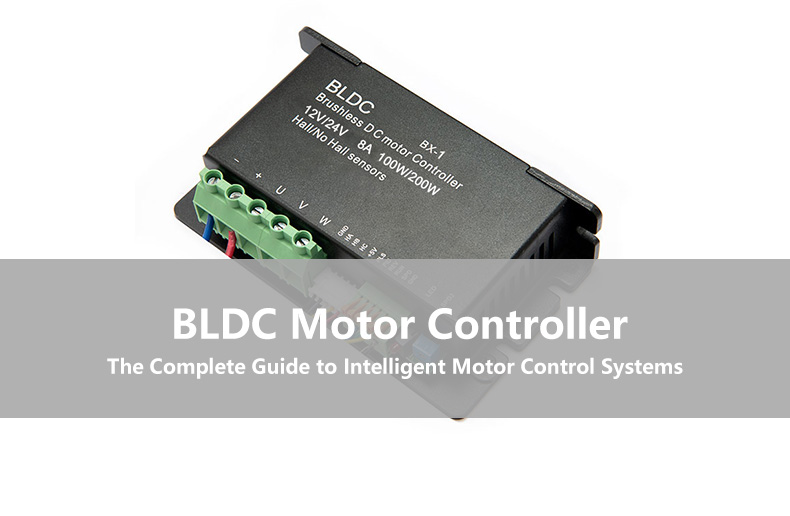
BLDC Motor Controller: The Complete Guide to Intelligent Motor Control Systems
A Brushless DC (BLDC) motor is only as smart as its controller. While the motor provides the mechanical power, the BLDC motor controller is the brain behind the operation, dictating every aspect of performance—from startup torque and speed precision to operational efficiency and system protection. For engineers, product designers, and technicians, understanding the intricacies of BLDC controllers is essential for unlocking the full potential of this advanced motor technology in applications ranging from e-bikes and drones to industrial automation and medical devices.
This comprehensive guide dives deep into the world of BLDC motor controllers. We will explore their fundamental operating principles, compare different types of control strategies, break down key specifications, and provide a practical framework for selecting the perfect controller for your application. As a leading manufacturer of both BLDC motors and their companion controllers, Greensky Power is uniquely positioned to provide expert insights into creating optimized, reliable motion solutions.
I. What is a BLDC Motor Controller and How Does It Work?
At its core, a BLDC motor controller is an electronic device that manages the position, speed, and torque of a brushless DC motor. Unlike brushed motors that commutate mechanically, BLDC motors require external electronic commutation to function.
The Basic Principle: Electronic Commutation
A BLDC motor has a permanent magnet rotor and a stationary stator with three windings. To create rotation, the controller must sequentially energize these windings in a specific pattern, creating a rotating magnetic field that “pulls” the rotor around. This process is called commutation.
The Control Loop: A Three-Stage Process
- Sensing: The controller first determines the rotor’s position. This is achieved through:
- Hall Effect Sensors: Most common method. Sensors embedded in the stator provide digital signals indicating the rotor’s position.
- Sensorless Control: The controller measures the Back Electromotive Force (Back-EMF) generated in the unpowered windings to infer the rotor’s position. This is common in cost-sensitive applications like fans and pumps.
- Processing: A microcontroller (MCU) or Digital Signal Processor (DSP) takes the position data and calculates the precise timing and sequence for energizing the windings based on the user’s command (e.g., a speed setpoint from a throttle or potentiometer).
- Power Delivery: The processor sends signals to a power stage, typically consisting of three pairs of MOSFETs or IGBTs arranged in a “three-phase bridge” configuration. These transistors act as high-speed switches, pulsing power to the motor windings in the correct sequence.
This continuous loop of sensing, processing, and power delivery happens thousands of times per second, resulting in smooth and precise motor rotation.
II. Types of BLDC Motor Control Strategies
The sophistication of the control algorithm directly impacts motor performance, efficiency, and cost. The main strategies are:
1. Trapezoidal (or Six-Step) Control
- How it works: Energizes two windings at a time while leaving the third floating. The current waveform resembles a trapezoid.
- Pros: Simple algorithm, lower computational requirements, and cost-effective.
- Cons: Produces torque ripple (slight pulsations), especially at low speeds, leading to less smooth operation and audible noise.
- Best for: Applications where cost is critical and smooth operation is not a top priority (e.g., simple fans, pumps, basic drills).
2. Sinusoidal Control
- How it works: Drives the three motor windings with currents that are sinusoidal in shape and 120 degrees out of phase. This creates a smoother, rotating magnetic field.
- Pros: Significantly reduced torque ripple and audible noise compared to trapezoidal control. Smoother operation at low speeds.
- Cons: More computationally intensive, requiring a more powerful MCU.
- Best for: Applications requiring quiet and smooth operation, such as medical devices, HVAC blowers, and high-end appliances.
3. Field-Oriented Control (FOC) / Vector Control
- How it works: This is the most advanced method. FOC mathematically transforms the three-phase currents into two independent components: one that produces torque (quadrature current) and one that controls the magnetic field (direct current). This allows for precise, independent control of torque and flux, similar to how a separately excited DC motor operates.
- Pros: Maximum efficiency across a wide speed and torque range. Excellent low-speed torque control and smooth operation. High dynamic response.
- Cons: Most computationally complex algorithm, requiring a high-performance processor (like an ARM Cortex-M). Highest cost.
- Best for: High-performance applications where efficiency and precise control are paramount. This includes e-bikes, industrial robots, drones, and electric vehicles.
III. Key Features and Specifications to Consider
Selecting the right BLDC motor controller involves matching its specifications to your motor and application requirements.
| Feature/Specification | Description | Why It Matters |
|---|---|---|
| Voltage & Current Rating | The operating voltage range (e.g., 12-48V) and maximum continuous/peak current. | Must be compatible with your power supply (battery) and motor. Exceeding current ratings can destroy the controller. |
| Control Method | Trapezoidal, Sinusoidal, or FOC. | Dictates the motor’s performance, smoothness, and efficiency. |
| Communication Interfaces | How the controller receives commands: PWM, Analog Voltage (0-5V), UART, CAN bus, etc. | Determines how easily it integrates with your main system (PLC, Arduino, Raspberry Pi, etc.). |
| Protection Features | Over-current, Over-voltage, Under-voltage, Over-temperature protection. | Critical for safeguarding both the controller and the motor from damage in fault conditions. |
| Programmability | Ability to adjust parameters like acceleration/deceleration ramps, current limits, and PID gains. | Allows for fine-tuning the motor’s behavior to the specific application. |
| Regenerative Braking | The ability to slow the motor by converting its kinetic energy back into electrical energy to charge the battery. | Increases efficiency and range in electric vehicles. |
| Sensorless Operation | Capability to run a sensored motor without Hall sensors or to run a sensorless motor. | Provides a backup mode if a Hall sensor fails and enables the use of cheaper sensorless motors. |
IV. How to Select a BLDC Motor Controller: A Step-by-Step Guide
Follow this process to ensure compatibility and optimal performance.
- Match the Motor Specifications:
- Voltage: The controller’s voltage range must match your motor’s rated voltage (e.g., a 48V motor needs a 48V controller).
- Current: The controller’s continuous current rating should be equal to or greater than the motor’s rated current. The peak current rating should handle the motor’s startup and surge demands.
- Define Your Performance Needs:
- For applications needing smooth, quiet, and efficient operation (e-bikes, medical pumps), choose a controller with FOC.
- For cost-sensitive applications with less demanding performance (fans, conveyors), a Trapezoidal controller may suffice.
- Choose the Communication Protocol:
- For simple speed control, PWM or a 0-5V analog signal is sufficient.
- For complex industrial machinery, a digital interface like CAN bus is necessary for networked communication.
- Verify Protection and Environmental Ratings:
- Ensure the controller has robust over-current and over-temperature protection.
- If used in a harsh environment, look for a controller with a suitable IP rating (e.g., IP65 for dust and water resistance).
- Consider Integration and Support:
- Does the supplier provide wiring diagrams, software tools, and technical support? Greensky Power, for instance, offers comprehensive support for integrating our controllers with our motors.
V. Greensky Power’s Integrated Motor & Controller Solutions
At Greensky Power, we understand that the motor and controller are a symbiotic pair. Our expertise lies in providing perfectly matched systems.
- Pre-Tuned Performance: We offer pre-configured motor-controller kits where the parameters are already optimized, saving you significant development time.
- Customization: We can design controllers with specific communication protocols, form factors, and software features to meet your unique application needs.
- Technical Support: Our engineering team provides full support to help you integrate and program our controllers for maximum performance.
Why an Integrated System is Superior: A mismatched controller can lead to poor efficiency, excessive noise, and even motor failure. By sourcing both components from Greensky Power, you ensure perfect compatibility and reliability.
Conclusion
The BLDC motor controller is the critical intelligence that transforms a simple BLDC motor into a high-performance, controllable motion system. The choice of control strategy—from basic trapezoidal to advanced Field-Oriented Control—directly determines the efficiency, smoothness, and responsiveness of your application. By carefully matching the controller’s specifications to your motor and performance requirements, you can unlock the full potential of BLDC technology.
As applications become smarter and more efficient, the role of the controller will only grow in importance. Partnering with a manufacturer that understands both motor and controller design is the key to success.
Need help selecting the right BLDC motor controller?
Contact Greensky Power’s technical team today. Let us help you design the perfect control solution for your project.
Submit Your Controller Requirements| Email: mkt@greensky-power.com
References
- Texas Instruments. “FOC for Brushless DC Motors”. TI Application Report, 2023.https://www.ti.com/lit/pdf/sprabs2
- Microchip Technology. “Sensored BLDC Motor Control Using dsPIC30F2010″. Microchip Application Note, 2024.https://ww1.microchip.com/downloads/en/AppNotes/Sensored-BLDC-Control-dsPIC30F2010-AN957.pdf
- Monolithic Power Systems (MPS). “What is a Motor Controller?”. MPS Explains, 2023.https://www.monolithicpower.com/en/learning/what-is-a-motor-controller
