
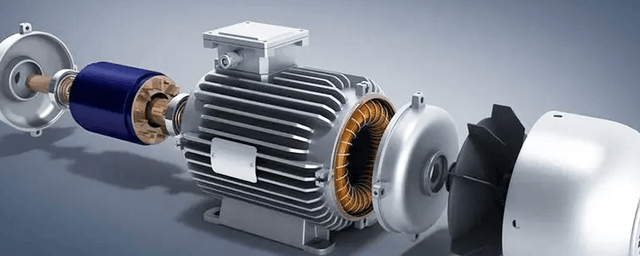
What Is the Difference Between AC and DC Motors?
Quick Answer:
AC and DC motors differ in power source and motion generation. AC motors use alternating current and electromagnetic induction to create a rotating magnetic field in the stator, driving the rotor without contact. DC motors run on direct current; a stationary magnetic field (permanent magnets or field windings) interacts with the armature via mechanical commutator/brushes or electronic commutation in brushless designs. AC motors generally offer lower maintenance and higher efficiency for continuous duty; DC motors excel in precise speed control and high starting torque. Modern efficiency standards (IEC 60034‑30‑1 and NEMA MG 1) now define minimum performance levels, narrowing the traditional efficiency gap.
Contents
- What Is an AC Motor?
- What Is a DC Motor?
- How AC and DC Motors Work: Step-by-Step Principle
- AC vs DC Motor: Feature Comparison Table
- Engineering Data: Efficiency, Temperature Limits, and Torque
- Best Applications for AC and DC Motors
- Step-by-Step Motor Selection Guide
- Common Engineering Mistakes When Selecting AC vs DC Motors
- Troubleshooting Table: Common Motor Problems
- Why Choose Greensky Power for Your Motor Solutions?
- References
- FAQ: AC vs DC Motors
What Is an AC Motor?
An AC motor converts alternating current electrical energy into mechanical energy through electromagnetic induction. The stator windings, energized by AC supply, generate a rotating magnetic field whose speed (synchronous speed) is determined by the supply frequency and the number of poles:
ns = 120 × f / p
where ns is synchronous speed in RPM, f is frequency in Hz (50 or 60 Hz), and p is the number of poles. For a 4-pole motor on a 60 Hz supply, the synchronous speed is 1,800 RPM.
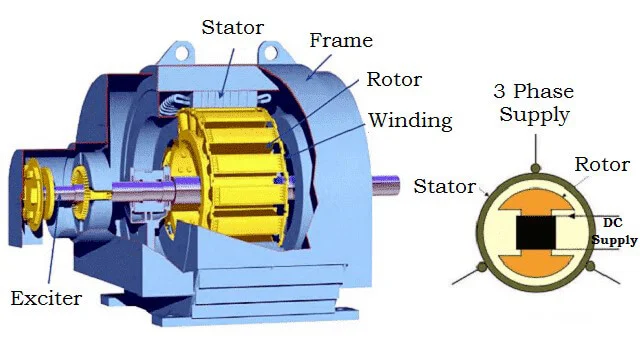
The two dominant AC motor subtypes are:
- Induction (asynchronous) motors — The rotor rotates slightly slower than the synchronous speed (the difference is called “slip”), which induces current in the rotor bars. Squirrel-cage induction motors are the workhorse of industrial applications due to their simplicity and robustness. Per three-phase asynchronous motor designs, these motors typically achieve 85–95% efficiency at rated load.
- Synchronous motors — The rotor rotates at exactly the synchronous speed, using permanent magnets or DC-excited field windings. Permanent magnet synchronous motors (PMSM) achieve IE4 and IE5 efficiency levels under IEC 60034-30-1 and are increasingly used in electric vehicles and high-precision servo systems.
What Is a DC Motor?
A DC motor converts direct current electrical energy into mechanical energy through the interaction of a magnetic field and current-carrying conductors. The torque produced by a DC motor follows the fundamental equation:
T = Kt × Φ × Ia
where T is torque, Kt is the torque constant, Φ is the magnetic flux per pole, and Ia is the armature current. This linear relationship gives DC motors their characteristic high starting torque and predictable speed-torque behavior.
The main DC motor subtypes include:
- Brushed DC motors — Use mechanical brushes and a commutator to reverse current direction in the armature windings. These are cost-effective and offer simple speed control by varying armature voltage, but brushes wear over time and require replacement. See our brushed DC motor product line for typical specifications.
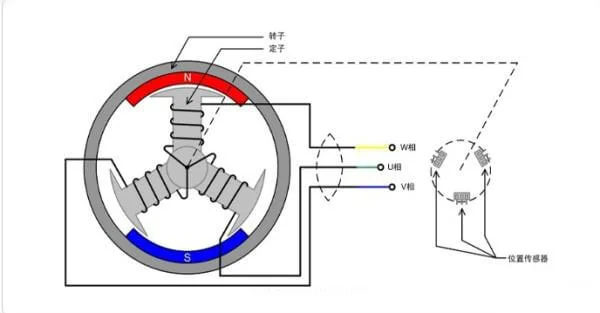
- Brushless DC motors (BLDC) — Replace mechanical commutation with electronic switching using Hall-effect sensors or back-EMF detection. BLDC motors eliminate brush wear, reduce EMI, and achieve efficiencies of 85–95%. Our brushless DC motor platform covers applications from e-bikes to industrial automation.
- Stepper motors — A specialized DC motor type that moves in discrete steps, enabling open-loop position control. Used in CNC machines, 3D printers, and precision positioning. See our stepper motor range for details.
How AC and DC Motors Work: Step-by-Step Principle
DC Motor Working Principle
- Magnetic field establishment — The stator (or housing) contains permanent magnets or field windings that create a stationary magnetic field between the north and south poles.
- Current supply to armature — Direct current flows through the armature windings on the rotor via brushes and commutator (brushed) or via an electronic controller (brushless).
- Lorentz force generation — According to the Lorentz force law (F = BIL), the current-carrying conductors in the magnetic field experience a mechanical force perpendicular to both the field and current direction.
- Commutation — The commutator (or electronic controller) reverses the current direction in the armature windings every half-rotation, ensuring the torque always acts in the same rotational direction.
- Back-EMF regulation — As the rotor spins, it generates a back-electromotive force (back-EMF) proportional to speed, which naturally limits the armature current and stabilizes the operating speed.
AC Motor Working Principle
- Stator excitation — Three-phase (or single-phase) AC voltage is applied to the stator windings, which are spatially distributed at 120° electrical apart.
- Rotating magnetic field — The phase-shifted currents in the stator windings produce a rotating magnetic field (RMF) that sweeps around the stator interior at synchronous speed (ns = 120f/p).
- Induction (induction motors only) — The rotating field cuts across the rotor conductors (squirrel-cage bars), inducing an electromotive force and current in the rotor by Faraday’s law of induction.
- Torque production — The induced rotor current interacts with the stator’s rotating magnetic field, producing torque (Lorentz force) that drives the rotor in the same direction as the field.
- Slip and self-regulation — The rotor must rotate slower than the synchronous speed (slip) to maintain induction. As load increases, slip increases, which raises the induced current and torque until equilibrium is reached.
AC vs DC Motor: Feature Comparison Table
| Feature | AC Motor | DC Motor |
|---|---|---|
| Power Source | Alternating current (single-phase or three-phase, 50/60 Hz) | Direct current (battery, rectified AC, or DC power supply) |
| Magnetic Field | Rotating magnetic field generated by stator windings | Stationary field from permanent magnets or field windings |
| Commutation | None required (induction motors); electronic (PMSM) | Mechanical brushes + commutator (brushed) or electronic (BLDC) |
| Speed Control | VFD required for variable speed; otherwise fixed by frequency and pole count | Simple voltage or current adjustment; wide range, fast response |
| Starting Torque | 150–250% of rated torque (induction); higher with VFD | Up to 400–500% of rated torque (series-wound); high at zero speed |
| Efficiency (Typical) | IE3: 85–95%; IE4 (PMSM): 90–96% | Brushed: 75–85%; Brushless: 85–95% |
| Maintenance | Very low — no brushes, no commutator; bearings only | Brushed: regular brush/commutator replacement; BLDC: low |
| Speed Range | Fixed speed (DOL) or variable with VFD (10:1 typical) | Wide variable range (20:1 or more) natively |
| Noise & EMI | Low noise; minimal sparking | Brushed: audible noise and EMI from arcing; BLDC: quiet |
| Cost (Same Power Rating) | Lower, especially in large frame sizes | Higher due to commutator/brushes or electronic controller |
| Power-to-Weight Ratio | Moderate; better in PMSM designs | High, especially in coreless and BLDC designs |
| Typical Lifespan | 15–20+ years (bearing-limited) | Brushed: 5,000–10,000 hours (brush-limited); BLDC: 15+ years |
Engineering Data: Efficiency, Temperature Limits, and Torque
Motor Efficiency Classes (IEC 60034-30-1)
The IEC 60034-30-1 standard, harmonized with NEMA MG 1 in North America, defines four international efficiency (IE) classes for line-operated AC motors. Each class represents approximately 10–20% lower losses than the one below it:
| IE Class | NEMA Equivalent | 4-Pole, 1.5 kW, 50 Hz | 4-Pole, 7.5 kW, 50 Hz | 4-Pole, 75 kW, 50 Hz |
|---|---|---|---|---|
| IE1 (Standard) | Standard Efficiency | 77.2% | 84.7% | 92.7% |
| IE2 (High) | High Efficiency | 82.8% | 88.7% | 94.7% |
| IE3 (Premium) | NEMA Premium | 85.3% | 90.4% | 95.2% |
| IE4 (Super Premium) | Super Premium | 87.7% | 92.0% | 96.0% |
Source: IEC 60034-30-1:2014 standard tables; NEMA MG 1 Part 12 & 31. Data confirmed by ABB Motor Guide (Rev D, 2021).
For DC motors, efficiency depends heavily on the commutation method. According to maxon’s DC motor technical handbook, their coreless wound DC motors achieve up to 89% maximum efficiency (e.g., RE 40, 150 W, 48 V), while brushless EC-i series motors reach 83% at 30 W rating. The coreless winding design eliminates iron losses from hysteresis and eddy currents, which is why brushless DC motor designs increasingly dominate precision applications.
Insulation Classes and Temperature Limits (IEC 60034-1)
| Insulation Class | Max Hot-Spot Temperature | Typical Ambient (40°C) | Allowed Temperature Rise | Common Application |
|---|---|---|---|---|
| Class A | 105°C | 40°C | 60°C | Obsolete; legacy equipment |
| Class E | 120°C | 40°C | 75°C | Small DC motors |
| Class B | 130°C | 40°C | 80°C | General-purpose AC motors |
| Class F | 155°C | 40°C | 100°C | Industrial AC & DC motors (most common) |
| Class H | 180°C | 40°C | 125°C | High-temp / heavy-duty motors |
Source: IEC 60034-1 Rotating electrical machines — Part 1: Rating and performance.
Key Torque and Speed Formulas
DC Motor Torque: T = Kt × Φ × Ia (linear relationship between torque and armature current)
DC Motor Speed: n = (V − IaRa) / KeΦ (speed is proportional to voltage minus armature voltage drop)
AC Induction Motor Torque: T = (3 × V² × R₂/s) / (ωs × [(R₁ + R₂/s)² + (X₁ + X₂)²])
AC Synchronous Speed: ns = 120 × f / p
where V is supply voltage, R and X are resistance and reactance, s is slip, ωs is synchronous angular speed, f is frequency, and p is pole count. The DC motor’s linear torque-current relationship makes it inherently easier to control torque directly, which is why DC motors remain preferred in servo and traction applications. For a deeper comparison of motor control strategies, see our guide on 5 types of control motors.
Best Applications for AC and DC Motors
AC Motor Applications
AC induction motors dominate applications requiring continuous, constant-speed operation with minimal maintenance:
- HVAC systems — Fans, blowers, and compressors run at fixed speeds for thousands of hours; the low maintenance and high reliability of AC motors make them ideal.
- Industrial pumps and conveyors — Three-phase induction motors rated IE3 or above are the standard for water treatment plants, chemical processing, and material handling.
- Household appliances — Washing machines, refrigerators, and air conditioners use single-phase AC motors for cost efficiency and grid compatibility.
- Industrial machinery — Machine tools, crushers, mixers, and extruders rely on AC motors paired with motor controllers or VFDs for process control.
DC Motor Applications
DC motors excel where precise speed control, high starting torque, or battery operation is required:
- Electric vehicles and e-bikes — BLDC motors provide high torque density and regenerative braking capability. See our e-bike motor controller guide for implementation details.
- Robotics and automation — Servo-grade DC motors offer sub-degree positioning accuracy and rapid acceleration/deceleration profiles.
- Material handling — Cranes, hoists, forklifts, and elevators use DC motors (or VFD-driven AC equivalents) for their high starting torque and smooth speed regulation.
- Battery-powered tools and devices — Cordless drills, medical devices, and consumer electronics rely on compact brushed or brushless DC motors.
- Precision machinery — CNC machines, printing presses, and textile equipment use DC servo motors for tight speed regulation under varying loads.
Step-by-Step Motor Selection Guide
Choosing between an AC and DC motor involves evaluating six key parameters. Follow this decision framework:
- Determine the power source. If the application is connected to the AC grid with no battery requirement, an AC motor is the natural choice. If the application is battery-powered or requires DC voltage (automotive, solar, portable), a DC motor is mandatory. For grid-connected applications needing variable speed, consider an AC motor + VFD or a BLDC motor with controller.
- Define the speed control requirement. Does the application need constant speed, or variable speed across a wide range? Constant-speed applications (pumps, fans) favor AC induction motors. Variable-speed applications with fast response (conveyors, winders, robotics) favor DC or BLDC motors. If you need speed control on an AC motor, a VFD-controlled AC gear motor bridges the gap.
- Calculate the starting torque requirement. Applications with high inertial loads (cranes, extruders, crushers) need 200–400% starting torque. Series-wound DC motors and VFD-driven AC motors can deliver this. Standard AC induction motors typically provide 150–250%.
- Check the duty cycle and environment. Continuous-duty (S1) applications in clean environments favor AC motors. Intermittent-duty or harsh environments (dust, moisture, explosive atmospheres) may require sealed DC motors or explosion-proof AC motors certified to IEC 60079.
- Evaluate maintenance tolerance. If brush replacement downtime is unacceptable, choose an AC induction motor or BLDC motor. If maintenance access is available and cost is the priority, a brushed DC motor may be acceptable. See our industrial BLDC motor guide for maintenance-free alternatives.
- Compare total cost of ownership. Factor in initial purchase price, controller/VFD cost, energy consumption over the motor’s life (typically 15–20 years for AC, 5–10 years for brushed DC), and maintenance labor. A higher-efficiency IE3/IE4 motor may cost 20–30% more upfront but save thousands in energy costs over its lifetime.
For applications requiring torque multiplication at low speed, consider pairing your motor with a gearbox. Our gearbox selection guide walks through ratio selection, efficiency losses, and mounting options.
Common Engineering Mistakes When Selecting AC vs DC Motors
- Ignoring the back-EMF constant in DC motor sizing. Engineers often select a DC motor based on rated torque alone, overlooking the back-EMF constant (Ke) that determines the maximum achievable speed at a given supply voltage. If Ke × nmax exceeds the supply voltage, the motor cannot reach the target speed.
- Undersizing the VFD for AC motor starting torque. A common mistake is selecting a VFD rated for the motor’s continuous current, not its starting current. AC induction motors can draw 6–8× rated current during direct-on-line starting. Even with a VFD, the drive must be sized for the peak torque demand, not just the running load.
- Confusing brushless DC with AC synchronous motors. BLDC motors and PMSMs use similar constructions (permanent magnet rotor, three-phase stator), but BLDC motors use trapezoidal (six-step) commutation while PMSMs use sinusoidal commutation. The drive electronics are different, and the two are not interchangeable without controller changes. See our PMSM vs induction motor comparison for details.
- Neglecting thermal derating at altitude or high ambient temperature. Per IEC 60034-1, motors must be derated when ambient temperature exceeds 40°C or altitude exceeds 1,000 m. A motor rated for 5 kW at sea level may need to be derated to 4.2 kW at 2,000 m altitude. This is often overlooked in procurement specifications.
- Using brushed DC motors in explosive atmospheres. Brush arcing makes brushed DC motors unsuitable for hazardous locations (Zone 1/Zone 2). Use explosion-proof AC motors certified to IEC 60079 or ATEX instead.
- Overlooking power factor correction for AC motors. Induction motors operate at 0.7–0.85 lagging power factor, which can trigger utility penalties. Power factor correction capacitors or synchronous condensers should be specified during system design.
Troubleshooting Table: Common Motor Problems
| Problem | Likely Cause | Solution | Applies To |
|---|---|---|---|
| Motor won’t start | Open circuit in stator/field winding; blown fuse; stuck brush | Check continuity with multimeter; replace fuse; inspect brush spring tension | Both AC & DC |
| Excessive sparking at brushes | Worn brushes; commutator grooves; brush spring fatigue; overload | Replace brushes; resurface or turn commutator; check load current against nameplate | Brushed DC |
| Motor overheating (>Class F limit) | Overload; voltage imbalance; blocked ventilation; bearing failure | Measure current vs. FLA; check voltage balance (<2%); clean air passages; replace bearings | Both AC & DC |
| Abnormal noise or vibration | Worn bearings; misalignment; unbalanced rotor; loose mounting | Vibration analysis (ISO 10816); replace bearings; realign coupling; rebalance rotor | Both AC & DC |
| Speed drops under load | Excessive slip (AC); armature resistance too high (DC); controller tuning | Check rotor bars for cracks (AC); measure armature resistance (DC); retune VFD/controller gains | Both AC & DC |
| Insulation failure / ground fault | Moisture ingress; thermal aging; voltage spikes from VFD (dV/dt) | Megger test (IEC 60034-27); dry windings; install dV/dt filter or sine-wave filter on VFD output | Both AC & DC |
| BLDC motor runs erratically | Hall sensor misalignment; phase wiring error; controller PWM failure | Verify Hall sensor timing (120° or 60°); check phase sequence; inspect controller MOSFETs | BLDC |
| AC motor trips breaker on startup | High inrush current (6–8× FLA) on direct-on-line start | Install soft starter or star-delta starter; or use VFD with current limit | AC Induction |
For motor testing procedures and acceptance criteria, refer to our electric motor testing standards guide, which covers megger testing, hipot testing, and dynamometer load testing per IEC 60034-2.
Why Choose Greensky Power for Your Motor Solutions?
Selecting the right motor technology is only half the equation — sourcing it from a manufacturer who understands your application is equally critical. Greensky Power has been designing and manufacturing electric motors since 2011, serving B2B customers across 50+ countries with a product portfolio that spans both AC and DC motor technologies.
Our engineering capabilities include:
- Full motor platform coverage — From micro AC motors and brushed DC motors to brushless DC motors, stepper motors, and gearboxes, we offer integrated motion solutions under one roof.
- OEM/ODM customization — Our R&D team of 8 PhD-level engineers provides custom motor design tailored to your specific torque, speed, voltage, and mounting requirements. We reinvest 10% of annual revenue into R&D.
- Quality assurance — Every motor undergoes 100% individual testing on dynamometers, in high-low temperature chambers, and in silent rooms. Our products carry ISO, CE, and energy efficiency certifications compliant with IEC and NEMA standards.
- Regional support — For North American and European customers, we provide local technical consultation, sample testing assistance, delivery coordination, and after-sales warranty support through our subsidiary United Motion Inc.
- Motor + controller integration — We design and manufacture motor controllers alongside the motors themselves, ensuring seamless compatibility and eliminating integration risk for your engineering team.
Whether your application calls for a high-efficiency three-phase AC motor rated to IE3, or a precision BLDC motor for a robotic actuator, our team can help you navigate the AC vs DC decision with application-specific data. Contact our engineering team to discuss your project requirements.
References
- International Electrotechnical Commission. IEC 60034-30-1:2014 — Rotating electrical machines — Part 30-1: Efficiency classes of line operated AC motors. Available at: https://webstore.iec.ch/publication/61488
- International Electrotechnical Commission. IEC 60034-1:2022 — Rotating electrical machines — Part 1: Rating and performance. Available at: https://webstore.iec.ch/publication/61474
- National Electrical Manufacturers Association. NEMA MG 1-2021 — Motors and Generators. Available at: https://www.nema.org/standards/view/Motors-and-Generators
- ABB. Low Voltage Process Motor Guide, Rev D. ABB Motors and Generators. Available at: https://library.e.abb.com/public/1fd380f8ca8b4934ae3fa609d764fd33/21043_ABB_Motor_Guide_REV_D.pdf
- ABB. “NEMA vs. IEC Efficiencies.” ABB Technical Article. Available at: https://new.abb.com/news/detail/70167/nema-vs-iec-efficiencies
- ABB. “Understanding the 2027 DOE Motor Standards.” ABB News, 2024. Available at: https://www.abb.com/global/en/news/132268/understanding-the-2027-doe-motor-standards
- maxon motor. DC Motor: Permanent Magnet DC Motor with Coreless Winding — Technical Handbook. maxon motor ag. Available at: https://www.maxonmotor.com/medias/sys_master/root/8803450421278/maxonDCmotor-Handouts.pdf
- Yaskawa America. Induction Motor Speed Torque Characteristics — Application Report AR.MOTOR.01. Available at: https://www.yaskawa.com/downloads/-/document/downloads?productGroup=Inverter Drives&productLine=AC Motors
- Schneider Electric. “Difference Between AC and DC Motor.” Schneider Electric Blog. Available at: https://eshop.se.com/in/blog/post/ac-and-dc-motor-differences.html
- Miyamasu, M. & Akatsu, K. (2011). “Efficiency Comparison Between Brushless DC Motor and Brushless AC Motor Considering Driving Method and Machine Design.” Proceedings of IECON 2011 — 37th Annual Conference of the IEEE Industrial Electronics Society, pp. 1830–1835. DOI: 10.1109/IECON.2011.6119584
- Lee, T.-Y., Seo, M.-K., Kim, Y.-J. & Jung, S.-Y. (2016). “Motor Design and Characteristics Comparison of Outer-Rotor-Type BLDC Motor and BLAC Motor Based on Numerical Analysis.” IEEE Transactions on Applied Superconductivity, vol. 26, no. 4, pp. 1–6. DOI: 10.1109/TASC.2016.2548079
- Echle, A., Gong, Y., Terfurth, J. & Parspour, N. (2020). “FEA-Based Comparison of BLDC and BLAC Modes for an Axial Flux Motor with Trapezoidal BEMF.” IECON 2020 — The 46th Annual Conference of the IEEE Industrial Electronics Society. DOI: 10.1109/IECON43393.2020.9255310
FAQ: AC vs DC Motors
1. What is the main difference between AC and DC motors?
The main difference is the power source: AC motors run on alternating current and use electromagnetic induction to produce a rotating magnetic field, while DC motors run on direct current and rely on a stationary magnetic field interacting with the armature through a commutator or electronic switching. This leads to differences in speed control, maintenance, starting torque, and cost.
2. Which motor type is more efficient, AC or DC?
Brushless DC motors and modern IE3/IE4 AC induction motors both achieve 90–96% efficiency. Brushed DC motors typically reach 75–85% due to brush friction and commutator losses. Per IEC 60034-30-1, IE3 Premium Efficiency AC motors are now the legal minimum in many regions, while IE4 Super Premium Efficiency motors using permanent magnet technology can exceed 95%. A 200 HP IE4 motor, for example, must reach at least 96.2% efficiency per ABB’s analysis of DOE 2027 standards.
3. Can I replace a DC motor with an AC motor?
Yes, but you must verify that the AC motor matches the required speed, torque, and power rating. If precise speed control is needed, a Variable Frequency Drive (VFD) must be added. The mechanical interface (shaft size, mounting flange) and electrical supply (single-phase vs three-phase) also need to be checked. In many cases, upgrading from a brushed DC motor to a brushless DC motor is a more direct replacement than switching to AC.
4. Why do DC motors have higher starting torque than AC motors?
DC motors produce maximum torque at zero speed (startup) because the armature current is limited only by resistance when there is no back-EMF. Series-wound DC motors can deliver up to 500% of rated torque at startup. AC induction motors, by contrast, typically produce 150–250% of rated torque at startup because the rotor frequency slip is highest at standstill but the power factor is poor.
5. What is the temperature limit for AC and DC motor insulation?
Per IEC 60034-1, motor insulation classes define maximum operating temperatures: Class B allows 130°C, Class F allows 155°C, and Class H allows 180°C. Most industrial motors use Class F insulation. Brushed DC motors may run hotter due to brush friction, while AC induction motors with IE3+ efficiency run cooler due to reduced losses. maxon specifies a maximum winding temperature of +155°C for their RE 40 DC motor series.
6. Which motor is better for electric vehicles?
Modern electric vehicles predominantly use Permanent Magnet Synchronous Motors (PMSM), which are technically AC motors driven by inverters. They combine the efficiency of AC designs with the compact size and high torque density of DC motors. Brushless DC motors are also used in smaller EVs and e-bikes due to their simple electronic commutation. For EV traction applications, the choice between PMSM and BLDC depends on the required power level, control complexity, and cost targets. See our BLDC motor applications guide for market-specific recommendations.
