

Permanent Magnet Motor vs Induction Motor: A 2025 Engineer’s Guide
Choosing between a Permanent Magnet (PM) motor and an Induction motor (often called an ACIM) is a critical decision that impacts your product’s performance, efficiency, and total cost of ownership. This comprehensive guide cuts through the complexity, providing a clear, data-driven comparison to help designers, engineers, and procurement specialists make the optimal choice for their specific application.
At a Glance: Key Differences
| Feature | Permanent Magnet Synchronous Motor (PMSM) | Induction Motor (IM) |
|---|---|---|
| Operating Principle | Rotor with permanent magnets synchronizes with the stator’s rotating magnetic field. | Rotor current induced by stator field creates magnetism; rotor speed “slips” behind the field. |
| Efficiency | Very High (IE4/IE5). Excellent efficiency even at partial loads. | Standard to High (IE1 to IE3). Best efficiency typically at or near full load. |
| Control Complexity | High. Requires an encoder and sophisticated controller for operation. | Low. Simple Variable Frequency Drive (VFD) is sufficient for speed control. |
| Initial Cost | Higher (due to magnet cost and complex control). | Lower. Well-established, cost-effective manufacturing. |
| High-Temp Performance | Limited by magnet properties (risk of demagnetization). | Excellent. Rugged construction, highly tolerant of high temperatures. |
| Size & Power Density | More compact and lightweight for the same power output. | Larger and heavier for an equivalent horsepower rating. |
| Maintenance | Essentially brushless and maintenance-free. | Very robust and simple, with a long history of proven reliability. |
How They Work: Fundamental Principles Explained
Induction Motors: The Workhorse of Industry
Think of an induction motor like a magnetic “gearbox” driven by induction. The stator windings create a rotating magnetic field. This changing field inducesa current in the rotor’s conductive bars (the “squirrel cage”), which in turn generates its own magnetic field. The interaction between the stator’s field and the induced rotor field produces torque. A key characteristic is slip: the rotor must rotate slightly slower than the stator’s magnetic field for current to be induced. This slip is essential for torque generation.
Permanent Magnet Motors: The Model of Efficiency
A Permanent Magnet motor operates synchronously. The stator functions similarly, creating a rotating magnetic field. However, the rotor contains powerful permanent magnets (often made from rare-earth materials like Neodymium). The magnetic field from the rotor is always “on.” The stator’s rotating field directly locks onto and pulls the rotor’s permanent magnetic field, forcing it to rotate at the exact same speed(synchronous speed). Since no current needs to be induced in the rotor, there are no inherent slip losses, leading to higher efficiency.
Head-to-Head Comparison: Breaking Down Key Performance Factors
Efficiency & Energy Savings
Winner for Peak Efficiency: PM Motors.
PM motors consistently achieve IE4 (Super Premium) and IE5 (Ultra Premium) efficiency levels. Their superior efficiency stems from the absence of rotor losses (I²R losses). This is crucial for applications with variable loads, as PM motors maintain high efficiency even at low speeds and partial loads, whereas induction motor efficiency drops significantly.
- Energy Impact: For an application running 24/7, like a pump or fan, a PM motor can lead to substantial energy savings, often paying back the higher initial cost within a few years.
Speed, Torque, and Control
Winner for Dynamic Performance: PM Motors.
PM motors provide high starting torque and excellent torque density across a wide speed range. This makes them ideal for applications requiring rapid acceleration, deceleration, and precise speed control (e.g., robotics, servo systems).
- Control Nuance: While PM motors offer superior control, achieving it requires a feedback device (encoder) and a more advanced controller, adding to system complexity and cost. Induction motors with standard VFDs offer good enough control for many industrial applications.
Size, Weight, and Power Density
Winner for Power Density: PM Motors.
For the same power output, a PM motor is significantly smaller and lighter than its induction motor counterpart. This is a critical advantage in electric vehicles, aerospace, and compact machinery where space and weight are at a premium.
Cost Analysis: Initial Investment vs. Total Cost of Ownership (TCO)
This is the core of the decision-making process for many businesses.
- Initial Cost: Induction Motors win. Their simpler construction and lack of expensive rare-earth magnets make them cheaper to purchase.
- Total Cost of Ownership (TCO): PM Motors can win in the long run. TCO factors in energy costs over the motor’s entire lifespan. For high-usage applications, the energy savings of a PM motor can far outweigh its higher purchase price.
Simple TCO Consideration: TCO = Initial Cost + (Energy Rate × Annual Operating Hours × Power Draw × System Life). A higher-efficiency PM motor will have a lower “operating cost” component in this equation.
Application-Based Recommendations
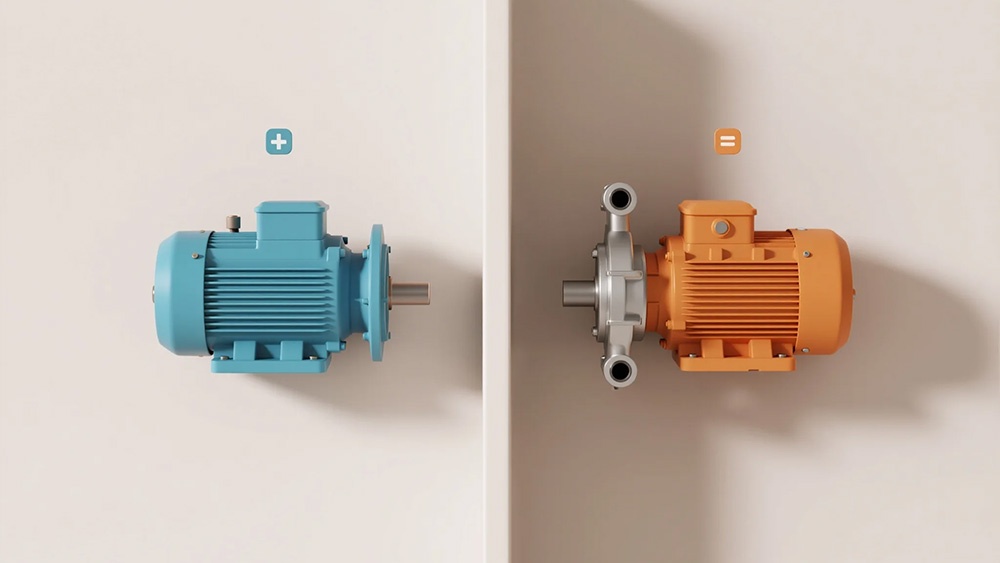
Choose a Permanent Magnet Motor if your application requires:
- Maximum Energy Savings: Pumps, fans, and compressors that run continuously.
- Compact Size and Light Weight: Electric vehicles, drones, robotics, and handheld tools.
- High Precision Control: CNC machinery, servo drives, and high-dynamic industrial automation.
Choose an Induction Motor if your priorities are:
- Lowest Initial Cost: Price-sensitive projects with lower operating hours.
- Extreme Ruggedness and Simplicity: Hostile environments with high temperatures, vibration, or contamination (e.g., mining, heavy-duty conveyors).
- Proven Reliability with Simple Control: Applications where basic variable speed is sufficient, and the robustness of a simple design is paramount.
Expert Motor Manufacturing for Both Technologies
At Greensky Power, we don’t just sell motors; we provide engineering solutions. Our expertise spans both high-efficiency Permanent Magnet motors for applications like E-bikes, precision automation, and high-efficiency HVAC systems, and robust, cost-effective Induction motors for industrial pumps, fans, and heavy machinery.
We understand that the “best” motor is the one that optimally balances performance, cost, and reliability for your specific use case. Our technical team is equipped to help you navigate this decision, offering both standard and customized solutions for either technology.
Make the Optimal Choice with Confidence
Still Unsure Which Technology is Best for Your Application?
Our engineering team is ready to analyze your requirements for torque, speed, duty cycle, and cost constraints. Get a data-backed recommendation tailored to your project.
