

What is Helical Gearbox: An Engineering Overview
Quick Answer
A helical gearbox is a speed reducer whose gears have teeth cut at an angle to the shaft axis, the helix angle, typically 15° to 30°, rather than straight across as on a spur gear. Because the angled teeth enter the mesh gradually instead of all at once, several tooth pairs carry the load at any instant. The overlap is worth 8–14 dB less noise and about 30–50% more allowable torque than a spur unit of the same size, but it also creates axial thrust, roughly 27% of the tangential force at 15° and 58% at 30°, all of which the thrust bearings have to absorb. A single precision helical mesh reaches 98–99.5% efficiency; a complete enclosed unit usually delivers 95–98%.
- What Is a Helical Gearbox?
- How a Helical Gearbox Works
- Helical Gearbox Types Compared
- Engineering Data: Efficiency, Speed & Load Capacity
- Best Applications
- How to Select a Helical Gearbox (with Worked Example)
- Common Engineering Mistakes
- Troubleshooting
- Why Choose Greensky Power
- Related Resources
- References
- FAQ
What Is a Helical Gearbox?
A helical gearbox is a mechanical power-transmission device built around helical gears: cylindrical gears whose teeth are cut on a helix rather than parallel to the shaft. Its job is to reduce rotational speed and multiply torque. Fitted between a prime mover and a driven machine, it turns the high-speed, low-torque output of an electric motor into the slow, high-torque motion that conveyors, extruders, mixers and cranes actually need. The reduction principle is the same as in any speed reducer. What sets the helical design apart is the tooth geometry, and the smooth, quiet engagement that geometry produces.

Central to all of it is the helix angle (ψ), measured between a tooth and the gear axis. General industrial units cluster between 15° and 30°, and 20° is the usual default for inline reducers. The helix angle governs the overlap ratio, the axial thrust, the noise signature and the way load is shared, which makes it the most influential single number in the whole box. Raise it and the mesh runs smoother and quieter, at the cost of more thrust on the bearings; the trade-off is quantified in the engineering data section below.
Gearbox vs. Gear Motor
A bare helical gearbox, also called a helical gear reducer or gear unit, is the reduction stage on its own. It is specified by ratio, rated torque and mounting, and then coupled to whichever motor the integrator selects. A helical gear motor arrives from the factory as motor, pinion and gearbox already assembled and aligned to a defined concentricity. Anyone weighing a gearbox against a gear motor is really choosing between two ways of working. The integrated unit removes field-assembly error, which is why OEM production normally specifies it, while a separate gearbox lets you keep an existing motor. Where one stage cannot reach the target ratio, two or three are stacked; the range of speed-reducer types and their ratio limits are covered in a companion guide.
How a Helical Gearbox Works
The principle is mechanical gear reduction, with the helix deciding how the teeth meet. Speed comes down, torque goes up, and because the contact is progressive instead of instantaneous, the transfer is smoother and quieter than through a spur mesh of the same size.
The Speed–Torque Trade
An ideal reducer delivers output torque equal to input torque multiplied by the ratio. Real units give some of it back to mesh friction, bearing drag and lubricant churning, which is what the efficiency term η accounts for:
Tout = Tin × i × η and nout = nin / i
where i is the reduction ratio, Tin the motor torque and η the gearbox efficiency. A helical mesh works mainly in rolling contact, so its efficiency stays high and, unusually among gear types, holds almost flat across the ratio range. A helical unit therefore keeps 95–98% from low ratios through to high, whereas a worm gear reducer of the same ratio may drop to 40–60%.
Helix Angle and Axial Thrust
Angled teeth also push the shaft sideways, a force called axial thrust. It scales with the tangent of the helix angle:
Fa = Ft × tan(ψ)
where Ft is the tangential (useful) load and ψ the helix angle. At 15° the thrust reaches about 27% of the useful force; at 20°, 36%; at 30°, 58%. Single-helical reducers therefore stay on moderate angles, and bearing selection has to be settled early rather than dealt with afterwards. Ignore the thrust and thrust-bearing failure is a predictable outcome. Double-helical, or herringbone, gears remove the problem by opposing two helices on the same gear; the price is roughly 1.5–2.5× the manufacturing cost of an equivalent single-helical gear.
Contact Ratio and Load Sharing
Spur teeth engage along their full width at once, which puts the contact ratio at roughly 1.2–1.6 and leaves only about one tooth pair carrying load at the pitch point. Helical teeth come in progressively and lift the contact ratio to 1.8–2.4. More teeth share the load at the same moment, peak contact stress falls, and the same gear size transmits more torque. No change of material is involved: the extra capacity comes from load sharing alone.
Helical Gearbox Types Compared
Helical gearing rarely travels alone. To hit a target ratio and a given shaft layout, it gets combined with spur, bevel, worm or planetary stages. The configurations an OEM is most likely to specify are compared below.
| Configuration | Tooth contact | Efficiency / stage | Noise vs. spur | Axial thrust | Typical ratio range |
|---|---|---|---|---|---|
| Spur | Line, simultaneous | 98–99.5% | Baseline | None | 1:1 to 6:1 per stage |
| Single helical | Progressive, overlapping | 98–99.5% | 8–14 dB lower | Present (tan ψ) | up to 10:1 per stage |
| Double helical / herringbone | Progressive, opposed | 98–99.5% | 8–14 dB lower | Cancelled | up to 10:1 per stage |
| Helical-bevel | Progressive + bevel | 92–97% (unit) | Low | Right-angle output | up to 200:1 (3-stage) |
| Helical-worm | Progressive + sliding | 50–90% (unit) | Low | Right-angle output | up to 300:1 compact |
| Planetary | Multiple planet teeth | 96–98% per stage | Low | Balanced (radial) | 3:1 to 10:1 per stage |
In practice, single-helical stages suit parallel-shaft inline drives, helical-bevel is the choice when the drive has to turn 90° while keeping helical efficiency, and a worm or cycloidal reducer earns its place only when self-locking or a very high compact ratio matters more than the efficiency loss. For coaxial, high-torque duty, a planetary gearbox competes directly with a multi-stage helical unit, so the planetary types are worth comparing before the architecture is fixed.
Engineering Data: Efficiency, Speed & Load Capacity
Catalogue headline efficiency hides the fact that losses multiply from stage to stage. Overall efficiency falls as stages are added, which is why a 3-stage 94% unit runs measurably hotter than a 2-stage 96% unit at the same output power.
| Configuration | Stages | Per-stage efficiency | Overall efficiency | Typical heat penalty |
|---|---|---|---|---|
| Single helical inline | 1 | 98–99.5% | ~98% | Lowest |
| Single helical inline | 2 | 98% | ~96% | Low |
| Single helical inline | 3 | 98% | ~94% | Moderate |
| Helical-bevel | 2–3 | 97–98% | 92–97% | Moderate |
| Helical-worm | 2 (helical + worm) | Worm stage 40–80% | 50–90% | Highest |
The helix angle itself is a compromise, and the table below puts numbers on both sides of it.
| Helix angle ψ | Axial thrust / tangential force | Noise vs. spur | Practical use |
|---|---|---|---|
| 8–12° | ~14–21% | Moderate reduction | Thrust-sensitive single helical |
| 15° | ~27% | 8–10 dB lower | General industrial inline |
| 20° | ~36% | 8–12 dB lower | Common helical reducer default |
| 30° | ~58% | Marginal extra gain | Double helical only (thrust cancels) |
Thermal Limits, Hardening and Duty
Under continuous S1 duty, temperature rise tracks power loss (Ploss = Pin × (1 − η)). A low-efficiency configuration therefore heats faster and may need an oil cooler or a larger frame. Industrial helical gears are normally case-carburised to about 58–62 HRC on the flank and then ground or honed; the hard surface resists pitting and reduces transmission error. Load rating is checked against two independent failure modes, surface pitting (contact stress) and tooth-root bending fatigue, per ISO 6336 or ANSI/AGMA 2101. Both checks have to pass at the applied service factor, and the average torque alone is not enough to clear them.
Best Applications
Helical gearboxes get chosen wherever a drive has to be quiet and torque-dense at the same time. The four application families that have anchored this range for helical gear reducers still hold, and a fifth has grown up alongside them.
Heavy industry is the classic home. Belt conveyors, crushers, extruders and mixers lean on the load-sharing capacity of helical teeth to survive shock loads, and automated versions of those conveyors follow the same drive logic into materials-handling equipment and packaging lines. Automotive and EV drivetrains come next, where compact helical and helical-bevel units change motor speed with little noise and near-constant efficiency across the ratio range, which is what suits electric-vehicle traction.
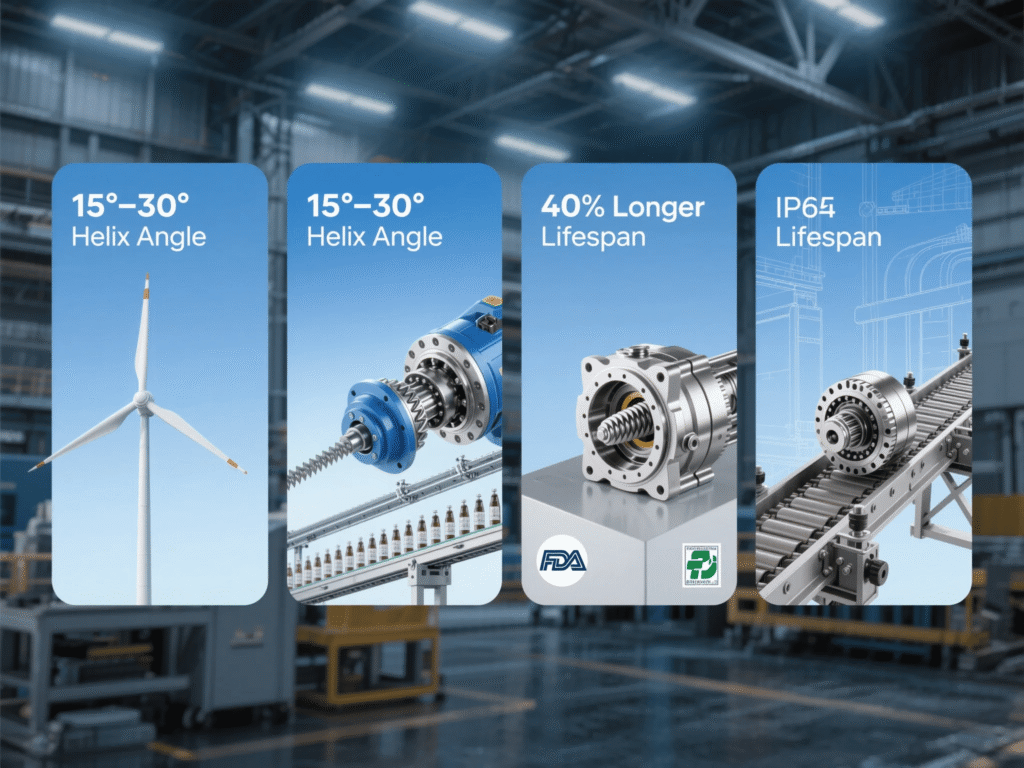
Renewable energy is the case that punishes a loose specification. Wind-turbine pitch and yaw drives have to hold precision under variable, reversing loads, so tooth-flank quality and backlash control matter more there than raw ratio does; the industrial fan and blower case follows a similar airflow-side selection logic. Food and pharmaceutical processing lives on something different again, namely stainless-steel, washdown-rated housings that keep helical units hygienic on bottling and filling lines, with the smooth mesh cutting the vibration that would otherwise shake product on a high-speed line.
Robotics and automation round out the list. Wrist joints and linear axes pair helical or planetary stages to get quiet, repeatable motion, the same requirement that makes robotic arms need speed reducers at every joint.
How to Select a Helical Gearbox (with Worked Example)
Selection goes wrong most often at the first step, choosing a service factor, so it is worth walking through with real numbers.

Selection Checklist
- Define the load. Required output torque
Treqand output speednout; output powerPout = (Treq × nout) / 9550. - Apply the service factor. Take
KAfrom ISO 6336-1 or AGMA according to power source and driven-machine character. Add about 10% above 10 h/day, +0.25 for direct-on-line (DOL) motor start and +0.2 for a diesel prime mover. ThenTselect = Treq × KA. - Pick the ratio.
i = nin / nout, then round up to the nearest standard ratio. - Size the frame. Choose the unit whose rated output torque at the given output speed is ≥
Tselect. Motor kW should not enter this decision. - Verify the motor.
Tin = Tselect / (i × η), then confirm the motor delivers it at rated, or starting, current. - Check thermals and mounting. Continuous S1 needs thermal headroom, and a vertical mount needs an oil seal to stop leakage. Confirm the output shaft radial and axial load limits.
- Set backlash and noise targets. Specify arc-minutes and dB as measurable figures rather than asking for “quiet” and “precise”. Ask for documented L10 life.
The general methodology that applies at any reducer size is set out in the speed-reducer motor selection guide, and the underlying torque relation in the motor torque calculation reference.
Worked Example: Conveyor Drive Sizing
Requirement: a belt conveyor needs Treq = 400 N·m at nout = 60 rpm, running 16 h/day. The motor is a 4 kW cage induction unit at nin = 1450 rpm, started direct-on-line. A 2-stage single-helical gearbox is proposed (η = 0.96).
| Step | Calculation | Result |
|---|---|---|
| Output power | (400 × 60) / 9550 | 2.51 kW |
| Service factor KA | moderate shock, 16 h/day, DOL start | 1.5 |
| Selection torque | 400 × 1.5 | 600 N·m |
| Ratio | 1450 / 60 → standard 25:1 | 25:1 |
| Actual output speed | 1450 / 25 | 58 rpm |
| Required motor torque | 600 / (25 × 0.96) | 25.0 N·m |
| Motor power needed | (25.0 × 1450) / 9550 | 3.80 kW → 4 kW motor OK |
The 25:1 unit lands at 58 rpm, within 3% of target, and a 4 kW motor covers the 3.8 kW requirement with margin. What the catalogue has to show is the gearbox rating: at least 600 N·m continuous at 58 rpm. The motor nameplate is not the number that matters here.
Common Engineering Mistakes
- Treating a DOL motor as a uniform load is the most common service-factor error, and it halves tooth-bending life without warning.
- Specifying a 30° single-helical mesh without thrust bearings ignores the axial thrust, overloads the radial bearings and shortens their life.
- Sizing on motor kW rather than output torque is the other frequent slip: a gearbox is a torque device, so the catalogue rating has to be compared at the actual output speed.
- Over-ratioing costs about 2% efficiency and a longer housing, with nothing gained once the speed target is met.
- Self-locking is tempting, but a worm unit running at 40–60% can double the input power of the equivalent helical drive.
- Running continuously at 100% load under S1 duty softens grease and can seize a low-efficiency unit, so size for the thermal ceiling.
- A vertical mount fitted without an oil seal lets lubricant migrate past the seal and starve the upper bearings.
- “Low noise” and “high precision” mean nothing without dB(A) and arc-minute figures.
Troubleshooting
Most field complaints come down to a handful of causes, and the table below pairs each symptom with the cause to check first and the fix that usually settles it. Two of them, noise and overheating, are as likely to be a sizing error as a worn part, so read the cause column before ordering spares.
| Problem | Likely cause | Solution |
|---|---|---|
| Excessive noise | Worn or mis-ground teeth; running a spur unit in a noise-sensitive area; wrong helix default | Check tooth quality to ISO 1328; switch to 20° helical; re-lubricate |
| Overheating | 3-stage low-efficiency unit in S1 duty; over-ratio; under-lubrication | Re-check efficiency and thermal rating; reduce to 2 stages; verify oil level |
| Thrust-bearing wear | High-helix single-helical mesh; wrong bearing type; overload | Reduce helix angle or specify double-helical; fit matched thrust bearings |
| Tooth pitting | Contact stress above rating; service factor too low | Re-rate with correct KA per ISO 6336; enlarge frame |
| Oil leakage at shaft | Vertical mount without proper seal; worn lip seal | Fit a suitable vertical-mount seal; replace the lip seal |
| Vibration / oil whirl | Misalignment; oil level too high at high pitch-line speed | Re-align to ≤0.05 mm; set oil to the level line; check mounting stiffness |
These are the common ones. Gear wear has several other root causes, and the eight causes of helical gearbox wear together with the gear-noise reduction guide take the diagnosis further.
Why Choose Greensky Power
Greensky Power is a China-based manufacturer of helical gear motors and custom electric motors serving industrial, automotive, renewable and food-processing OEMs worldwide. Our helical gearboxes pair two- and three-stage parallel-shaft designs with brushed DC, brushless DC and AC motors, and are quoted with documented torque ratings, service factors and L10 life rather than generic claims. We support OEM/ODM customisation across ratio, mounting, shaft, flange and brake, and our engineers work from your output torque, speed and duty cycle to specify the smallest ratio that meets the target with proper headroom.
Material and lubricant compatibility must be verified against the actual operating environment and duty cycle before final specification: temperature range, washdown chemistry and load profile all affect seal and lubricant selection.
Related Resources
- Gearbox overview (pillar page)
- Gearbox vs. gear motor — what is the difference?
- Different types of speed reducers
- How does a planetary gearbox work?
- Types of planetary gearbox
- NMRV worm gearbox selection
- What is a worm gear reducer?
- Bevel gearbox guide
- Cycloidal reducer explained
- Harmonic drive vs. planetary gear
- Speed-reducer motor selection guide
- How to calculate the torque of a motor
- How do I choose a gear reducer?
- The 8 causes of helical gearbox wear
- How to reduce gear noise in a gear reducer
- Gear motor manufacturers and suppliers in China
- Electric motor basics
- Brushless DC motor
References
- ANSI/AGMA 2101-E25: Fundamental rating factors and calculation methods for involute spur and helical gear teeth (macropitting and bending strength). agma.org
- ANSI/AGMA 6000-C22: Design manual for enclosed gear drives. agma.org/standards
- ISO 6336-1:2019: Calculation of load capacity of spur and helical gears, Part 1: basic principles, influence factors (application factor KA). iso.org/standards
- ISO 1328-1: Cylindrical gears, ISO system of flank tolerance classification (gear accuracy grades). iso.org/standard/63811
- IEC 60034-1:2022: Rotating electrical machines, rating and performance (insulation and temperature classes). webstore.iec.ch/en/publication/65446
- IEC 60034-30-1: Efficiency classes of line-operated AC motors (IE1–IE4). webstore.iec.ch/publication/91195
- ANSI/NEMA MG 1-2021: Motors and generators standard. webstore.ansi.org/standards/nema/ansinemamg2021
- NEMA: Motor and generator product resources. nema.org/products/pages/motor-and-generator.aspx
- U.S. Department of Energy: Motor load and efficiency reference. energy.gov motor systems tip sheet
- International Energy Agency: Electric motors and energy efficiency. iea.org/energy-system/industry/electric-motors
- SKF: Bearing failures and their causes. skf.com/group/support/bearing-failures-and-their-causes
- Siemens: SIMOTICS electric motors. siemens.com/global/en/products/drives/electric-motors
- maxon: EC motor and gearhead technology. maxongroup.com/maxon/view/content/ec-technology
- FAULHABER: Drive-system know-how. faulhaber.com/en/know-how
Technical content reviewed by Greensky Power applications engineering. Figures are typical industry ranges; final specification requires verification against the selected motor, duty cycle and operating environment.
FAQ
What is a helical gearbox used for?
A helical gearbox is used wherever a motor has to drive a slower, higher-torque load quietly and efficiently: belt conveyors, crushers, extruders, mixers, wind-turbine pitch drives, electric-vehicle drivetrains, food-processing lines and robotic joints. It reduces motor speed, multiplies torque and runs 8–14 dB quieter than an equivalent spur unit.
Helical or spur gearbox — which is better?
It comes down to noise, load and budget. A helical gearbox carries roughly 30–50% more torque at the same size and runs 8–14 dB quieter, but costs 30–40% more and needs thrust bearings to handle axial thrust. Spur suits low-speed, cost-sensitive drives; helical suits high-load or noise-sensitive ones. Meshing efficiency is nearly equal, 98–99% either way.
How do I calculate the axial thrust of a helical gearbox?
Axial thrust equals the tangential load times the tangent of the helix angle: Fa = Ft × tan(ψ). For a 20° helix the thrust is about 36% of the useful tangential force; at 15° it is about 27% and at 30° about 58%. Size the thrust bearings for this force; double-helical gears cancel it by opposing two helices on one gear.
What is the efficiency of a helical gearbox?
A single helical mesh reaches 98–99.5%. A complete enclosed unit is typically 95–98% for one or two inline stages, falling to about 94% for three stages and 92–97% for a helical-bevel unit. Unlike a worm drive, helical efficiency stays high and barely changes with the reduction ratio.
Can a helical gearbox be mounted vertically?
Yes, but a vertical mount needs an oil seal designed for that orientation, otherwise lubricant migrates past the shaft seal and starves the upper bearings. Confirm the mounting position with the supplier, verify the lubricant level for vertical duty, and check that the output shaft radial and axial load limits are respected.
What service factor should I use for a helical gearbox?
Use KA = 1.0–1.25 for uniform loads such as a light fan, 1.25–1.5 for moderate shock such as a loaded conveyor, and 1.75–2.5 for heavy shock such as a crusher. Add about 10% above 10 hours a day and +0.25 if the motor starts direct-on-line. Then select a unit rated for the required torque multiplied by KA.
