

Top 10 Stepper Motor Companies in the World (2026)
Quick Answer
No auditable public ranking of stepper motor companies exists: stepper revenue is never reported separately inside the groups that make them. Documented catalogue range and specification depth can be compared, so that is what this list uses, and the numbering is a reading order, not a league table. The ten names span miniature PM steppers from Nagano, hybrid ranges from Japan and China, linear-actuator assemblies from the United States and automotive steppers from Switzerland. Use it to shortlist three suppliers, then run their datasheets through the six checks in the datasheet section.
- How this list was built, and what it leaves out
- What changed in this version
- The ten companies at a glance
- The ten companies, one by one
- Matching the company to the machine
- Reading a stepper datasheet: six lines that separate suppliers
- What to put in the RFQ
- Where the Chinese supply base fits
- Five mistakes buyers make
- Why Greensky Power
- References
- FAQ
How This List Was Built, and What It Leaves Out
Most “top stepper motor company” lists are assembled from press releases and a search engine. They rank names by how often the name appears, add a paragraph of “significant market share” for each, and leave the reader no closer to knowing who can actually wind the motor they need.
This list is built the other way round. Each entry is described by what the company documents publicly: which frame sizes it lists, which step angles, whether it supports unipolar or bipolar windings, and whether it publishes torque-speed curves with the drive conditions attached. A buyer can check all of it, and it is what predicts whether a quotation will survive contact with the machine.
Three criteria decided inclusion, and anyone reading this page can check all three. A company needed a documented stepper range: frame sizes, step angles, phase count, winding options and a stated holding-torque span. It also needed documentation deep enough to publish torque-speed curves with the driver voltage, current setting and microstep attached, and to state tolerances where a weaker catalogue would say “typical”. The third criterion was application coverage, meaning the equipment families in which the supplier is routinely designed in.
Revenue and unit volume were left out on purpose. None of these companies discloses stepper revenue as a line item, and the few trade-press estimates that circulate cannot be reconciled with each other. Market-share percentages go the same way: a percentage with no denominator and no source is a rhetorical device, not a fact.
Size and fit come apart here. A company can be enormous and still be a poor fit for a 42 mm hybrid at 0.4 N·m, and a small company can be the best source for exactly that frame. The order groups similar companies near each other; it does not claim that number three is better than number seven. For the country-level picture of motor manufacturing, which is a different question, our review of the seven motor manufacturing powers covers it.
What Changed in This Version
This page was last revised in March 2025 and carried a “2025” label in the title. Three corrections were made in this edition, and they are recorded here instead of being quietly edited away, because a list that hides its errors is worth less than one that shows them.
Entry ten was mislabelled. The tenth company was headed “SIEMENS” with a Munich address, but the link on the entry pointed to Topband, a Shenzhen motor and controls group. One of the two was wrong, and the link is the harder thing to fake, so the entry now names Topband and describes what that company actually documents. Siemens’ motor catalogue is built around servo, asynchronous and linear machines, with no stepper range of its own, which is consistent with the entry having been a copy error.
Entry four pointed at the wrong Nidec entity. The address given was the St. Louis headquarters of Nidec Motor Corporation, the North American industrial motor business. Nidec’s stepping motor range sits in Nidec Advanced Motor, formerly Nidec Servo, in Japan, and the series names below are taken from that catalogue.
Unsourced market claims were removed. The previous version stated a global market size and used the phrase “market share” six times across ten entries, none of it referenced. Those sentences are gone, replaced with what each company publishes.
The Ten Companies at a Glance
The table compresses the section that follows into one screen. If you are shortlisting, read the last column first: it names the situation in which each supplier is the natural enquiry and not merely the reflex one.
| Company | Base | Documented stepper range | Where it is the natural enquiry |
|---|---|---|---|
| 1. Aspina (Shinano Kenshi) | Nagano, Japan | Small PM steppers and brushless motors for office, medical and appliance drives | Miniature, quiet, long-life mechanisms |
| 2. MinebeaMitsumi | Nagano, Japan | Miniature PM and hybrid motors, with in-house bearings and magnets | High-volume small motors where bearing supply matters |
| 3. Moons’ Industries | Shanghai, China | Steppers, drives, integrated motors, BLDC and servo under one catalogue | Motor, drive and controller from one source |
| 4. Nidec Advanced Motor | Japan | KH / KV / KF / KT series, 28–86 mm, 59 mN·m to 9.3 N·m | Wide frame coverage with connector options |
| 5. Sanyo Denki | Tokyo, Japan | Stepping motors alongside servo and cooling fans | Machines already standardised on the brand |
| 6. Oriental Motor | Tokyo, Japan | αSTEP closed loop, 2-phase and 5-phase, 13–90 mm, 0.36° to 1.8° | One catalogue for motor, driver and network control |
| 7. Tamagawa Seiki | Nagano, Japan | Step motors and drivers, 20 mm flange upward, 2- and 5-phase | Instrumentation where sensors come from the same house |
| 8. AMETEK Haydon Kerk Pittman | Connecticut, USA | Hybrid rotary steppers Size 8–23, stepper-based linear actuators, lead screws | Linear motion and lab or medical instruments |
| 9. Sonceboz | Switzerland | Stepper motors and mechatronic actuators for automotive instrument clusters | Automotive-scale programmes with PPAP expectations |
| 10. Topband | Shenzhen, China | Stepper among BLDC, coreless and servo motor platforms | High-volume appliance, tool and robotics modules |
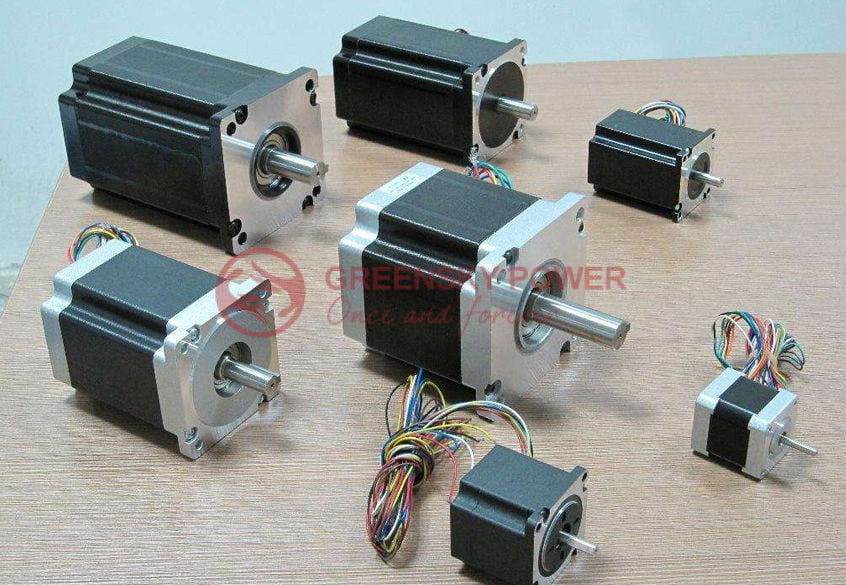
The Ten Companies, One by One
Each entry covers the same ground: what the company is, what it documents for steppers, and where it stops being the right answer. The last part matters most, because every supplier on this page is competent at something and none is competent at everything.
1. Aspina (Shinano Kenshi) · Nagano, Japan
A century-old Japanese group, founded in 1918, organised into drive systems and precision motors, industrial solutions, and assistive technology. Its stepper presence is in small permanent-magnet motors for office equipment, medical pumps and appliance actuators, where what matters is quiet running and long service life, not high torque in a NEMA 23 frame.
Where it stops: if the axis needs a 57 mm hybrid at 1 N·m or more, this is not the catalogue. Where it wins is the mechanism nobody wants to hear: a document feeder, a peristaltic pump head, a louvre actuator. The corporate site is us.aspina-group.com.
2. MinebeaMitsumi · Nagano, Japan
An integrated parts manufacturer whose advantage is vertical: it makes the miniature ball bearings, the magnets and the windings that go into its own motors. That matters more than it sounds, because bearing quality and bearing supply are the two failure modes that quietly decide whether a small-motor programme ships on time.
Its stepper documentation concentrates on miniature PM and small hybrid motors for office automation, automotive sub-assemblies and appliances. Where it stops: large frames and high holding torque are not the centre of the catalogue. For buyers, the useful question is whether the volume justifies the tooling a group of this size prefers, because below that threshold a smaller specialist is easier to work with.
3. Moons’ Industries · Shanghai, China
Founded in 1994, Moons’ is the clearest example of a supplier that sells a stack rather than a part: stepper motors, stepper drives, integrated motors, brushless motors, servo drives and the control products around them. For a machine builder, that means one supplier can answer a question about the motor, the driver voltage and the current setting at the same time.
Its stepper range covers the standard hybrid frames with a broad choice of windings, and the company holds ISO 9001 and ISO 14001 certification according to its own documentation. Where it stops: agency approvals and documentation packages for medical or automotive programmes need to be confirmed project by project; they cannot be assumed. It is a strong first call for factory automation and laboratory equipment.
4. Nidec Advanced Motor (formerly Nidec Servo) · Japan
The stepping motor range sits in the Nidec group’s servo and stepping business, and it is unusually well documented. The catalogue lists 2-phase 1.8° types in 28, 39, 42, 56, 60 and 86 mm frames, 3-phase types at 0.6° and 1.2° in 35, 42 and 60 mm, holding torque from 59 mN·m in the smallest 39 mm frame up to 9.3 N·m in bipolar mode on the 86 mm frame, with both unipolar and bipolar winding options and a choice of lead-wire or connector termination.
That breadth is the reason it appears here: few suppliers publish a single table that runs from a 20 mm-class motor to a 9 N·m frame. Where it stops: for a single frame size at commodity volume, a specialist will usually be cheaper. The range is published at nidec-advancedmotor.com.
5. Sanyo Denki · Tokyo, Japan
Motors, cooling fans and power systems, with stepping motors inside a portfolio built around servo drives and thermal management. For a machine builder already using the brand’s fans or servo amplifiers, the stepper line is a consolidation decision as much as a technical one: one supplier, one documentation format, one qualification file.
Where it stops: steppers are one line among several, so a requirement that needs unusual windings or a bespoke shaft may move slowly. Where it wins is the machine with several axes where the stepper is the simple one and the rest of the panel is already decided. Buyers should ask specifically for the torque-speed curve at the driver voltage they will use, because the published curve is often drawn at the supplier’s own driver.
6. Oriental Motor · Tokyo, Japan
The most stepper-centred catalogue of the ten. It documents αSTEP closed-loop steppers, 2-phase and 5-phase motors from 13 mm to 90 mm frames (NEMA 5 to NEMA 34), basic step angles of 0.36°, 0.72°, 0.9° and 1.8°, geared, encoder and electromagnetic brake options, vacuum-rated variants, and drivers in AC or DC input form with pulse, built-in controller, EtherNet/IP, EtherCAT and PROFINET versions.
The closed-loop variant is the part worth understanding: it runs as a stepper, then corrects position when the load moves faster than the command, and it can report a positioning-complete or alarm signal. Where it stops: the price reflects the documentation and the driver ecosystem, so a single open-loop axis at commodity volume is over-specified by this route. Catalogue: orientalmotor.com.
7. Tamagawa Seiki · Nagano, Japan
Better known for resolvers, rotary encoders, gyros and servo motors, Tamagawa also maintains a Step Motors and Drivers product category, with open-loop positioning from a 20 mm flange upward in both 2-phase and 5-phase types. Its own documentation frames the step motor plainly: rotation is set by pulse count, speed by pulse rate, and holding torque is what keeps the axis still while energised.
Where it wins is the instrument or robot joint where the resolver, the encoder and the motor come from one supplier and share one qualification. Where it stops: distribution outside Japan runs through partners, so lead time and local support need checking before the design freeze, not after it. Site: tamagawa-seiki.com.
8. AMETEK Haydon Kerk Pittman · Connecticut, United States
Three AMETEK brands under one motion business: Haydon, Kerk and Pittman. The stepper relevance is linear motion, where a stepper motor drives a lead screw through an anti-backlash nut, and the catalogue covers hybrid rotary steppers from Size 8 (21 mm) to Size 23 (57 mm) in single or double stack, alongside stepper-based linear actuators.
Where it wins is the laboratory or medical instrument where the axis is a syringe, a slide or a valve, not a rotating shaft, and where the anti-backlash nut and the lead screw are part of the specification. Where it stops: above a 57 mm frame or for a plain rotary axis, a hybrid specialist is the shorter path. Site: haydonkerkpittman.com.
9. Sonceboz · Sonceboz-Sombeval, Switzerland
A Swiss motion specialist whose stepper business is built around automotive instrument clusters and mechatronic actuators. That is a demanding niche in a specific way: the volumes are large, the qualification is formal, and the failure that matters is not a loss of torque but a needle that reads wrong at minus thirty degrees.
Where it wins is any programme that arrives with a PPAP expectation attached and a ten-year service requirement. Where it stops: this is not a general industrial catalogue, and a buyer looking for a stocked 42 mm hybrid in small quantities is in the wrong shop. Site: sonceboz.com.
10. Topband · Shenzhen, China
Shenzhen Topband was founded in 1996 and listed on the Shenzhen Stock Exchange in 2007; its motor division followed in 2007, and the group’s motor platforms now span brushless, coreless, stepper and servo types alongside controllers and gearboxes. The stepper sits inside a mechatronic offer; it is not the centre of it.
That is the honest characterisation, and it is also the reason the entry is worth keeping: for an appliance, power-tool or robotics programme where the stepper is one part of a module, a supplier that also builds the controller and the gearbox can take cost out of the assembly. Where it stops: the public catalogue emphasises brushless and coreless motors, so stepper depth, winding options and approvals must be confirmed for each project; treat the catalogue as a starting point only. Site: topband.com.cn.
Matching the Company to the Machine
Shortlists get shorter when the duty is named first. The table maps the six duties that come up most often onto the type of supplier that suits them, which is usually more useful than starting from the company list.
| Duty | Supplier type that fits | Why |
|---|---|---|
| Single axis, 42–86 mm hybrid, 0.2–3 N·m | Hybrid specialist or a large catalogue house | The frames are standard; the differentiator is winding choice and curve documentation |
| Closed-loop stepper replacing a servo | Supplier with an integrated closed-loop system | The loop lives in the driver, so motor and driver must come from one design |
| Miniature axis in a handheld or desktop device | PM stepper specialist, 20–42 mm | Bearing quality and acoustic behaviour dominate at this size |
| Linear axis with a lead screw | Linear-motion assembly supplier | Nut, screw and motor are specified together or not at all |
| Volume appliance or tool module | Mechatronic module supplier | Controller, gearbox and motor are costed as one assembly |
| Automotive or medical programme | Supplier with formal qualification experience | PPAP, change notification and traceability are the deliverable, not the motor |
A closed-loop stepper is still not a servo, and buying one does not remove the need to size the axis; the trade is set out in our comparison of servo and stepper motors and in the note on what an integrated stepper motor actually is. A gearbox also changes the duty more than a different supplier does, so the ratio usually gets decided before the vendor: see choosing a stepper motor gearbox.
Applications pull the choice further. A 3D printer axis wants low inductance and a documented microstep response, not raw holding torque, as set out in stepper motors for 3D printing; a robot joint wants torque density and a brake, covered in high torque stepper motors for robotics. The generic procedure, if the duty is not yet pinned down, is in the stepper motor selection guide.
Reading a Stepper Datasheet: Six Lines That Separate Suppliers
Most supplier comparisons fail before price is discussed, because the two datasheets cannot be compared. One quotes holding torque at 2 A unipolar, the other at 2 A bipolar; one shows a torque-speed curve at 24 V, the other at 48 V; one states step angle accuracy, the other states a typical value. Six lines decide whether the numbers mean the same thing. How the motor produces torque in the first place is covered in how stepper motors work.
| Line | What an honest datasheet states | What a thin one hides |
|---|---|---|
| Holding torque | The current, the drive mode (unipolar or bipolar) and how many phases are energised | A single figure with no mode, which can flatter the motor by 30–40% |
| Torque-speed curve | Driver voltage, current setting, microstep and coupling method | A curve from the supplier’s own driver, unusable with yours |
| Step angle accuracy | ±5% of one full step, non-cumulative, with the measurement basis | A resolution figure for microstepping passed off as accuracy |
| Thermal data | Temperature rise at a stated current, insulation class and ambient | A class letter with no rise figure, and no ambient assumption |
| Ingress and sealing | An IP rating to IEC 60034-5, and whether the shaft seal is included | “Suitable for harsh environments” with no code |
| Shaft loading | Permitted axial and radial load, and the distance from the mounting face | Silence, which is how belt tension destroys front bearings |
Most specifications diverge quietly on holding torque. A bipolar rating and a unipolar rating of the same motor are not the same number, and a supplier who quotes whichever is higher without saying which it is has not lied, but has made the comparison impossible. Ask for both, or ask for the winding diagram.
Once the supplier is talking, standards settle the rest of the comparison. Insulation class and temperature rise are defined in IEC 60034-1 [1], and enclosure ratings follow the IP code in IEC 60034-5 [2]. What does not apply matters too: IEC 60034-30-1, the IE efficiency classification, covers single-speed line-operated AC motors and explicitly excludes machines with mechanical commutators and compact drives that cannot be tested separately [4]. A stepper therefore has no IE class, and a supplier who claims one is describing the wrong standard. Noise limits behave the same way: IEC 60034-9 covers network-supplied machines from 1 kW upward, so a 42 mm stepper sits outside it [3] and must be specified by measurement, not by grade.
What to Put in the RFQ
The enquiry that gets a useful answer is short and specific. These ten items cover it, and each is included because leaving it out produces a quotation that cannot be used.
| Item | Why the supplier needs it |
|---|---|
| Working point: speed and torque together | A torque alone does not define the winding; the same frame behaves differently at 120 and 900 rpm |
| Driver voltage, current setting and microstep | Sets the torque-speed curve the supplier must meet |
| Winding preference or the drive mode available | Unipolar and bipolar need different windings and different lead counts |
| Frame size, shaft and mounting interface | Where late changes come from; a 5 mm shaft with a flat is not a default |
| Load inertia and the transmission ratio | Decides whether the motor or the gearbox is the limiting element |
| Duty cycle, including holding time | A stepper dissipates full copper loss while standing still |
| Ambient temperature, mounting surface and IP requirement | Thermal resistance and ingress protection both depend on installation |
| Lead wire or connector, length and flex requirement | Connector choice often decides the achievable IP rating |
| Approvals and documentation for the target market | Changes insulation, creepage, marking and the test plan |
| Annual volume and tooling responsibility | Sets whether a custom lamination or a standard frame is the economic answer |
The first two rows carry the most weight. A supplier who receives only a torque will quote the smallest motor that produces it on paper, and that motor will be chosen at standstill, which is the one condition the machine rarely uses. Send the speed-torque point and the drive conditions, and the reply can be checked against a curve.
Where the Chinese Supply Base Fits
Six of the ten entries above are in Japan, two in China, one in Switzerland and one in the United States, which reflects where stepper engineering has historically concentrated, not where steppers are made in volume. The volume is in China, and pretending otherwise makes the list less useful than it should be.
What the Chinese base offers is cost, tooling flexibility and lead time, and on standard hybrid frames the engineering quality is often indistinguishable from a Japanese motor of the same specification. What varies far more is documentation: torque-speed curves drawn at an unstated voltage, holding torque quoted without the drive mode, and a first-article report that consists of a photograph of the label. The supply base is not the problem; the variance between individual factories is. Our overview of Chinese stepper motors covers the landscape, and the OEM route for custom windings and shafts is described under OEM hybrid stepper motor manufacturing.
| Check on a Chinese supplier | What to ask for | Red flag |
|---|---|---|
| Winding consistency between lots | Resistance and inductance per phase on the first-article report, with lot numbers | “Typical values” only, no per-lot data |
| Magnet grade and source | The grade family and the maximum operating temperature | A torque figure with no magnet grade anywhere |
| Bearing specification | Bearing maker and clearance class | “High quality bearing” |
| Thermal test basis | Temperature rise at a stated current and ambient | Insulation class quoted alone |
| Change notification | A named process owner and a written PCN procedure | No answer to the question |
Where the buying route matters more than the factory, the pattern repeats: distributors add stock and local support but not engineering, and the economics differ by region. The trade-offs for stock-and-support buying are set out in our note on stepper motor distributors, and the volume-tier pricing structure in wholesale stepper motors. For European programmes with a compliance file to build, the requirements are collected under standards-compliant European stepper motors.
Five Mistakes Buyers Make
- Ranking suppliers by brand recognition. Brand predicts documentation quality and supply stability reasonably well, and predicts the motor in the box poorly. The same frame can come from three factories under three labels.
- Comparing holding torque across datasheets. Unipolar and bipolar ratings of the same motor differ, and a single figure with no drive mode is not a specification. Ask for both, or for the winding diagram.
- Ignoring the standstill loss. A stepper draws its set current while holding position, so a duty cycle calculated from motion time alone understates the heat. The thermal consequence is a motor that passes on the bench and derates on the machine.
- Accepting a curve drawn on the supplier’s driver. A torque-speed curve is only transferable if the voltage, current and microstep match your drive. Otherwise it describes a system you are not buying.
- Buying samples from the sample room. A hand-built sample proves the design exists, not that the line can hold it. Order ten from production, measure step angle, holding torque and no-load current, and compare with the first-article report.
The fifth mistake is the expensive one, because it surfaces after tooling. Measuring ten production motors takes an afternoon and catches the two failures that matter: a winding that has drifted between lots and a step angle accuracy that was measured on a bench motor rather than a production one.
Why Greensky Power
We are not on the list above, and it would be dishonest to place ourselves in it. What we can do is the part the list cannot: answer a specification question with a number, a test method and a curve, in the frame you actually need.
Our stepper work covers 20 to 86 mm hybrid frames with custom windings, shaft and lead configurations, brakes and gearboxes, and the documentation that goes with them: per-lot resistance and inductance, a temperature-rise figure at a stated current, and a torque-speed curve drawn at the driver voltage you will use. The full range is on the stepper motor page, and the manufacturer profile is under stepper motor manufacturer.
If the shortlist above has three names on it, the useful next step is not a fourth quotation. It is a specification both suppliers must answer in the same terms, which is what the six datasheet lines and the ten RFQ items are for.
References
- International Electrotechnical Commission. (2026). IEC 60034-1:2026 — Rotating electrical machines, Part 1: Rating and performance. IEC. https://webstore.iec.ch/en/publication/89961
- International Electrotechnical Commission. (2020). IEC 60034-5:2020 — Rotating electrical machines, Part 5: Degrees of protection provided by the integral design of rotating electrical machines (IP code). IEC. https://webstore.iec.ch/en/publication/64224
- International Electrotechnical Commission. (2021). IEC 60034-9:2021 — Rotating electrical machines, Part 9: Noise limits. IEC. https://webstore.iec.ch/en/publication/66184
- International Electrotechnical Commission. (2025). IEC 60034-30-1:2025 — Rotating electrical machines, Part 30-1: Efficiency classes of line operated AC motors (IE code). IEC. https://webstore.iec.ch/en/publication/91195
- International Electrotechnical Commission. (2013). IEC 60529:1989+AMD2:2013 — Degrees of protection provided by enclosures (IP code). IEC. https://webstore.iec.ch/en/publication/2452
- International Electrotechnical Commission. (2022). IEC 61800-3:2022 — Adjustable speed electrical power drive systems, Part 3: EMC requirements and specific test methods for PDS and machine tools. IEC. https://webstore.iec.ch/en/publication/65056
- National Electrical Manufacturers Association. (2001). NEMA ICS 16:2001 — Industrial control and systems: motion/position control motors, controls, and feedback devices (includes errata, 2002). NEMA. https://webstore.ansi.org/standards/nema/nemaics162001
- Acarnley, P. P. (2002). Stepping motors: a guide to theory and practice (4th ed.). Institution of Engineering and Technology. https://doi.org/10.1049/PBCE063E
- Krishnan, R. (2010). Permanent magnet synchronous and brushless DC motor drives. CRC Press. https://doi.org/10.1201/9781420014235
- International Organization for Standardization. (2026). ISO 9001:2026 — Quality management systems, Requirements. ISO. https://www.iso.org/standard/9001
FAQ
Q: Which company is the largest stepper motor manufacturer?
There is no auditable public ranking. Stepper motors sit inside much larger motor and mechatronics businesses, and none of the major groups reports stepper revenue separately, so any single-number claim is an estimate rather than a disclosed figure. What can be compared is documented catalogue range, the depth of published specification data, and the applications where a supplier is routinely designed in.
Q: Are Japanese or Chinese stepper motor companies better?
Neither category is better in general; the split is by duty. Japanese and European suppliers publish detailed torque-speed curves, offer multi-phase and network-connected drivers, and carry approvals for medical and automotive programmes, at a price that reflects it. Chinese suppliers win on landed cost, tooling flexibility and lead time, and engineering quality varies far more between individual factories than between countries.
Q: What should I check in a stepper motor datasheet?
Six lines decide most of the comparison: the current and drive mode behind the holding-torque figure, the conditions behind any torque-speed curve, the step-angle accuracy statement, the temperature rise and insulation class, the IP rating, and the permitted shaft load. A datasheet that quotes holding torque without saying whether it is unipolar or bipolar cannot be used to compare two suppliers.
Q: Does a famous brand guarantee a better stepper motor?
No. Brand predicts documentation quality and supply stability far better than it predicts the motor in the box. Some well-known names sell rebadged motors for frames they do not wind themselves, and some small factories produce excellent motors for one specific frame. The reliable signal is a supplier who answers a specification question with a number, a test method and a curve.
Q: Why was Siemens removed from this list?
The previous version listed Siemens in tenth place but linked the entry to Topband’s website, which points to a copy error rather than a considered ranking. Siemens’ motor catalogue is built around servo, asynchronous and linear machines, with no stepper range of its own, while Topband does list stepper motors among its motor platforms. The entry now names Topband, and the correction is recorded on the page.
Q: How do I qualify a supplier I have not used before?
Ask for three things before price: a torque-speed curve with the driver voltage, current and microstep stated; a first-article report covering step angle, holding torque, insulation resistance and no-load current; and a named process owner for change notification. Then buy ten pieces from the production line and measure them. A supplier who resists any of those three is telling you something useful.
Greensky Power builds hybrid stepper motors in 20 to 86 mm frames with custom windings, shafts, brakes and gearboxes, and ships each lot with the data a buyer can check: per-lot resistance and inductance, a temperature rise at a stated current, and a torque-speed curve at your driver voltage. Send the working point and the drive conditions, and we will answer with a curve, not a slogan. Contact the engineering team.