
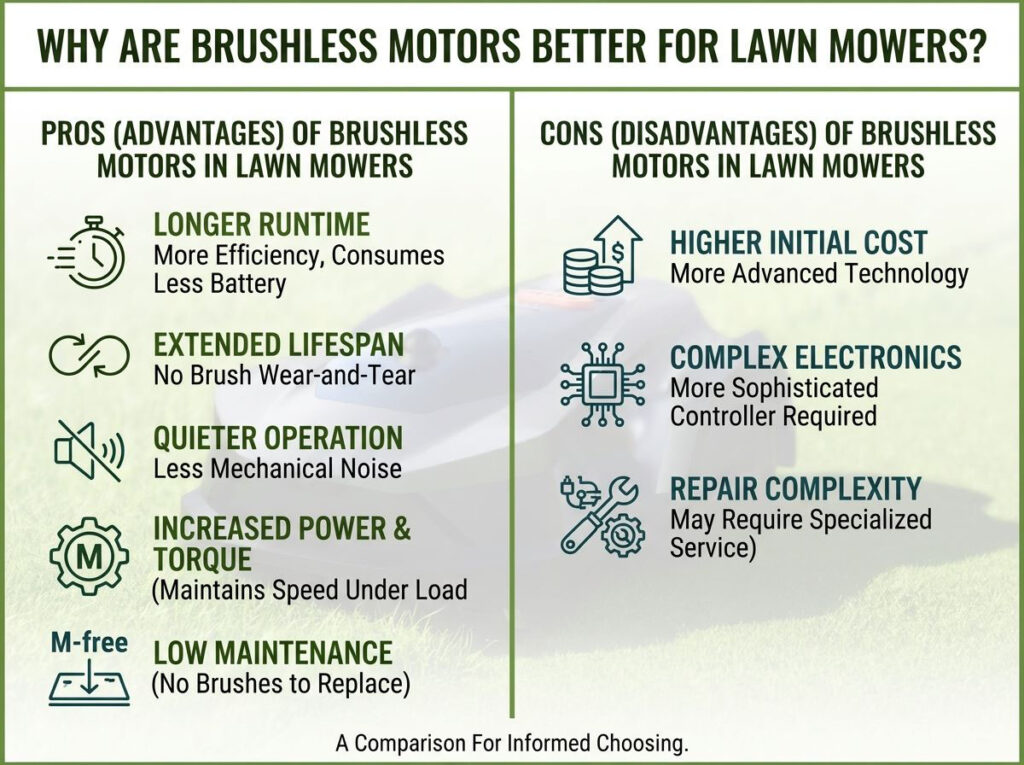
Why Are Brushless Motors Better for Lawn Mowers?
Brushless DC (BLDC) motors are considered better for modern lawn mowers because they deliver higher efficiency, better torque control, lower maintenance, longer lifespan, and improved thermal performance compared with traditional brushed motors. In electric lawn mower systems, especially cordless and commercial-grade platforms, motor efficiency directly affects runtime, cutting consistency, battery consumption, and long-term reliability.
Unlike brushed motors that rely on physical carbon brushes and mechanical commutation, brushless motors use electronic controllers to manage current switching. This eliminates friction losses and reduces wear. As a result, brushless lawn mower motors can maintain stable blade speed under changing grass density while generating less heat and noise. For OEM manufacturers and engineering teams, BLDC technology also enables smarter motor control, compact design, higher torque density, and improved system integration with lithium battery platforms.
As the global market shifts toward cordless outdoor power equipment, brushless motor technology is becoming the standard architecture for residential, commercial, and robotic lawn mower systems.
What Is a Brushless Lawn Mower Motor?
A brushless lawn mower motor is an electronically commutated electric motor designed to drive mower blades or wheel traction systems without using carbon brushes. Most modern electric lawn mowers use BLDC motors because they offer superior efficiency and dynamic load response compared with brushed DC motors.
In a BLDC motor, permanent magnets are mounted on the rotor while electromagnetic windings are placed on the stator. Electronic controllers continuously switch phase currents according to rotor position feedback, generating a rotating magnetic field that drives the rotor. Because there are no brushes contacting the commutator, the motor experiences lower friction, lower electrical noise, and significantly reduced mechanical wear.
For lawn mower applications, this architecture is extremely important. Grass-cutting loads are highly variable. Wet grass, tall grass, slope conditions, and sudden blade resistance all create fluctuating torque demand. Brushless motors can rapidly adjust output current and torque through electronic control algorithms, allowing the blade to maintain stable RPM during heavy cutting conditions.
Modern cordless lawn mower systems commonly use:
- 36V BLDC motors
- 48V BLDC motors
- 60V battery-powered mower motors
- 72V commercial mower drive motors
Industrial OEM suppliers increasingly integrate intelligent motor controllers with CAN communication, thermal monitoring, and programmable torque curves to improve mowing performance and battery optimization.
Related solutions:
Why Are Brushless Motors Better for Lawn Mowers?
The main reason brushless motors are better for lawn mowers is that mowing applications demand high torque under changing loads while maintaining energy efficiency and durability. Traditional brushed motors struggle in these conditions because brush friction creates heat, efficiency losses, and faster component degradation.
Higher Efficiency
Brushless motors commonly achieve 85–93% efficiency, while brushed motors often operate in the 70–80% range. Higher efficiency means more battery energy is converted into usable blade power instead of wasted heat.
For cordless lawn mowers, this directly translates into:
- Longer runtime
- Lower battery drain
- Reduced heat generation
- Smaller battery requirements
Better Torque Response
BLDC motors dynamically adjust current according to load demand. When the mower encounters dense grass, the controller increases torque output instantly. This helps maintain cutting quality and prevents blade stall.
Longer Lifespan
Because there are no brushes to wear out, brushless motors typically achieve much longer operational life. In commercial mowing environments where equipment may run several hours per day, reduced maintenance becomes a major economic advantage.
Lower Noise and Vibration
Electronic commutation reduces sparking and mechanical friction. This lowers acoustic noise and improves user comfort, which is increasingly important in residential and municipal mowing regulations.
Smarter Motor Control
Brushless systems support advanced control functions including:
- Variable speed control
- Soft start
- Current limiting
- Overload protection
- Thermal monitoring
- Battery communication
These functions improve both safety and system reliability.
Brushless vs Brushed Motor Lawn Mower Comparison
| Parameter | Brushless Motor | Brushed Motor |
|---|---|---|
| Efficiency | 85–93% | 70–80% |
| Maintenance | Very low | Frequent brush replacement |
| Thermal Performance | Excellent | Moderate |
| Noise Level | Lower | Higher |
| Torque Control | Precise electronic control | Limited |
| Lifespan | Long | Shorter |
| Initial Cost | Higher | Lower |
| Battery Runtime | Longer | Shorter |
| Commercial Suitability | Excellent | Limited |
Although brushed motors still appear in low-cost entry-level lawn mowers, the market is rapidly transitioning toward brushless platforms because long-term operating cost and performance benefits outweigh initial motor cost differences.
How Brushless Motor Efficiency Improves Lawn Mower Performance
Efficiency is one of the most important engineering metrics in electric lawn mower systems. Motor efficiency affects runtime, heat generation, battery size, and even mechanical reliability.
In brushed motors, electrical energy is partially lost through:
- Brush friction
- Commutator sparking
- Copper losses
- Mechanical wear
Brushless motors eliminate brush contact entirely, reducing energy loss significantly. The result is higher usable power output per watt consumed.
For example, if two lawn mowers use the same 48V lithium battery pack:
- A brushed motor mower may operate for 35–40 minutes
- A brushless mower may operate for 50–60 minutes
This improvement is especially important for:
- Commercial landscapers
- Municipal maintenance fleets
- Large residential properties
- Robotic mowing systems
High-efficiency BLDC motors also reduce battery cycling frequency, helping extend lithium battery lifespan and reducing total ownership cost.
Torque Density and Cutting Performance Explained
Torque density refers to how much torque a motor can generate relative to its physical size and weight. Brushless motors typically achieve much higher torque density than brushed motors, which is critical in compact lawn mower platforms.
A mower blade experiences highly dynamic resistance during operation. Dry grass creates relatively light load conditions, while wet or thick grass creates sudden torque spikes. A high torque density motor can handle these spikes without losing blade speed.
Benefits of higher torque density include:
- Improved cutting consistency
- Reduced blade stall
- Smaller motor packaging
- Lighter mower design
- Better battery utilization
Commercial-grade 72V brushless mower motors often use high-energy permanent magnets combined with optimized stator winding geometry to maximize torque output.
Many OEM systems now integrate:
- Field-oriented control (FOC)
- Sine-wave drive algorithms
- Hall sensor positioning
- Sensorless vector control
These technologies further improve low-speed torque stability and dynamic response.
Thermal Performance and Heat Management in BLDC Lawn Mower Motors
Thermal management is a major engineering challenge in electric lawn mower systems. Excessive heat reduces efficiency, damages insulation, weakens magnets, and shortens motor lifespan.
Brushless motors generally produce less heat because:
- No brush friction exists
- Electronic commutation is more efficient
- Current control is more precise
- Rotor losses are minimized
Lower heat generation allows the motor to sustain high power output longer without thermal shutdown.
Common Cooling Methods
| Cooling Method | Application | Advantages |
|---|---|---|
| Natural Air Cooling | Residential mowers | Simple and low cost |
| Forced Air Cooling | Commercial equipment | Better thermal stability |
| Aluminum Housing Dissipation | Compact mower motors | Improved heat transfer |
| Integrated Fan Cooling | High-speed systems | Enhanced airflow |
Thermal sensors are increasingly integrated into premium mower motors to monitor winding temperature in real time.
Control Systems in Brushless Lawn Mowers
One of the largest advantages of brushless lawn mower systems is advanced electronic control capability.
Unlike brushed motors that simply respond to applied voltage, BLDC systems continuously regulate motor behavior through intelligent controllers.
Typical Control Features
- Adaptive torque output
- Variable blade speed
- Battery optimization
- Current limiting
- Overtemperature protection
- Obstacle detection
- Regenerative braking in traction systems
Modern robotic lawn mowers rely heavily on sophisticated BLDC control algorithms because navigation, traction, and cutting all require precise motor coordination.
Field-oriented control (FOC) is now widely adopted in premium mower systems because it provides:
- Smoother operation
- Higher efficiency
- Lower acoustic noise
- Better torque accuracy
For OEM manufacturers, controller compatibility is a key selection factor when sourcing custom mower motors.
Brushless Lawn Mower Applications
Brushless lawn mower motors are used across multiple outdoor power equipment categories.
Residential Lawn Mowers
Cordless residential mowers increasingly use 36V and 48V BLDC motors because homeowners demand quieter operation and longer runtime.
Commercial Landscaping Equipment
Commercial landscaping fleets require durable motors capable of continuous operation under heavy load conditions. High-voltage BLDC systems improve productivity while reducing maintenance.
Robotic Lawn Mowers
Robotic mowers depend on compact, efficient, and low-noise brushless motors for:
- Blade drive
- Wheel traction
- Steering systems
Ride-On Electric Mowers
Large electric ride-on mowers often integrate:
- 72V traction motors
- Independent blade drive motors
- Electronic differential control
Industrial Turf Equipment
Golf course maintenance and municipal turf equipment increasingly adopt brushless drive systems because of lower emissions and reduced operational cost.
How to Choose a Brushless Motor for Lawn Mower Applications
Choosing the best brushless motor for lawn mower applications requires balancing power, efficiency, thermal stability, and cost.
Voltage Range
- 24V–36V: Small residential mowers
- 48V: Mid-size cordless systems
- 60V–72V: Commercial and heavy-duty platforms
Power Range
- 500W–1000W: Light-duty cutting
- 1kW–3kW: Commercial push mowers
- 3kW–8kW: Ride-on electric mowers
Speed and Torque
Blade motors require high-speed capability while maintaining stable torque under changing loads. Engineers should evaluate:
- Peak torque
- Continuous torque
- Rated RPM
- Torque ripple
Cooling Method
High-load commercial systems should use forced-air or advanced aluminum heat dissipation structures.
Controller Compatibility
Ensure compatibility with:
- FOC controllers
- CAN communication
- Battery management systems
- Hall sensor architecture
Environmental Protection
Outdoor mower motors should include:
- IP protection
- Dust sealing
- Water resistance
- Corrosion-resistant housing
For OEM projects, custom shaft design, mounting interfaces, and controller integration are also critical considerations.
Request datasheet support or contact our engineers for custom mower motor solutions.
Brushless vs Induction Motors for Lawn Mowers
| Parameter | Brushless DC Motor | Induction Motor |
|---|---|---|
| Efficiency | Very high | Moderate |
| Torque Density | High | Lower |
| Weight | Compact | Heavier |
| Control Precision | Excellent | Moderate |
| Battery Compatibility | Excellent | Limited |
| Cost | Higher | Lower |
Induction motors are still used in some corded lawn mowers because of their simplicity and low cost. However, for battery-powered systems, BLDC motors provide significantly better energy efficiency and dynamic performance.
Future Trends in Brushless Lawn Mower Motor Technology
The lawn mower industry is rapidly moving toward intelligent electrification. Several trends are accelerating adoption of brushless motors:
- Higher energy-density lithium batteries
- Smart motor controllers
- Robotic lawn care systems
- IoT-enabled diagnostics
- Quiet residential operation requirements
- Zero-emission landscaping regulations
Future BLDC mower motors will likely incorporate:
- Integrated drive electronics
- AI-based torque optimization
- Predictive maintenance systems
- Advanced thermal modeling
- Lightweight composite housings
OEM manufacturers that invest early in high-efficiency brushless platforms will gain significant competitive advantages in performance, runtime, and reliability.
FAQ: Brushless Lawn Mower Motors
Are brushless lawn mower motors worth the extra cost?
Yes. Although brushless motors have higher initial cost, they provide better efficiency, longer runtime, lower maintenance, and extended lifespan. Over time, total ownership cost is usually lower than brushed motor systems.
Why do brushless lawn mowers last longer?
Brushless motors eliminate carbon brushes and commutators, which are common wear components in brushed motors. Reduced friction and lower heat generation improve durability and reduce maintenance requirements.
What voltage is best for a brushless lawn mower motor?
The ideal voltage depends on application size. Residential mowers commonly use 36V–48V systems, while commercial and ride-on mowers may use 60V–72V architectures for higher power output.
Do brushless motors improve battery runtime?
Yes. Higher motor efficiency means less energy is wasted as heat. This allows more battery energy to be converted into usable cutting power, improving runtime significantly.
Can brushless motors handle wet grass better?
Brushless motors typically respond better to sudden load changes because controllers dynamically increase torque output. This helps maintain blade speed during dense or wet grass cutting conditions.
What is the lifespan of a brushless lawn mower motor?
A high-quality BLDC lawn mower motor can operate for thousands of hours depending on cooling, load conditions, and environmental protection. Commercial-grade systems often achieve substantially longer service life than brushed alternatives.
Conclusion
Brushless motors are better for lawn mowers because they solve the key engineering limitations associated with brushed motor systems. Higher efficiency, better torque density, lower maintenance, smarter control capability, and improved thermal management make BLDC motors the preferred technology for modern electric mowing equipment.
As battery-powered outdoor power equipment continues to expand globally, brushless motor systems are becoming essential for both residential and commercial mower platforms. OEM manufacturers increasingly require compact, efficient, and reliable motor solutions that support intelligent control integration and long operational life.
Greensky Power provides custom brushless motor solutions for electric lawn mowers, robotic mowers, and commercial outdoor equipment platforms, including:
- 48V BLDC mower motors
- 72V industrial mower drive motors
- Custom OEM motor development
- High-efficiency outdoor power solutions
Request datasheet support, get OEM solutions, or contact our engineers to discuss your lawn mower motor project requirements.
References
- https://www.energy.gov/eere/articles/how-electric-motors-work
- https://ieeexplore.ieee.org/document/8765987
- https://www.sciencedirect.com/topics/engineering/brushless-dc-motor
- https://www.nidec.com/en/technology/motor/basic/00013/
- https://www.maxongroup.com/maxon/view/content/brushless-dc-motors
- https://www.boschrexroth.com/en/us/products/electric-drives-and-controls/
- https://www.electronics-tutorials.ws/electromagnetism/brushless-dc-motor.html
- https://www.researchgate.net/publication/338497066_Brushless_DC_Motor_Drive_Systems
