
What Motor a Small Electric Forklift Uses, and How Each One Is Sized
Quick Answer
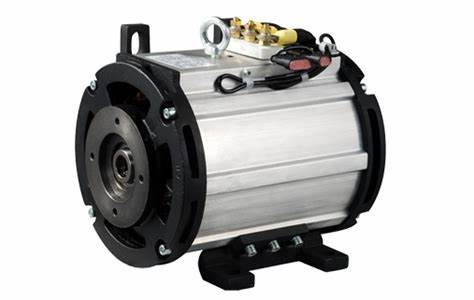
A small electric forklift in the 1 to 2 tonne class typically has separate traction, hydraulic-pump and steering motor functions. The traction motor is usually a three-phase AC induction machine rated around 3 to 8 kW on a 24 or 48 V platform, driving the wheels through a reduction gear. A hydraulic-pump motor of similar power serves the lift and tilt circuits and may carry a short-time rating. Steering is handled by a smaller motor, typically a few hundred watts. Older or lower-cost trucks may still use series-wound DC traction motors.
- The Short Answer: Two Motors That Matter, Not One
- Which Truck Type You Have Changes the Answer
- The Traction Motor: Why AC Induction Replaced DC
- The Hydraulic Pump Motor Is Rated on Short-Time Duty
- Voltage Platform: 24, 48 or 80 V
- Sizing the Traction Motor from Gradeability
- Sizing the Pump Motor from Lift Speed
- From Wheel Torque to Motor Torque
- Where BLDC and PMSM Fit in Small Forklifts
- Duty Cycle and Why Oversizing Makes It Worse
- Six Failure Modes and What They Point To
- What Goes on the Specification Sheet
- References
- FAQ
The Short Answer: Two Motors That Matter, Not One
Forklift motor enquiries often omit which function the motor serves. A truck may have at least three motor functions, each with a different rating basis. Identifying the role first helps avoid specifying a replacement against the wrong duty.
| Motor | What it drives | Typical rating, 1 to 2 t class | Duty basis | Typical type |
|---|---|---|---|---|
| Traction, or travel | drive wheels through a reduction gear and differential | 3 to 8 kW, 24 or 48 V | continuous S1 while travelling | three-phase AC induction, occasionally DC series |
| Hydraulic pump | lift, lower and tilt cylinders through a gear pump | 4 to 8 kW at peak, 24 or 48 V | short-time S2, or S3 near 15 percent | DC series on older trucks, AC induction or PMSM on current ones |
| Steering | steering pump or electric power steering | 0.3 to 1.0 kW | intermittent, very low duty | small DC or BLDC |
| Optional attachments | side shift, clamp, fork positioner | 0.5 to 2 kW | intermittent | small DC, shared hydraulic circuit |
A quotation for a forklift motor needs to state its role. The traction motor and pump motor may share a frame size, but their winding and thermal ratings can differ because one is intended for travel duty and the other may operate only for short lifting intervals.
The full taxonomy of what is available across DC, AC and PMSM is covered separately in common types of electric forklift motors; this page stays on the small-machine numbers.
Which Truck Type You Have Changes the Answer
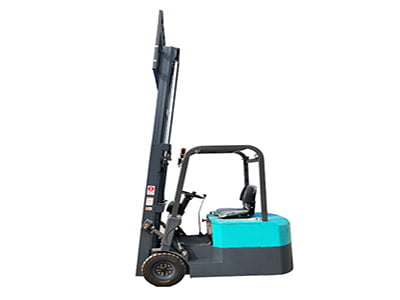
Forklift designs differ in motor count and layout. Identify the truck type before comparing power ratings, since it determines whether the drive uses a differential, whether steering is electric and how many hydraulic functions the pump supplies.
- Electric pallet truck, 1.0 to 1.5 t. Usually one traction motor on 24 V with an integral reduction gear, and a lift pump built into the same housing. No differential, no power steering, and the cheapest 24 V DC platform in the category.
- Three-wheel counterbalance, 1.0 to 1.5 t. One traction motor through a differential, plus electric power steering because the rear wheel steers. The steering motor is small but runs almost continuously, so its duty is the opposite of the lift motor’s.
- Four-wheel counterbalance, 1.5 to 2.5 t. 48 V is standard. Either a single traction motor with a differential or two wheel motors with electronic differential control, the second being the arrangement that makes tight-aisle handling possible.
- Reach truck, 1.0 to 2.0 t. Traction plus reach, lift and tilt functions, so either three pump motors or one pump with a valve block. Duty is higher than a counterbalance truck’s, and the motor is specified on that duty rather than on capacity.
Two trucks with the same rated capacity can therefore need different motors. A 1.5 t pallet truck and a 1.5 t reach truck each lift 1,500 kg, but their pump duty can differ substantially. The stated fivefold difference in pump operating hours per shift should be checked against representative duty-cycle data; it affects thermal sizing as well as power selection.
The Traction Motor: Why AC Induction Replaced DC
For decades, series-wound DC motors were common in forklift traction drives. Their torque rises with current, which suits loaded starts, and they can use a simple chopper controller. Many newer designs use AC induction motors as inverter cost and maintenance requirements have changed.
| Property | DC series motor | AC induction motor | BLDC or PMSM |
|---|---|---|---|
| Efficiency at rated point | 75 to 82 percent | 85 to 92 percent | 88 to 94 percent |
| Brush and commutator service | every 1,500 to 3,000 hours | none | none |
| Regenerative braking | limited, needs extra hardware | standard on a four-quadrant inverter | standard |
| Torque at zero speed | high, limited by current | high with field-oriented control | highest per frame size |
| Controller cost | low | moderate | moderate, needs rotor position |
| Water and dust tolerance | poor, carbon dust plus moisture | good with the right IP rating | good |
What changed when DC became AC
Lower-cost three-phase inverters with field-oriented control made AC induction drives more practical. In some fleets, the purchase cost is offset by lower brush and commutator maintenance and less associated downtime. Initial cost can still favour DC on smaller trucks.
Regenerative braking is also available through a four-quadrant inverter. In warehouse duty with frequent stops, recovered energy may be a meaningful share of traction energy; the 10 to 20 percent range cited here depends on the route, load, braking profile and battery. Any effect on battery changes per shift should be established from fleet data.
The Hydraulic Pump Motor Is Rated on Short-Time Duty
A common source of sizing errors is the duty rating. The pump motor lifts a load for a few seconds, then idles while the truck travels, then lifts again. Its nameplate power describes a short-time rating, not a continuous one, and comparing it with a continuously rated motor of the same number is meaningless.
Reading a lift-motor nameplate
A pump motor marked 6 kW at S3 15 percent is rated for the stated cyclic duty, with operation during 15 percent of the cycle. Under the simplified thermal-equivalence assumption used here, its continuous equivalent is about 6 x sqrt(0.15) = 2.3 kW. A 6 kW continuous-duty motor would need to be selected and thermally sized for that continuous output.
The square-root relation reflects the assumed duty and thermal model. A replacement chosen by the kW figure alone may overheat if its duty rating does not match the truck’s operating cycle; the original motor can also be unsuitable if the truck’s actual duty has changed.
| Duty designation | Meaning | Typical forklift use | Effect on rating |
|---|---|---|---|
| S1 | continuous, thermal equilibrium reached | traction motor while travelling | nameplate equals continuous capability |
| S2, short-time | load applied for a stated period, then rest | lift motor on simple trucks, S2 10 or 30 min | nameplate applies to that period only |
| S3, intermittent | cyclic, with a stated duty factor | lift and tilt on most counterbalance trucks | rating scales with the duty factor |
| S4 to S5 | cyclic with starting or braking influence | traction in dense stop-start duty | starting losses enter the thermal budget |
Voltage Platform: 24, 48 or 80 V
Battery voltage selection depends in part on power demand and cable length. For the same power, increasing voltage reduces current; with the same cable resistance, that also reduces I²R cable loss.
| Platform | Typical truck class | Current at 5.3 kW | Relative cable loss | Comment |
|---|---|---|---|---|
| 24 V | pallet trucks, 3-wheel up to about 1.2 t | 221 A | 4.0 | cheap batteries, heavy cables, short runs |
| 48 V | 1.2 to 2.5 t counterbalance | 111 A | 1.0 | the mainstream choice for small trucks |
| 80 V | 3 t and above, high-duty fleets | 66 A | 0.36 | fast travel, larger frames, higher cost |
Cable and connector consequences
At the same power, a 24 V system draws more current than a 48 V system, which affects cable cross-section and the ratings of connectors, contactors and fuses. This helps explain the use of 48 V platforms in many trucks around the 1.5 t class; the appropriate voltage still depends on the complete vehicle design.
The selection logic for the battery side is set out in battery voltage selection for AGV motors, which uses the same trade-off between current, cable mass and charger availability.
Sizing the Traction Motor from Gradeability
Traction-motor sizing should include the truck’s required gradeability with a full load. Ramp speed and grade determine the tractive force and power at that operating point; the required top speed also affects the motor’s speed range and base-speed selection.
The tractive force needed on a ramp is the sum of rolling resistance and the gravity component along the slope:
F = m x g x (f + sin theta)
where m is the laden mass, f the rolling resistance coefficient, and theta the ramp angle. Then P = F x v / eta, with v the speed on the ramp and eta the drivetrain efficiency.
Worked example: 1.5 t counterbalance on an 8 percent ramp
| Quantity | Value | Note |
|---|---|---|
| Rated capacity | 1,500 kg | given |
| Service mass with battery | 2,800 kg | typical for the class |
| Laden mass, m | 4,300 kg | capacity plus service mass |
| Ramp | 8 percent, theta = 4.57 degrees | sin theta = 0.0797 |
| Rolling resistance, f | 0.02 | solid tyre on concrete |
| Tractive force, F | 4,205 N | 4300 x 9.81 x 0.0997 |
| Speed on ramp | 4 km/h = 1.111 m/s | design choice |
| Power at the wheels | 4.67 kW | F x v |
| Drivetrain efficiency | 0.88 | gear and differential |
| Motor shaft power | 5.3 kW | 4.67 / 0.88 |
Under these example assumptions, the traction motor shaft power is about 5.3 kW, placing it in the 5 to 6 kW range. At 6 km/h on the same ramp, the calculated requirement rises to 8.0 kW. Gradeability should therefore be stated together with the speed at which it applies.

Sizing the Pump Motor from Lift Speed
The lift-power calculation uses load, gravity and lift speed. Motor shaft power must also account for cylinder and pump efficiency, while the duty cycle determines the thermal rating.
P = (m x g x v) / (eta_cyl x eta_pump)
Worked example: 1.5 t at 0.30 m/s
| Quantity | Value | Note |
|---|---|---|
| Load plus carriage | 1,650 kg | 1,500 kg load, 150 kg attachment |
| Lift speed, laden | 0.30 m/s | typical for the class |
| Lifting power | 4.86 kW | 1650 x 9.81 x 0.30 |
| Cylinder efficiency | 0.95 | seal friction |
| Pump efficiency | 0.85 | gear pump at working pressure |
| Motor shaft power | 6.0 kW | 4.86 / (0.95 x 0.85) |
| Duty factor | 15 percent S3 | 20 s lift in a 3 minute cycle |
| Equivalent continuous power | 2.3 kW | 6.0 x sqrt(0.15) |
The duty factor and equivalent continuous figure are central to comparing these options. A 6 kW S3 15 percent rating is not interchangeable with a 6 kW continuous rating. Specify both power and duty; a motor ordered by the kW figure alone may have the wrong thermal capacity or frame size.
From Wheel Torque to Motor Torque
Start with the force required at the tyre, then convert it to wheel and motor torque. Wheel torque is tractive force multiplied by tyre radius; motor torque is wheel torque divided by the reduction ratio and drivetrain efficiency.
T_wheel = F x r and T_motor = T_wheel / (i x eta)
For the example above, with a 0.25 m tyre radius and a 16:1 reduction, the wheel torque is 4,205 x 0.25 = 1,051 N·m and the motor torque is 1,051 / (16 x 0.88) = 74.6 N·m. At 4 km/h the wheel turns at 42.4 rpm, so the motor runs at 679 rpm.
At the calculated ramp point, the motor runs at about one third of its 2,000 rpm base speed and must provide 74.6 N·m without thermal derating. Check that the inverter can supply the required current at this speed; a limit below the calculated requirement would reduce the available tractive effort. The torque-speed curve is therefore needed alongside the nameplate power.
The same chain, applied to a warehouse robot rather than a forklift, is worked through in AGV motor torque calculation and in how much torque an AGV needs.
Where BLDC and PMSM Fit in Small Forklifts
Permanent-magnet machines, including BLDC and PMSM designs, are used in some lithium-battery trucks and compact pallet trucks. They can offer higher part-load efficiency, although the result depends on motor and controller design and on the truck’s duty cycle.
The trade-off is the controller. A PMSM needs rotor position, either from Hall sensors or from a sensorless estimator, and sensorless starting under a loaded fork is the weak point. On a truck that must pull away on a ramp with 1.5 t on the forks, Hall feedback is the safer choice; the comparison is set out in Hall sensor versus sensorless BLDC motors.
Where the frame envelope is tight, an integrated wheel motor removes the differential and the prop shaft entirely. That architecture is described in AGV wheel motor design, and the choice between it and a conventional geared drive is covered in gear motor versus direct drive.
For a 24 V pallet truck the 24 V BLDC motor for warehouse AGV and robotics is the reference platform; the wider family is in best motor types for AGVs and motors for warehouse AGVs.
Duty Cycle and Why Oversizing Makes It Worse
When a motor overheats, moving to the next frame size may not solve the cause. A larger motor can run at a lower load factor, but whether that increases losses depends on its efficiency curve, control settings and cooling. Diagnose the operating conditions before changing the rating.
Induction-motor efficiency varies with load and model; the cited 75 to 100 percent peak range and drop below about 40 percent are general estimates, not a rule for every motor. A 7.5 kW motor carrying a 3 kW average load operates at about 40 percent of rating. Compare its actual efficiency and losses with the proposed 4 kW motor before concluding which will run cooler. Additional mass also affects the vehicle load calculation.
The correct response to a hot motor is to check the duty first: cycle time, ambient temperature, cooling path, and whether the inverter is holding current limit for longer than the design assumed. The thermal side of that diagnosis is covered in AGV motor overheating.
Speed selection interacts with this as well. A motor running well below base speed has less internal airflow and a lower cooling coefficient, so the same torque produces a higher winding temperature. The practical envelope is in AGV motor speed and rpm selection.
Six Failure Modes and What They Point To
The table lists common forklift-motor symptoms, possible causes and measurements that can help distinguish them. The actual failure frequency depends on truck design and service conditions.
| Symptom | Likely cause | Measurement that confirms it |
|---|---|---|
| Insulation resistance falling over weeks | water ingress after washdown, failed shaft seal | megger at 500 V, trend rather than single reading; below 1 MΩ on a 48 V machine is a warning |
| Thermal trip in summer only | ambient above the rated 40 degrees C, blocked cooling fins | winding temperature against ambient, airflow at the fan cowl |
| Loss of pull-away torque | battery sag, contactor resistance, inverter current limit | terminal voltage during the first two seconds of travel |
| Brush sparking and short brush life | DC machine, commutator wear, overload | brush length and commutator bar marking pattern |
| Whine or judder at low speed | PWM carrier against a structural or gear mesh resonance | change carrier frequency, then measure vibration |
| Position or speed fault on PMSM | Hall or encoder failure, cable routed beside power cables | signal integrity at the controller with the motor turning by hand |
What the symptom points to
Two patterns can help narrow the diagnosis. A thermal trip that occurs only in summer may point to ambient temperature or restricted cooling; replacing the motor alone may not address it. If pull-away torque is low but normal travel follows, measure battery and controller voltage during acceleration before condemning the motor.
Three service intervals worth keeping
Routine inspection can reveal problems before they cause a motor failure. An insulation-resistance test at 500 V, taken cold and recorded over time, can help identify deteriorating insulation. Cleaning the cooling path reduces the risk of heat-related trips.
Checking the brake air gap catches the parking brake drifting out of adjustment, which otherwise shows up as a truck that will not hold on a ramp and gets blamed on the motor. Interval values belong in the truck manufacturer’s schedule; the point here is that all three are recorded rather than judged by feel.
What Goes on the Specification Sheet
A motor specification should include the operating details suppliers need to select a suitable unit. The following items help make the requirements explicit.
| Item | Why it changes the motor |
|---|---|
| Role: traction, pump or steering | sets duty class and therefore frame size |
| Rated power and base speed | defines the torque-speed envelope below base speed |
| Peak torque and its duration | ramp start, breakaway, relief valve setting |
| Duty: S1, S2 with period, or S3 with duty factor | the single most consequential line on the sheet |
| Battery voltage and working range | winding turns, insulation class, controller match |
| Ingress protection and washdown practice | sealing, breather, corrosion protection |
| Ambient and altitude | derating above 40 degrees C or 1,000 m |
| Mounting: flange, shaft, key, pilot diameter | drop-in fit versus adapter plate |
| Brake: spring-applied, electrically released | parking brake on grade, required by machine safety standards |
| Feedback: Hall, encoder or sensorless | starting under load and low-speed control |
| Connector and cable length | assembly time and ingress risk at the gland |
Many counterbalance trucks use a spring-applied, electrically released brake so the vehicle can hold when controls are released or power is lost. Confirm the brake type and holding requirement for the specific truck and applicable safety standards, then include the interface in both motor and vehicle drawings.
Sizing a motor for a small electric truck? Send the laden mass, the ramp and the speed on it, the lift speed and load, the battery voltage and the duty cycle. We will return the shaft power, the torque at the worst case and the frame that covers both. Contact the engineering team.
References
- International Electrotechnical Commission. (2022). IEC 60034-1:2022 Rotating electrical machines – Part 1: Rating and performance. webstore.iec.ch/en/publication/65446
- International Electrotechnical Commission. (2014). IEC 60034-2-1:2014 Rotating electrical machines – Part 2-1: Standard methods for determining losses and efficiency from tests. webstore.iec.ch/en/publication/121
- International Electrotechnical Commission. (2025). IEC 60034-30-1:2025 Rotating electrical machines – Part 30-1: Efficiency classes of line operated AC motors (IE code). webstore.iec.ch/en/publication/91195
- International Electrotechnical Commission. (2016). IEC TS 60034-30-2:2016 Rotating electrical machines – Part 30-2: Efficiency classes of variable speed AC motors (IE code). webstore.iec.ch/en/publication/30830
- International Electrotechnical Commission. (2013). IEC 60529:1989+AMD1:1999+AMD2:2013 Degrees of protection provided by enclosures (IP Code). webstore.iec.ch/en/publication/2452
- International Electrotechnical Commission. (2023). IEC 61800-9-2:2023 Adjustable speed electrical power drive systems – Ecodesign for power drive systems, motor starters, power electronics and their driven applications. webstore.iec.ch/en/publication/111276
- International Organization for Standardization. (2011, amended 2020). ISO 3691-1:2011/Amd 1:2020 Industrial trucks – Safety requirements and verification – Part 1: Self-propelled industrial trucks. iso.org/standard/78303.html
- European Parliament and Council. (2023). Regulation (EU) 2023/1230 on machinery and repealing Directive 2006/42/EC. eur-lex.europa.eu/eli/reg/2023/1230/oj
- European Commission. (2019). Commission Regulation (EU) 2019/1781 laying down ecodesign requirements for electric motors and variable speed drives. eur-lex.europa.eu/eli/reg/2019/1781/oj
- U.S. Department of Energy. (2024). Motors and drives systems – advanced manufacturing office resources. energy.gov/eere/amo/motor-systems
FAQ
Q: What motor does a small electric forklift use?
A small counterbalance forklift in the 1 to 2 tonne class normally uses three motors. The traction motor is a three-phase AC induction machine of roughly 3 to 8 kW at 24 or 48 V, driving the wheels through a reduction gear. The hydraulic pump motor, of similar or slightly higher power, drives the lift and tilt pump and is rated on short-time duty. A separate steering motor of a few hundred watts completes the set.
Q: Do small electric forklifts still use DC motors?
Only in older machines and in the cheapest pallet trucks. Series-wound DC motors survived because a simple chopper controller was cheap, but brush and commutator maintenance every 1,500 to 3,000 hours, no regenerative braking and lower efficiency pushed almost all new counterbalance trucks to AC induction with a field-oriented inverter.
Q: How much power does a 1.5 tonne electric forklift need?
On an 8 percent ramp with a full 1,500 kg load at 4 km/h, the tractive force is about 4,200 N and the motor shaft delivers roughly 5.3 kW. Lifting 1,650 kg at 0.30 m/s needs about 6.0 kW at the pump motor shaft. Exact figures depend on tyre radius, rolling resistance and the relief valve setting, so they should be recalculated for each machine.
Q: Why is the lift motor rated higher than the traction motor?
It usually is not, once duty is accounted for. The lift motor works at roughly 15 percent duty, so its 6 kW nameplate corresponds to an equivalent continuous power near 2.3 kW. The traction motor works continuously while the truck travels and is thermally limited by that duty rather than by its peak figure.
Q: Should I choose 24 V or 48 V for a small forklift?
For trucks above about 1.2 tonnes, or for sustained ramp duty, 48 V is often the more practical platform. At 5.3 kW the example draws about 221 A at 24 V and 111 A at 48 V. With the same cable resistance, the 24 V system has roughly four times the conductor loss. A 24 V platform remains common on lighter trucks used on flat warehouse floors.
Q: What kills forklift motors in service?
Water ingress after washdown, thermal abuse from a blocked cooling path or an ambient above the rated 40 degrees C, brush wear on older DC machines, and bearing failure from mast vibration. Insulation resistance below 1 MΩ on a 48 V machine is an early warning that should be acted on before the winding fails.