
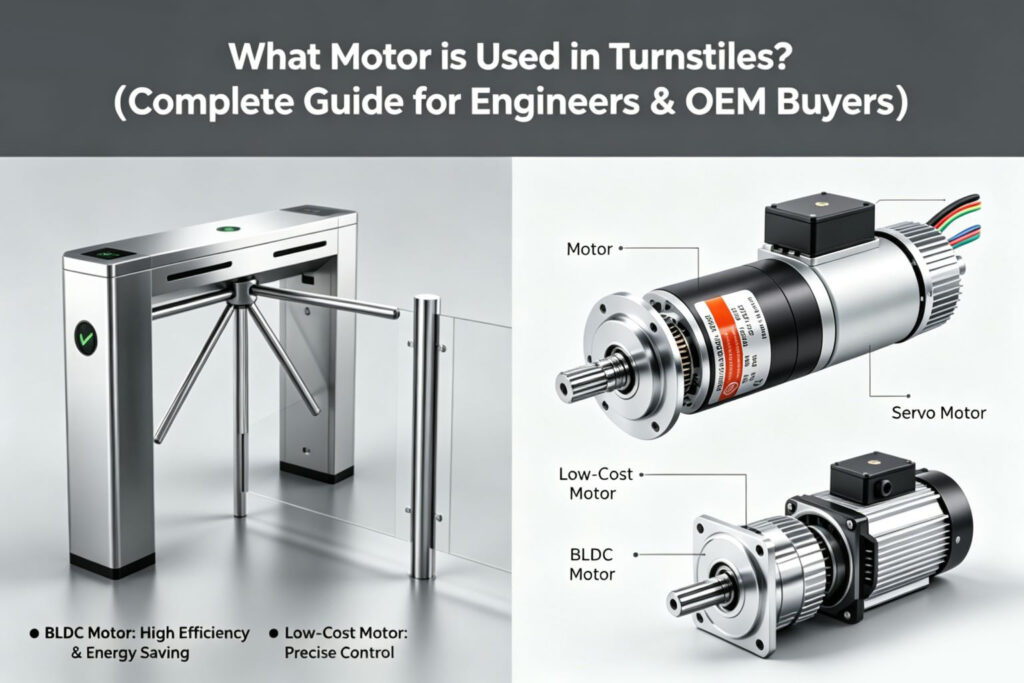
What Motor is Used in Turnstiles? (Complete Guide for Engineers & OEM Buyers)
Featured Snippet:
Turnstiles typically use BLDC motors, servo motors, or stepper motors depending on the required performance, precision, and cost. Modern high-end turnstiles increasingly adopt BLDC motors due to their high efficiency, smooth operation, low noise, and long lifespan. Servo motors are used where precise positioning is critical, while stepper motors are suitable for low-cost systems. The best motor choice depends on torque requirements, control accuracy, duty cycle, and environmental conditions.
In access control systems, selecting the right motor is a critical engineering decision that directly affects reliability, throughput efficiency, user experience, and long-term maintenance cost. For OEM manufacturers, system integrators, and procurement teams, understanding what motor is used in turnstiles is not just about choosing a motor type—it is about optimizing the entire electromechanical system for performance, durability, and cost efficiency.
This engineering guide provides a deep technical breakdown of turnstile motor technologies, including BLDC, servo, stepper, and AC motors. It also covers control strategies, torque requirements, thermal performance, and practical selection criteria for real-world industrial applications.
What Motor Is Used in Turnstiles?
Turnstiles use different types of motors depending on application complexity, traffic volume, and performance requirements. The most common motor types include:
1. BLDC Motors (Most Common in Modern Systems)
- High efficiency (85–92%)
- Low noise and smooth rotation
- Long lifespan due to no brushes
- Ideal for high-end flap barriers and speed gates
2. Servo Motors (High Precision Applications)
- Closed-loop control with encoder feedback
- High positioning accuracy
- Used in premium access systems
3. Stepper Motors (Cost-Sensitive Systems)
- Simple control without feedback
- Lower cost but limited efficiency
- Suitable for low-duty-cycle applications
4. AC Motors (Traditional Systems)
- Robust and simple
- Used in older or heavy-duty turnstiles
👉For high-performance solutions, check our BLDC Motor for Turnstile
Why BLDC Motors Are Dominating Modern Turnstile Systems
BLDC motors have become the preferred choice in modern turnstile design due to their superior performance characteristics.
Engineering Advantages
- Higher efficiency reduces energy consumption
- Smooth torque output improves user experience
- Low noise operation for indoor environments
- Reduced maintenance compared to brushed systems
In high-traffic environments such as metro stations and office buildings, these advantages translate into lower operational costs and improved system reliability.
BLDC vs Servo vs Stepper Motor for Turnstiles
| Parameter | BLDC Motor | Servo Motor | Stepper Motor |
|---|---|---|---|
| Efficiency | High | High | Low |
| Precision | High (with control) | Very high | Moderate |
| Cost | Moderate | High | Low |
| Noise | Low | Low | Higher |
| Best Application | Modern turnstiles | High-end systems | Basic systems |
BLDC motors provide the best balance between cost, performance, and reliability for most turnstile applications.
Efficiency and Energy Consumption in Turnstile Motors
Energy efficiency is a key consideration in high-duty-cycle environments.
BLDC Motor Efficiency
- 85–92% efficiency
- Reduced energy waste
Stepper Motor Efficiency
- 50–70% efficiency
- Constant current consumption
Over time, higher efficiency significantly reduces operating costs, especially in large-scale installations.
Torque Density and Mechanical Requirements
Turnstile motors must provide sufficient torque to handle mechanical loads and user interaction.
Key Considerations
- Starting torque for barrier movement
- Holding torque for locked positions
- Dynamic torque for smooth operation
BLDC motors offer high torque density, enabling compact designs without sacrificing performance.
Thermal Performance and Cooling Design
Thermal management affects reliability and lifespan.
- BLDC motors generate less heat due to high efficiency
- Stepper motors generate continuous heat due to constant current
- Proper cooling ensures long-term stability
For outdoor or high-temperature environments, thermal design becomes critical.
Control Systems in Turnstile Motors
Control systems determine motor performance and user experience.
BLDC Control
- FOC or trapezoidal control
- Smooth acceleration and deceleration
Servo Control
- Closed-loop with encoder
- High precision positioning
Stepper Control
- Open-loop control
- Simple but less efficient
Modern smart turnstiles integrate motor control with access control systems and IoT platforms.
Reliability and Lifespan Considerations
Turnstiles operate in high-frequency environments, making reliability critical.
- BLDC motors offer long lifespan due to no brushes
- Servo systems depend on electronics reliability
- Stepper motors may suffer from overheating
For high-traffic systems, BLDC motors provide the best balance of durability and performance.
How to Choose Turnstile Motor for Your Application
Motor selection must align with application requirements.
Key Selection Criteria
- Voltage: 24V / 48V systems commonly used
- Power Range: Typically 50W–500W
- Speed & Torque: Based on gate type
- Cooling: Air cooling sufficient in most cases
- Controller: FOC controller recommended for BLDC
Application Recommendations
- Flap barrier → BLDC motor
- Swing gate turnstile → BLDC or servo motor
- Tripod turnstile → Stepper or BLDC motor
👉 Request OEM solution: Custom Motor Development
Applications of Turnstile Motors
- Metro and transportation hubs
- Office buildings and commercial complexes
- Stadiums and event venues
- Industrial access control systems
Each application requires different motor characteristics based on usage frequency and environmental conditions.
Cost vs Performance Trade-Off in Turnstile Motors
| Factor | BLDC Motor | Servo Motor | Stepper Motor |
|---|---|---|---|
| Initial Cost | Moderate | High | Low |
| Efficiency | High | High | Low |
| Maintenance | Low | Moderate | Low |
| Total Cost | Best ROI | High | Higher long-term |
BLDC motors typically provide the best balance of cost and performance for most applications.
Future Trends in Turnstile Motor Technology
- Increasing adoption of BLDC motors
- Integration with smart access systems
- Energy-efficient designs
- Advanced control algorithms (FOC)
These trends are shaping the next generation of access control systems.
FAQ: What Motor Is Used in Turnstiles?
1. What is the best motor for turnstiles?
BLDC motors are generally the best choice due to their efficiency, low noise, and long lifespan.
2. Why are BLDC motors preferred?
They provide smooth operation, high efficiency, and low maintenance, making them ideal for modern systems.
3. Can stepper motors be used in turnstiles?
Yes, but they are typically used in low-cost or low-duty-cycle applications.
4. What voltage is used in turnstile motors?
Most systems use 24V or 48V DC motors.
5. How to choose a turnstile motor?
Consider torque, speed, efficiency, control system, and application requirements.
Conclusion: Choosing the Right Motor for Turnstiles
Understanding what motor is used in turnstiles is essential for designing reliable and efficient access control systems. BLDC motors have emerged as the dominant solution due to their superior performance and long-term cost advantages.
For OEMs and system integrators, selecting the right motor ensures optimal system performance, reduced maintenance, and improved user experience.
Need help selecting a turnstile motor?
✔ Request datasheet
✔ Get OEM motor solution
✔ Contact our engineers today
References
- IEEE Industrial Electronics Society
- IEC Motor Efficiency Standards
- Access Control System Engineering Reports
