
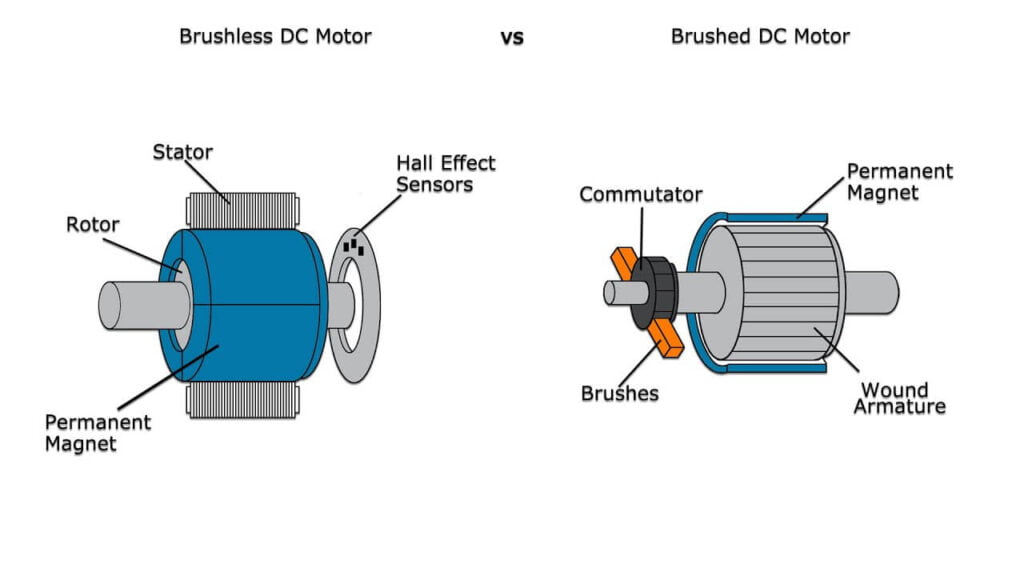
Key Difference Between Brush and Brushless DC Motors
[ez-toc]
What Are Brushed and Brushless DC Motors?
Both are DC motors: they convert direct-current electrical power into rotational mechanical power using the Lorentz force (F = B·I·L) on a current-carrying conductor in a magnetic field. The only thing that differs is how the current direction in each coil is reversed — the process called commutation.
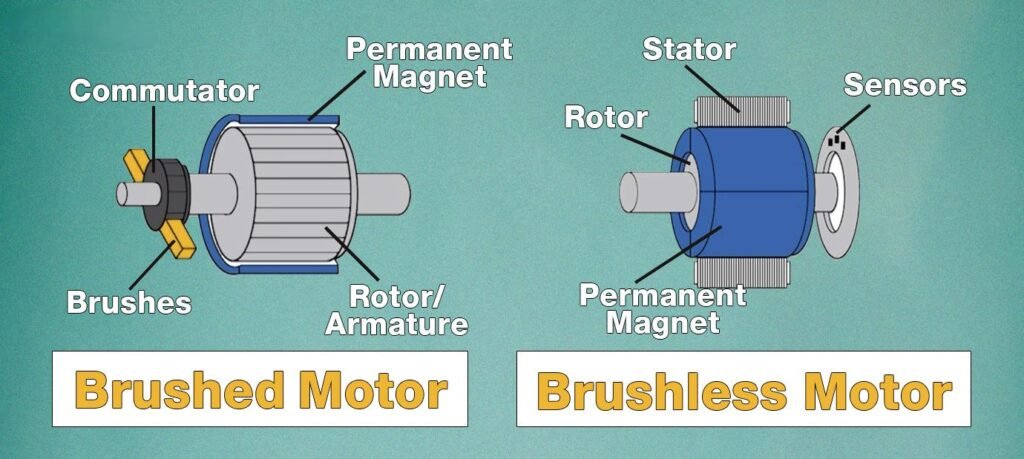
Brushed DC Motor (Mechanical Commutation)
In a brushed motor, the rotor (armature) carries the windings. Stationary carbon brushes press against a rotating commutator (copper segments separated by insulating mica). As the shaft turns, the brushes feed current to whichever coil is optimally placed, automatically reversing polarity every few degrees so torque always acts one way. For a deeper look at the contact itself, see our guide on what motor brushes are and how they work.
Brushless DC Motor (Electronic Commutation)
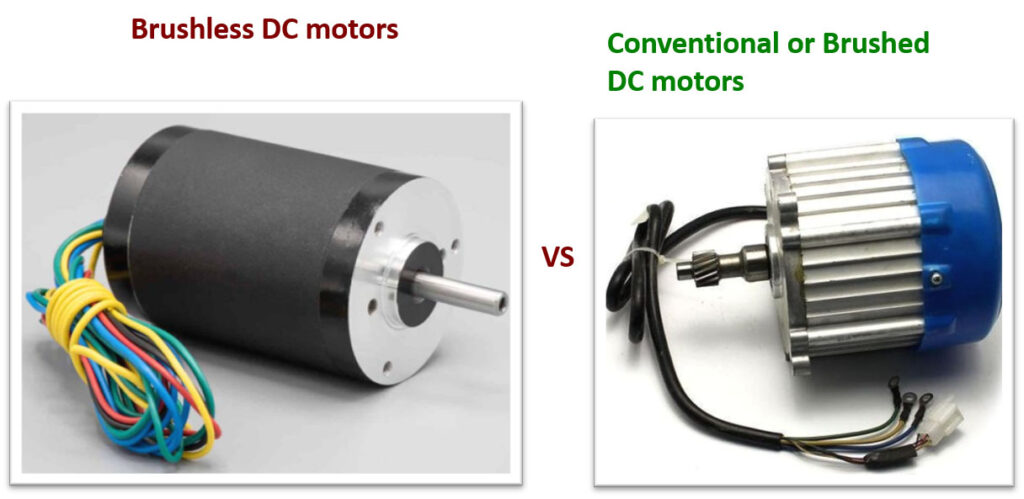
A BLDC motor is an “inside-out” DC motor. The permanent magnets are on the rotor and the windings are in the stationary stator. Because there is no brush-to-commutator contact, an electronic controller must switch the three-phase stator current in sync with rotor position (sensed by Hall sensors or estimated sensorlessly). Electrically, a well-commutated BLDC produces the same speed–torque curve as a brushed DC motor — the controller just does the commutator’s job electronically. See the trade-offs in our BLDC disadvantages guide.
How Each Motor Commutates: Step-by-Step
Brushed Motor Commutation Cycle
- DC applied to brush terminals — current enters the positive brush.
- Current crosses the sliding contact into the commutator segment touching that brush, then into the connected armature coil.
- The energized coil becomes an electromagnet; the stator field pushes it, producing torque (T = kₜ·Iₐ).
- The rotor turns, carrying the commutator. A few degrees before the coil reaches its dead spot, the brush crosses to the next segment.
- Current reverses in that coil, feeding the next optimally-placed coil — torque stays in one direction.
- The cycle repeats dozens to thousands of times per second, giving smooth rotation with mechanical commutation.
Brushless Motor Commutation Cycle
- Controller energizes phase A — the rotor (magnet) aligns toward the stator field.
- Hall sensors report rotor angle (or the controller estimates it from back-EMF, E = kₑ·ω).
- Controller switches to phase B — the field “leads” the magnet, pulling it forward.
- Sequence advances through phases A→B→C→A, six steps per electrical revolution in block commutation.
- For smooth torque, sinusoidal/FOC commutation shapes the phase currents into sine waves using encoder feedback.
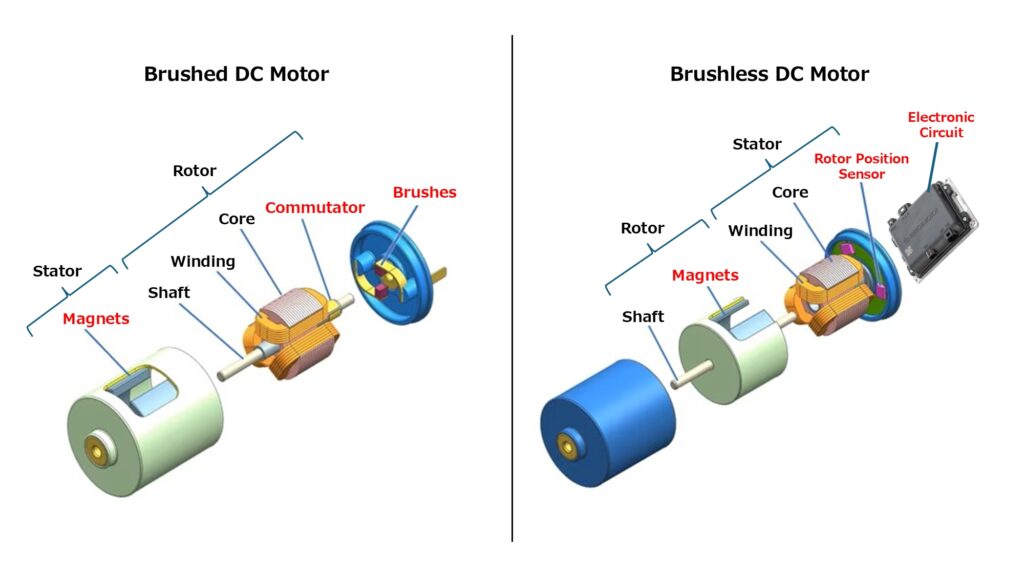
The brushed motor’s commutator performs this switching with zero extra parts; the BLDC offloads it to silicon — which is why a BLDC cannot run from a bare battery without a controller, while a brushed motor can.
Feature Comparison: Brushed vs Brushless DC Motor
| Property | Brushed DC Motor | Brushless DC Motor (BLDC) |
|---|---|---|
| Commutation method | Mechanical (brushes + commutator) | Electronic (controller + position sensor) |
| Winding location | Rotor (armature) | Stator |
| Magnet location | Stator (field coils or PM) | Rotor |
| Typical efficiency | 75–85% | 85–95% |
| Service life | 1,000–5,000 h (brush-limited) | 10,000–30,000+ h (bearing-limited) |
| Max continuous speed | ~5,000–10,000 rpm (up to ~18,000) | 50,000–120,000 rpm possible |
| Control complexity | Direct DC voltage; no controller | 3-phase ESC / servo drive required |
| Electrical noise (EMI) | High — brush arcing | Low — no arcing (only PWM switching) |
| Torque ripple | Low (mechanical commutation) | 14% (block) → ~1–2% (FOC) |
| Sealed / cleanroom use | Limited — carbon dust, sparks | Excellent — fully sealable |
| Explosive atmosphere | Not recommended (ignition risk) | Acceptable with proper IP rating |
| Motor unit cost | Lower | Higher (2–3×) |
| System cost (with drive) | Low | Moderate to high |
Where the Losses Live (Why Efficiency Differs)
The headline “brushless is more efficient” is true for most iron-core motors — but it is not universal. maxon’s engineering notes point out that its iron-less core brushed motors have no eddy-current losses (no iron to lose energy in), whereas a BLDC’s stator iron does — and those eddy losses grow with the square of speed. At high rpm, a brushless motor can actually be less efficient than a coreless brushed one. This is exactly why the honest answer to “which is better” is “it depends on duty and speed.”
| Loss mechanism | Brushed | Brushless (iron-core) |
|---|---|---|
| Brush friction & commutation arc | Yes (~2–5% of input) | None |
| Copper (I²R) winding loss | Yes | Yes |
| Iron eddy-current loss | Low (rotor often coreless) | Yes — grows with speed² |
| Controller (switching) loss | None | ~3–10% depending on drive |
| Best efficiency regime | Low-to-mid speed, simple duty | Mid-to-high speed, continuous duty |
Engineering Data: Efficiency, Life, Speed & Torque
These are the numbers an engineer actually uses when specifying. Ranges reflect typical small-to-industrial units; exact values come from each manufacturer’s datasheet (tested per IEEE 112).
| Parameter | Brushed | Brushless (BLDC) | Note / source |
|---|---|---|---|
| Efficiency (typical) | 75–85% | 85–95% | Higher at partial load for BLDC |
| Service life | 1,000–5,000 h | 10,000–30,000+ h | maxon: brushed 1k–3k avg, best 10k; BLDC ~20k h (machinebuilding/maxon) |
| Max continuous speed | ~5k–10k rpm (≤18k) | 50k–120k rpm | BLDC limited only by bearings / balancing |
| Torque constant kₜ | Set by winding | Same formula T = kₜ·Iₐ | Identical EM physics |
| Torque ripple | Low | 14% block → 1–2% FOC | maxon academy: block commutation 14% |
| Stall / starting torque | High (series type) | High with sensored control | See why power tools use brushed |
| Cost multiple | 1× | 2–3× (motor+controller) | Breaks even in 1–4 yrs continuous duty |
Torque Formulas (Identical Physics, Different Loss Path)
Both motor families obey the same DC-machine equations:
- Torque: T = kₜ · Iₐ (kₜ = torque constant, Iₐ = armature/phase current)
- Back-EMF: E = kₑ · ω (kₑ = speed constant, ω = angular speed)
- Terminal relation: V = E + Iₐ·Rₐ (Rₐ includes brush contact drop in brushed; controller drops in BLDC)
The difference is what eats the loss term. In a brushed motor, brush contact drop (0.5–2 V per set) and friction never reach the armature as useful torque. In a BLDC, the controller’s switching loss and stator eddy currents replace the brush loss — and, crucially, the BLDC winding sits in the stator where it can be fan- or frame-cooled, so it runs cooler than rotor-wound brushed coils.
Temperature Limits (IEC 60034-1 / NEMA MG 1)
Both motor classes are rated to the same insulation temperature classes. Because BLDC windings are externally cooled, they typically run several °C cooler at the same output — extending insulation life (the “10 °C halves life” rule).
| Insulation class | Max winding temp | Typical use |
|---|---|---|
| Class B | 130 °C | General-purpose brushed & BLDC |
| Class F | 155 °C | Industrial, inverter-rated BLDC |
| Class H | 180 °C | Harsh-duty, high-power density |
Best Applications for Each Motor Type
The selection is driven by duty cycle, control needs, environment, and total cost — not by which is “newer.”
| Application | Recommended | Why |
|---|---|---|
| Power tools (budget) | Brushed | Lowest cost, no controller, high starting torque |
| Automotive seats / windows / wipers | Brushed | Intermittent, proven, cheap, built-in stops |
| Toys / hobby / door locks | Brushed | Seconds of duty/day; price dominates |
| HVAC blowers / fans | Brushless | Variable speed saves 30–50% energy, quiet |
| Medical / lab pumps | Brushless | No carbon dust, low EMI, long maintenance-free life |
| Robotics / AGV drives | Brushless | Precise velocity, sealed, battery efficiency |
| Drones / UAV props | Brushless (outrunner) | High power-to-weight, 50k+ rpm |
| EV / e-bike drivetrain | Brushless | Range via efficiency + regen braking |
| Explosive / cleanroom | Brushless | No spark, no debris |
Note the irony: brushed motors still win in power tools at the budget end (see why power tools generally use brushed motors), while premium cordless tools have shifted to BLDC for runtime. The market is bifurcating, not simply replacing.
Selection Guide: Brushed or Brushless? (Step-by-Step)
- Define duty cycle. Running 8+ h/day? BLDC’s maintenance-free life and efficiency pay back in 1–4 years. Seconds/day? Brushed wins on price.
- Check speed requirement. Need >10,000 rpm continuously, or 50,000+ rpm? BLDC (brushed commutators bounce and wear past ~10k rpm).
- Assess the environment. Flammable vapor, dust, cleanroom, or sealed enclosure → BLDC (no spark, no carbon debris).
- Evaluate control needs. On/off or basic PWM only → brushed + simple driver. Need precise speed/position → BLDC + encoder/FOC.
- Count the cost layers. Brushed = motor only. BLDC = motor + controller + sensors. Budget the system, not the motor.
- Plan maintenance access. If brushes are hard to reach, the brushed motor’s “cheap motor” advantage evaporates through downtime.
- Size torque with the formulas. Use T = kₜ·Iₐ and V = E + Iₐ·Rₐ; remember brushed Rₐ includes brush drop, BLDC V includes controller drop.
Common Engineering Mistakes When Choosing
| Mistake | Why it hurts |
|---|---|
| Assuming “brushless is always better” | Ignores duty, cost, and the high-speed eddy-loss caveat — over-specs and overspends |
| Comparing motor price only, not system cost | BLDC needs a controller; brushed needs brushes + labor over life |
| Direct drop-in swap brushed → BLDC | Different wiring (2-wire vs 3-phase+Hall), mounting, and drive — a system change |
| Specifying brushed for a sealed enclosure | Carbon dust + spark risk; fails cleanliness/safety requirements |
| Overlooking torque ripple in BLDC | Block commutation’s 14% ripple causes vibration/audible hum in precision drives |
| Forgetting bearing life limits BLDC | “Maintenance-free” is relative — bearings still wear in dusty/vibrating duty |
Troubleshooting: Brushed vs Brushless Failure Modes
| Problem | Likely Cause | Solution |
|---|---|---|
| Brushed: sparking / weak output | Worn brushes, grooved commutator, wrong grade | Replace brush set, resurface commutator, set pressure |
| Brushed: intermittent power | Bouncing brush, worn spring, loose lead | Seat brush, replace spring, tighten lead |
| Brushed: torque loss over time | Commutator film degraded, brush wear | See why a DC motor loses torque |
| BLDC: no start / stutter | Hall sensor fault, open phase, controller error | Test Hall signals, check phase continuity, swap drive |
| BLDC: vibration / hum | Block-commutation torque ripple, cogging | Use sinusoidal/FOC; add cogging compensation |
| BLDC: overheats under load | Controller loss, poor stator cooling, overload | Improve cooling, right-size motor, check PWM frequency |
| Either: insulation failure | Over-temp, moisture, voltage spikes | Megger per IEEE 43; see DC motor troubleshooting |
Frequently Asked Questions
What is the main difference between brushed and brushless DC motors?
The difference is the commutation method. A brushed DC motor switches current in the rotor windings mechanically, using carbon brushes sliding on a commutator. A brushless DC motor puts the windings in the stationary stator and the magnets on the rotor, and switches current electronically through a controller that tracks rotor position. This single change removes the wear part (brushes) but adds a drive electronic.
Which is more efficient, brushed or brushless?
For most iron-core motors, brushless is more efficient: typically 85–95% versus 75–85% for brushed, because there are no brush-friction or commutation-arc losses. The exception is high-speed duty — a coreless (iron-less) brushed motor has no eddy-current losses, while a BLDC’s stator iron losses grow with the square of speed, so at very high rpm the brushed coreless unit can win. Always check the datasheet at your operating point.
Which motor lasts longer?
Brushless lasts far longer in continuous duty: 10,000–30,000+ hours versus 1,000–5,000 hours for brushed, because brush wear — not bearing wear — limits brushed life. maxon cites ~1,000–3,000 h average for brushed (best case 10,000 h) and ~20,000 h for BLDC when run within specification. Brushed motors are designed around planned brush replacement; BLDC life is essentially bearing-limited.
Is a brushless motor always better than a brushed one?
No. Brushless costs 2–3× more (motor + controller + sensors) and adds a failure mode (the drive). For simple, low-duty, cost-critical jobs — door locks, toys, automotive seats, budget power tools — a brushed motor is cheaper, simpler, and perfectly adequate. “Better” depends on duty cycle, speed, environment, and total cost of ownership, not on the technology being newer.
Can you replace a brushed motor with a brushless one directly?
Rarely. A BLDC requires a 3-phase electronic controller and usually Hall sensors or an encoder, whereas a brushed motor runs from two DC wires. Mounting, shaft, and electrical interfaces usually differ too. Plan for a system-level change — motor, drive, and wiring — not a drop-in swap.
Why do brushless motors have torque ripple?
Because electronic commutation is discrete. In simple block commutation the current switches abruptly every 60° electrical, producing a theoretical torque ripple of about 14% (maxon). Sinusoidal commutation / field-oriented control (FOC) with encoder feedback reduces ripple to roughly 1–2%. Brushed motors avoid this because mechanical commutation is effectively continuous — though they trade it for brush wear.
Why Choose Greensky for Brushed & Brushless Motion
Whether your design keeps the brushes or drops them, Greensky supplies both paths from one source, built to IEC 60034 and NEMA MG 1 dimensions so they drop into existing mounts:
- Brushed PMDC motors with documented commutator specs, brush-grade options, and replacement-brush programs for maintenance teams.
- Brushless (BLDC) motors and gear motors with matched Hall sensors and drives — eliminating brush wear, sparking, and commutation maintenance entirely.
- Integrated gear motors that multiply torque at the output shaft, reducing the current (and brush stress) the motor core must handle — see our gearbox vs gear motor guide.
- Flange compatibility: IEC B5/B14 and NEMA C-face with customized pilot diameters — see our motor flange guide.
- Low-MOQ OEM/ODM: small batches for spares programs and custom shaft/encoder configurations.
Related Reading
- What Is a DC Motor? Types, Principle & Formulas
- What Are Motor Brushes? Types & How They Work
- Why Do Power Tools Generally Use Brushed Motors?
- What Causes a DC Motor to Lose Torque?
- How to Troubleshoot a DC Motor: Step-by-Step Guide
- BLDC Motor Disadvantages Engineers Should Know
- AC vs DC Motor: Which to Choose
- Gearbox vs Gear Motor: Differences & Selection
- Why Robotic Arms Need Speed Reducers
- What Is a Motor Flange? IEC vs NEMA Mounting
References
- IEC 60034-1 — Rotating Electrical Machines: Rating and Performance (temperature classes, sparking). webstore.iec.ch/publication/67467
- IEC 60034-30-1 — Efficiency Classes for Rotating Electrical Machines (IE1–IE5). webstore.iec.ch/publication/67784
- NEMA MG 1 — Motors and Generators (safety, thermal, mounting dimensions). nema.org/standards/view/mg-1-motors-and-generators
- IEEE 112 — Standard Test Procedure for Polyphase Induction & DC Motors (efficiency/loss methods). standards.ieee.org/ieee/112/4213
- IEEE 43-2013 — Recommended Practice for Insulation Resistance Testing of Rotating Machinery. standards.ieee.org/ieee/43/4385
- maxon — Brushed vs brushless DC motors (iron-less core efficiency nuance). maxongroup.com/…/brushed-vs-brushless-dc-motors-17012
- maxon academy PDF — EC/BLDC commutation: 14% block ripple, FOC 1–2%, selection criteria. support.maxongroup.com/…/4415181729042
- maxon Support — PWM current ripple, torque ripple, cogging in iron-core BLDC. support.maxongroup.com/…/25308916177436
- machinebuilding.net (maxon motor UK) — How to choose between brushed and brushless DC motors (life, speed, vacuum). machinebuilding.net/ta/t0961.htm
- U.S. DOE — Electric Motor Efficiency Determination & Repair Guidance. energy.gov/eere/amo/articles/determination-electric-motors
