
Are Biomass Pellet Boilers Environmentally Friendly?
[ez-toc]
What Is a Biomass Pellet Boiler?
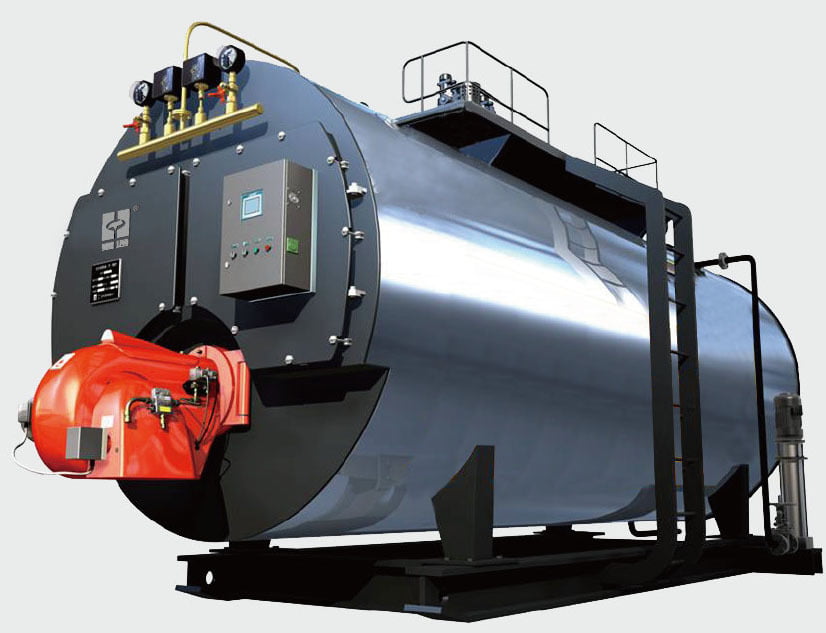
A biomass pellet boiler is a heating appliance that burns compressed organic fuel — usually wood pellets made from sawdust, wood shavings, straw or agricultural residue — to heat water for central heating and hot water. The pellets are dense (density ≥ 1.1 g/cm³), uniform, and flow automatically from a hopper through an auger drive into a combustion chamber, which is what makes pellet units far more automated than hand-fed log boilers.
The core components are:
- Fuel hopper and feed auger — meters pellets into the burn pot. The auger is driven by a geared motor; see our geared-motor overview for why reduction gearing is used here.
- Combustion chamber with controlled primary and secondary air — staged air keeps flame temperature moderate and suppresses thermal NOx.
- Heat exchanger — transfers heat from flue gas to the water circuit.
- Induced-draft fan — pulls combustion gases through the exchanger and up the flue. This fan is an AC motor whose speed is usually set by a variable-frequency drive (VFD) so airflow tracks boiler load.
- Ash removal and emissions control — cyclone or bag filter for PM, sometimes a flue-gas condenser to recover latent heat.
How a Pellet Boiler Differs From a Log or Chip Boiler
| Fuel | Feeding | Automation | Emissions control | Best use |
|---|---|---|---|---|
| Wood pellets | Automatic hopper + auger | High; runs days unattended | Easy — uniform fuel, low moisture | Continuous heat load (homes, factories) |
| Wood chips | Automatic, larger mechanism | Medium | Moderate — variable moisture | Large institutional / district heat |
| Logs | Manual | Low | Hard — operator-dependent | Single-room stoves, backup heat |
How a Biomass Pellet Boiler Works (Step by Step)
- Pellet metering. The hopper auger delivers a metered mass of pellets (typically 6–8 mm diameter) into the burn pot at a rate set by the controller.
- Ignition. An electric igniter or hot-surface element lights the bed; within minutes the boiler reaches control temperature.
- Staged combustion. Primary air feeds the flame; secondary air injected above the flame completes combustion at a controlled temperature, limiting NOx and unburned carbon.
- Heat transfer. Hot gases pass over the heat-exchanger surfaces, heating the water loop. Flue-gas temperature at the exchanger exit typically sits at 120–180°C.
- Draft control. The induced-draft fan, governed by a drive controller, holds the correct negative pressure so combustion stays stable as load changes.
- Emissions cleanup. A cyclone or bag filter drops particulate matter; in condensing designs, a flue-gas condenser recovers latent heat and can lift seasonal efficiency above 90%.
- Ash handling. Bottom ash is removed periodically; modern units are often self-cleaning.
Feature Comparison: Pellet vs Gas, Oil, Coal, Log and Heat Pump
The honest environmental verdict has to be a comparison, because “friendly” is relative. The table below uses typical published values for well-tuned systems.
| System | Lifecycle CO2 (kg/kWh heat) | On-site NOx | On-site PM | Efficiency | Notes |
|---|---|---|---|---|---|
| Biomass pellet (modern, EN 303-5 class 5) | ~0.02–0.06* | Low–moderate | Low (if filtered) | 80–90%+ | *biogenic CO2 reabsorbed; small lifecycle tail from farming/pelletizing/transport |
| Natural gas condensing | ~0.20 | Very low | Negligible | 89–95% | Fossil CO2 not recovered |
| Heating oil | ~0.27 | Very low | Negligible | 85–92% | Fossil CO2 not recovered |
| Coal (legacy) | ~0.30+ | High | High (SO2, ash) | 60–75% | Worst on every axis |
| Log stove (open) | ~0.02–0.06* | High | High | 50–70% | Dirty combustion, indoor + outdoor PM |
| Air-source heat pump | ~0.04–0.09** | None on-site | None on-site | up to 300–400% (COP 3–4) | **depends on grid carbon intensity |
Source basis: IEA and IRENA lifecycle ranges for solid biomass vs fossil heating; EU Ecodesign and EN 303-5 emission frameworks; Energy Saving Trust consumer comparisons. Exact figures vary with fuel origin, moisture, and grid mix.
Engineering Data: Efficiency, Emissions Limits and Combustion Math
Efficiency and the EN 303-5 / Ecodesign Benchmarks
Modern pellet boilers reach 80–90% seasonal efficiency (LHV basis). In the EU, two standards frame the “how clean” question:
- EN 303-5:2012 sets emission classes (3, 4, 5) for solid-fuel boilers. The strictest, class 5, limits dust/PM to around 20–30 mg/m³ (at 13% O2) and organic gaseous carbon (OGC) to ~20 mg/m³, with CO limits tightening by class.
- EU Ecodesign Regulation (EU) 2015/1189 caps local-space-heater emissions at PM ≤ 40 mg/m³ (ns) and OGC ≤ 120 mg/m³, and sets minimum seasonal space-heating efficiency — the compliance floor for appliances sold in the EU.
| Metric | EN 303-5 class 5 (typical) | Ecodesign 2015/1189 (floor) |
|---|---|---|
| Particulate matter (PM) | ≤ 20–30 mg/m³ | ≤ 40 mg/m³ (ns) |
| Organic gaseous carbon (OGC) | ≤ 20 mg/m³ | ≤ 120 mg/m³ |
| Carbon monoxide (CO) | class-dependent, tens–hundreds mg/m³ | referenced via EN 303-5 |
| Seasonal efficiency | 80–90%+ | minimum set by regulation |
Pellet Fuel Quality (ISO 17225-2)
Pellet grade drives both efficiency and emissions. Premium-grade wood pellets per ISO 17225-2 are: moisture ≤ 10%, ash ≤ 0.7%, net calorific value ~16.5–19 MJ/kg (about 3,950–4,550 kcal/kg). High ash or moisture raises PM and slagging and drops usable heat.
| Grade (ISO 17225-2) | Moisture | Ash | Net calorific value | Use |
|---|---|---|---|---|
| A1 (premium) | ≤ 10% | ≤ 0.7% | ~16.5–19 MJ/kg | Automated boilers, clean combustion |
| A2 | ≤ 10% | ≤ 1.5% | ~16.3–19 MJ/kg | Standard automated use |
| B | ≤ 10% | ≤ 3.0% | ~15.5–18 MJ/kg | Less sensitive / larger plant |
Combustion Heat Calculation
The usable heat from a boiler is the fuel energy times efficiency:
Q_useful = m_fuel × LHV × η
where m_fuel is pellet mass flow (kg/h), LHV the lower heating value (kJ/kg), and η boiler efficiency. For a pellet LHV of ~17,000 kJ/kg and η = 0.88, each kg of pellets yields ~15,000 kJ of usable heat.
Flue-Gas Temperature and Corrosion Limit
Keep flue-gas exit above the acid-dew-point to avoid cold-end corrosion. Biomass pellets are very low in sulfur, so the dew point is low (~90–110°C), but operators still hold exit temperatures at 120°C or higher. In one documented retrofit (see case study below), adding an air preheater cut exhaust from 240°C to below 150°C while raising boiler efficiency by 6 percentage points — a reminder that “hotter flue” is wasted heat, not better combustion.
Best Applications for Biomass Pellet Boilers
| Application | Why pellets fit | Watch-outs |
|---|---|---|
| Industrial process steam / drying | Continuous load; displaces coal or gas at lower carbon; automation suits 24/7 operation | Ash handling, alkali-metal slagging on superheaters |
| District / campus heating | Large, steady demand amortizes capital; central filtration controls PM | Fuel storage and delivery logistics |
| Rural / off-grid buildings | Independent of gas grid; local fuel supply | Dry fuel storage required |
| Greenhouses & agricultural heating | CO2 from flue can aid plant growth; waste heat reused | Local air-quality permits |
| Replacing legacy coal boilers | Biggest CO2 and SO2 cut; often mandated by clean-air policy | Retrofit of combustion and draft systems |
Step-by-Step Selection Process (with a Worked Example)
Sizing a pellet boiler is about matching peak thermal demand without grossly oversizing, because an oversized fixed-rate biomass boiler runs at part-load where combustion is dirtier and standby losses grow.
Procedure
- Define the heat load. Sum space heating, DHW, and process heat at design conditions (kW or kJ/h).
- Add losses. Include distribution and standby losses (typically +10–20%).
- Pick boiler output. Target ~110–120% of peak; use a buffer tank instead of a 2× oversize.
- Size fuel feed. Convert heat demand to pellet mass via
m = Q / (LHV × η); confirm hopper/auger duty with a stepper or geared feed drive. - Specify draft. Size the induced-draft fan and its VFD to the flue-gas volume at peak, with modulation down to ~30% load.
- Confirm emissions compliance. Verify EN 303-5 class and Ecodesign limits for your market; budget for PM filtration.
Worked Example — Grain Drying
Given: dry 2,000 kg/h of grain from 25% to 14% moisture (wet basis); latent heat of vaporization at ~60°C ≈ 2,358 kJ/kg; boiler η = 0.88; pellet LHV = 17,000 kJ/kg.
1. Water removed: mw = 2000 × (0.25 − 0.14) / (1 − 0.14) = 2000 × 0.1285 ≈ 257 kg/h.
2. Evaporation duty: 257 × 2,358 = 606,000 kJ/h = 168 kW (thermal).
3. With 15% system losses: 168 × 1.15 ≈ 193 kW needed at the water side.
4. Fuel input: 193 / 0.88 = 219 kW into the boiler.
5. Pellet mass flow: 219 × 3,600 / 17,000 ≈ 46 kg/h.
Result: specify a ~200–250 kW boiler (right-sized) and an auger rated for ~50 kg/h pellets. Do not install a 400 kW unit — at 30–40% part-load it falls below its clean-combustion modulation range, raising CO/PM and wasting fuel on idle. A buffer tank absorbs load swings so the boiler can run near its efficient band.
Common Engineering Mistakes
- Wet or off-spec fuel. Moisture > 10% tanks efficiency and spikes PM and CO; non-premium ash accelerates slagging.
- Undersized draft / wrong fan control. A fixed-speed induced-draft fan cannot follow load; a VFD is the standard fix and typically pays back fast in fan energy.
- Flue-gas below dew point. Letting exit temperature sag under ~120°C invites corrosion and condensation in the stack.
- Ignoring alkali-metal deposition. Biomass ash is rich in alkali chlorides that condense on superheater tubes, forming hard sulfate deposits. This is the single biggest availability killer in industrial biomass boilers (see case study).
- No PM filtration. Relying on a bare flame to meet EN 303-5 / Ecodesign limits almost always fails; budget a cyclone or bag filter.
- Oversizing. See the selection example — part-load operation defeats clean combustion.
Troubleshooting: Problem → Cause → Solution
| Problem | Likely cause | Solution |
|---|---|---|
| Low efficiency / high fuel use | Wet fuel, air-fuel imbalance, excessive flue-gas temperature | Verify pellet moisture ≤ 10%; tune secondary air; add/check air preheater |
| High exhaust temperature | Inadequate heat-transfer area, soot fouling | Clean exchanger; add economizer / air preheater; check draft |
| Slagging & alkali deposits on tubes | Alkali chlorides from ash condensing on hot surfaces | Add soot-blower / shot-cleaning; lower flame temp; blend fuel; manage sulfur |
| High PM in flue gas | No/blocked filter, poor combustion, wet fuel | Service cyclone/bag filter; tighten combustion; use ISO 17225-2 premium pellets |
| CO spikes | Incomplete combustion, insufficient O2, part-load operation | Raise secondary air; avoid deep part-load; check ignition and control loop |
| Ignition failure / flameout | Pellet bridge in hopper, auger fault, weak igniter | Inspect auger motor and gearbox; clear bridge; test igniter |
| Excessive fan energy use | Oversized fixed-speed induced-draft fan (“big motor, small load”) | Retrofit VFD on the draft fan motor |
Real-World Case Study: Coal-to-Biomass Retrofit
One documented industrial retrofit converted a coal-water-slurry boiler (actual efficiency ~66%, high SO2/NOx) to an 8 t/h biomass pellet boiler. Key engineering outcomes:
- Emissions: SO2 dropped to ~2.86 mg/m³ (vs hundreds of times higher for coal) without any desulfurization plant, because pellet sulfur content is negligible.
- Alkali deposition fixed: a steel-shot ash-cleaning system on the heat-exchanger bundle, run automatically, restored heat transfer and extended superheater life.
- Fan energy: fitting a variable-frequency drive to the induced-draft fan motor saved over 80,000 kWh/year by matching fan speed to boiler load — the classic “big-motor-small-load” correction.
- Waste heat: an added air preheater cut exhaust from 240°C to <150°C, raising efficiency by ~6 points; condensate recovery saved ~220 t of standard-coal equivalent per year.
- Circular economy: ash and wastewater were turned into hollow bricks, closing the residue loop.
This is the kind of operational evidence that separates a marketing claim from an engineering verdict — biomass boilers can be clean and efficient, but only with the right fuel, draft control, and deposit management.
Frequently Asked Questions
Are wood pellets carbon neutral?
On a sustainable-fuel basis, yes — the CO2 released when pellets burn is re-absorbed as new trees or energy crops grow, so the biogenic carbon is cyclic. A small non-biogenic tail remains from growing, pelletizing, and transporting the fuel. If the wood is sourced unsustainably (e.g., clearing old-growth forest), the claim breaks down.
Do pellet boilers produce NOx and particulate matter?
Yes. They emit far less than log stoves or coal, and a modern EN 303-5 class 5 / Ecodesign-compliant unit with filtration keeps PM very low, but they are not zero-emission. Staged combustion and PM filters are what make the difference.
How do pellet boilers compare to gas boilers on emissions?
Gas wins on local air quality (virtually no NOx or PM on-site) but pellet wins on CO2 because gas is a fossil fuel whose carbon is not recovered. Pellet efficiency (80–90%) is comparable to a condensing gas boiler.
Are pellet boilers better than heat pumps?
For total emissions, usually not — a heat pump moves heat with electricity and can reach 300–400% efficiency, so its lifecycle emissions depend mainly on grid carbon intensity. Pellets are the stronger choice where grid power is dirty, fuel is locally abundant, or process heat (steam) is needed.
What emissions standards apply to pellet boilers?
In the EU, EN 303-5 classes the boiler by PM/OGC/CO limits, and Ecodesign Regulation (EU) 2015/1189 sets the compliance floor for solid-fuel space heaters. Fuel quality is governed by ISO 17225-2. In the US, the EPA certifies residential wood heaters under its NSPS (Method 28).
How efficient are biomass pellet boilers?
Well-tuned modern units run 80–90% (LHV), and condensing designs with flue-gas recovery can exceed 90% seasonal efficiency — in the same league as condensing gas boilers, and well above legacy coal or open log stoves.
Can I use a pellet boiler in a smoke-control area?
Only if the appliance is approved for that designation (e.g., Ecodesign-compliant, low-emission models). Always check local authority approval before installation; an uncertified unit is typically prohibited in smoke-control zones.
Why Choose Greensky?
Greensky supplies the electric drive subsystems that make a biomass boiler run clean and automatic — not the firebox, but everything around it that engineers actually struggle with:
- Induced-draft fan drives. Our AC motors paired with VFDs let the fan track boiler load, cutting fan energy (the retrofit above saved 80,000+ kWh/year) and stabilizing combustion.
- Fuel-feed augers. Geared and BLDC or stepper feed drives with the right reduction — see our gearbox guide — meter pellets precisely for clean combustion.
- Full motor family. BLDC, brushed DC, AC, and geared versions, selected by calculation, not catalogue.
- Custom and OEM. Through custom motor development and OEM/ODM programmes, we match shafts, flanges (see our flange guide) and ratios to your boiler platform — usually faster than forcing a standard part to fit.
For the broader drive landscape, start with our electric motor basics guide or our BLDC basics and servo motor pages.
Related Resources
- AC motors for draft fans and pumps
- Motor controllers and VFDs
- Brushless DC motor range
- Geared motors and reducers
- Electric motor basics: types and selection
- BLDC basics: commutation, Kv, and sizing
- Servo motors explained
- Custom motor development
- OEM/ODM motor programmes
References and Standards
- US EPA — Burn Wise (wood smoke and residential combustion): https://www.epa.gov/burnwise
- US EPA — Residential Wood Heaters (NSPS, Method 28): https://www.epa.gov/residential-wood-heaters
- EU — Ecodesign Regulation (EU) 2015/1189 for solid-fuel local space heaters (EUR-Lex): https://eur-lex.europa.eu/legal-content/EN/TXT/?uri=CELEX:32015R1189
- ISO — ISO 17225-2:2021 Solid biofuels — Fuel specifications and classes (wood pellets): https://www.iso.org/standard/74552.html
- HETAS — UK solid-fuel appliance certification and biomass boiler guidance (EN 303-5 / Ecodesign compliance): https://www.hetas.co.uk/
- IEA Bioenergy — Technology collaboration programme: https://www.ieabioenergy.com/
- IEA — Bioenergy topic (lifecycle and deployment): https://www.iea.org/energy-system/renewables/bioenergy
- IRENA — Bioenergy technology brief: https://www.irena.org/Energy-Transition/Technology/Bioenergy
- US DOE — Bioenergy Technologies Office (bioenergy and efficiency): https://www.energy.gov/eere/bioenergy
- Energy Saving Trust — Biomass advice (UK consumer comparisons): https://energysavingtrust.org.uk/advice/biomass/
- Siemens Energy — Power plants and biomass generation: https://www.siemens-energy.com/global/en/offerings/power-generation/power-plants.html
- Fröling — Biomass boiler manufacturer (emissions technology): https://www.froeling.com/
- Viessmann — Biomass / wood-fired heating systems: https://www.viessmann.com/
Content reviewed by Greensky’s application engineering team. Figures are typical published values; confirm against the cited standards and your local regulations before specification.
