
Quick Answer
The world’s top bearing manufacturers are dominated by eight global players — SKF, Schaeffler (FAG/INA), NSK, NTN, Timken, JTEKT, MinebeaMitsumi and NACHI — which together hold roughly 75% of the high-end bearing market.
- What Are Bearing Companies and Why They Matter to Your Motor
- Top 10 Bearing Companies in the World
- Bearing Types at a Glance
- How to Choose a Bearing Company: Step-by-Step
- Matching Bearing Brands to Applications
- Common Mistakes When Selecting Bearing Suppliers
- Bearing Problem → Cause → Solution
- Why Choose Greensky Power
- Related Resources
- References
- Frequently Asked Questions
What Are Bearing Companies and Why They Matter to Your Motor
A bearing company designs and manufactures the rolling elements that let a shaft spin with minimal friction. In a motor or gearbox, bearings carry the radial and axial loads, set the shaft position, and largely determine how long the drive lasts.
The global rolling bearing market is worth roughly USD 90–100 billion, and the top six manufacturers alone account for more than half of it. That concentration matters: the brand you specify determines the data available to you, the tolerances you can expect, and the supply chain resilience behind your product.
A useful distinction before the list: a bearing manufacturer designs and produces bearings under its own quality system, while a bearing distributor resells them. For critical applications, you want a manufacturer or an authorized partner — not an unverified trading company.
Top 10 Bearing Companies in the World
The ranking below uses four verifiable criteria: global market share, disclosed revenue, product breadth, and OEM/aftermarket footprint. Figures are the latest disclosed fiscal-year results (see References for sources).
| Rank | Company | HQ | 2025 Revenue (approx.) | Market Share | Core Strength |
|---|---|---|---|---|---|
| 1 | SKF (AB SKF) | Gothenburg, Sweden | SEK 91.6 bn (~USD 8.7 bn) | ~17.7% | Broadest portfolio, condition monitoring, wind & aerospace |
| 2 | Schaeffler (FAG / INA) | Herzogenaurach, Germany | EUR 23.5 bn (group) | ~13% | Automotive, needle roller, EV drive systems |
| 3 | NSK Ltd. | Tokyo, Japan | JPY 796.7 bn (~USD 5.4 bn) | ~13.3% | Precision & high-speed bearings, machine tools |
| 4 | NTN Corporation | Osaka, Japan | ~USD 6.2 bn | ~10.7% | Wheel hubs, tapered roller, agricultural |
| 5 | Timken Company | North Canton, Ohio, USA | USD 4.58 bn | ~5–6% | Tapered roller bearings, heavy industry |
| 6 | JTEKT (Koyo) | Osaka, Japan | ~USD 4.8 bn | — | Automotive bearings, steering systems |
| 7 | MinebeaMitsumi (NMB) | Tokyo, Japan | ~USD 9 bn (group) | — | Miniature & precision ball bearings |
| 8 | NACHI-Fujikoshi | Toyama, Japan | ~USD 2 bn | — | Machine tools, robotics, hydraulics |
| 9 | C&U Group | Hangzhou, China | ~USD 1.5 bn | — | High-volume standard & automotive bearings |
| 10 | RBC Bearings | Oxford, Connecticut, USA | ~USD 1.6 bn | — | Thin-section, aerospace, defense |
An important 2026 update: NSK and NTN signed a merger memorandum in May 2026, with a target closing in October 2027. Combined, the new entity would hold roughly 24% of the global bearing market — overtaking SKF as the largest bearing manufacturer in the world. If you are running a long-term sourcing strategy, this is the single biggest structural change to factor in.
SKF — The Portfolio Leader

Founded in 1907 in Gothenburg, SKF (Svenska Kullagerfabriken, “Swedish Ball Bearing Factory”) invented the self-aligning ball bearing and remains the world’s largest bearing manufacturer by revenue. It offers more than 20,000 standard catalogue items, from miniature bearings weighing a few milligrams to spherical roller bearings of several tonnes.
For motor and gearbox engineers, SKF’s value is data depth: every catalogue entry publishes C, C0, limiting speed, and clearance data, plus its Explorer and INSOCOAT (electrically insulated) ranges address bearing currents in inverter-driven motors.
Schaeffler (FAG / INA) — The Automotive and Precision Powerhouse
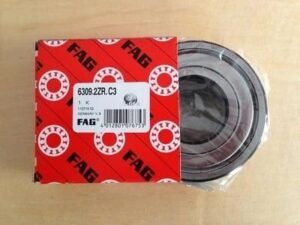
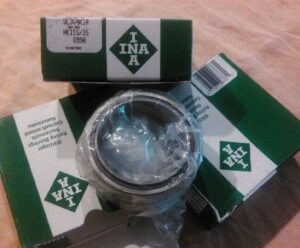
Schaeffler Group, headquartered in Herzogenaurach, Germany, operates the FAG (ball and roller bearings, est. 1883) and INA (needle roller bearings, est. 1946) brands. FAG’s X-life range raises dynamic load ratings through improved raceway geometry and surface finish.
For electric motor bearings, FAG and INA publish insulated variants and high-speed spindle grades that matter when PWM inverter drives induce shaft voltages.
NSK — Precision and High-Speed Specialist
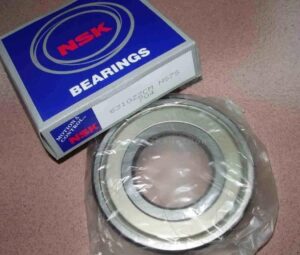
NSK, founded in 1916 as Japan’s first bearing manufacturer, is strongest in precision and high-speed applications: machine tool spindles, semiconductor equipment, and electric motors. Its HPS (High Performance Standard) and Spacea series target low noise, high precision, and long life.
NSK’s materials engineering — Z steel, VAR vacuum-refined steel, and EP steel — is a genuine differentiator for high-reliability applications.
NTN — Wheel Hubs and Heavy Duty
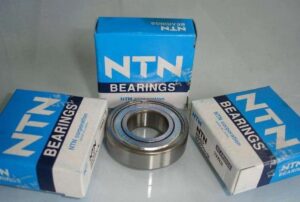
NTN, established in 1918 and headquartered in Osaka, is one of Japan’s three largest bearing makers. Its ULTAGE long-life series and wheel hub assemblies are widely specified in automotive and agricultural equipment. NTN’s strength is in tapered roller and wheel-end bearings for load-heavy, contaminated environments.
Timken — Tapered Roller Reference
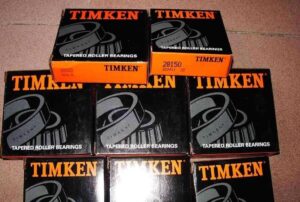
Founded in 1899 by Henry Timken, the inventor of the tapered roller bearing, Timken is the global reference for that type. Headquartered in North Canton, Ohio, it serves heavy industry, mining, rail, and aerospace. Timken acquired Torrington in 2003, adding needle roller bearings to its portfolio.
JTEKT (Koyo), MinebeaMitsumi (NMB), NACHI, C&U, RBC
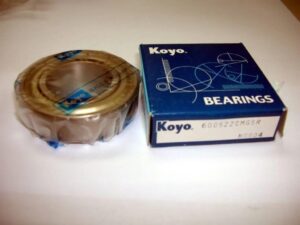
- JTEKT (Koyo): formed from the merger of Koyo Seiko and Toyota Machine Works; a major automotive bearing and steering supplier.
- MinebeaMitsumi (NMB): the leader in miniature ball bearings for electronics, medical devices, and robotics.
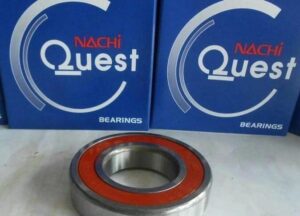
- NACHI-Fujikoshi: strong in machine tools, robotics, and hydraulic equipment in addition to bearings.
- C&U Group: China’s largest bearing manufacturer, competitive on high-volume standard and automotive bearings.
- RBC Bearings: specialist in thin-section, self-lubricating, and aerospace-grade bearings.
Bearing Types at a Glance
Before comparing brands, confirm you are comparing the right bearing type. The table below maps the common types to their load capacity, speed capability, and typical motor and gearbox applications.
| Bearing Type | Radial Load | Axial Load | Max Misalignment | Speed Capability | Typical Use |
|---|---|---|---|---|---|
| Deep groove ball | Excellent | Moderate (both directions) | 2–10 arc minutes | High | General electric motors, fans, pumps |
| Angular contact ball | High | High (one direction) | ~2 arc minutes | Very high | Machine tool spindles, EV traction motors |
| Self-aligning ball | Moderate | Low | Up to 3° | Moderate | Long shafts, textile, agricultural machinery |
| Cylindrical roller | Very high | Low | Low | High | Gearbox shafts, compressors |
| Tapered roller | Very high | High (one direction) | Low | Moderate | Wheel hubs, gearboxes, heavy industry |
| Spherical roller | Very high | Moderate | Up to 2° | Low–moderate | Crushers, rolling mills, wind main shafts |
| Needle roller | High (small envelope) | Low | Very low | Moderate–high | Gearboxes, transmissions, compact assemblies |
| Thrust ball / roller | Low | Very high (one direction) | Very low | Low–moderate | Vertical shafts, extruders, crane hooks |
Two rules follow from this table. First, if a load is purely axial, the deep groove ball bearing is the wrong family — use a thrust bearing. Second, if the shaft will deflect or the mounting is imprecise, a self-aligning or spherical roller bearing prevents edge stress that destroys a rigid type.
Precision Grades and What They Cost
Bearing precision is graded by ISO 492 (dimensional and running accuracy). Higher grades cost more and matter only where the application demands them.
| ISO Class | ABEC (US) | Max Radial Runout (50 mm bore) | Typical Application |
|---|---|---|---|
| Class 0 | ABEC 1 | 20 µm | General electric motors, conveyors, fans |
| Class 6 | ABEC 3 | 10 µm | Pumps, standard machine tools, gear motors |
| Class 5 | ABEC 5 | 5 µm | Precision gearboxes, robotics |
| Class 4 | ABEC 7 | 4 µm | High-speed machine tool spindles |
| Class 2 | ABEC 9 | 2.5 µm | Instrument and ultra-precision spindles |
For most motor and gearbox products, Class 6 (ABEC 3) or Class 0 is sufficient. Specifying Class 5 or better on a standard gear motor multiplies bearing cost with no measurable gain in service life — precision pays back only where runout directly affects the end product, such as a spindle that must hold a micron-level tolerance.
Sealing and Lubrication Selection
Sealing and lubrication determine real-world life far more than the brand name does. Use the table below to match the seal to the environment.
| Environment | Recommended Seal | Lubrication | Notes |
|---|---|---|---|
| Clean, dry, maintainable | ZZ metal shield or open | Grease or oil | Lowest friction, highest speed |
| Dusty, outdoor | 2RS contact seal | Grease (pre-filled) | Seals block particulate ingress |
| Wet or wash-down | 2RS or 2RS + flinger | FDA H1 grease (food grade) | Shields alone will not stop water |
| High speed (>10,000 rpm) | Open or low-friction seal | Oil (oil mist or jet) | Oil removes heat; grease would overheat |
| Vacuum / cleanroom | Low-outgassing seal | Low-outgassing grease | Avoid standard petroleum grease |
| High temperature (>90 °C) | Metal shield + C3 clearance | High-temp synthetic grease | Standard grease life collapses |
One frequently overlooked detail: a 2RS contact seal adds friction and derates the limiting speed, sometimes by 30% or more. If a design needs both speed and protection, a hybrid solution — shielded on one side, sealed on the other — often beats a full 2RS on both sides.
How to Choose a Bearing Company: Step-by-Step
Brand selection should follow the engineering selection, not precede it. Work in this order.
- Define the load. Identify radial and axial loads, including shock factors. Pure radial → deep groove ball bearing. Combined load → angular contact or tapered roller. Misalignment → self-aligning or spherical roller.
- Set the required life. Decide the target L10h life. Typical values: 20,000–30,000 h for gearboxes, 30,000–50,000 h for electric motors, up to 100,000 h for continuous heavy duty.
- Calculate the required dynamic load rating C using the ISO 281 formula below.
- Select the smallest bearing that meets or exceeds C from the catalogue.
- Verify static rating and speed limits (C0 with a safety factor of 1.5–2.0; limiting speed for the chosen lubrication).
- Check the environment — sealing (ZZ shield vs 2RS contact seal), lubrication, and temperature.
- Then choose the brand whose published data, precision grade, and availability best fit that specification.
Worked Example: Selecting a Bearing for a Gear Motor
Consider a gear motor with the following duty:
- Shaft diameter: 30 mm
- Radial load per bearing: 1,200 N
- Axial load: light, treated as zero for the first pass
- Speed: 2,900 rpm
- Target life: 30,000 hours
Because the load is predominantly radial, a deep groove ball bearing is the correct type.
Step 1 — Required dynamic load rating. For a purely radial load, P = Fr = 1,200 N. Using the ISO 281 rearrangement:
C = P × (L10h × n / 16,667)^(1/p)
C = 1,200 × (30,000 × 2,900 / 16,667)^(1/3)
C = 1,200 × (5,220)^(1/3)
C = 1,200 × 17.34
C ≈ 20,800 N
Step 2 — Select a size. A 6206 deep groove ball bearing (30 mm bore) has a basic dynamic load rating C of about 20,300 N — marginally below the requirement. The next size up, 6306 (30 mm bore, C ≈ 29,600 N), clears it with a healthy margin.
Step 3 — Check static and speed limits. The static rating C0 of the 6306 is about 15,600 N; at a static safety factor of 2.0 this covers a peak load up to 7,800 N, well above the expected peak. Limiting speed for grease lubrication is about 11,000 rpm, comfortably above 2,900 rpm.
Result: a 6306-2RS bearing with C3 clearance (for inverter-driven heat and a tight inner-ring fit), one fixed and one floating support. This is the point at which you check which brands — SKF, NSK, Schaeffler, or others — catalogue a 6306-2RS C3 with published C and C0 data.
Counter-intuitive but data-backed: the fastest route to a wrong bearing is matching the bore size and ignoring the axial load factor Y. For a deep groove ball bearing, Y rises sharply as the Fa/C0 ratio grows, so a nominally radial bearing can be loaded well beyond P = Fr. Always compute the equivalent dynamic load P = X·Fr + Y·Fa before sizing.
Matching Bearing Brands to Applications
No single brand wins every application. The table below maps common duty to the brands whose engineering strengths fit best — a practical starting point for a shortlist.
| Application | First Choice | Strong Alternative | Why |
|---|---|---|---|
| General industrial motor | SKF / FAG | NSK | Broad catalogue, complete data |
| Inverter-driven motor (shaft currents) | SKF (INSOCOAT) | FAG insulated / NSK | Insulated bearings prevent fluting |
| Machine tool spindle | SKF Super-precision / FAG X-life | NSK Spacea | Class 4–5 precision, low runout |
| Automotive transmission | FAG / NTN | NSK | High-volume automotive approval |
| Wheel hub bearing | NTN / SKF | Timken | Integrated hub units |
| Heavy industry (mining, mills) | Timken | SKF | Tapered and spherical roller depth |
| Gearbox needle roller | INA | NTN | Needle roller core competence |
| Wash-down / food grade | INA stainless | SKF stainless Y-bearings | Corrosion-resistant stainless |
| Miniature / electronics | MinebeaMitsumi (NMB) | NSK | Miniature ball bearing leader |
| Aerospace / defense | RBC | Timken | Thin-section, AS9100 supply |
| Cost-sensitive high volume | C&U | Regional specialists | Scale economics, adequate quality |
The pattern behind the table: specify by engineering strength, not by habit. A brand that dominates automotive wheel hubs may be overkill — or simply wrong — for a miniature medical pump bearing, and vice versa.
What Actually Drives Total Cost of Ownership
The purchase price of a bearing is the smallest part of its cost. For industrial equipment, the dominant costs are downtime, replacement labour, and lost output. That is why a 12% unit-price saving on a low-cost bearing can be the most expensive decision in the bill of materials.
| Cost Element | Typical Weight in TCO | How Brand Choice Affects It |
|---|---|---|
| Unit purchase price | 5–15% | Lower for economy brands |
| Installation labour | 5–10% | Similar across brands |
| Planned maintenance | 10–20% | Lower with better sealing and lubrication |
| Unplanned downtime | 40–60% | Highest risk with unverified suppliers |
| Energy consumption | 5–15% | Lower friction grades save power over life |
The counter-intuitive conclusion: for high-load, hard-to-replace, or continuous-duty bearings, paying more upfront is usually cheaper over the asset’s life. Reserve cost-driven brand switching for low-load, easily replaced positions where a failure is a nuisance, not a shutdown.
Common Mistakes When Selecting Bearing Suppliers
- Treating brand as the first decision. Brand should follow the specification. Choosing a brand before defining load and life leads to over- or under-sizing.
- Buying on price alone for precision applications. A low-cost substitute can raise field return rates enough to erase years of savings — the failure cost dwarfs the unit saving.
- Skipping ISO 281 life verification. Catalogue size charts are a starting point, not a substitute for a life calculation, especially with contamination or poor lubrication.
- Ignoring the lubrication and contamination factor. Even 0.002% water in the lubricant can cut fatigue life by up to 48%. The aISO factor exists precisely for this.
- Assuming shields are sufficient. ZZ shields block coarse particles only; wet or wash-down environments need 2RS contact seals.
- Overrating precision grades. P5 or P4 costs far more than P0. If P0 meets the application, the extra precision is waste.
Bearing Problem → Cause → Solution
| Problem | Likely Cause | Engineering Solution |
|---|---|---|
| Premature spalling | Insufficient L10 life or overload | Recalculate C; move up a size or series |
| Noise and vibration | Wrong precision or vibration grade | Specify P6/P5 and Z3/Z4 vibration grades |
| Overheating | Excessive speed or over-tight fit | Reduce preload; verify limiting speed and clearance |
| Seal leakage / ingress | Shield instead of contact seal | Switch ZZ → 2RS for wet or dusty duty |
| Electrical erosion (fluting) | Shaft currents in inverter drive | Use insulated bearings (INSOCOAT-type) or ceramic hybrids |
| Axial play after service | Wrong clearance or thermal growth | Re-specify C3 for hot or tight-fit conditions |
Why Choose Greensky Power
Greensky Power designs and manufactures motors and gear motors that integrate bearings into complete drive systems. Because we specify bearings every day for PMDC, BLDC, gear motor, and worm gearbox products, our engineering team can advise on bearing selection, sealing, and clearance as part of the whole drive design.
When you source a gear motor from us, the bearing specification is part of the delivered system — not an afterthought. For OEM programs, we can align bearing brands, precision grades, and lubricants to your approved vendor list and document the selection.
Related Resources
- Top 10 Electric Motor Manufacturers in the World
- Top 10 Popular BLDC Motor Applications & Markets
- What Is a DC Motor? Types, Working Principle & Engineering Formulas
- High Precision Planetary Gearboxes: Backlash, Stiffness and Real Positioning Accuracy
- Benefits of a High Torque Brushless DC Motor
- Custom Brushless DC Motors for Your Application
- Planetary Gear Motor Applications
References
- AB SKF, Annual Report 2025 — SKF Group. https://www.skf.com/group/investors
- Schaeffler AG, Annual Report 2025 — Schaeffler Group. https://www.schaeffler.com/en/investor-relations/
- NSK Ltd., Integrated Report / Financial Results FY2024 — NSK. https://www.nsk.com/company/ir/
- NTN Corporation, Annual Report — NTN. https://www.ntn-corp.co.jp/global/ir/
- The Timken Company, Annual Report 2025 — Timken. https://investors.timken.com/
- JTEKT Corporation, Integrated Report — JTEKT. https://www.jtekt.co.jp/e/ir/
- MinebeaMitsumi Inc., Annual Report — MinebeaMitsumi. https://www.minebea-mitsumi.com/en/ir/
- Market Research Future, Ball Bearing Market — Top Companies & Manufacturers (2025–2035 forecast). https://www.marketresearchfuture.com/reports/ball-bearing-market/companies
- ISO 281:2007, Rolling bearings — Dynamic load ratings and rating life. https://www.iso.org/standard/38124.html
- ISO 76:2006, Rolling bearings — Static load ratings. https://www.iso.org/standard/39049.html
- ISO 492, Rolling bearings — Radial bearings — Dimensional and geometrical tolerances. https://www.iso.org/standard/66779.html
- SKF, Rolling bearings catalogue — Bearing selection and life calculation. https://www.skf.com/group/products/rolling-bearings
- NSK, Bearing Technical Calculation Tool — NSK. https://www.nsk.com/products/
- Schaeffler, FAG Rolling Bearings — Technical Handbook. https://www.schaeffler.com/en/products/
Frequently Asked Questions
Which is the largest bearing company in the world?
SKF is the largest by revenue, with roughly 17.7% of the global market (~SEK 91.6 bn in 2025). However, the NSK–NTN merger, targeted for October 2027, would create a rival holding about 24%.
How do I choose a bearing brand for an electric motor?
Start with the load and required L10 life, calculate the needed C value using ISO 281, then pick the brand that publishes complete C, C0, and speed data for that size. For inverter-driven motors, prefer brands offering insulated bearings.
Are SKF, FAG, NSK, and Timken the same quality?
All four are premium manufacturers with comparable quality systems (ISO 9001, and IATF 16949 for automotive). The practical difference is application fit and catalogue depth: SKF for portfolio breadth, FAG for automotive, NSK for precision, Timken for tapered roller.
What is the difference between a bearing manufacturer and a distributor?
A manufacturer designs and produces bearings under its own quality system; a distributor resells finished bearings. For critical applications, source from a manufacturer or an authorized, traceable partner.
How long should a motor bearing last?
Target 30,000–50,000 hours for electric motors and up to 100,000 hours for continuous heavy-duty applications. Actual life depends on lubrication, contamination, and load — verify with the ISO 281 modified rating life (Lnm).
What does the C3 clearance mean and when should I use it?
C3 is an internal clearance larger than standard (CN). Use it for hot-running applications, tight inner-ring fits, or high-speed motors where thermal expansion would otherwise consume the working clearance.