
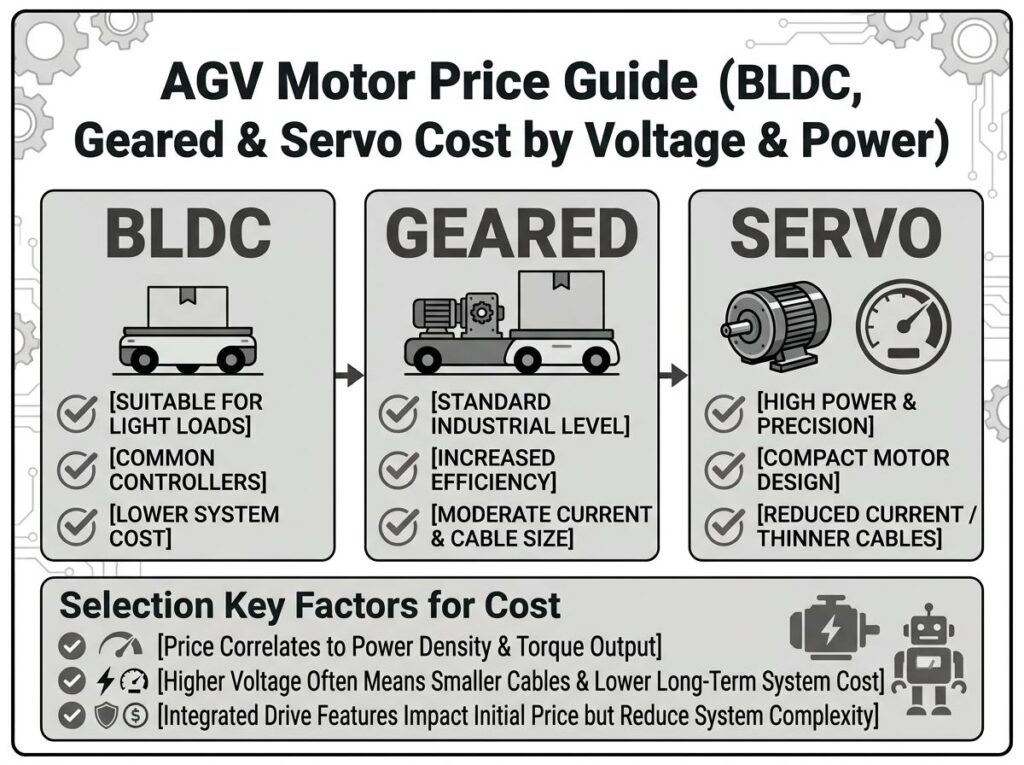
AGV Motor Price Guide: BLDC, Geared & Servo Cost by Voltage & Power
[ez-toc]
What Drives AGV Motor Price?
Before comparing numbers, it helps to separate the five cost levers that set an AGV motor price. Two AGVs can use “a 48 V BLDC” yet quote 4× apart because the rest of the spec differs:
- Topology & feedback — Hall-only BLDC is cheapest; add an encoder + FOC servo firmware and the motor alone rises 1.5–3×. A brushed DC is cheapest of all but is a false economy (see BLDC vs servo).
- Power & voltage — 200 W hub motors start near $70; 60 V 6 kW heavy-traction servos reach $1,400. Voltage itself barely changes motor cost but reshapes harness and battery cost (see our battery-voltage selection guide).
- Duty & insulation class — S1 continuous-rated windings, F/H insulation and IP65+ sealing add material cost versus a light-duty S3 motor.
- Brand tier — Chinese volume OEMs list $70–1,400; Maxon, FAULHABER and Yaskawa precision lines run $140–3,300 because of tight tolerances, medical/cleanroom grades and local support.
- System vs bare motor — The useful unit is the axis (motor + gearbox + encoder + brake + controller), not the bare rotor.
How the Quoted Price Breaks Down
A realistic AGV drive quotation is a stack of five cost blocks. Understanding them prevents the classic “cheap motor, expensive system” trap:
Step 1 — Bare motor
The rotor-stator assembly. Zhibi lists 24/48 V 200–750 W BLDC servos at $136–169, an 80 mm 750 W–1 kW unit at $187–195, and 1–3 kW units at $229–365. Zltech hub motors (24 V, 150 W, 150 kg load) list $95–130, with 10-inch 48 V 800 W 300 kg units at $198–245. These are FOB China volumes; margin, freight and tariffs stack on top.
Step 2 — Gearbox
A planetary reducer (90–95% efficient) adds $20–120 depending on ratio and backlash grade. Helical planets for noise-sensitive hospital use cost more than spur. See our gear vs direct-drive analysis for the TCO trade.
Step 3 — Feedback & brake
Incremental encoder (2,500 PPR) adds ~$15–40; a 17-bit absolute encoder $40–90; an electromagnetic brake $20–60. These are small in dollars but decisive for docking accuracy.
Step 4 — Controller / drive
Zhibi lists single-axis 24/48 V 50 A servo drives at $169–180 and dual-channel 1–10 kW drivers at $415–960. A matched FOC servo drive is where smooth low-speed control—and most of the servo premium—comes from.
Step 5 — Certification & compliance
CE/UL, IP sealing, and (for the U.S.) DOE/NEMA efficiency certification add cost but de-risk import and fleet uptime. From June 1, 2027 the U.S. DOE requires 10 CFR Part 431 IE4 for mid-range motors—specifying IE3 today may force a redesign before export.
AGV Motor Price by Topology & Tier
| Tier / topology | Typical spec | Bare motor (FOB) | Full axis cost | Best fit |
|---|---|---|---|---|
| Hub / inline BLDC (entry) | 24 V, 150–400 W, Hall | $70–160 | $55–155 | Light cart, AGC <300 kg, mechanical-stop docking |
| Standard BLDC servo (mid) | 24/48 V, 400 W–1 kW, encoder + brake | $136–365 | $160–460 | Warehouse AMR, 50–500 kg, SLAM navigation |
| Integrated servo / heavy BLDC | 48–72 V, 1–5 kW, 17-bit, CANopen | $500–1,400 | $500–1,500 (3-axle forklift) | Forklift, 1–3 t pallet, precision handling |
| Premium precision (Maxon / FAULHABER / Yaskawa) | 24–48 V, 150 W–2 kW, medical/clean grade | $140–3,300 | $300–3,500 | Compact, high-reliability, low-noise, tight-tolerance |
| Heavy AC servo (>2 t) | 72–80 V, 2–5 kW, 23-bit, EtherCAT | — | $630–1,780 / axis | Automotive/steel-coil AGV, sub-mm assembly |
These figures synthesize public OEM listings (Zhibi, Zltech, Keya on Made-in-China), Maxon/FAULHABER/Yaskawa catalogue pricing, and GreenSky’s own per-axis system-cost data published in our BLDC vs servo guide. They are indicative FOB/volume ranges, not firm quotes—tariff, freight, MOQ and exchange rate move them.
Engineering Data: TCO, Efficiency, Duty
Efficiency class vs price premium (IEC 60034-30-1)
| IE class | Typical efficiency | Price vs IE3 | Payback at >3,000 h/yr |
|---|---|---|---|
| IE1 (standard) | 82–87% | baseline (phasing out) | — |
| IE2 (high) | 85–89% | ≈ IE3 | rarely justified |
| IE3 (premium) | 90–92% | baseline | — |
| IE4 (super premium) | 93–95% | +15–40% | 1.1–3.0 years |
IE4 motors cost more upfront because of extra copper and low-loss silicon steel, but the winding runs cooler, so bearings and insulation last longer. Siemens SIMOTICS SD ships IE4 across 2.2–1,000 kW at >96% efficiency, and SKF E2 energy-efficient bearings cut friction 30–50% and roughly double grease life—both directly lower fleet TCO. The U.S. DOE will mandate IE4 for mid-range motors from June 2027.
Total cost of ownership formula
Over a 5-year deployment, TCO for one axis is:
TCO = P_motor + P_gear + P_feedback + P_drive + (E_annual × kWh_price × years) + M_years − S_resale
where E_annual = (P_out / η) × hours/yr. The energy term dominates: a 500 W BLDC at 90% efficiency drawing a 1 kW-load-equivalent for 6,000 h/yr at $0.12/kWh costs ~$800 in electricity—versus ~$960 for a 75%-efficient brushed unit. The $160 efficiency gap already exceeds the typical motor price difference.
Duty cycle and the “wrong motor” tax
| IEC 60034-1 duty | Profile | Cost implication |
|---|---|---|
| S1 | Continuous run | Favor IE4; energy dominates TCO |
| S3 / S4 | Intermittent, frequent start-stop | Size RMS torque; brake + thermal rating matter |
| S6 | Continuous with rest | Balance efficiency and duty factor, not peak |
Choosing a motor on peak torque instead of RMS over the real cycle either overpays (oversized) or cooks the winding (undersized → replacement). See our overheating guide for the failure math.
Typical Price Points by AGV Class
| AGV class | Motor config | Voltage | Axis cost | Source basis |
|---|---|---|---|---|
| Light AGC / cart (<300 kg) | Standard BLDC, Hall, PWM | 24 V | $55–155 | GreenSky BLDC-vs-servo Sc.1 |
| Warehouse AMR (50–500 kg) | BLDC servo, FOC, 17-bit | 24/48 V | $160–460 | GreenSky Sc.2 |
| Forklift AGV (1–3 t) | BLDC servo traction + lift | 48 V | $500–1,500 (3 axes) | GreenSky Sc.3 |
| Heavy industrial (>2 t) | AC servo | 72/80 V | $630–1,780 / axis | GreenSky Sc.4 |
| Hub-drive micro-AMR | 24 V 150 W hub BLDC | 24 V | $95–130 (motor only) | Zltech listing |
For full application mapping by robot type, see our warehouse, manufacturing, hospital, airport and logistics motor guides.
How to Specify Without Overpaying
- Fix the duty first. Continuous S1 vs intermittent S3/S4/S6 changes the right motor more than price tier. Match IEC 60034-1 duty before touching the catalogue.
- Calculate RMS torque, not peak. Use our torque calculator over the real cycle; oversizing wastes 30–50% of motor cost.
- Pick the cheapest topology that meets accuracy. Mechanical-stop cart → Hall BLDC ($55–155). SLAM AMR → BLDC servo ($160–460). Sub-mm assembly → AC servo. Don’t pay servo premium for a cart.
- Choose voltage by current, not habit. 48 V is the cost-optimal default for 300 kg–1.5 t; 24 V only for light carts; 60/72 V for 1.5–3 t. See the voltage guide.
- Set the IE class by running hours. Multi-shift or S1 → IE4 (payback 1–3 yr). Single-shift intermittent → IE3. Never buy below the DOE floor for your export market.
- Quotation the full axis. Demand motor+gear+encoder+brake+drive as one number, with efficiency and duty on the nameplate.
- Negotiate on volume and TCO, not sticker. At 500+ units, OEM FOB drops 20–40%; a 2-point efficiency gain saves more across the fleet than any unit discount.
- Verify the standards. Require IEC 60034-30-1 efficiency class, NEMA MG 1-2021 (or DOE 10 CFR 431 for the U.S.) compliance, and IP/thermal rating on the datasheet.
Common Procurement Mistakes
| Mistake | Hidden cost | Fix |
|---|---|---|
| Buying on lowest bare-motor price | Brushed/low-eff. unit → 20% more energy, 30–50% higher 5-yr TCO | Specify BLDC + planetary; compare TCO |
| Over-specifying servo for a cart | 2–3× unnecessary spend | Hall BLDC where docking is mechanical |
| Sizing on peak, not RMS torque | Oversized motor or burnt winding | RMS over real duty cycle |
| Choosing 24 V for a heavy payload | Thick harness, 4× copper loss, larger battery | Move to 48 V at >500 W |
| Ignoring duty class on the nameplate | Premature failure under S3/S4 | Match IEC 60034-1 duty |
| Skipping efficiency certification | Blocked U.S. import after 2027 IE4 rule | Require IE3 now, IE4 for mid-range |
| Forgetting harness & battery in the budget | Low-voltage “saving” erased by cabling | Cost the whole drive system |
Troubleshooting: When the Quote Looks Wrong
| Symptom in the quote | Likely cause | What to do |
|---|---|---|
| Bare motor 3× a competitor | Premium brand (Maxon/FAULHABER/Yaskawa) or medical grade | Confirm tolerance/EMC needs; drop tier if unwarranted |
| Axis cost far below market | Brushed DC or no encoder/brake | Check efficiency, duty, certification |
| 48 V unit pricier than 24 V same power | Higher insulation / controller grade | Normal; recover via smaller harness |
| No IE class stated | Uncertified or below IE3 | Reject for export; demand IEC 60034-30-1 |
| Huge MOQ discount cliff | Tooling amortization | Phase buys; 500+ units unlocks 20–40% |
| Controller cost > motor cost | High-res FOC servo drive | Expected for servo; right-size to accuracy |
| Quote silent on duty | S1-only rating assumed | Demand S3/S4/S6 data for start-stop AGVs |
| IP rating absent for washdown | Standard motor quoted | Require IP65+/IP66 for floor-washed sites |
FAQ
How much does an AGV motor cost?
A single AGV motor ranges from about US $70 for a 24 V 150 W hub BLDC to $1,800+ per axis for a heavy integrated servo; the complete drive axis costs roughly $55–1,780 depending on topology and duty. Buy on TCO, not unit price.
Why does an AGV servo motor cost more than a standard BLDC motor?
A BLDC servo adds encoder, FOC firmware and a matched controller, costing ~1.5–3× a Hall-only BLDC. It buys smooth low-speed control and ±0.5–2 mm docking—needed for SLAM AMRs and forklifts, not for mechanical-stop carts.
Does a higher IE efficiency class raise the AGV motor price, and is it worth it?
IE4 costs 15–40% more than IE3 but is only ~2–5% of lifetime cost; on continuous or multi-shift duty it pays back in 1–3 years and extends component life. IE3 is fine for single-shift intermittent carts. IEC 60034-30-1 classes are the global benchmark; U.S. DOE requires IE4 for mid-range motors from June 2027.
Is 24V, 48V or 60V cheaper for an AGV motor?
The motor isn’t much cheaper by voltage; the harness and battery are. A 1 kW load draws ~42 A at 24 V but ~21 A at 48 V, so 24 V needs thicker cable. 24 V suits light carts; 48 V is the cost-optimal default; 60/72 V for 1.5–3 t heavy traction.
What is the cheapest motor for an AGV and when is it a false economy?
A brushed DC is cheapest (<$50) but false economy: 75% vs 90% efficiency, brush service every 2,000–5,000 h, and $200–500/h fleet downtime. BLDC planetary cuts 5-yr TCO 30–50%; energy saving repays the premium in 12–18 months.
Which manufacturers publish AGV-grade motor prices and data?
Chinese OEMs (Zhibi, Zltech, Keya) list $70–1,400. For precision, Maxon (EC frameless DT 65 S 48 V 290 W €266–346; EC 60 flat 24 V 150 W $138–188), FAULHABER (BX4/BP4, 12–48 V, up to 158 mNm, 91%, −40 to +125 °C) and Yaskawa (Sigma-7, 24-bit, 350% overload) publish full data. Siemens SIMOTICS SD IE4 and SKF E2 bearings complete a low-TCO drivetrain.
Why Choose GreenSky?
Specify the right AGV motor at the right price
GreenSky Power is a Chinese B2B motor manufacturer supplying BLDC, geared and servo drive systems for AGV, AMR and mobile-robot builders worldwide. We publish transparent per-axis cost ranges, match IEC 60034-1 duty and IE3/IE4 efficiency to your real cycle, and support OEM/ODM volumes with CE, IP65+ and NEMA/DOE-aligned documentation. Explore our AGV motor selection guide or talk to our engineering team about an OEM build.
References
- IEC 60034-1:2022 — Rotating electrical machines, Part 1: Rating and performance (duty cycles S1–S10). webstore.iec.ch/publication/83173
- IEC 60034-30-1:2014 — Efficiency classes IE1–IE4 for low-voltage AC motors. webstore.iec.ch/publication/6794
- NEMA MG 1-2021 — Motors and Generators (free download), efficiency & performance. nema.org/standards/view/motors-and-generators
- U.S. DOE, 10 CFR Part 431, Subpart B — Energy conservation standards for electric motors (IE4 from June 1, 2027). ecfr.gov
- IEEE, “Optimizing motor and drives packages for best cost of ownership, performance & reliability,” PCIC 2012, DOI 10.1109/PCICON.2012.6549683. ieeexplore.ieee.org/document/6549683
- IEA, Energy Efficiency 2025 — global motor-system efficiency policy. iea.org/reports/energy-efficiency-2025
- SKF Energy Efficient (E2) deep-groove ball bearings — 30–50% lower friction, 2× grease life. skf.com
- Siemens SIMOTICS SD — IE4 super-premium efficiency (2.2–1,000 kW, >96%). siemens.com
- Maxon EC frameless DT 65 S & EC 60 flat — brushless DC motor pricing & data (48 V 290 W; 24 V 150 W). maxongroup.com
- FAULHABER BX4 / BP4 brushless DC-servomotors — 12–48 V, up to 158 mNm, 91% efficiency, −40 to +125 °C. faulhaber.com
