
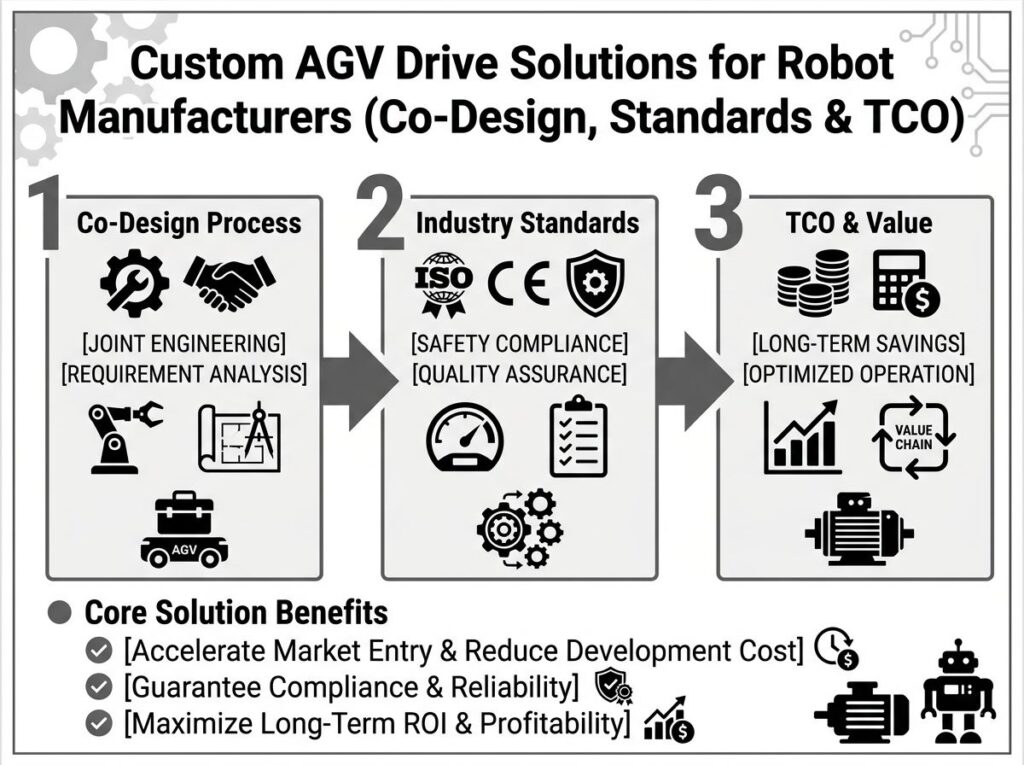
Custom AGV Drive Solutions for Robot Manufacturers: Co-Design, Standards & TCO
Quick Answer: A custom AGV drive solution is a co-engineered traction or steering module built around your robot’s exact envelope, load, duty and bus voltage — integrating the BLDC/servo motor, gearbox, encoder and brake into one calibrated unit validated to IEC 60034-1 duty and an IE efficiency class. Choose custom when the chassis is space-constrained, the duty exceeds S3 40% (or runs S1 24/7), positioning must beat ±2 mm, or ambient/Noise limits are tight. The payoff is a smaller, cooler, quieter module that cuts your assembly and commissioning labor — but only if the duty cycle, thermal class and supplier capability (Cpk ≥ 1.33, dual-source) are specified up front. Co-design typically runs 10–20 weeks; proven module platforms compress that to a fraction.
[ez-toc]
What Is a Custom AGV Drive Solution?
For an AGV or AMR manufacturer, the drive is the single subsystem that decides floor speed, docking accuracy, battery life and — ultimately — whether the robot ships on schedule. A custom AGV drive solution is not a catalogue motor bolted to a wheel. It is a co-engineered mechatronic module specified against your robot’s real operating envelope:
- Mechanical integration — motor + planetary/harmonic gearbox + encoder + brake sized to a fixed wheel-well, axial limit (often <60 mm) and mounting pattern.
- Electrical matching — winding, pole count and Kt/Ke tuned to your 24/48/60 V bus and to the AGV battery voltage you already chose.
- Control co-design — Hall + FOC or encoder servo firmware, current-loop bandwidth and comms (CANopen / EtherCAT) aligned to your motion controller.
- Standards validation — duty cycle per IEC 60034-1, an IE efficiency class, a thermal class, and (for the U.S.) DOE/NEMA efficiency certification.
Contrast this with off-the-shelf: a standard hub BLDC is fastest to integrate and cheapest per unit, but you inherit its envelope, torque curve and duty limit. Motors for AGV summarizes the topology landscape; the decision to customize is driven by constraints, not by a desire for a “better” motor.
How a Custom AGV Drive Is Co-Engineered (5 Steps)
A credible custom-drive program follows a phased co-design loop. Skipping a step is the most common reason robot manufacturers slip their launch:
Step 1 — Duty & envelope profiling
Capture the real mission: payload, gradient, stop frequency, speed profile, ambient, ingress and noise ceiling. Translate it into an IEC 60034-1 duty (S1 continuous, S3 intermittent, S4 with starts, S6 continuous-periodic) and a target thermal class. Communicate the duty explicitly — if you don’t, the supplier defaults to S1 and may under-size the winding (see AGV motor overheating).
Step 2 — Simulation & torque sizing
Derive the wheel torque from the vehicle model, then the motor torque through the gear ratio and efficiency:
T_motor = (F · r) / (ratio · η_gear) where F = m·g·Crr + m·g·sinθ + m·a
Check the RMS torque against the S3/S4 duty, and run a thermal simulation to confirm the hotspot stays under the Class F 155 °C limit. Maxon’s HEJ/HPJ joint program and Yaskawa’s system simulation services are built exactly for this phase.
Step 3 — Prototype build & bench test
Build 3–10 units on the module platform. Bench-test at 100% + 30% overload, log Kt/Ke, cogging, no-load current and encoder linearity. Lock the Bill of Characteristics (BoC) — the dimensions and parameters that, if changed, change the robot’s behavior.
Step 4 — Vehicle integration & field validation
Mount into the chassis; validate docking repeatability, EMC (CISPR 11 Class B for hospitals, IEC 60601-1-2 for medical), low-speed smoothness and thermal rise over a full shift. This is where BLDC-vs-servo trade-offs become concrete.
Step 5 — Tooling, pilot lot & scale
Release tooling, qualify a second source, run a pilot lot at Cpk ≥ 1.33, then ramp. Track on-time delivery (>99% world-class) and DPPM (<500 world-class) from day one — the metrics that keep your line running.
Custom vs Standard vs ODM: When Each Wins
| Approach | Lead time | Unit cost | Design freedom | Best fit |
|---|---|---|---|---|
| Off-the-shelf hub BLDC | 1–3 weeks | Lowest ($70–160 bare) | None — adapt robot to motor | Point-to-point carts <300 kg, mechanical-stop docking |
| Standard BLDC servo module | 2–6 weeks | Low–mid ($160–460/axis) | Mounting only | Warehouse AMR, 50–500 kg, SLAM navigation |
| ODM adapted module | 10–16 weeks | Mid ($220–700/axis) | High — gearbox, encoder, housing | Hospital, airport, manufacturing robots with space/thermal limits |
| Full custom co-design | 16–24 weeks | High ($500–1,800+/axis) | Total — winding to mechanics | Sub-mm assembly, aerospace/defense, unique kinematics |
The cost gap is smaller than it looks once you add the labor a custom module removes from your assembly line. That is the TCO argument developed in our AGV motor price guide.
Engineering Data: Duty, Efficiency, Thermal, Formulas
IEC 60034-1 duty cycles for custom AGV drives
| IEC class | Profile | AGV robot fit | Sizing rule |
|---|---|---|---|
| S1 | Continuous, steady-state | 24/7 line-feeding, conveyor-style AGV | Rated = continuous; no derate |
| S3 | Intermittent, no start effect | Goods-to-person AMR, pick-and-place | Derate by cyclic duration factor (ed%) |
| S4 | Intermittent with starting | Assembly-line feeder, frequent start-stop | Start current heats winding; RMS method |
| S5 | Intermittent with braking | AGV with regenerative braking | Dissipate or recover braking energy |
| S6 | Continuous-periodic (no-load) | Sortation, continuous duty with pauses | Derate by ed%; motor never stops |
| S7 | Continuous with braking | High-cycle handling, tarmac tugs | Start + brake within cycle; no rest |
Thermal & efficiency classes
| Thermal class | Max hotspot | Allowable rise @40 °C | AGV drive use |
|---|---|---|---|
| Class B (130) | 130 °C | 80 K | Light-duty AMR, intermittent |
| Class F (155) | 155 °C | 105 K | Standard for AGV traction |
| Class H (180) | 180 °C | 125 K | Heavy-duty, high-ambient, sealed |
| IE class (IEC 60034-30-1) | Nominal efficiency | AGV drive note |
|---|---|---|
| IE3 (Premium) | 90–92% | U.S. baseline; fine for single-shift |
| IE4 (Super Premium) | 93–95% | Required by U.S. DOE from June 2027 (1–750 HP) |
| IE5 | >95% | PMSM/SynRM; ~20% lower loss than IE4 |
Key formulas for co-design
- Required wheel force:
F = m·g·Crr + m·g·sinθ + m·a - Motor torque through gear:
T_motor = (F · r) / (ratio · η) - RMS (duty) torque:
T_rms = √(Σ(Tᵢ²·tᵢ) / Σtᵢ)— verifies S3/S4 sustainability - Resistance-method temperature rise (IEC 60034-1):
ΔT = (R₂−R₁)/R₁ · (235+T₁) − (T₂−T₁) - Process capability (mass production):
Cpk = min[(USL−μ)/3σ, (μ−LSL)/3σ]— target ≥ 1.33
Manufacturer custom-drive capability (for benchmarking)
| Manufacturer | Custom platform | Key data for AGV co-design |
|---|---|---|
| Maxon | HEJ / HPJ joint modules, EC frameless DT | 0.0002–480 Nm range; up to 86% efficiency; IP67; EtherCAT; simulation & optimization services; TCO focus |
| FAULHABER | BX4 / BP4 / BXT coreless BLDC | 12–48 V; up to 158 mNm, 152 W; 91% efficiency; −40 to +125 °C; optional analog Hall; <74 mm length |
| Yaskawa | Sigma-7 servo + custom gear motors | 50 W–15 kW; 24-bit encoder; 350% overload; 3.1 kHz bandwidth; SIL3/STO; IP67; tailor-made solutions |
| Siemens | SIMOTICS SD (IE4) | High-efficiency IE4 drives for continuous-duty logistics |
| SKF | E2 energy-efficient bearings | Lower friction → cooler, longer-lived AGV drive bearings |
Application Scenarios by Robot Type
The customization vector changes with the robot class. Match the constraint to the engineering response:
| Robot manufacturer segment | Binding constraint | Customization focus |
|---|---|---|
| Warehouse AMR OEM | Throughput, battery life | IE4 BLDC + planetary, S3/S6 duty, low-loss bearings (see motors for warehouse AGVs) |
| Hospital delivery robot OEM | ≤45 dB(A), EMC, clean | Coreless BLDC, FOC, IEC 60601-1-2 / CISPR 11 B (see hospital delivery robots) |
| Airport baggage AGV OEM | S1 24/7, dust/thermal | Heavy BLDC + sealed gearbox, H-class, IP65 (see airport baggage AGVs) |
| Manufacturing line AGV OEM | S3/S4/S7, stop-line cost | High-RMS servo, brake, regen handling (see manufacturing AGVs) |
| Logistics / last-mile OEM | Dynamic response, fleet MTBF | Distributed 24 V bus, modular actuators (see logistics robots) |
| Heavy / AGC OEM (>2 t) | Torque, durability | 72–80 V integrated servo, 23-bit encoder, dual-redundant |
How to Specify a Custom AGV Drive (8 Steps)
- Lock the duty cycle. State S1/S3/S4/S6 and the ed% — never leave it implicit.
- Define the envelope. Wheel diameter, axial limit, mounting pattern, mass budget.
- Compute torque & speed. Use the formulas above; add 30% overload margin for ramp starts (compare with our torque calculation guide and speed/RPM guide).
- Pick the topology. Hub BLDC, geared BLDC, integrated servo or coreless — see gear vs direct-drive and Hall vs sensorless.
- Set the efficiency class. IE3 for single-shift; IE4 to pre-empt the 2027 U.S. DOE rule and cut TCO on continuous duty.
- Specify feedback & comms. Hall+FOC for cost; encoder servo for ±2 mm docking; CANopen/EtherCAT for fleet control.
- Define the BoC & quality gate. Cpk ≥ 1.33, 100% burn-in, second source for motor + encoder.
- Validate thermally. Run a full-shift field test; confirm hotspot < Class F 155 °C and no low-speed cogging at your minimum speed.
Common Customization Mistakes
| # | Mistake | Consequence |
|---|---|---|
| 1 | Leaving duty cycle unspecified | Supplier assumes S1; winding under-sized; field overheating |
| 2 | Optimizing unit price over TCO | Cheap motor burns 8% more energy; payback lost in 12–18 mo |
| 3 | Skipping the RMS torque check | S3/S4 duty exceeds rating; premature bearing failure |
| 4 | No second source | Single-supplier stoppage halts your whole robot line |
| 5 | Ignoring EMC until certification | Redesign late; hospital/auto programs slip months |
| 6 | Under-specifying thermal class | Class B in a sealed wheel cooks the windings |
| 7 | No BoC lock | Silent magnet/winding substitution changes Kt/Ke mid-production |
Troubleshooting: When the Custom Drive Misbehaves
| Problem | Cause | Solution |
|---|---|---|
| Overheats in field, passed bench | Duty was S3 in use, S1 on paper | Re-profile duty; re-wind for ed%; add cooling |
| Low-speed judder / cogging | Hall-only commutation at <100 RPM | Add encoder + FOC, or HFI start (see Hall vs sensorless) |
| Docking drift > ±5 mm | Encoder resolution too low | Upgrade to 17–24-bit absolute encoder |
| Battery drains early | IE3 on continuous S1 duty | Step to IE4; recover regen via S5/S7 brake |
| EMC test fails | Unshielded encoder / no filter | Shield harness, add CM choke, meet CISPR 11 B |
| Lot-to-lot torque drift | BoC not locked; Cpk < 1.33 | Lock winding/magnet spec; enforce Cpk gate |
| Assembly labor too high | Module not integrated | Move to ODM single-module (motor+gear+encoder+brake) |
| Single supplier stockout | No qualified second source | Dual-source motor and encoder; hold safety stock |
FAQ
What is a custom AGV drive solution?
A co-engineered traction or steering module built around your robot’s exact envelope, load, duty and bus voltage — integrating the BLDC/servo motor, gearbox, encoder and brake into one calibrated unit, validated to IEC 60034-1 duty and an IE efficiency class. Off-the-shelf suits generic carts; custom wins when space, weight, noise, thermal or duty is constrained.
When should a robot manufacturer choose custom over off-the-shelf?
When at least two hold: fixed wheel-well below ~60 mm axial; continuous duty beyond S3 40% or S1 24/7; positioning better than ±2 mm; ambient >50 °C or noise <45 dB(A); or you want one integrated module to cut assembly labor. Simple under-300 kg carts are usually fine with a standard hub BLDC.
What IEC and NEMA standards should a custom AGV drive meet?
Specify IEC 60034-1:2022 (duty S1–S10, thermal Class B/F/H), IEC 60034-30-1:2014 (IE3–IE5) and NEMA MG 1-2021 §12.58 (±20%-loss tolerance). For U.S.-bound fleets, design to IE4 now to meet the DOE 10 CFR Part 431 rule from June 1, 2027.
How long does a custom AGV drive development take?
Typically 10–20 weeks across profiling, simulation, prototype, integration and pilot lot. Proven module platforms (Maxon HEJ/HPJ, FAULHABER BX4/BP4, Yaskawa Sigma-7) compress this because only the gearbox, encoder and housing are adapted.
Which manufacturers offer custom AGV drive co-design?
Maxon (custom robotic drive systems, simulation services, HEJ/HPJ joints), FAULHABER (BX4/BP4/BXT coreless BLDC, optional analog Hall), Yaskawa (Sigma-7 servo, tailor-made gear motors), and Chinese drive-wheel specialists (Yikong, Plutools, ZLing) for cost-sensitive ODM. Tier the brand to the duty.
How do we de-risk a custom AGV drive supply chain?
Require ISO 9001 (IATF 16949 / ISO 13485 for auto/medical), demand Cpk ≥ 1.33 on critical dimensions, insist on 100% functional and burn-in data, qualify a second source for motor and encoder, and lock the winding/magnet spec via a Bill of Characteristics.
Why Choose GreenSky?
Co-engineer your AGV drive with GreenSky
GreenSky Power develops custom AGV motors and drive modules for robot manufacturers worldwide — from duty-profiled BLDC and geared servo units to fully integrated wheel modules validated to IEC 60034-1, IEC 60034-30-1 (IE3–IE4) and NEMA MG 1. Our vertically integrated line handles winding, gearbox, encoder and brake in one BoC-locked build, with Cpk ≥ 1.33 quality gates and dual-source options so your production line never waits on a single supplier. Talk to our application engineers about your chassis envelope and duty cycle — most ODM programs reach pilot in under 16 weeks.
References
- IEC 60034-1:2022 — Rotating electrical machines — Part 1: Rating and performance (duty cycles S1–S10, thermal classes). webstore.iec.ch/publication/69035
- IEC 60034-30-1:2014 — Efficiency classes of single-speed, three-phase, cage-induction motors (IE1–IE5). webstore.iec.ch/publication/7097
- NEMA MG 1-2021 — Motors and Generators (§12.58 efficiency tolerance, ±20% losses). nema.org/standards/view/mg-1-2021-motors-and-generators
- U.S. DOE 10 CFR Part 431 — Energy Conservation Standards for Electric Motors (IE4 from June 1, 2027, 1–750 HP). ecfr.gov/title-10/part-431/subpart-B
- IEEE — Hong, F. et al. (2025). “AGV Vehicle Dynamics Optimization in Automated Logistics Warehousing Systems.” ISSMAS. DOI: 10.1109/ISSMAS65783.2025.11102937
- IEEE — Xu, H. et al. (2019). “Design and Implementation of Differential Drive AGV Based on Laser Guidance.” ICRAS. DOI: 10.1109/ICRAS.2019.8808992
- Maxon — Custom robotic drive solutions, HEJ/HPJ joints, EC frameless DT, simulation services. maxongroup.com/…/robotics
- FAULHABER — Brushless DC servomotors BX4 / BP4 / BXT (coreless, 12–48 V, up to 158 mNm, 91% η). faulhaber.com/…/brushless-dc-servomotors
- Yaskawa — Sigma-7 servo systems, 24-bit encoder, 350% overload, tailor-made gear motors. yaskawa.com/…/sigma-7-servo-products
- SKF — E2 energy-efficient deep-groove ball bearings; Siemens — SIMOTICS SD IE4 drives for continuous-duty logistics. skf.com · siemens.com/simotics
