
1000W BLDC Motor Manufacturer
Greensky builds 1000 W brushless DC motors for industrial, EV and OEM programmes: high torque, high efficiency, 48 V / 72 V windings, geared and IP65 variants. This page is written for the engineer and the buyer who has to qualify a supplier, not just pick a part number — so it also shows how the published ratings are checked, what a monthly capacity figure actually implies, and which documents to request before a purchase order.
Professional 1000W Brushless DC Motor Supplier
Our 1000 W BLDC motors are designed for high power applications requiring strong torque, stable operation and long lifespan. They are used in electric vehicles, industrial automation and heavy-duty equipment, and are supplied either as a bare motor or as a matched motor-and-drive package with the controller, harness and Hall wiring configured together.
A 1000 W figure describes input power at a rated point, not the torque available at every speed. That distinction decides whether a motor suits a conveyor starting under load, a pump running continuously, or a vehicle climbing a ramp — three duties that ask for three different windings from the same 1 kW frame.
We build to a drawing rather than to a catalogue page. Winding, shaft, flange, mounting, connector, cable exit and labelling are fixed per order, and the drawing set issued against your application is the controlling document. Anything not fixed in the specification table below is confirmed there, in writing, before tooling.
Three questions that decide the winding
- Continuous torque, not peak watts — the duty that heats the winding is the average, so state the torque a machine holds for hours, plus the peak and how long it lasts.
- Speed at that torque — torque and speed together set the power point. A 1 kW motor asked for its rated torque at half speed is a 500 W motor that will run hot.
- How the heat leaves — a foot-mounted motor on a steel frame, a fan-cooled motor and a sealed hub all dissipate differently, so the same winding carries different continuous ratings.
Seal, connector and cable-jacket materials must be verified against the actual service environment: coolant, wash-down chemicals, hydraulic oil and UV do not attack the same elastomers, and an IP code describes an enclosure test rather than chemical compatibility.
1000W Brushless DC Motor Models
Four builds are produced from the same 1000 W class. The bold line is the published characteristic; the paragraph underneath explains where that choice starts to cost something.
48V 1000W BLDC Motor
High efficiency · Low current loss · EV applications. At 48 V a 1 kW motor draws roughly 23.7 A at the published >88% efficiency, so cable, fuse and connector sizing are all driven by that number. The same winding on 72 V draws about 15.8 A for the same shaft power.
72V 1000W BLDC Motor
Higher speed output · Better performance · Long distance use. A higher bus voltage lowers current and voltage sag at the same power, which helps on long cable runs and steep packs. It does not raise shaft power on its own — the winding must be matched to the new voltage.
Geared 1000W BLDC Motor
High torque output · Low speed control · Heavy load systems. A planetary stage trades speed for torque, so the useful rating moves to the gearbox output shaft. Gear ratio, backlash and the output bearing load become part of the specification, not an accessory.
Waterproof BLDC Motor (IP65)
Outdoor use · Dust & water protection · Long lifespan. IP65 is dust-tight and jet-tested, which suits outdoor and wash-down equipment. The code does not cover immersion, steam cleaning or the connector and shaft seal, so confirm those on the drawing. Seal, cable-jacket and gasket materials must be verified against the actual service environment rather than assumed from the two digits.
All four carry the same 1000 W label and behave very differently on a machine. Ask for the rated torque at the speed you actually run, state whether the figure is at the motor shaft or the gearbox output, and say whether it is continuous or peak.
Checking a 1000 W Rating Before You Trust It
Torque, speed and power are locked together by T = 9550 × P / n, with T in N·m, P in kW and n in rpm. Once two of the three are published, the third is not a free choice. The chart below plots that relationship for 1 kW against the 3000–5000 rpm and 2.5–5 N·m figures carried over from the original page, so the two ranges can be compared on the same axes.
| Speed | Torque at 1 kW | Where it sits |
|---|---|---|
| 1910 rpm | 5.0 N·m | Top of the published window, but below the published 3000 rpm floor |
| 3000 rpm | 3.18 N·m | Bottom of the published speed band; inside the torque window |
| 3820 rpm | 2.5 N·m | Bottom of the published torque window |
| 5000 rpm | 1.91 N·m | Top of the published speed band; below the torque window |
The published figures 2.5–5 N·m and 3000–5000 rpm are carried over from the original page exactly as published, and are not silently corrected here. For a 1000 W machine, T = 9550 × P / n gives about 3.18 N·m at 3000 rpm and 1.91 N·m at 5000 rpm, so both ends of the torque window sit at speeds outside or at the edge of the published speed band. The most likely explanations are that the low-speed end belongs to the geared build at its output shaft, or that the high end is a short-duration peak. We do not guess which. Confirm the measurement point, continuous versus peak and its duration, and whether the speed refers to motor or gearbox output before the winding is frozen.
What 50,000+ Motors a Month Means for Your Order
A monthly capacity figure is only useful if it can be turned into something you can check. Divided by a plausible calendar it becomes a takt time, and that number tells you whether the claim is consistent with a real production line — and how much of that line your own order would occupy.
50,000 a month is about 4 motors a minute
At 25 working days and one 8-hour shift, 50,000 units is 2,000 a day, 250 an hour, roughly one every 14 seconds. Two shifts halves that takt. Ask which shift pattern the figure assumes, because a monthly total quoted on three shifts and a takt quoted on one are different factories.
One number, many models
That output is spread across frame sizes, windings and gearbox variants, so it is a mixed-model line rather than 50,000 identical units. Changeover time between models is what decides whether a small run is cheap or expensive — ask how many changeovers a week the line absorbs.
How much of the line you occupy
A 5,000-unit annual order is about 417 a month, under 1% of the stated output. It will not drive the schedule, which is fine — but it does mean your run has to fit the changeover calendar rather than set it. Plan pilot batches around the mix, not around your own ramp.
| Your annual volume | Monthly equivalent | Share of 50,000 a month | What it changes in the conversation |
|---|---|---|---|
| 1,200 units | 100 a month | ≈0.2% | Sample and pilot quantities matter more than unit price; ask which standard build you can use unmodified |
| 5,000 units | 417 a month | ≈0.8% | Custom labelling and packaging are practical; a dedicated winding is usually not |
| 20,000 units | 1,667 a month | ≈3.3% | A custom shaft or flange and a scheduled production slot start to be worth tooling |
| 60,000 units | 5,000 a month | ≈10% | Line allocation, buffer stock and a documented capacity plan become part of the agreement |
These are arithmetic on the published monthly figure at 25 working days, not a contracted capacity commitment or a quotation. Real output depends on shift pattern, model mix, changeover frequency and material availability at the time of order. Ask for the current figure in writing against your specific model, and for the lead time at your quantity rather than at the headline rate.
Technical Specifications — 1000W BLDC Motor
The published working range for this class, followed by the system interface, the items still to be confirmed, and the documents available today.
| Parameter | Value |
|---|---|
| Rated power | 1000W (1 kW) |
| Voltage | 48V / 72V as published; 24V on request |
| Speed | 3000 – 5000 RPM (as published; measurement point to confirm) |
| Torque | 2.5 – 5 Nm (as published; some values imply the geared output or a peak — see the rating check above) |
| Efficiency | >88% |
| Cooling | Air cooling / optional |
| Protection | IP54 / IP65 |
| Certification | CE / RoHS as published; EMC attestation M:2025.206.C112258 held for the GSBLD DC motor series |
| Build variants | 48 V, 72 V, geared, waterproof IP65 |
| Supply form | Bare motor, or matched motor plus controller and harness |
| Options | Custom voltage, gearbox integration, controller matching, thermal and structure optimisation, custom mounting and shaft |
The datasheet covers the general BLDC series, not a page dedicated to one application variant. Send the torque, speed, duty and mounting you need and we issue a drawing against that build. If a download does not start in a mobile in-app browser, open this page in the system browser and tap again.
Supply and interface — confirm before design freeze
What to ask for · its current status · why it matters on a real machine| Item | Status | Why it is on this list |
|---|---|---|
| Measurement point for torque and speed | Not specified — confirm before design freeze | Motor shaft, gearbox output or after a belt reduction are three different numbers for the same machine. So is continuous versus peak. Without the datum, two quotations cannot be compared and the rating check above cannot be completed. |
| Duty type and ambient | Configured per order | A conveyor that runs all shift and a machine that cycles ten times a minute need different thermal assumptions. Ambient temperature and altitude derate the published rating, so both belong in the enquiry. |
| Winding, Hall and connector pinout | See the BLDC series datasheet | Phase and Hall order must match between motor and drive; reversing either way will not run correctly. Connector type decides whether the harness plugs in or is spliced in the field. |
| Controller matching | Issued with the matched drive per order | A motor and a drive bought separately can both be correct and still not work together. Current limit, commutation mode and speed-command range have to be set for this winding. |
| Gear ratio, backlash and output bearing load | Not specified for the geared build — confirm per order | On a geared motor the useful rating is at the output shaft, and the radial load the gearbox output bearing accepts limits overhung pulley or pinion loads. Those values change with the ratio chosen. |
| Shaft, flange and mounting drawing | Issued against your drawing per order | Shaft diameter, keyway, pilot and hole pattern decide whether the motor drops into your machine or needs an adaptor plate. This is the most common cause of a second sample round. |
| Test report and certificate pack | Per batch; certificate numbers issued per project | Which tests were run, at what load point and against which standard is what an incoming inspection compares against. A logo alone is not a test record. |
Applications of 1000W BLDC Motors
Four application families, each with the one specification that decides whether the build works.
Electric Vehicles
High power for e-bikes, scooters and mobility systems. The deciding figure is continuous torque at the wheel over the route gradient, not the 1 kW label — and the vehicle-level approval belongs to the vehicle builder.
AGV Robots
Reliable heavy-duty performance. Duty cycle dominates: an AGV that runs 20 hours a day needs the thermal rating for that average load, plus a brake and an encoder interface defined at the same time.
Industrial Automation
Stable torque for machinery and conveyors. Speed regulation and the drive’s current limit matter more than peak power, because a conveyor jam is a stall condition the motor has to survive.
Pumps & Compressors
High efficiency continuous operation. A pump runs at one duty point for hours, so efficiency at that point and the ability to start against head decide the selection — fluid and seal compatibility are confirmed separately.
The same 1 kW motor will be right for one row and wrong for the next. Send the load curve, not the application name: continuous torque, peak torque and its duration, speed range, duty cycle and ambient.
Why Choose Our 1000W BLDC Motors?
The five published reasons, each followed by what it actually means when the motor is on a machine.
High Torque for Heavy Duty
Strong torque for heavy-duty applications. Because maximum torque is available from zero speed, the useful limit becomes the drive’s current setting and the thermal headroom, not a mechanical clutch.
Energy Efficient
Energy efficient and low heat generation. The published >88% efficiency is what keeps the winding cooler at a given output, which is what extends continuous duty in an enclosed machine.
Long Service Life
Long service life with minimal maintenance. With no brushes to replace, the service interval is set by bearings and seals, so the mounting and belt tension on your machine matter as much as the motor.
Wide Voltage Range
Wide voltage range and customization options. 24 V, 48 V and 72 V windings from the same frame let a machine run from a battery pack or a rectified supply without changing the mechanical interface.
Quality Control & CE
Strict quality control and CE compliance as published. Incoming, in-process and outgoing inspection on each batch, with the test record issued alongside the shipment rather than on request only.
One Line, Sample to Volume
The sample you approve is built on the same line as the production run, so the approved unit and the delivered unit share tooling, winding process and test limits. That is what makes a first article inspection meaningful.
Customization Options
We provide customized BLDC motor solutions based on project requirements. These are the five changes that come up most often, and the fourth column of the drawing each one touches.
Custom voltage (24V / 48V / 72V)
Winding turns and wire gauge set the kV of the motor, so the same frame is wound for the pack you have. Changing voltage later means a new winding, not a firmware setting.
Gearbox integration
Planetary stage matched to the required output speed and torque, with ratio, backlash and output bearing load written into the specification rather than left to the catalogue.
Controller matching
Motor and drive configured as one package: current limit, commutation mode, speed command range and fault behaviour all set for this winding and this load.
Thermal and structure optimisation
Winding insulation, cooling path and housing chosen for the duty and ambient you state, so the continuous rating reflects your machine rather than a bench at 25 °C.
Custom mounting & shaft design
Shaft diameter, keyway, pilot diameter, hole pattern and overall length are the items most often changed, and the ones that most often cause a second sample round when they are left implicit. Send your existing drawing, or the interface you need to fit, and we work from that rather than from a standard frame.
We support
- Prototype development — a working sample on your machine before tooling is committed
- Small batch production — pilot runs for field trials and internal validation
- Large scale OEM manufacturing — volume production with your labelling and packaging
Samples are built on the same line as production, so the unit you approve is the unit you receive. Drawings, test reports and change notices ship with the order, which is what a supplier audit will ask to see.
What to send with an RFQ
- Continuous torque, peak torque and peak duration
- Speed range and the speed at which torque is rated
- Supply voltage and whether it is a battery or a rectified DC bus
- Duty cycle: hours per day and starts per hour
- Ambient temperature, altitude and how the motor is cooled
- Shaft, flange and mounting drawing, or the interface to match
- Annual volume, sample quantity, market of sale and labelling
Our Manufacturing Capabilities
Greensky supports OEM and ODM development for BLDC motor application manufacturers.
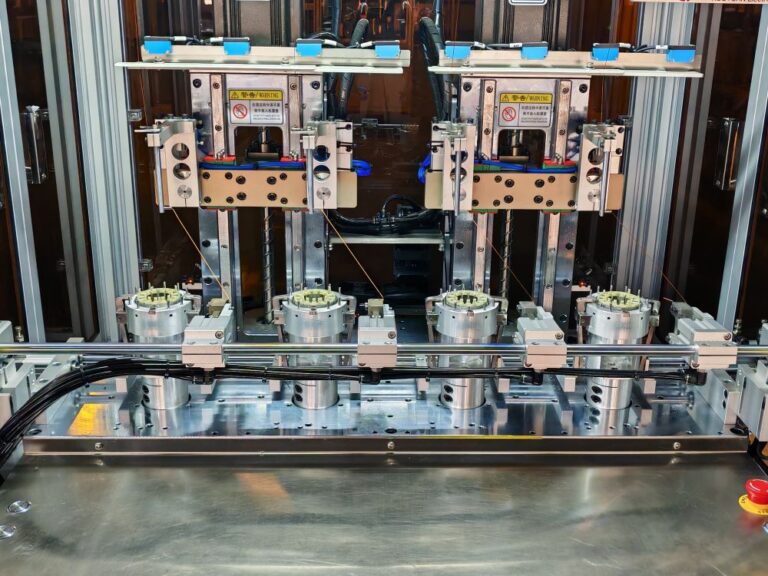
Motor Production Line
Advanced motor production lines ensure consistent quality and high production capacity for global BLDC motor application manufacturers.
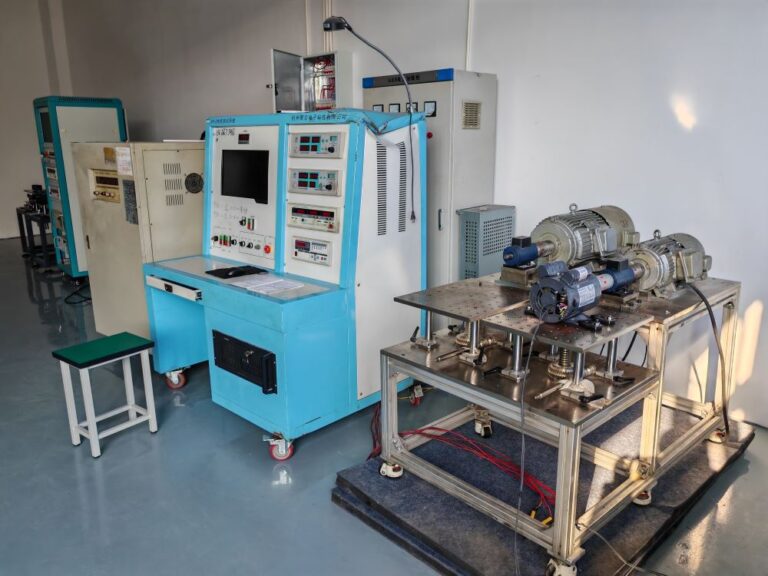
Motor Testing Laboratory
Professional motor testing equipment verifies torque, efficiency, durability and performance before shipment.
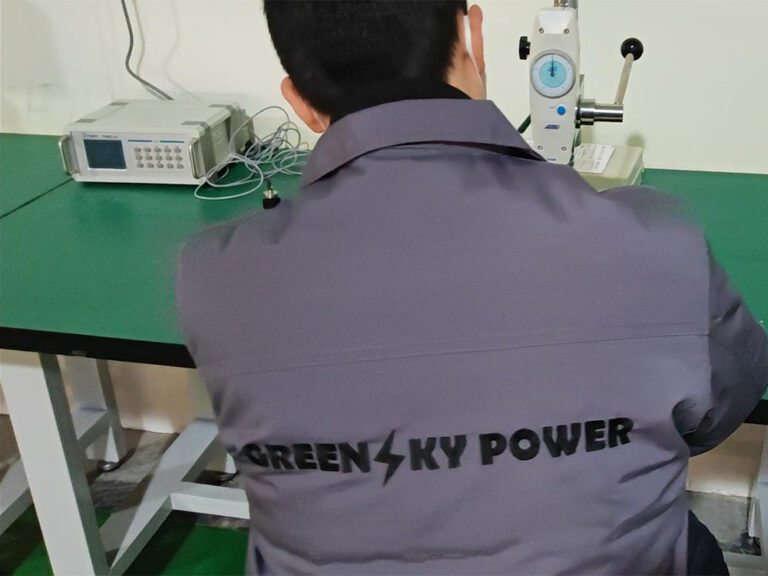
Quality Inspection
Strict quality inspection procedures ensure each motor meets international standards and customer specifications.

OEM Production
Flexible OEM manufacturing supports custom BLDC Motor solutions for BLDC motor application manufacturers.
Inside the Plant: Material In, Motor Out
A factory is a material flow before it is a set of machines. These are the three points a visiting buyer usually asks to see, because each one shows where a defect can still be caught cheaply.

Incoming material
Laminations, magnet grade, magnet wire, bearings and housings are the five items that decide most of the motor’s behaviour. Incoming inspection here is what makes an outgoing test report mean something.

Winding and assembly
Winding, impregnation and magnet assembly set the motor’s efficiency and its insulation life. Ask for the in-process checks at these stations, not only the final test, because a winding fault found here costs a fraction of one found at the end of the line.
Test, pack, ship
Final test against the agreed load point, then packing specified for the route: a sea container and an air pallet put different loads on a shaft. Confirm the packing standard with the order rather than assuming it.
A plant visit is not always practical, so the same evidence can be assembled remotely: a process flow with the inspection points marked, a sample test report from a comparable build, and photographs of the stations above with your part number on the fixture. Ask for all three, then compare them against the machine you intend to build.
How to Verify a Motor Supplier’s Quality Claim
Three documents carry almost all of the quality evidence in a motor purchase, and each one has a specific thing to check. None of them is a logo.
The QMS certificate — check the edition
ISO 9001:2026 is the current, sixth edition, published on 16 September 2026; ISO 9001:2015 was withdrawn on the same date. If a supplier sends a 2015 certificate, that is not a red flag on its own — certification bodies are running a transition — but ask when the audit is booked and read the scope, because a scope limited to assembly does not cover winding or magnet bonding.
The lab — accredited or in-house
ISO/IEC 17025:2017 is the standard for testing and calibration laboratory competence, and accreditation bodies use it as the assessment criterion. An in-house bench is perfectly normal and faster; an accredited lab gives a result that a third party will accept. Know which one produced the report you were sent.
RoHS — the report, not the badge
Directive 2011/65/EU (RoHS 2) restricts six substances in electrical and electronic equipment: lead, mercury, hexavalent chromium, PBB and PBDE at 0.1% by weight in homogeneous material, and cadmium at 0.01%. Ask for the test report by homogeneous material, since a pass at assembly level can hide a non-compliant solder or plating.
What we provide with an order
- Incoming, in-process and outgoing inspection records for the batch
- Final test data at the load point agreed in the order
- The drawing set the motors were built to, revision controlled
- Change notices when a winding, magnet or bearing source changes
- CE / RoHS documentation as published, with the scope stated
What is issued per project
- Certificate numbers, issuing body and the certified scope
- Any third-party test requested for your application
- PPAP-style documentation if your programme requires it
- Material and substance declarations for your own compliance file
Certificate numbers, issuing body and validity are printed on the documents themselves, and the four held today are listed in the conformity documents section below. For anything outside those families, the equivalent document is quoted with the offer.
A quality claim is only as good as the record behind it. Two suppliers can both say “strict quality control” and mean entirely different things; the difference shows up in whether they can name the inspection point, the test load and the standard the test was run against.
What the Conformity Documents Actually Say
Four attestations of conformity are held, one per product family, all issued by UDEM International Certification. Each names the directive it was assessed against — and that is the part worth reading, because the four documents do not all sit under the same directive.

DC motors — EMC
EMC Directive 2014/30/EU, Annex II. Certificate M:2025.206.C112258, issued 1 Mar 2025, valid to 1 Feb 2030. Covers the GSBLD series, which is the brushless family this page describes.

AC motors — LVD + EMC
Low Voltage Directive 2014/35/EU, Annex III, together with EMC 2014/30/EU. Certificate M:2024.206.C106834, issued 18 Sep 2024, valid to 17 Sep 2029.

Speed reducers — Machinery
Machinery Directive 2006/42/EC, Annex VIII — a different directive from the motor documents. Certificate M:2024.206.C106832, issued 18 Sep 2024, valid to 17 Sep 2029.

Stepper motors — EMC
EMC Directive 2014/30/EU, Annex II, held outside the DC motor file. Certificate M:2024.206.C106833, issued 18 Sep 2024, valid to 17 Sep 2029.
Where a motor is built into finished equipment, the declaration of conformity for that equipment is issued by the equipment manufacturer, and these documents become part of the technical file rather than the whole of it. Tell us the market at enquiry stage so the right document set is quoted with the offer.
Factory, Trading Company or Brand Agent
All three are legitimate ways to buy a motor. The differences show up when something goes wrong or when the specification has to change, not when the quotation is issued.
| What matters | Factory direct (Greensky) | Trading company | Brand agent |
|---|---|---|---|
| Who owns the design change | The winding, magnet and shaft are ours, so a change is a drawing revision with a date and a cost | A request passed to a third party; the revision history lives elsewhere | The brand’s engineering gate, with its own lead time |
| Finding the cause of a fault | Test data, winding records and the build drawing are in the same building | Depends on how much the intermediary can obtain from the plant | Possible, but routed through a support process |
| Custom shaft, flange or winding | Practical from a few hundred units; tooling is in house | Possible if the plant accepts the order; tooling cost passes through | Usually limited to catalogue options |
| Small quantity and samples | Samples built on the production line, so the trial unit matches the volume unit | Often easier to arrange a mixed or small trial order | Catalogue stock, but rarely a custom sample |
| Price structure | Material, labour and tooling, with the margin visible as one line | Intermediary margin on top of the same factory cost | Brand, stock and support are priced into the unit |
| Who answers for the batch | The plant that built it, against the drawing it was built to | The intermediary, which then has to go back to the plant | The brand, under its own warranty terms |
| Typical risk | You carry the integration work yourself | The specification gets paraphrased between two parties | Catalogue fit is assumed to be application fit |
The practical test is not the company type but whether the party quoting can answer a rating question without forwarding it. Ask one: at what speed is the 2.5–5 N·m measured, and is it continuous or peak. The answer, or the absence of one, tells you more than the profile of the company.
Why Choose Greensky as Your Motor Manufacturer
Greensky is a professional electric motor manufacturer specializing in motion control solutions. We work with BLDC motor application manufacturers worldwide to develop reliable motor solutions.
- Strong R&D team — winding, magnetics and drive design in house
- Advanced motor manufacturing equipment — automated winding and magnet assembly lines
- Strict quality control — incoming, in-process and outgoing inspection on every batch
- OEM customization capability — from a first sample to annual volume
- Global export experience — motors shipped to more than 50 countries

Request a 1000W BLDC Motor Quotation
What to include in your message
- Load — continuous torque, peak torque and how long the peak lasts.
- Speed — the speed at which that torque is needed, and the full operating range.
- Supply — 24 V, 48 V or 72 V, battery or rectified DC bus, and the available current.
- Duty and environment — hours per day, starts per hour, ambient, altitude, wash-down or outdoor exposure.
- Mechanical interface — shaft, flange and mounting drawing, or the existing motor you are replacing.
- Order plan — sample quantity, annual volume, market of sale and labelling requirements.
Send an inquiry
Send a load case and a mounting drawing — we reply with a motor proposal within 24 hours.
FAQ – 1000W BLDC Motor
1. What is the torque of a 1000W BLDC motor?
Typically 2.5–5 N·m depending on speed and configuration, as published on the original page. That range needs a qualification: at 1000 W, T = 9550 × P / n gives about 3.18 N·m at 3000 rpm and 1.91 N·m at 5000 rpm, so 5 N·m corresponds to roughly 1910 rpm. In practice the low-speed end belongs to the geared build at its output shaft or to a short-duration peak. Tell us the speed at which you need the torque, and whether it is continuous, and we issue the rating at that point.
2. What applications require a 1000W motor?
Electric vehicles, AGV robots, industrial automation and heavy-duty systems commonly use 1000 W BLDC motors, as published. The application name is not enough to select one: a conveyor that jams, a pump that runs continuously and a vehicle that climbs a ramp need different windings from the same frame. Send the continuous torque, the peak torque and its duration, the speed range and the duty cycle.
3. Do you support OEM customization?
Yes, we provide full OEM/ODM services tailored to your application requirements. Custom voltage (24 V / 48 V / 72 V), gearbox integration, controller matching, thermal and structure optimisation, and custom mounting and shaft design are listed in the customization section. Prototype development, small batch production and large scale OEM manufacturing are all supported, and samples are built on the same line as production.
4. Are you a factory or a trading company?
We are the manufacturer. Winding, magnet assembly, gearbox integration and final test are carried out in our own plant, which is why a drawing revision, a fault investigation and a test record all come from the same place. The practical test for any supplier is whether the person quoting can answer a rating question without forwarding it — ask at what speed the 2.5–5 N·m is measured, and whether it is continuous or peak.
5. What is your monthly capacity, and how does my order fit?
The published figure is 50,000+ motors a month across the range. At 25 working days and one 8-hour shift that is about 2,000 a day, or one motor roughly every 14 seconds; two shifts halves the takt. That output is spread across frame sizes, windings and gearbox variants, so it is a mixed-model line rather than 50,000 identical units. A 5,000-unit annual order is under 1% of the monthly figure, which means your run fits the changeover calendar rather than setting it. Ask for the current capacity and lead time in writing against your specific model.
6. Which certificates can you send, and how do I verify them?
CE and RoHS documentation as published, plus per-batch inspection and final test records. Three things are worth checking. First, the QMS certificate edition: ISO 9001:2026 is current and ISO 9001:2015 was withdrawn on 16 September 2026, so a 2015 certificate should come with a transition date. Second, whether the test lab is accredited to ISO/IEC 17025:2017 or is an in-house bench — both are legitimate, but a third party will only accept one. Third, the RoHS report: Directive 2011/65/EU limits lead, mercury, hexavalent chromium, PBB and PBDE to 0.1% and cadmium to 0.01% by weight in homogeneous material, so ask for the report by material rather than a badge. The four attestations we hold are listed with their numbers, directives and validity dates in the conformity documents section, and each names a series rather than every part number, so check the annex for your model.
7. Can you match an existing motor or a competitor part number?
Usually yes, and the fastest route is to send the drawing or the physical sample. What we need is the mounting interface (shaft diameter, keyway, pilot, hole pattern), the electrical interface (voltage, rated torque and speed, connector and pinout) and the duty. From that we confirm whether an existing build fits, or what changes. Matching a part number alone is not enough, because the same number is often built to different windings for different customers.
Looking for BLDC Motor Solutions?
Contact us for customized 1000W BLDC motor solutions, or see the custom BLDC motor page if your build falls outside the standard range. Greensky Power is committed to becoming your reliable long-term motor manufacturing partner — standard models or fully customized OEM solutions.
Professional response guaranteed within 24 hours. Add.: No.597 Bin’an, Hangzhou, China 310052 · E-mail: mkt@greensky-power.com · TEL: +86 571 8819 5488