
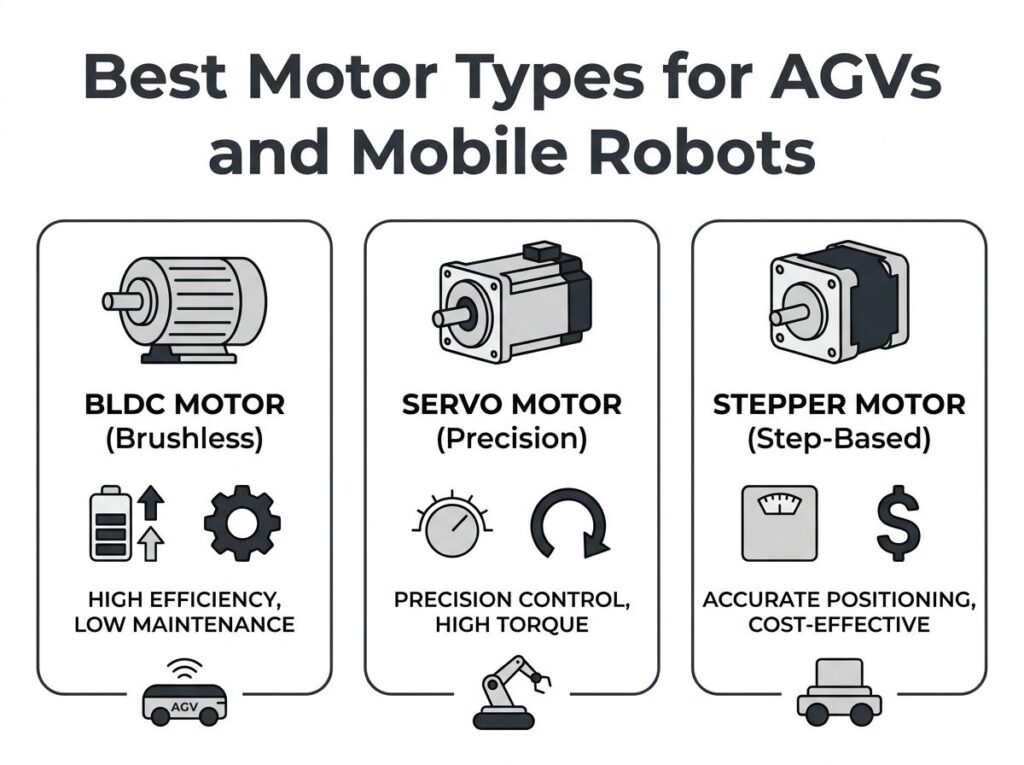
Best Motor Types for AGVs and Mobile Robots
A specification-level comparison of BLDC, servo, stepper, brushed DC, and direct-drive motors for automated guided vehicles (AGVs) and autonomous mobile robots (AMRs)—with engineering data, IEC 60034-1 / NEMA MG 1 references, and a payload-based selection framework.
Quick Answer
For most AGVs and mobile robots, a brushless DC (BLDC) motor with an integrated planetary gearbox is the best choice. It delivers 85–92% efficiency, 10,000–20,000+ hour service life, and the lowest total cost of ownership for payloads from 50–500 kg. Specify a servo-grade BLDC (encoder + field-oriented control) when ±0.5–2 mm positioning is required, and a full AC/DC servo motor for loads above 1 ton or ±0.1 mm precision docking. Stepper motors fit only light carts under ~100 kg; brushed DC is a legacy low-cost option with high maintenance; direct-drive and quasi-direct-drive (QDD) suit precision low-speed platforms. All motors should target IEC 60034-30-1 IE3/IE4 efficiency and be rated for the AGV duty cycle (typically IEC S3 or S4).
[ez-toc]
What Is an AGV / AMR Drive Motor?
An AGV or AMR drive motor is the electromechanical actuator that converts battery DC power into the traction, steering, and lifting force a mobile robot needs. Unlike industrial motors bolted to mains power, AGV motors run from a battery pack—typically 24 V, 36 V, or 48 V DC—must survive thousands of start-stop cycles per day, and require closed-loop feedback for navigation accuracy.
The motor is never standalone. It operates as part of an integrated drive system:
| Subsystem | Function | Engineering requirement |
|---|---|---|
| Motor | Converts electrical → mechanical energy | High efficiency at battery voltage; adequate continuous & peak torque |
| Gearbox | Multiplies torque, reduces speed to wheel RPM | Planetary preferred: 92–97% per stage, 5–15 arc-min backlash |
| Encoder / Hall | Position & speed feedback for dead-reckoning | 1,000–4,096 PPR (motor shaft) or 17–24 bit absolute |
| Brake | Holds position on slope / e-stop | Electromagnetic, 24 V, power-off engaged |
| Controller | Commutation & current loop | FOC for BLDC; matches CANopen / EtherCAT / Modbus |
The five motor technologies competing for AGV drive
- BLDC (Brushless DC) — electronic commutation, the dominant AGV drive technology.
- BLDC Servo — BLDC + high-resolution encoder + FOC; closed-loop precision tier.
- AC/DC Servo — permanent-magnet synchronous motor with vector control; highest precision & overload.
- Stepper — open-loop pulse-driven; low-cost, light-load only.
- Brushed DC — legacy, simple control, high maintenance.
- Direct Drive / QDD — low-ratio or zero-ratio torque transmission for backlash-free motion.
How AGV Motors Work
An AGV motor converts stored energy into controlled wheel motion through a closed power chain. For a geared BLDC drive, the path is:
- Battery release — the 24/48 V pack delivers DC current to the controller (state of charge sets available voltage).
- Controller conversion — the servo drive performs electronic commutation (FOC), switching stator phases based on rotor position from Hall/encoder feedback.
- Motor electromechanical conversion — the rotating field produces torque; efficiency here is 85–95% for BLDC/servo vs. 60–75% for brushed DC.
- Gearbox torque multiplication — the planetary reducer scales motor torque by ratio
i(e.g., 20:1) while cutting speed to wheel RPM; ~3–8% loss per stage. - Wheel-to-floor traction — output torque at the wheel overcomes rolling resistance, gradient, and acceleration;
F = T_wheel / r_wheel. - Encoder feedback loop — wheel pulses feed odometry; the controller corrects speed to hold the navigation target.
In a direct-drive wheel, steps 4 is removed—the motor rotor is the wheel hub, eliminating gear loss but requiring very high motor torque at low speed (low speed constant). A quasi-direct-drive (QDD) uses a 6:1–20:1 ratio to retain back-drivability while multiplying torque.
Motor Type Comparison Table
The table below ranks the five core technologies plus direct-drive across the parameters that matter for AGV engineering. Values reflect typical catalog data and AGV duty.
| Parameter | BLDC (geared) | BLDC Servo | AC/DC Servo | Stepper | Brushed DC | Direct Drive / QDD |
|---|---|---|---|---|---|---|
| Efficiency | 85–92% | 88–93% | 90–95% | 70–80% | 60–75% | 88–94% (no gear loss) |
| Service life (h) | 10,000–20,000+ | 10,000–20,000+ | 10,000–20,000+ | 10,000+ | 2,000–5,000 | 10,000–20,000+ |
| Positioning accuracy | ±0.5–2 mm* | ±0.2–1 mm | ±0.1 mm | ±1–5 mm (open) | ±5–10 mm | ±0.1–0.5 mm |
| Overload capacity | 150–200% | 200–300% | 300% (3–5 s) | Not advised | 200–300% | 200–400% |
| Typical voltage | 24 / 48 V | 24 / 48 V | 48 / 72 V | 12 / 24 V | 24 / 48 V | 24 / 48 V |
| Speed range | 0–6,000 RPM | 0–6,000 RPM | 0–10,000 RPM | Narrow (>1k RPM drops) | 0–5,000 RPM | 0–1,500 RPM (hub) |
| Backlash | 5–15 arc-min | 5–15 arc-min | 1–10 arc-min | None (open) | 5–15 arc-min | ~0 (QDD small) |
| Noise | 48–55 dB | 50–58 dB | 50–60 dB | 55–65 dB | 60–70 dB | 45–55 dB |
| Relative cost | Medium | Medium–High | High | Low–Medium | Low | High |
| Best AGV class | 50–500 kg AMR | 100–800 kg AMR | >1 t / precision | <100 kg AGC | Legacy / low-cost | Service / collab. AMR |
*With encoder + FOC. Positioning figures assume an appropriately specified gear ratio and navigation system.
Engineering Data & Formulas
IEC 60034-1 duty cycles for AGV motors
Most AGVs operate under IEC 60034-1 S3 (intermittent periodic) or S4 (intermittent with starting influence) duty. The motor’s continuous torque rating must cover the RMS torque over the full cycle, not just the peak.
| IEC Class | Description | AGV match | Torque derating |
|---|---|---|---|
| S1 | Continuous running | Conveyor-following / 24-7 line AGV | None — rated = continuous |
| S2 | Short-time | Batch transport, long idle between moves | Can exceed S1 by 1.5–2× for short bursts |
| S3 | Intermittent periodic | Goods-to-person AMR, pick-and-place | Depends on duty cycle % (ed) |
| S4 | Intermittent + starting | Frequent start-stop feeder AGV | Derate 10–20% vs S1 (start current heat) |
| S5 | Intermittent + braking | AGV with regen braking on ramps | Brake energy adds heat — dissipate/regen |
IEC 60034-30-1 efficiency classes & NEMA mapping
| IEC class | Loss vs IE1 | NEMA equivalent | AGV guidance |
|---|---|---|---|
| IE1 | Baseline | Standard Efficiency | Not acceptable for new AGV design |
| IE2 | −~20% | High Efficiency | Minimum only if paired with VSD |
| IE3 | −~35% | Premium (NEMA MG 1 T12-12) | Acceptable floor for AGV motors |
| IE4 | −~45% | Super Premium | Recommended for battery runtime |
| IE5 | −~55% | (none yet in NEMA) | Emerging; sync-reluctance + VSD |
NEMA MG 1 design types & AGV relevance
| NEMA Design | Locked-rotor torque | Pull-up torque | IEC equiv. | AGV suitability |
|---|---|---|---|---|
| A | 100–200% | 100–140% | — | Low start torque; not ideal |
| B (common) | 150–200% | 100–140% | Design N | Adequate with gearbox multiplication |
| C | 200–250% | 140–200% | Design H | Heavy payload, frequent starts |
| D | 275%+ | — | — | Highest start torque; high slip |
Core sizing formulas
F_total = F_roll + F_grade + F_acc (N)
F_roll = μ × m × g (rolling resistance)
F_grade = (slope %) × m × g (gradient resistance)
F_acc = m × a (acceleration resistance)
T_motor = T_wheel / (i × η_gear) (reflected to motor shaft)
T_rms = √[(T₁²t₁ + T₂²t₂ + … + Tₙ²tₙ) / (t₁ + t₂ + … + tₙ)] (S3/S4 duty)
Manufacturer benchmark data
| Manufacturer / model | Key spec | AGV relevance |
|---|---|---|
| Maxon MW500 wheel drive | ≤500 kg/drive; 11.4–23.7 N·m cont.; 30–48 V; IP54; 1024 cpt | Compact AGV/AMR wheel, integrated BLDC + planetary |
| Maxon IDX 56 (EC-i + EPOS4) | 471–794 mNm; 24/48 V; IP65; FOC | High-torque-density servo-grade AGV axis |
| Faulhaber DualGear (BX4 + GPT) | Ø32 mm; 1.1 N·m cont. / 7 N·m max; ≤0.6° backlash; −30…120 °C | Dual-output logistics wheel / conveyor |
| Yaskawa Sigma-7 SGM7D | 1.3–240 N·m; 30–360 rpm; 24-bit encoder; 3.1 kHz bandwidth; 350% overload 3–5 s; STO SIL3 | Precision heavy AGV / direct-drive wheel |
| SKF E2 deep-groove bearing | 30–50% lower friction vs standard; drop-in to IEC 355 frame | Boosts motor efficiency, extends bearing life |
Best Applications for Each Motor Type
| Motor type | Best-fit AGV / mobile robot | Why |
|---|---|---|
| BLDC (geared) | Warehouse AMR, unit-load AGV, 50–500 kg | Best efficiency/cost/maintenance balance; Hall or low-res encoder sufficient |
| BLDC Servo | SLAM-navigated AMR, light forklift AGV, 100–800 kg | Smooth low-speed approach, ±0.5–2 mm docking, payload compensation |
| AC/DC Servo | Forklift AGV, heavy industrial >1 t, assembly AGV | Sub-mm precision, 300% overload for ramp start, thermal stability |
| Stepper | Light AGC, top-lift jacks, <100 kg carts | Lowest cost, simple open-loop; acceptable ±1–5 mm |
| Brushed DC | Legacy / cost-sensitive internal transport | Simple 2-wire control; acceptable where duty is low and maintenance is tolerated |
| Direct Drive / QDD | Service robot, delivery AMR, collaborative mobile platform | Backlash-free, back-drivable, high bandwidth near humans |
Step-by-Step Selection Process
- Define the power source. Battery 24/48 V → BLDC family. AC mains available → AC servo. This rules out AC servo for most battery AGVs unless DC-AC conversion is present.
- Set the positioning requirement. Mechanical stop (±5–10 mm) → standard BLDC. QR/laser/vision (±1–2 mm) → BLDC servo. Sub-mm assembly → AC servo.
- Compute wheel torque. Use
T_wheel = (F_roll + F_grade + F_acc) × rfor the fully loaded vehicle on the max gradient. - Reflect to the motor shaft.
T_motor = T_wheel / (i × η); pick a gear ratio that lands motor speed in its 1,500–3,000 RPM efficiency band. - Validate thermal rating. Confirm continuous torque > duty-cycle RMS torque after ambient derating. Check IEC S3/S4 class.
- Specify feedback & brake. Encoder resolution from accuracy need; electromagnetic brake for slope/park/e-stop.
- Confirm efficiency & compliance. Target IE3 minimum, IE4 preferred; verify IEC 60034-1 and (for EU) EU 2024/1834 / (for US) DOE 2027 alignment. Run a 5-year TCO compare.
Common Engineering Mistakes
| Mistake | Consequence | Correct approach |
|---|---|---|
| Sizing on peak, not RMS torque | Thermal trip / winding burnout in S3 duty | Size to RMS over full cycle + ambient derating |
| Choosing stepper for >100 kg traction | Step loss, stalled vehicle | Use BLDC or servo with closed-loop feedback |
| Under-specifying gear ratio | Motor outside efficiency band, high current | Target 1,500–3,000 RPM motor speed at cruise |
| Ignoring inertia matching | Oscillation, tuning difficulty | Keep J_load/J_rotor ≤ 5:1 (servo) to 15:1 (BLDC) |
| Skipping IP rating | Bearing contamination, winding corrosion | IP54 min indoor; IP65 for >12-month field; IP66+ wash-down |
| No brake on slope applications | Roll-away on e-stop | Specify 24 V electromagnetic power-off brake |
| 24 V motor on 48 V bus (or vice-versa) | Half speed / overvoltage fault | Match motor rating to battery nominal voltage |
| Brushed DC for multi-shift fleet | Brush replacement cost > savings | Standardize on BLDC for uptime |
| Over-specifying servo for simple AGC | Wasted budget | Mechanical-stop AGC → standard BLDC + Hall |
| No regen path on S5 duty | Overvoltage trip on ramp braking | Add regen circuit / dissipation resistor |
Troubleshooting Table
| Problem | Likely cause | Solution | Applies to |
|---|---|---|---|
| Motor overheats in service | RMS torque > continuous rating; high ambient | Derate, upsize, or improve cooling; Class F/H | BLDC / Servo |
| Position drift at dock | Low encoder resolution; belt slip | Increase PPR / use absolute encoder; tighten coupling | Servo / BLDC servo |
| Step loss / stall | Open-loop stepper under sudden load | Switch to closed-loop stepper or BLDC servo | Stepper |
| Wheel slip on launch | Insufficient starting torque | Higher ratio or Design C/D start torque | All geared |
| Excess acoustic noise | Spur gear whine; resonance | Use helical planetary; damp mounting | Geared |
| Battery drains fast | Low motor/gear efficiency | Move to IE4 BLDC + 92%+ planetary; reduce losses | Brushed / worm |
| Controller overvoltage on brake | No regen path (S5) | Add regen resistor / bidirectional drive | All |
| Cannot hold on slope at rest | No brake or brake failed | Add/verify 24 V electromagnetic brake | All |
| Premature bearing failure | Contamination; wrong lube | Raise IP rating; use SKF E2 low-friction bearing | All |
| Speed hunting | Poor loop tuning; low bandwidth | Raise speed-loop bandwidth; auto-tune (e.g., Sigma-7 3.1 kHz) | Servo / BLDC servo |
FAQ
What is the best motor type for most AGVs?
For the 50–500 kg payload class, a BLDC motor with an integrated planetary gearbox is the dominant choice: 85–92% efficiency, 10,000–20,000+ hour life, low noise, moderate cost. Use servo-grade BLDC when ±0.5–2 mm positioning or high-dynamic maneuvers are needed.
When should I use a servo motor instead of a BLDC?
Specify servo for loads above 1 ton, ±0.1 mm docking accuracy, or maneuvers needing 300% overload for 3–5 s. Servo costs more but delivers higher bandwidth (Yaskawa Sigma-7: 3.1 kHz) and absolute-encoder precision. See our BLDC vs Servo for AGVs guide.
Can stepper motors be used in AGVs?
Only for light AGCs under ~100 kg with ±1–5 mm tolerance and low speed. They lose torque above ~1,000 RPM and risk step loss. Closed-loop (hybrid) steppers mitigate this but remain inferior to BLDC for traction.
What efficiency class should an AGV motor meet?
Target IE3 as a floor, IE4 where battery runtime matters. Per IEC 60034-30-1, IE4 cuts losses ~15% vs IE3; with a 92–97% planetary stage, combined efficiency exceeds 85%. U.S. DOE 2027 and EU 2024/1834 push IE4 as baseline.
Is direct-drive or geared better for AGV wheels?
Geared BLDC is the pragmatic default—high reduction multiplies torque compactly and improves inertia matching. Direct-drive / QDD suits precision low-speed platforms (service robots, collaborative AMRs) where backlash-free motion matters. Full trade-off: Gear Motor vs Direct Drive for AGVs.
How do I size an AGV motor for my payload?
Start from T_wheel = (rolling + gradient + acceleration force) × wheel radius, reflect through the gear ratio to the motor shaft, then verify continuous torque exceeds duty-cycle RMS torque. Our AGV Motor Torque Calculation Guide has the worked example.
Why Choose GreenSky Power?
GreenSky Power — AGV & Mobile Robot Drive Motors Since 2011
We design and manufacture motion solutions for AGV and AMR OEMs in 50+ countries. For the “best motor type” decision, we provide:
- Full motor portfolio from one supplier — BLDC, BLDC servo, micro-AC servo, stepper, and brushed DC, deployable standalone or with our planetary / spur / worm / right-angle gearboxes.
- Direct-drive & QDD options — low-ratio precision wheels for collaborative and service robots.
- IEC 60034-1 / NEMA MG 1 compliance — every motor tested per IEC 60034 and GB 1032; batch dynamometer reports shipped with each order; Thermal Class F (155 °C) standard.
- IE3 / IE4 efficiency built into the platform; SKF-class low-friction bearings available for extended life.
- AGV-specific engineering support — send payload, speed, acceleration, gradient, and wheel diameter; we return a calculation sheet with recommended motor, gearbox, and controller.
Start with our AGV Motor Selection Guide, or explore AGV Motor Efficiency & Battery Runtime for the power-chain analysis. European programs: AGV Motor Supplier for Europe. Custom/OEM: OEM AGV Motor Manufacturing Guide.
References
Ten authority sources underpinning the standards, efficiency, and manufacturer data in this article:
- IEC — IEC 60034-1:2022, Rotating electrical machines — Rating and performance (duty cycles S1–S10). webstore.iec.ch/publication/27530
- IEC — IEC 60034-30-1:2014, Efficiency classes for line-operated AC motors (IE1–IE5). webstore.iec.ch/publication/6397
- NEMA — MG 1-2021, Motors and Generators (Table 12-12 efficiency; Design A/B/C/D torque classes). nema.org/standards/view/mg-1-2016-r2021-motors-and-generators
- DOE — U.S. Department of Energy, Energy Efficiency Standards for Commercial and Industrial Electric Motors (10 CFR Part 431; 2027 IE4 rule). energy.gov/eere/amo/energy-efficiency-standards-commercial-and-industrial-electric-motors
- IEA — Energy Efficiency 2025, International Energy Agency (motor systems = 53% of global electricity). iea.org/reports/energy-efficiency-2025
- SKF — Energy Efficient (E2) deep-groove ball bearings for electric motors (30–50% friction reduction). skf.com/us/industry-solutions/…/skf-energy-efficient-deep-groove-ball-bearings.html
- Siemens — SIMOVE AGV system platform & Digital Factory motor production (Digital Twin, −40% material handling time). assets.new.siemens.com/…/difa-b10193-01-7600flyersimove210x280mm-300.pdf
- Maxon — Wheel Drive MW500 for AGV & AMR (≤500 kg/drive; 11.4–23.7 N·m; 30–48 V; IP54). maxongroup.com/…/motor-wheel-drive-500-download-link.pdf
- Faulhaber — DualGear drive system (BX4 + GPT; Ø32 mm; 1.1 N·m cont.; ≤0.6° backlash) for logistics. faulhaber.com/fr/lp/faulhaber-dualgear/
- Yaskawa — Sigma-7 servo systems (SGM7D 1.3–240 N·m; 24-bit encoder; 3.1 kHz bandwidth; 350% overload; STO SIL3). yaskawa.eu.com/motion-control/Sigma-7
Academic references (peer-reviewed motor / AGV drive design):
- Zhang R., Chai R., Chai S., Xia Y., Tsourdos A. “Design and Practical Implementation of a High Efficiency Two-Layer Trajectory Planning Method for AGV.” IEEE Trans. Industrial Electronics, 2024, 71(2):1811–1822. doi.org/10.1109/TIE.2023.3250847
- Xin J., Wu X., D’Ariano A., Negenborn R., Zhang F. “Model Predictive Path Planning of AGVs.” IEEE Trans. Intelligent Transportation Systems, 2023, 24(7):6943–6954. doi.org/10.1109/TITS.2023.3254147
- Zhang S., Wu X., Zhao H., et al. “Drive structure and path tracking strategy of omnidirectional AGV.” Journal of Measurement Science and Instrumentation, 2023, 14(4):431–441. doi.org/10.3969/j.issn.1674-8042.2023.04.006
- Hong F., Ye J., Liu Z., et al. “AGV Vehicle Dynamics Optimization in Automated Logistics Warehousing Systems.” 2025 11th IEEE ISSMAS. (dynamic optimization extends component life ~30%)
