
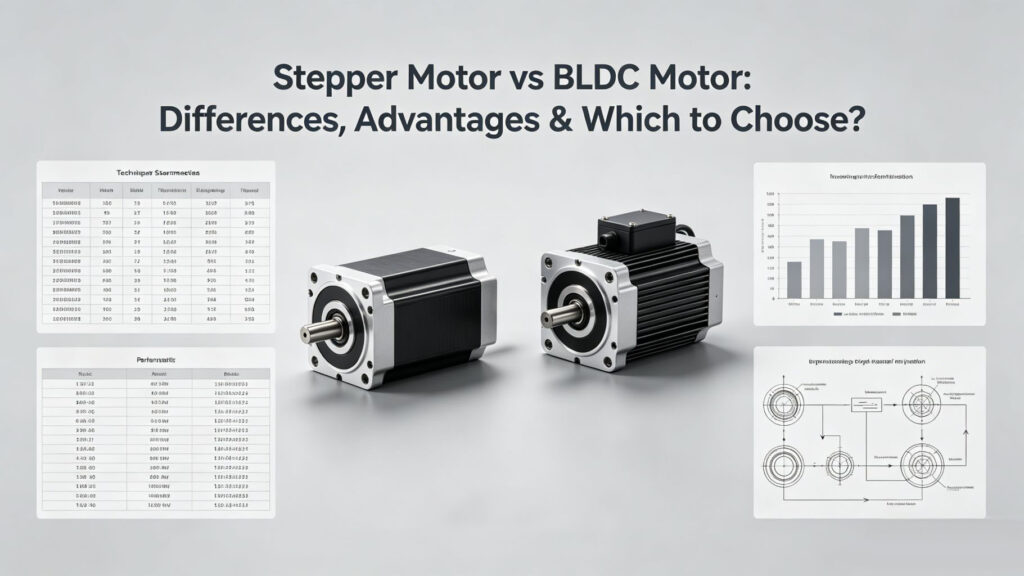
Stepper Motor vs BLDC Motor: Differences, Advantages & Which to Choose?
Featured Snippet:
Stepper motors are ideal for precise positioning and low-speed control without feedback systems, while BLDC motors offer higher efficiency, better torque density, and superior performance in dynamic and high-speed applications. The best choice depends on whether your application prioritizes accuracy, cost simplicity, or energy efficiency and long-term reliability. For OEM and industrial buyers, BLDC motors are typically preferred for performance-driven systems, while stepper motors remain optimal for positioning-focused applications such as CNC and 3D printing.
When evaluating stepper motor vs BLDC motor, engineers and procurement managers must consider more than basic specifications. The decision affects system architecture, control strategy, energy consumption, and long-term maintenance costs. In modern industrial environments—where automation, efficiency, and reliability are critical—understanding the engineering trade-offs between these motor types is essential.
What Is a Stepper Motor?
A stepper motor is a brushless synchronous motor that divides a full rotation into discrete steps. Each pulse sent to the motor results in a precise angular movement, enabling open-loop position control without feedback systems.
Key Engineering Characteristics
- Discrete step movement (e.g., 1.8° per step)
- High holding torque at standstill
- Simple control without feedback loop
- Lower efficiency compared to BLDC motors
Stepper motors are widely used in applications where precise positioning is required, such as CNC machines, 3D printers, and medical devices.
What Is a BLDC Motor?
A Brushless DC (BLDC) motor uses electronic commutation and permanent magnets to deliver continuous rotation with high efficiency and precise control.
Key Engineering Characteristics
- Continuous rotation with smooth torque output
- High efficiency (85–95%)
- Requires electronic speed controller (ESC)
- High power density
BLDC motors are widely used in electric vehicles, robotics, HVAC systems, and industrial automation.
👉 Explore solutions: BLDC Motor Product Range
Stepper Motor vs BLDC Motor: Key Differences Explained
| Parameter | Stepper Motor | BLDC Motor |
|---|---|---|
| Control Type | Open-loop (no feedback) | Closed-loop (with controller) |
| Efficiency | Low (50–70%) | High (85–95%) |
| Torque Behavior | High at low speed | Consistent across speed range |
| Speed Range | Low to moderate | Wide (low to high speed) |
| Precision | Very high positioning accuracy | Requires feedback for precision |
| Cost | Lower system cost | Higher initial cost |
The core difference lies in how motion is generated: stepper motors move in discrete steps, while BLDC motors provide continuous rotation. This leads to fundamental differences in performance, efficiency, and control requirements.
Why BLDC Motors Are More Efficient Than Stepper Motors
Efficiency is a key factor in modern motor selection, especially in energy-sensitive industrial systems.
Engineering Analysis
- Stepper motors draw constant current regardless of load → energy loss
- BLDC motors adjust current dynamically based on load
- Reduced copper and iron losses in BLDC design
In applications such as conveyor systems or electric mobility, switching from stepper to BLDC motors can significantly reduce energy consumption and operating costs.
Torque Density and Dynamic Performance Comparison
Torque density and dynamic response are critical in modern automation systems.
Stepper Motor Characteristics
- High holding torque at zero speed
- Torque drops rapidly at higher speeds
BLDC Motor Advantages
- High torque across wide speed range
- Better acceleration and deceleration
- Higher power density
For dynamic systems such as AGVs or robotic arms, BLDC motors provide superior performance.
Thermal Performance and Heat Management
Thermal management directly impacts motor lifespan and reliability.
Stepper Motors
- Continuous current leads to constant heat generation
- Lower efficiency increases thermal stress
BLDC Motors
- Lower heat due to higher efficiency
- Heat concentrated in stator → easier cooling
This makes BLDC motors more suitable for continuous-duty industrial applications.
Control System Differences: Stepper motor vs BLDC motor
Control strategy is a key decision factor for engineers.
Stepper Motor Control
- Simple pulse-based control
- No feedback required (open-loop)
- Lower system complexity
BLDC Motor Control
- Requires ESC or driver
- Supports closed-loop control with sensors
- Enables high precision and smart integration
For Industry 4.0 and smart automation, BLDC motors provide more flexibility.
Reliability and Lifespan Comparison
Reliability is a key concern for OEM buyers.
- Stepper Motors: Simple design but prone to overheating
- BLDC Motors: Longer lifespan due to efficient operation
In continuous-use systems, BLDC motors typically offer better long-term reliability.
How to Choose Stepper or BLDC Motor for Your Application
Motor selection should be based on application requirements rather than general preferences.
Key Selection Factors
- Voltage: 12V / 24V / 48V / 72V systems
- Power: From small precision motors to kW-level systems
- Speed & Torque: Continuous vs holding torque needs
- Cooling: Passive or forced cooling
- Controller: Stepper driver vs ESC
Application-Based Recommendations
- CNC / 3D printing → Stepper motor
- Electric vehicles → BLDC motor
- Robotics → BLDC motor
- Precision positioning → Stepper motor
👉 Get OEM support: Custom Motor Solutions
Industrial Applications of Stepper and BLDC Motors
Stepper Motor Applications
- CNC machines
- 3D printers
- Medical equipment
- Precision positioning systems
BLDC Motor Applications
- Electric vehicles (48V / 72V systems)
- Robotics and automation
- HVAC systems
- Industrial machinery
👉 Explore EV solutions: Electric Vehicle Motor
Cost Comparison: Stepper Motor vs BLDC Motor
| Cost Factor | Stepper Motor | BLDC Motor |
|---|---|---|
| Initial Cost | Lower | Higher |
| Operating Cost | Higher (inefficient) | Lower |
| Maintenance | Low | Low |
| Total Cost of Ownership | Higher in long-term use | Lower for continuous operation |
While stepper motors offer lower upfront costs, BLDC motors provide better ROI in energy-intensive applications.
Future Trends: Stepper Motor vs BLDC Motor in Modern Industry
Industry trends are shifting toward efficiency and smart systems.
- Increasing adoption of BLDC motors in automation
- Integration with IoT and smart control systems
- Energy efficiency regulations driving BLDC growth
Stepper motors will remain relevant in niche precision applications, but BLDC motors are becoming dominant in broader industrial use.
FAQ: Stepper Motor vs BLDC Motor
1. Which motor is better for precision applications?
Stepper motors are better for precision positioning because they move in fixed steps and do not require feedback systems.
2. Why are BLDC motors more efficient?
BLDC motors adjust current based on load and eliminate constant power draw, reducing energy losses significantly.
3. Can BLDC motors replace stepper motors?
In some applications, yes. However, stepper motors are still preferred for low-cost, high-precision positioning tasks.
4. Which motor is better for continuous operation?
BLDC motors are better due to higher efficiency and lower heat generation.
5. What is the cost difference?
Stepper motors have lower upfront cost, but BLDC motors offer better long-term value.
6. Is BLDC better than stepper motor?
Neither is universally better—BLDC excels in high-speed efficiency and dynamic torque, while steppers lead in open-loop positioning simplicity and low-speed stability.
7. Which motor is more precise?
Stepper motors typically offer superior open-loop positioning accuracy without feedback hardware, whereas BLDCs require encoders to match precision.
8. Can BLDC replace stepper motor in CNC?
Yes, but only with closed-loop control systems; BLDCs outperform in high-RPM cutting tasks, while steppers remain simpler for low-speed precision milling.
Conclusion: Which Motor Should You Choose?
When comparing stepper motor vs BLDC motor, the choice depends on your application priorities. Stepper motors excel in precision and simplicity, while BLDC motors deliver superior efficiency, performance, and long-term reliability.
For most modern OEM and industrial applications, BLDC motors are becoming the preferred choice due to their efficiency and scalability.
Need help selecting the right motor?
✔ Request datasheet
✔ Get OEM motor solution
✔ Contact our engineers today
References
- IEEE Transactions on Industrial Electronics
- IEC Motor Efficiency Standards
- Industrial Motion Control Reports
