
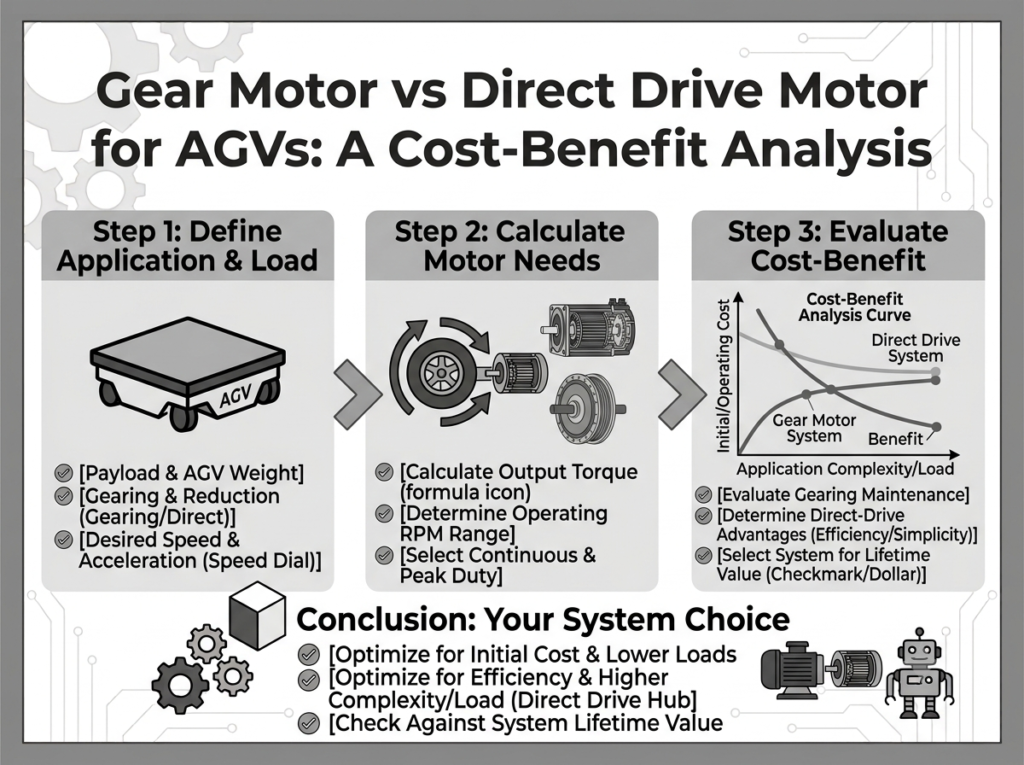
Gear Motor vs Direct Drive Motor for AGVs: Selection Guide with Engineering Standards
[ez-toc]
Quick Answer
For AGV drive systems, gear motors multiply torque from compact high-speed motors through planetary or worm gearheads, making them the dominant choice for heavy-payload AGVs (500+ kg) operating at 0.5–2 m/s. Direct drive motors eliminate the gearbox entirely, offering zero backlash, 90–95% transmission efficiency, and minimal maintenance — ideal for precision-critical AMRs, service robots, and continuous-duty warehouse platforms. A third option, quasi-direct drive (QDD), uses low-ratio gearheads (6:1–20:1) to bridge the torque-density gap while retaining most direct drive benefits. The selection hinges on four factors: payload-to-speed ratio, positioning tolerance, duty cycle per IEC 60034-1 classification, and total cost of ownership over the vehicle’s service life.
What Is a Gear Motor? What Is a Direct Drive Motor?
Gear Motor (Geared Drive)
A gear motor combines an electric motor (BLDC, brushed DC, or AC) with a mechanical gearbox that reduces output speed and multiplies torque. The gearbox ratio N defines the relationship between motor shaft speed and wheel speed. Common gearbox types for AGVs include:
| Gearbox Type | Typical Ratio Range | Efficiency | Backlash | AGV Use Case |
|---|---|---|---|---|
| Planetary (epicyclic) | 3:1 – 100:1 | 85–95% | 0.5–1.5° | Primary drive wheel, heavy-payload AGV |
| Worm gear | 5:1 – 60:1 | 70–85% | 1–3° | Steering motor, self-locking applications |
| Parallel shaft (spur) | 3:1 – 200:1 | 90–97% | 0.5–2° | Conveyor AGV, auxiliary drive |
| Harmonic (strain wave) | 50:1 – 160:1 | 70–85% | 0–0.5° | Precision AGV joint, docking mechanism |
For AGV wheel drives, planetary gearboxes dominate due to their compact coaxial design, high torque density, and acceptable backlash. Faulhaber’s GPT planetary gearhead series, for example, handles continuous torque up to 18 Nm and intermittent torque up to 25 Nm in a 42 mm diameter package [1]. Their DualGear system pairs a 32 mm BX4 brushless motor with dual GPT gearheads specifically for AGV and intralogistics wheel drives [2].
Direct Drive Motor
A direct drive motor transmits torque to the load with no intermediate gearbox. The motor rotor couples directly to the AGV wheel hub or drive shaft. To produce sufficient torque at the low speeds typical of AGV wheels (50–500 RPM), direct drive motors use one or more of these design strategies:
- Large diameter, high pole count — Torque scales with rotor volume and pole pairs. Maxon’s EC 90 Flat uses 12 pole pairs to deliver 1 Nm continuous torque without a gearhead [3].
- External rotor (outrunner) topology — The rotor surrounds the stator, increasing the air gap radius and leverage arm for greater torque per ampere.
- Halbach array magnets — Concentrates flux on one side of the magnet array, boosting air gap flux density. A 2024 IEEE study demonstrated a Halbach-array axial-flux PM machine for direct-drive AGVs achieving high torque density under natural cooling [4].
- High current capacity — Larger windings and advanced thermal management (integrated cooling fins, potting compounds) allow sustained high-torque operation.
Yaskawa’s SGM7D direct drive servo series covers rated torque from 1.3 Nm to 240 Nm with maximum speeds of 180–360 RPM, using a 24-bit absolute encoder (16.77 million pulses/revolution) for positioning precision [5]. The Sigma-7 SERVOPACK achieves a speed loop bandwidth of 3.1 kHz — significantly higher than typical gear motor systems [6].
Quasi-Direct Drive (QDD) — The Third Option
QDD motors use low-ratio gearheads (typically 6:1 to 20:1) that preserve most of the direct drive’s back-drivability and low inertia while multiplying torque. A 2024 IEEE IROS paper noted that QDD motors combine “high torque density, superior control bandwidth, and transparent torque feedback” — making them increasingly popular in legged robots and dynamic AGV platforms [7]. The trade-off is that QDD introduces some backlash and friction compared to true direct drive, but far less than high-ratio gear systems.
How Each Architecture Works
Gear Motor Power Flow
- Motor generates torque at high speed — A BLDC motor typically runs at 3,000–10,000 RPM at its efficiency sweet spot. At this speed, the motor operates near its maximum electrical efficiency (often 85–92%).
- Gearbox reduces speed, multiplies torque — A 30:1 planetary gearbox reduces 6,000 RPM to 200 RPM at the wheel. Output torque increases proportionally: Tout = Tmotor × N × ηgear, where N is the gear ratio and ηgear is gearbox efficiency (typically 0.85–0.95 for planetary).
- Inertia matching — The gearbox reduces the reflected load inertia by the square of the ratio: Jreflected = Jload ÷ N². This allows a small motor to control a large AGV mass with stable dynamics.
- Wheel receives torque — The output shaft drives the wheel through a coupling, hub, or integrated wheel assembly.
Direct Drive Power Flow
- Motor generates torque directly at wheel speed — The motor must produce full wheel torque (e.g., 20–80 Nm for a 500 kg AGV) at 50–300 RPM without speed reduction. This requires a physically larger motor with more pole pairs and higher current.
- No mechanical reduction — Torque transfers from rotor to wheel with zero gear loss. The only losses are motor electrical losses (copper, iron) and bearing friction.
- Load inertia directly couples to motor — Without a gearbox, the full AGV mass inertia reflects to the motor. The motor must have sufficient torque margin to accelerate this inertia. This is why direct drive motors tend to be larger in diameter — they need high torque density to handle the un-reduced load.
- Wheel receives torque — The rotor is typically integrated into or directly coupled to the wheel hub, eliminating coupling backlash and compliance.
QDD Power Flow
- Motor runs at moderate speed — Typically 1,000–4,000 RPM, between the high-speed gear motor and the low-speed direct drive.
- Low-ratio gearbox (6:1–20:1) provides partial reduction — Multiplies torque while keeping reflected inertia low enough for dynamic response.
- Back-drivability retained — The low gear ratio means the system can be back-driven by external forces (important for safety compliance and shock absorption in human-interaction scenarios).
Feature Comparison Table
| Parameter | Gear Motor (High-Ratio) | QDD (Low-Ratio) | Direct Drive (No Gear) |
|---|---|---|---|
| Torque density (Nm/kg) | High (5–20) | Medium-High (3–12) | Low-Medium (1–6) |
| Transmission efficiency | 75–95% (gearbox dependent) | 90–95% | 95–98% (bearing friction only) |
| Backlash | 0.5–3° (grows with wear) | 0.3–1° | 0° (zero backlash) |
| Positioning accuracy | ±0.5–2° at wheel | ±0.1–0.5° | ±0.01–0.1° (encoder limited) |
| Back-drivability | Low (high ratio self-locks) | High (compliant to external forces) | Full (direct coupling) |
| Reflected inertia (Jload/N²) | Very low (easy control) | Low-moderate | Full load inertia (requires high torque motor) |
| Maintenance intervals | 5,000–10,000 hours (grease, gear inspection) | 5,000–8,000 hours | 20,000+ hours (bearings only) |
| Noise level | 50–65 dB (gear mesh noise) | 45–55 dB | 35–45 dB (electromagnetic only) |
| Motor size for equivalent wheel torque | Small (high-speed, low-torque motor) | Medium | Large (high-torque, low-speed motor) |
| Cost (motor + gearbox) | $ Lowest | $$ Medium | $$$ Highest (large motor, precision encoder) |
| Typical AGV speed range | 0.3–3 m/s | 0.5–2.5 m/s | 0.2–2 m/s |
| Best AGV payload range | 200–5,000+ kg | 50–500 kg | 50–1,000 kg |
| Control bandwidth | Low (gear compliance limits) | High | Highest (Yaskawa Sigma-7: 3.1 kHz) [6] |
Engineering Data: Efficiency, Thermal Limits, Torque Formulas
Transmission Efficiency Breakdown
System-level efficiency depends on both the transmission path and the motor’s operating point. The table below maps efficiency components per IEC 60034-30-1 and manufacturer datasheets:
| Component | Gear Motor System | Direct Drive System | Source |
|---|---|---|---|
| Motor electrical efficiency | 85–92% (runs at rated speed, peak efficiency) | 78–90% (runs at low speed, may be below peak) | IEC 60034-30-1 IE3/IE4 classes [8] |
| Gearbox efficiency | 85–95% planetary, 70–85% worm | N/A (no gearbox) | Faulhaber GPT datasheet: ηmax = 74% for 42GPT [1] |
| Bearing + coupling loss | 1–3% | 1–2% | Manufacturer typical values |
| Cable + controller loss | 2–4% | 2–4% | Yaskawa Sigma-7 datasheet [6] |
| System total | 68–84% | 76–88% | Calculated |
Note: The system efficiency gap narrows when the direct drive motor operates well below its rated speed, where electromagnetic efficiency drops due to reduced back-EMF utilization. This effect is documented in Maxon’s motor type selection guide, which recommends evaluating the speed-torque gradient (Δn/ΔM) to determine if a motor can operate efficiently at the target wheel speed without a gearhead [9].
IEC 60034-1 Duty Cycle Classification for AGVs
The motor’s duty cycle classification directly affects which architecture is viable. Per IEC 60034-1:2022 (Edition 15) [8]:
| IEC Class | Description | Thermal Behavior | AGV Application | Architecture Suitability |
|---|---|---|---|---|
| S1 (Continuous) | Constant load to thermal equilibrium | Full thermal load | 24/7 conveyor AGV, long-haul transport | Direct drive preferred (efficiency compounds over 8,000+ h/yr) |
| S2 (Short-time) | Runs briefly, cools fully between cycles | Can exceed S1 torque 1.5–2× | Batch transport, long idle between moves | Both viable; gear motor often cheaper |
| S3 (Intermittent periodic) | Cyclic on-off, starting thermally negligible | 1.6× S1 torque at S3-40% | Warehouse AMR, goods-to-person, pick-and-place | Both viable; QDD increasingly popular |
| S4 (Intermittent + starting) | Starting current adds thermal load | Effective continuous torque reduced | High-frequency start-stop AGV (assembly feeder) | Gear motor preferred (motor runs cool at rated speed between starts) |
| S5 (Intermittent + braking) | Starting + electrical braking heat | Full start-brake-stop thermal cycle | Bridge crane AGV, precision positioning | Gear motor with brake; direct drive if precision critical |
For S3/S4 duty cycles, the motor must be validated using RMS torque over the full cycle:
TRMS = √[(T₁²×t₁ + T₂²×t₂ + … + Tn²×tn) / (t₁ + t₂ + … + tn)]
The RMS torque must not exceed the motor’s S1-rated torque at the operating ambient temperature. This calculation is essential for AGV motor sizing and applies to both gear motor and direct drive architectures.
NEMA MG 1 Efficiency and Thermal Classes
For North American AGV deployments, NEMA MG 1-2021 defines efficiency requirements and thermal classifications [10]:
| NEMA Class | IEC Equivalent | Efficiency Level | Applicability to AGV |
|---|---|---|---|
| Standard Efficiency | IE1 | Baseline | Not recommended for AGV (efficiency too low for battery operation) |
| Energy Efficient | IE2 | ~85–90% | Minimum for AGV auxiliary motors (pumps, lifts) |
| NEMA Premium | IE3 | ~88–94% | Required by DOE for general-purpose motors sold in US since 2016 |
| Super Premium | IE4 | ~91–96% | Emerging standard for high-end AGV drive motors |
Most AGV-grade BLDC motors use Class F (155°C) insulation per IEC 60034-1 / NEMA MG 1, with Class H (180°C) for high-ambient or heavy-duty applications [8][10]. The thermal class sets the maximum winding temperature, which in turn determines the continuous torque rating.
Torque Formulas: Gear Motor vs Direct Drive
Gear Motor Output Torque
Twheel = Tmotor × N × ηgear
Where: Tmotor = motor rated torque (Nm), N = gear ratio, ηgear = gearbox mechanical efficiency
Example: A BLDC motor rated at 0.5 Nm paired with a 50:1 planetary gearbox at 90% efficiency produces: Twheel = 0.5 × 50 × 0.90 = 22.5 Nm
Direct Drive Torque Requirement
Twheel = Tmotor (no multiplication)
To achieve the same 22.5 Nm at the wheel, a direct drive motor must produce 22.5 Nm continuously — requiring a significantly larger motor (typically 90–120 mm diameter vs 30–40 mm for the geared version).
Reflected Inertia
Jreflected = Jload ÷ N²
With a 50:1 ratio, the AGV’s 0.1 kg·m² wheel inertia reflects as only 0.00004 kg·m² to the motor — making the system easy to control. A direct drive motor sees the full 0.1 kg·m², requiring more torque for acceleration: Taccel = J × α.
Speed-Torque Gradient (Maxon Method)
Maxon defines the speed-torque gradient Δn/ΔM (RPM per mNm) as a key motor constant [9]. For a direct drive motor to work without a gearbox, the required operating point must fall within the motor’s continuous operating range on its speed-torque curve. If the required torque at the target speed exceeds the continuous torque line, a gearhead becomes necessary.
Best Applications for Each Motor Type
When to Choose a Gear Motor for Your AGV
| AGV Type | Payload | Speed | Why Gear Motor Wins |
|---|---|---|---|
| Towing AGV (warehouse) | 1,000–5,000 kg | 0.5–1.5 m/s | High torque at low speed from compact motor; cost-efficient for fleet deployment |
| Pallet mover (forklift AGV) | 500–2,000 kg | 0.5–2 m/s | Torque multiplication needed for lift + drive; planetary gearbox handles shock loads |
| Assembly line AGV | 300–1,000 kg | 0.3–1 m/s | S4 duty cycle with frequent starts; motor runs at efficient speed between stops |
| Outdoor heavy-duty AGV | 2,000–10,000 kg | 0.3–1 m/s | Gearbox provides torque multiplication and inertia isolation for rough terrain |
When to Choose a Direct Drive Motor for Your AGV
| AGV/AMR Type | Payload | Speed | Why Direct Drive Wins |
|---|---|---|---|
| Warehouse AMR (goods-to-person) | 50–300 kg | 1–2 m/s | Zero backlash for precise docking; high efficiency extends battery life in 24/7 operation |
| Service/delivery robot | 20–100 kg | 0.5–1.5 m/s | Silent operation (no gear noise); back-drivable for human safety compliance |
| Medical/cleanroom AGV | 50–200 kg | 0.3–1 m/s | Zero particle generation (no gear grease); minimal maintenance for sterile environments |
| Precision positioning AGV | 100–500 kg | 0.2–1 m/s | Sub-degree positioning accuracy; high control bandwidth for dynamic correction |
When to Choose QDD for Your AGV
| AGV/Robot Type | Payload | Key Requirement | Why QDD Wins |
|---|---|---|---|
| Collaborative mobile robot | 50–200 kg | Safety + torque | Back-drivable for human contact safety; sufficient torque for moderate payloads |
| Omnidirectional AGV (Mecanum) | 100–400 kg | Precision + dynamics | Low backlash for Mecanum wheel coordination; high bandwidth for directional changes |
| Legged/wheeled-leg robot | 20–150 kg | Dynamic response + compliance | Absorbs impact through back-drivability; QDD torque ripple research shows 72.7% speed tracking improvement [7] |
Step-by-Step Selection Process
Step 1: Define the AGV’s Torque-Speed Operating Point
Calculate the required wheel torque using the standard AGV traction formula:
Twheel = (m × a + m × g × sin θ + Crr × m × g) × rwheel ÷ nwheels
Where: m = total AGV mass (kg), a = acceleration (m/s²), g = 9.81 m/s², θ = ramp angle, Crr = rolling resistance coefficient (0.01–0.03 for rubber on concrete), rwheel = wheel radius (m), nwheels = number of driven wheels.
For detailed torque calculations with worked examples, see our AGV Motor Torque Calculation Guide.
Step 2: Determine the Required Wheel Speed
ωwheel = VAGV ÷ rwheel (rad/s)
RPMwheel = (VAGV × 60) ÷ (2π × rwheel)
For AGV speed and RPM selection methodology, see our AGV Motor Speed and RPM Selection Guide.
Step 3: Evaluate Whether Direct Drive Can Meet the Torque at That Speed
Plot the operating point (Twheel, RPMwheel) on candidate direct drive motor speed-torque curves. If the point falls within the continuous duty region, direct drive is viable. If it falls outside, a gearhead is required.
| Operating Point Location | Recommendation |
|---|---|
| Within continuous duty region of direct drive motor | Direct drive viable — proceed to evaluate precision/maintenance requirements |
| Within intermittent region but outside continuous | QDD viable — add 6:1 to 20:1 gearhead to shift operating point |
| Outside both regions | Gear motor required — calculate needed gear ratio: N ≈ Twheel ÷ (Tmotor × ηgear) |
Step 4: Assess Positioning Accuracy Requirements
| Required Positioning Tolerance | Architecture | Rationale |
|---|---|---|
| ±5 mm or looser | Gear motor acceptable | Backlash contribution within tolerance band |
| ±2–5 mm | QDD or precision planetary gear motor | Low-backlash planetary (≤0.5°) or QDD recommended |
| ±1 mm or tighter (docking, charging contacts) | Direct drive | Zero backlash essential for repeatable precision docking |
Step 5: Evaluate Duty Cycle per IEC 60034-1
Classify your AGV’s operating pattern into S1–S5. For S1 (continuous), the efficiency advantage of direct drive compounds significantly over 8,000+ hours/year. For S3/S4 (intermittent), both architectures are viable — the gear motor’s efficiency loss is less impactful because the motor runs less often. See the Engineering Data section above for the full classification table.
Step 6: Check Space Constraints
| Space Profile | Recommended Architecture | Reasoning |
|---|---|---|
| Low clearance, flat envelope (under-deck) | Direct drive (pancake/flat motor) | Maxon EC Flat series: 90 mm diameter, ~30 mm thick [3] |
| Cylindrical, in-wheel | QDD or gear motor (coaxial planetary) | Faulhaber DualGear: 32 mm diameter, dual output [2] |
| Longitudinal, parallel shaft | Gear motor (parallel shaft or right-angle) | Compact in-line or perpendicular packaging |
Step 7: Calculate Total Cost of Ownership (5-Year)
| Cost Factor | Gear Motor | Direct Drive |
|---|---|---|
| Initial purchase (motor + gearbox + encoder) | $ Low | $$ High (large precision motor) |
| Energy cost (5 yr, S3-40% duty, $0.15/kWh) | $$ Higher (gear losses) | $ Lower (efficient transmission) |
| Maintenance (grease, gear inspection, replacement) | $$ Every 5,000–10,000 h | $ Bearings only, 20,000+ h |
| Downtime cost (production loss during maintenance) | $$ Periodic | $ Minimal |
| 5-year TCO | $$ Moderate | $$ Moderate-High (initial cost amortizes over time) |
For AGVs running 2-shift or 3-shift operations (4,000–6,000 hours/year), the direct drive’s energy savings typically offset its higher purchase price within 2–3 years. For single-shift or intermittent operations, the gear motor’s lower initial cost usually wins on TCO.
Common Engineering Mistakes
| # | Mistake | Consequence | Correct Approach |
|---|---|---|---|
| 1 | Selecting a gear motor without checking backlash growth over service life | AGV navigation drift after 6–12 months; docking failures | Request gearbox backlash data at 5,000 h and 10,000 h from manufacturer; add margin to positioning tolerance |
| 2 | Choosing direct drive without verifying thermal capacity at the actual duty cycle | Motor overheats under S3/S4 intermittent load; winding insulation degrades | Calculate RMS torque over full cycle per IEC 60034-1; verify against motor’s thermal class limit (Class F: 155°C) |
| 3 | Oversizing the gearbox ratio to “be safe” | Excessive reflected inertia reduction; system becomes sluggish; gear efficiency drops at low load ratios | Size gear ratio to place motor operating point at 70–90% of rated speed under normal load |
| 4 | Ignoring the motor’s operating point efficiency when comparing architectures | Direct drive assumed always more efficient — but at low speed, motor electrical efficiency may drop below gear motor system efficiency | Evaluate system-level efficiency (motor + gearbox + controller) at the actual operating point, not just transmission efficiency |
| 5 | Using a worm gearbox for the primary drive wheel | 70–85% efficiency wastes 15–30% of battery energy; heat generation limits continuous duty | Use planetary gearboxes for primary drive (85–95% efficiency); reserve worm gears for self-locking steering applications |
| 6 | Neglecting QDD as a middle-ground option | Binary choice between high-backlash gear motor and expensive large direct drive motor — missing the optimal compromise | Evaluate QDD (6:1–20:1 ratio) when direct drive cannot meet torque but full gear ratio is overkill |
| 7 | Not accounting for cogging torque in direct drive motors at low speed | Velocity ripple at low AGV speeds; jerky motion during precision docking | Select slotless/coreless direct drive motors (e.g., Yaskawa SGM7E coreless series [5]) or implement cogging torque compensation in firmware |
| 8 | Specifying NEMA Premium (IE3) motor but pairing with inefficient gearbox | IE3 motor efficiency gains erased by 75% efficient worm gearbox | Match motor efficiency class with gearbox efficiency; use planetary gears (90%+) with IE3/IE4 motors |
Troubleshooting Table
| Problem | Likely Cause | Solution | Architecture |
|---|---|---|---|
| AGV drifts off path after 3–6 months of operation | Gearbox backlash increasing due to gear wear; encoder calibration no longer compensates | Re-measure backlash; if >2°, replace gearbox; consider migrating to QDD or direct drive for precision-critical units | Gear motor |
| Motor overheats during continuous warehouse operation | S1 duty cycle exceeds motor thermal capacity; insufficient heat sinking | Verify RMS torque < S1 rated torque per IEC 60034-1; add heatsink or forced cooling; consider Class H insulation upgrade | Both |
| Jerky motion at low speed (precision docking) | Cogging torque in direct drive motor; or backlash crossing in gear motor | Direct drive: implement cogging compensation or switch to coreless motor; Gear motor: reduce backlash or switch to QDD | Both |
| Excessive noise in commercial environments (hospitals, offices) | Gear mesh noise, especially at low speed; backlash rattle during direction reversal | Switch to low-noise gearhead (Faulhaber GPT LN series: -10 dB [1]); or migrate to direct drive/QDD for silent operation | Gear motor |
| AGV cannot climb specified ramp grade | Torque insufficient at required speed; motor stalls below rated speed where torque drops | Recalculate torque requirement with actual ramp angle; increase gear ratio or motor size; verify against speed-torque curve | Both |
| Battery range shorter than specified | System efficiency lower than calculated; gearbox losses underestimated; motor operating outside efficient range | Measure actual current draw at operating speed; compare with motor efficiency map; consider direct drive or higher-efficiency gearbox | Both |
| Wheel does not back-drive when AGV is pushed manually (towing mode) | High gear ratio self-locks the system; motor back-EMF creates braking torque | Add electromagnetic clutch to disconnect motor; or reduce gear ratio (QDD); or use direct drive with disconnect switch | Gear motor |
| Positioning repeatability degrades over temperature range | Thermal expansion changes gear engagement; encoder thermal drift; motor resistance change affects torque constant | Use temperature-compensated encoders; specify operating temperature range per IEC 60034-1; verify positioning at temp extremes | Both |
| Gearbox failure within warranty period | Shock loads exceeding intermittent torque rating; inadequate lubrication; misalignment | Verify peak torque < intermittent rating (e.g., Faulhaber 42GPT: 25 Nm intermittent [1]); check lubrication interval; verify shaft alignment | Gear motor |
| Torque ripple causes vibration at specific speeds | Cogging torque harmonics interacting with mechanical resonance; gearbox friction torque periodicity | Implement ARLO + MPC-FOC torque ripple reduction (72.7% improvement demonstrated [7]); avoid resonant speed bands | QDD / Direct drive |
Frequently Asked Questions
1. Is a direct drive motor always better than a gear motor for AGVs?
No. Direct drive excels in precision, efficiency, and maintenance-free operation, but gear motors deliver higher torque density from a smaller package. For AGVs carrying heavy payloads (500+ kg) at low speed in compact spaces, gear motors often remain the more practical and cost-effective choice. QDD motors offer a middle ground when neither extreme fits perfectly.
2. What is the typical efficiency difference between gear motor and direct drive AGV systems?
Direct drive systems achieve 90–95% transmission efficiency by eliminating gear losses. Planetary gear motors typically operate at 85–92% gearbox efficiency, with worm gears lower at 70–85%. However, gear motors run their motors at peak-efficiency speeds, so system-level efficiency gaps are often smaller than transmission-level data suggests — sometimes as little as 5–8% depending on the operating point.
3. How does backlash affect AGV navigation accuracy?
Backlash in gear systems creates dead zones between commanded and actual wheel position. Planetary gearboxes typically have 0.5–1.5 degrees of backlash. Over time, gear wear increases this value, causing cumulative navigation drift — a problem specific to gear motors that direct drive eliminates entirely. For AMRs requiring dynamic path planning, even small backlash can cause oscillation in closed-loop navigation controllers.
4. What IEC 60034-1 duty cycle applies to AGV drive motors?
Most AGVs operate under S3 (intermittent periodic duty) or S4 (intermittent with starting influence). S1 (continuous duty) applies to 24/7 conveyor-style AGVs. An S3-40% duty cycle allows a motor to deliver approximately 1.6× its S1-rated torque during on-periods, provided sufficient cooling time exists between cycles. The motor’s RMS torque over the full cycle must not exceed its S1 continuous torque rating.
5. What is QDD and when should I consider it for my AGV?
QDD (Quasi-Direct Drive) uses a low-ratio gearbox (typically 6:1 to 20:1) that retains high back-drivability and low inertia while multiplying torque. QDD is ideal for AGVs requiring both precision and moderate torque density — such as service robots, delivery AMRs, and collaborative mobile platforms operating near humans. IEEE IROS 2024 research showed QDD motors can achieve 72.7% improvement in speed tracking accuracy with proper torque ripple compensation [7].
6. Should I choose a BLDC or servo motor for my AGV’s direct drive system?
Both BLDC and AC servo motors can operate in direct drive configurations. BLDC motors (like Maxon EC Flat) are cost-effective and offer high torque density for battery-powered AGVs. AC servo motors (like Yaskawa SGM7D) provide higher precision (24-bit encoder) and control bandwidth (3.1 kHz) but may require higher voltage and more complex drive electronics. The choice depends on your AGV’s voltage bus, precision requirements, and budget. See our servo vs stepper motor comparison for additional context on closed-loop control architectures.
Why Choose GreenSky Power for Your AGV Motor?
GreenSky Power designs and manufactures motion control solutions for AGV and AMR manufacturers since 2011, serving OEM customers in over 50 countries. For the gear motor vs direct drive decision, we offer:
- Both architectures from one supplier — Our motor platforms (brushed DC, BLDC, micro AC) deploy in direct drive configurations or pair with our gearbox lineup (planetary, worm, parallel shaft, right-angle). See our Direct Drive Motor vs Gear Motor guide for the general comparison, and our spur vs planetary gearbox comparison for gearbox-specific guidance.
- AGV-specific engineering support — Provide your AGV parameters (mass, speed, acceleration, slope, wheel diameter) and our engineering team returns a calculation sheet with recommended motor, gearbox, and controller specifications. Start with our Motor for AGV selection guide for the framework.
- IEC 60034 / NEMA MG 1 compliance — All motors tested per IEC 60034 and GB/T 1032 testing standards, with dynamometer test reports included with every shipment. Thermal class F (155°C) standard; Class H (180°C) available for high-ambient deployments.
- OEM/ODM customization — Custom motor design with integrated encoder, brake, and gearbox options tailored to your AGV’s space constraints and duty cycle. Whether you need a compact gear motor for a heavy-payload tow AGV or a frameless direct drive motor for an in-wheel AMR, our R&D team (8 PhD engineers, 10% revenue reinvested in R&D) delivers tailored solutions.
- North American regional support — Through our subsidiary United Motion Inc., we provide local technical response, sample testing assistance, delivery coordination, and after-sales warranty support for customers in North America and Europe.
Contact GreenSky Power with your AGV specifications — gross mass, target speed, acceleration, slope angle, wheel diameter — and our engineering team will recommend the optimal motor architecture (gear motor, QDD, or direct drive) with a detailed calculation sheet.
References
- Dr. Fritz Faulhaber GmbH & Co. KG, “GPT Gearhead Series — Planetary Gearheads for High Torque Applications,” Technical Documentation, 2024. Available at: https://www.drivesweb.com/from-exceptionally-quiet-to-extremely-robust and https://eshop.faulhaber.com/en/42GPT-1294-1/42GPT-1294-1
- Dr. Fritz Faulhaber GmbH & Co. KG, “DualGear — The New Dual Drive System for Logistics,” Product Brochure, 2024. Available at: https://www.faulhaber.com/nl/lp/faulhaber-dualgear/ and https://www.ien.eu/article/dr-fritz-faulhaber-gmbh-co-kg-drive-system-enables-two-synchronous-movements
- Maxon Group, “EC 90 Flat — Brushless DC Motor with High Torque Density,” Product Specification, 2024. Available at: https://www.robotics.org/content-detail.cfm/Industrial-Robotics-News/A-Flat-Motor-for-High-Torque/content_id/7216 and https://machinebuilding.net/ta/t1075.htm
- R. Tu, H. Yang, H. Lin et al., “Electromagnetic-Thermal Coupled Design of Halbach-Array Axial-Flux PM Machine for Direct-Drive Automated Guided Vehicle,” IEEE Transactions on Transportation Electrification, vol. 11, no. 1, pp. 2097–2107, 2025. DOI: 10.1109/TTE.2024.3415079
- Yaskawa Electric Corporation, “SGM7D Direct Drive Servomotor — Sigma-7 Series Product Overview,” Technical Catalog, 2024. Available at: https://www.yaskawa.co.uk/_downloads/download_d2682 and https://www.yaskawa.com/products/motion/sigma-7-servo-products/direct-drive-servo-motors/sgm7d-direct-drive/
- Yaskawa Europe GmbH, “Sigma-7 Series — High-Performance Servo Drives with 3.1 kHz Speed Loop Bandwidth,” Product Brochure BL.Sigma-7.01, 2024. Available at: https://www.yaskawa.eu.com/motion-control/Sigma-7 and https://www.yaskawa.com/delegate/getAttachment?documentId=BL.Sigma-7.01
- IEEE/RSJ International Conference on Intelligent Robots and Systems (IROS), “Torque Ripple Reduction in Quasi-Direct Drive Motors Through Angle-Based Repetitive Learning Observer and Model Predictive Torque Controller,” 2024. DOI: 10.1109/IROS58592.2024.10801721
- International Electrotechnical Commission, IEC 60034-1:2022 Rotating Electrical Machines — Part 1: Rating and Performance, Edition 15, 2022. Reference: https://drgmotor.com/en/blog/electric-motors/motor-duty-types-s1-s9 and https://www.anma-tech.nl/en/gebruiksklassen-pompen/
- Maxon Group, “Motor Type Selection — Technical Document,” Aug. 2019. Available at: https://www.maxongroup.us/medias/sys_master/root/8835096313886/5-Motor-Type-Selection.pdf
- National Electrical Manufacturers Association, NEMA MG 1-2021: Motors and Generators, Rosslyn, VA: NEMA, 2021. Efficiency class reference: https://www.bauergear.se/rwdx/files/International-Effiency-Regulations.pdf
- IEEE International Electric Machines & Drives Conference (IEMDC), “Comparison of Rotor Arrangements of Transverse Flux Machines for a Robotic Direct Drive Optimized by Genetic Algorithm and Regression Tree Method,” 2023. Reference: http://foreigndata.cmes.org/detailview.aspx?id=105662294
- Z. Xiang, S. Bi, X. Zhu, L. Quan, Z. Lu, “High Torque Density and Lightweight Design of Permanent Magnet In-Wheel Motor Based on Magnetic Field Modulation Effect,” IEEE Transactions on Magnetics, 2023. DOI: 10.1109/TMAG.2023.3303484
- ALVA Industries, “Direct Drive vs. Geared Actuators — When to Use Direct Drive for Precision and Dynamics,” Automation International, Aug. 2025. Available at: https://automation-mag.com/news/99230-direct-drive-vs-geared-actuators
- Anaheim Automation, “Gearbox vs Direct Drive Motors: When to Use Each in Motion Control Systems,” Technical Blog, Mar. 2026. Available at: https://anaheimautomation.com/blog/post/gearboxes-vs-direct-drive-motors-when-to-use-each-in-motion-control-systems
- Rotontek, “What Are the Benefits of Using Motor Wheels in AGV — Direct Drive Efficiency Analysis,” Technical Article, 2025. Available at: https://rotontek.com/what-are-the-benefits-of-using-motor-wheels-in-agv/
- C. T. Yen and Y. H. Tsai, “Motor Parametric Calculations for Robot Locomotion,” Engineering Proceedings, vol. 20, no. 1, p. 8, Jul. 2022. Available at: https://www.mdpi.com/2673-4591/20/1/8
- S. P. N. Singh and C. E. Hubert, “How to Model Brushless Electric Motors for the Design of Robotics Applications,” arXiv preprint arXiv:2310.00080, Oct. 2023. Available at: https://arxiv.org/pdf/2310.00080
- Shenzhen Zhongling Technology, “Hub Servo Motors Redefine Robot Walking Power — Geared vs Direct Drive Hub Motor Comparison,” Industry Article, 2025. Available at: https://www.zlingkj.com/en/industry-information/wheel-hub-servo-motor-redefining
