
PMSM Motor
Overview:
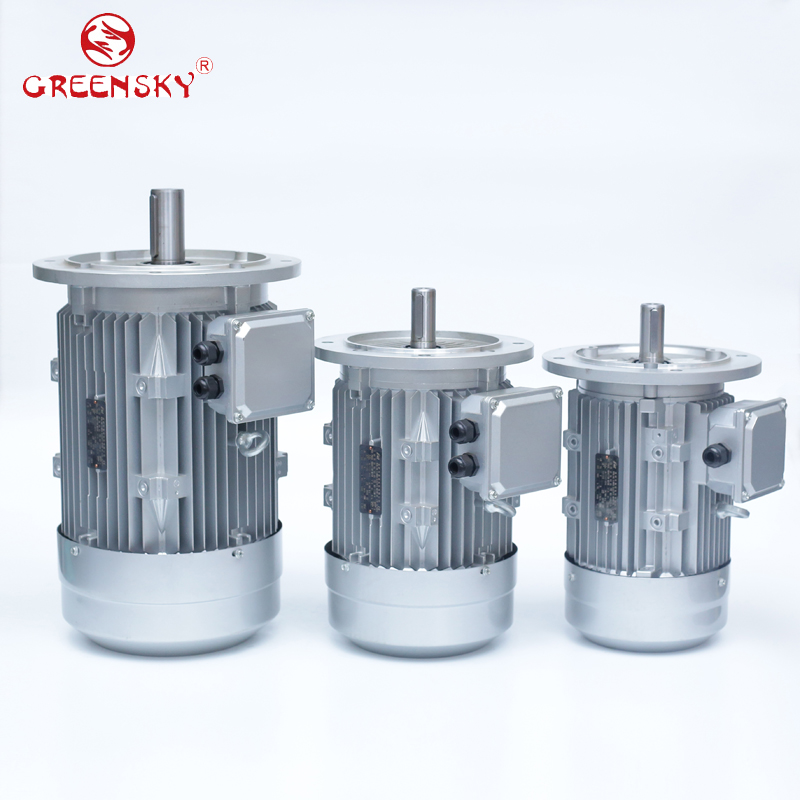
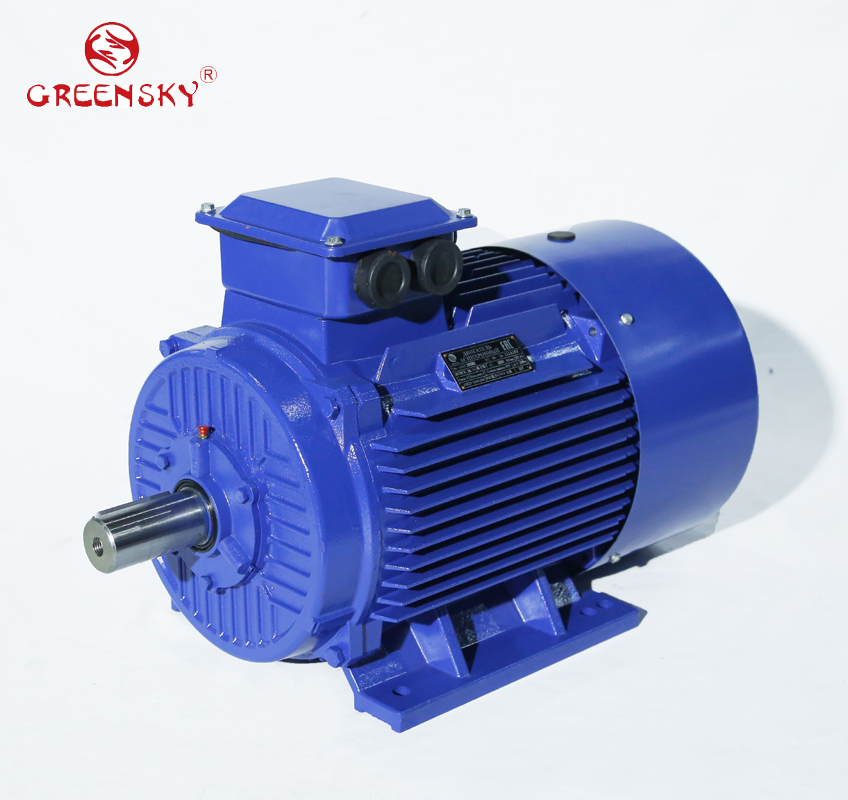
Greensky GSAPM permanent magnet synchronous motors mount high-energy rare-earth magnets on the rotor and pair an optimised three-phase stator with a matched servo or variable-frequency drive. Because the rotor carries its own magnetic field, there is no slip and no rotor copper loss — the shaft turns in exact synchronism with the stator field at IE4 / IE5-class efficiency, with high torque density, a wide constant-power speed range and almost no torque ripple. Frame sizes 80–210 with IEC 60072-1 mounting dimensions and custom windings, shafts and flanges cover pumps, fans, compressors, conveyors and motion-control machinery. For battery-powered drives, see our brushless DC motors.
Key Specifications
| Parameter | Value |
|---|---|
| Motor type | Permanent magnet synchronous motor (PMSM), three-phase, GSAPM series |
| Rotor | High-energy rare-earth permanent magnets on the rotor (no rotor winding, no rotor copper loss) |
| Rated power | 0.75 kW ~ 30 kW |
| Rated voltage | 220 V / 380 V (custom winding on request) |
| Frequency | 50 Hz / 60 Hz base; variable frequency from the matched drive |
| Poles | 2 / 4 / 6 / 8 |
| Rotor speed | Synchronous — shaft speed equals the rotating stator field speed (zero slip) |
| Efficiency class | IE4 / IE5-class design (up to approx. 95 %) |
| Drive requirement | Matched servo drive or VFD with sinusoidal field-oriented control (FOC) |
| Frame size | IEC 80 ~ 210; mounting dimensions to IEC 60072-1 and GB/T 4772 |
| Enclosure | TEFC, IC411 (totally enclosed fan cooled) |
| Protection class | IP55 |
| Insulation class | Class H |
| Duty type | S1 continuous |
| Ambient / altitude | -15 °C ~ +40 °C; altitude ≤ 1000 m |

Reference: Greensky brushless DC motors (BLDC) | ABB motors and generators — PMSM and IE4 / IE5 motor technology
How a PMSM Motor Works
The GSAPM series is a permanent magnet synchronous motor (PMSM) family. High-energy rare-earth magnets are mounted on the rotor, so the shaft turns in perfect synchronism with the rotating stator field — there is no slip and no rotor copper loss. Driven by a matched servo or variable-frequency drive, this design delivers IE4 / IE5-class efficiency, high torque density, a wide constant-power speed range and smooth, low-noise operation. Unlike a three-phase induction motor, a PMSM needs no magnetising current, so efficiency stays high even at partial load.
The GSAPM range covers frame sizes 80–210 with mounting dimensions in accordance with IEC 60072-1 and GB/T 4772. The complete rating table is shown in the technical data sheet below.
PMSM Motor Characteristics
Eight design priorities shape every GSAPM rotor and stator — from magnet grade and winding layout to cooling and feedback — and together they define how the motor behaves in service.
High Efficiency
No magnetising current and no rotor copper loss, so efficiency stays in the IE4 / IE5 class right across the load range.
High Torque Density
Rare-earth magnets on the rotor deliver more torque per unit of volume and weight than an equivalent induction motor.
High Power at Low Speed
Full torque is available near zero speed, so the drive can often omit a gearbox and its mechanical losses.
Extremely Broad Speed Range
A wide constant-power region supports both low-speed torque and high-speed running from one motor frame.
High Reliability & Stability
Fewer wearing parts, sealed construction and a robust rotor hold output steady over long continuous duty.
Low Noise & Low Vibration
Optimised magnetic circuit and balanced rotor keep torque ripple, acoustic noise and vibration minimal.
Long Service Life
No brushes, no rotor current and Class H insulation reduce thermal ageing and maintenance demand.
Precise Speed & Position Control
The synchronous rotor plus encoder feedback gives accurate speed and position regulation for motion axes.
Greensky manufactures the GSAPM PMSM series alongside its brushless DC motors, stepper motors, gearboxes and motor controllers; custom windings, shafts and mounting flanges are available via custom motor development.
PMSM Motor Applications
High efficiency across the whole load range, high torque density and accurate synchronous speed control make the GSAPM series a good fit wherever a drive runs for long hours or has to hold speed precisely — from HVAC compressors and electric mobility to renewable energy, appliances and robotics.
HVAC & Air Compressors
Inverter compressors and variable-speed fans cut energy use and run quieter than fixed-speed units.
Electric Mobility
E-bike, scooter and light EV traction drives profit from high torque density and regeneration.
Industrial Automation
Servo axes, conveyors and positioning stages use precise synchronous speed control.
Renewable Energy
Water pumps, wind and generator sets benefit from high efficiency at partial load.
Home Appliances
Inverter washing machines and refrigerators run smoothly with low vibration and noise.
Robotics & Conveyors
Robotic joints and material handling need fast dynamic response and compact size.
Engineered for Efficient Synchronous Drive
Because the rotor carries its own magnetic field, a Greensky PMSM needs no magnetising current and produces no rotor copper loss. Efficiency therefore stays high from part load to full load, while the synchronous rotor holds speed without slip for precise, quiet motion control.
Reference: Greensky three-phase asynchronous motors | Nidec motor technology reference
PMSM vs BLDC Motor: Key Differences
| Parameter | PMSM (Permanent Magnet Synchronous Motor) | BLDC (Brushless DC Motor) |
|---|---|---|
| Rotor excitation | Permanent magnets on the rotor (surface-mounted or interior IPM; typically rare-earth NdFeB) | Permanent magnets on the rotor (usually surface-mounted; ferrite or NdFeB) |
| Back-EMF waveform | Sinusoidal — distributed, sinusoidally wound stator | Trapezoidal — concentrated winding, trapezoidal back-EMF |
| Commutation / drive | Sinusoidal PWM with field-oriented control (FOC); current vector kept aligned with the rotor field | Six-step (square-wave) electronic commutation, energising windings in discrete steps |
| Supply | Three-phase AC from a variable-frequency drive (VFD) or servo drive | DC bus from an electronic controller / ESC |
| Position feedback | High-resolution encoder or resolver typical (sensorless speed control also possible) | Low-resolution Hall sensors typical (sensorless commutation also possible) |
| Control complexity & cost | Higher — needs an FOC-capable drive and accurate parameter tuning | Lower — simple commutation logic, economical controllers |
| Typical efficiency | Approx. 90–95 % (IE4 / IE5-class designs are achievable) | Approx. 85–90 % (varies with load and drive) |
| Torque ripple | Very low — near-constant torque throughout the rotation | Noticeable ripple at each commutation step; higher harmonic content |
| Low-speed smoothness | Excellent — stable and quiet even close to zero speed | Prone to cogging at very low speed |
| Noise & vibration (NVH) | Very low — optimised magnetic design and balanced rotor | Low, but slightly higher acoustic noise from discrete torque pulses |
| Speed regulation range | Wide, including a broad constant-power region and field weakening | Wide at medium–high speed; narrower fine speed regulation |
| Typical power range | Fractional to tens of kW in industrial and traction duty | Milliwatts to several kW, from micro drives to light mobility |
| Typical applications | HVAC compressors and fans, EV / light-mobility traction, servo axes, CNC, robotics, high-precision pumps and generators | Cooling fans, pumps, compressors, home appliances, e-bikes, drones, power tools, cost-sensitive drives |
| Relative cost | Higher motor and drive cost — offset by higher efficiency over the life of the machine | Lower system cost — the cost-effective choice for general-purpose duty |
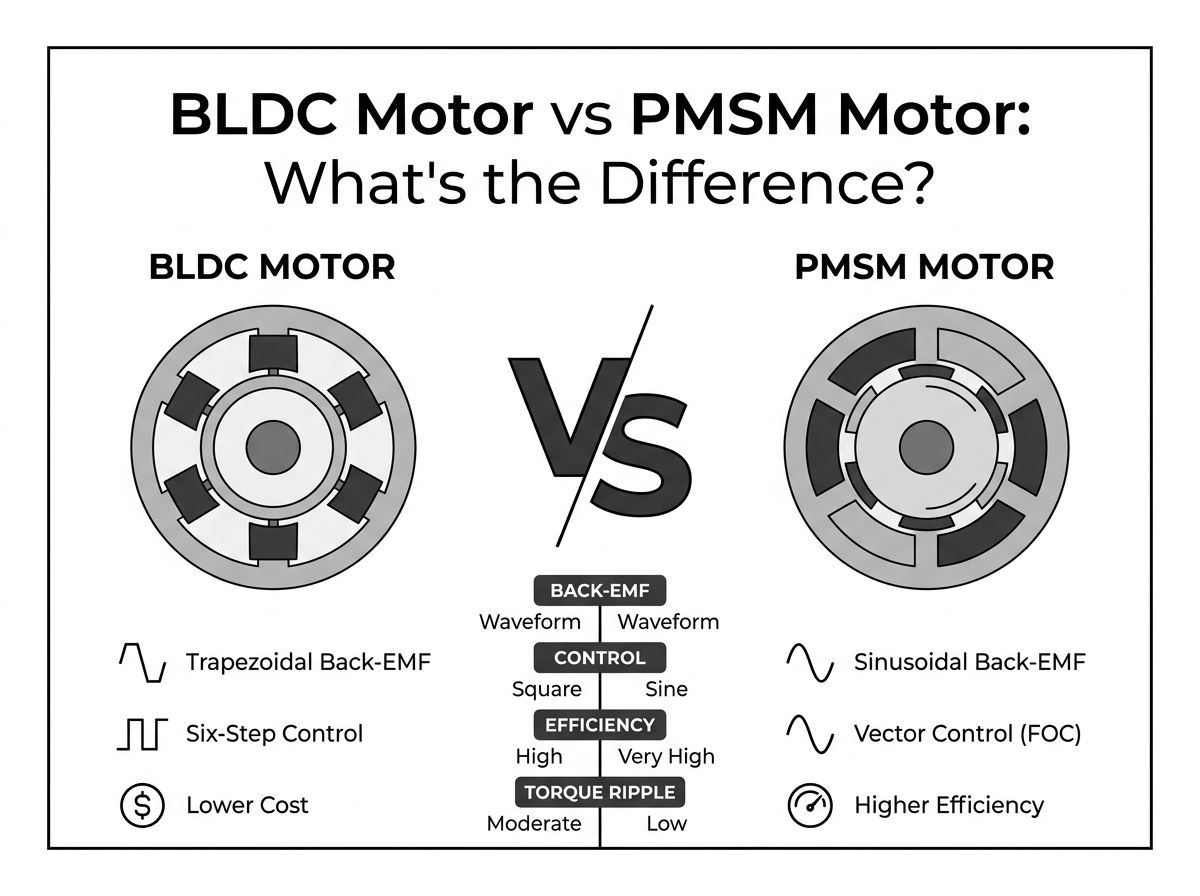
Note: PMSM and BLDC motors are both permanent-magnet synchronous machines at heart — the practical distinction is the back-EMF waveform and the way the drive commutates the windings. Modern field-oriented control blurs the boundary further, because it can drive a trapezoidal machine with sinusoidal currents. Efficiency, torque-ripple and speed figures above are typical industry ranges; the final numbers for a given motor depend on frame size, load profile and drive tuning. Confirm the selection against Greensky’s tested data sheet and your actual duty cycle.
PMSM Motor FAQ
What is a PMSM motor and how does it work?
A Permanent Magnet Synchronous Motor (PMSM) uses high-energy rare-earth permanent magnets on the rotor and a three-phase winding on the stator. Because the rotor carries its own magnetic field, the shaft turns at exactly the same speed as the rotating stator field — there is no slip. A matched servo or variable-frequency drive feeds the stator with sinusoidal current, so the motor delivers high efficiency, smooth torque and precise speed and position control.
What is the difference between a PMSM and a BLDC motor?
Both are permanent-magnet synchronous machines, but they differ in back-EMF waveform and drive method. A BLDC motor has a trapezoidal back-EMF and is driven by six-step (square-wave) commutation; a PMSM has a sinusoidal back-EMF and is driven by sinusoidal field-oriented control. The practical result is that a PMSM runs with almost no torque ripple, quieter and slightly more efficiently, while a BLDC motor gets a simpler and cheaper controller.
Does a PMSM motor need a controller, or can it run directly on AC power?
A PMSM must be driven by a matched variable-frequency drive or servo drive — it cannot start or run directly from the mains supply. The drive generates the sinusoidal currents that keep the stator field aligned with the rotor, and for servo-class duties it closes the speed or position loop. Greensky can supply a matched drive or confirm compatibility with the drive you already use.
Does a PMSM motor need an encoder or resolver?
For speed control only, sensorless field-oriented control is often sufficient. For accurate position control — servo axes, robotics, CNC and similar duties — a high-resolution encoder or resolver is normally fitted so the drive can align the stator current with the rotor position precisely.
How efficient is a PMSM motor, and what efficiency class does it reach?
Because there is no rotor winding and no slip, a PMSM typically reaches around 90–95 % efficiency, and IE4 / IE5-class designs are achievable. Actual efficiency depends on frame size, load profile and drive tuning, so the final figure should be confirmed against Greensky’s tested data for the specific frame you select.
Are PMSM motors more expensive than BLDC or induction motors?
The motor itself usually costs more than an equivalent induction motor, because of the rare-earth magnets and the tighter winding tolerances, and the drive is more sophisticated than a simple BLDC controller. In continuous-duty, energy-intensive machinery the higher efficiency and the absence of rotor loss often offset that premium over the total cost of ownership.
What power and voltage range do Greensky PMSM motors cover?
The Greensky GSAPM series spans approximately 0.55 kW to 30 kW, with 220 V and 380 V windings, 2 / 4 / 6-pole versions (about 3000 / 1500 / 1000 rpm) and IP55 protection. Model-level power, rated torque and mounting dimensions are listed in the PMSM technical data sheet — please confirm the final selection against your required torque-speed curve and duty cycle.
Which applications are PMSM motors best suited for?
PMSM motors are favoured wherever efficiency, smooth low-speed torque or accurate positioning matter: HVAC compressors and fans, electric and light-mobility traction, industrial servo axes and conveyors, renewable-energy pumps and generator sets, inverter home appliances, and robotics. They are also a strong choice wherever a machine runs for long periods under variable load.
Can a PMSM motor run in sensorless mode?
Yes. Sensorless field-oriented control supports speed control in many pump, fan and compressor applications, reducing wiring and cost. Applications that need tight position control generally still use a feedback device. Greensky can advise on the right configuration for your load and speed range.
Why does a PMSM motor overheat, and how can I avoid it?
Overheating normally comes from undervoltage, sustained overload, blocked cooling or incorrect drive parameters. To avoid it, match the drive’s rated current to the motor, keep the duty within the S1 rating, ensure the cooling path is clear and the ambient temperature is within specification, and verify that the torque-speed demand stays inside the data-sheet curve. If a motor still runs hot, re-check the load and the drive settings before changing anything mechanical.
What maintenance does a PMSM motor require?
Very little. With no brushes and no rotor winding there are no wearing electrical parts, so routine maintenance is limited to checking bearings, cooling and terminal connections. For a given output a PMSM is also more compact and lighter than an induction motor, which simplifies machine integration.
Can Greensky supply a custom PMSM motor for my machine?
Yes. Greensky supports OEM and ODM projects covering voltage, winding, shaft, flange and mounting, encoder type, IP rating, insulation class and cable configuration, together with a matched drive. Send your torque-speed requirement, duty cycle and installation constraints, and the engineering team will propose a configuration.
