
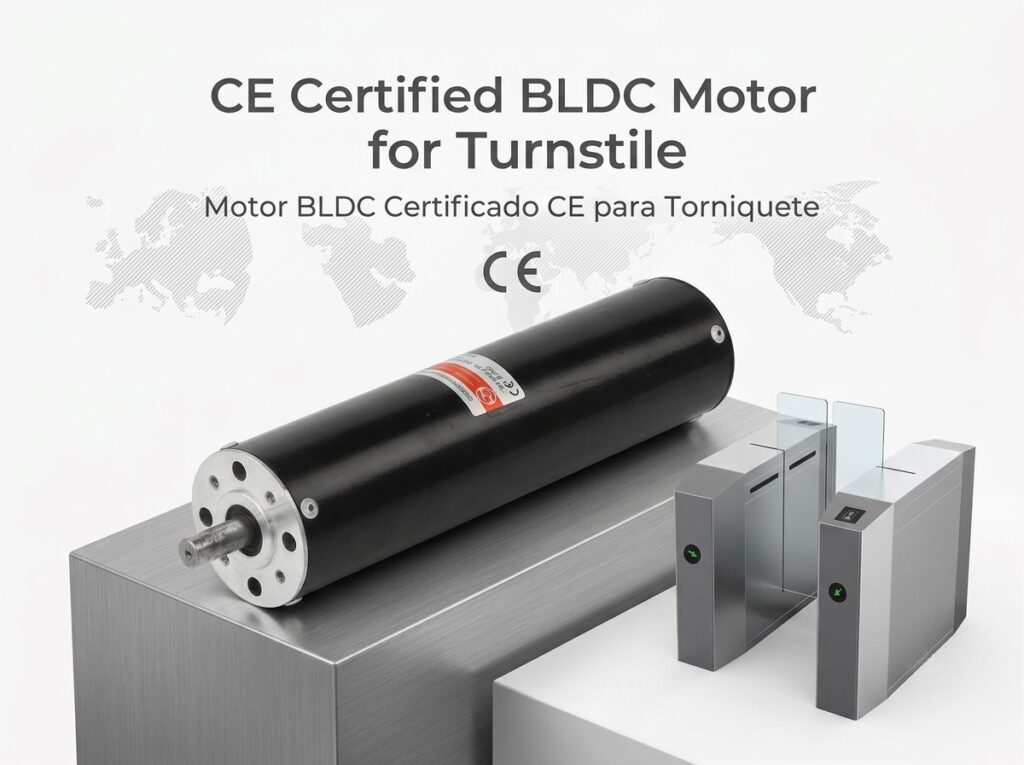
CE Certified BLDC Motor for Turnstile
As access control systems become faster, smarter, and more energy-efficient, the demand for CE certified BLDC motor for turnstile systems continues to grow across Europe, the Middle East, and North America. Modern flap barriers, swing gates, and speed gates require motors capable of delivering precise motion control, low noise, rapid response, and long operational life under continuous duty cycles.
Compared with traditional brushed DC motors or AC geared motors, BLDC motors provide significantly higher efficiency, lower maintenance requirements, and better torque-to-size ratio. For OEM manufacturers and procurement teams, CE certification is equally critical because it ensures compliance with European safety, EMC, and low-voltage directives. Selecting the right turnstile motor therefore involves both electromechanical engineering considerations and regulatory compliance requirements.
This engineering guide explains how CE certified BLDC motors work in turnstile systems, compares them with alternative motor technologies, and provides a practical OEM purchasing framework for engineers and industrial buyers.
What Is a CE Certified BLDC Motor for Turnstile Systems?
A CE certified BLDC motor for turnstile systems is a brushless DC motor designed for pedestrian access control equipment and tested to comply with European regulatory standards. These motors are commonly integrated into flap barriers, swing gate turnstiles, tripod turnstiles, and speed gates used in metro stations, office buildings, airports, factories, and stadiums.
The motor itself operates using electronic commutation rather than mechanical brushes. A controller continuously switches current through the stator windings while permanent magnets on the rotor generate rotational movement. This architecture eliminates brush wear, improves operational stability, and enables highly accurate speed and torque control.
CE certification typically involves compliance with:
- EMC Directive (Electromagnetic Compatibility)
- Low Voltage Directive (LVD)
- RoHS environmental requirements
- Machinery safety standards
For European OEM projects, CE compliance is not optional. Many public transportation and commercial infrastructure projects require documented conformity before system integration approval.
Typical Electrical Specifications
- Voltage range: 24V / 36V / 48V DC
- Power range: 50W–750W
- Speed range: 500–4000 RPM
- Operating mode: Continuous duty
- Protection grade: IP54–IP65
Why Are BLDC Motors Preferred for Modern Turnstile Systems?
The primary reason why BLDC motors dominate modern access control systems is their superior dynamic performance under repetitive motion cycles. A turnstile motor may operate tens of thousands of times daily while maintaining precise positioning accuracy and low acoustic noise.
Traditional brushed motors struggle in this environment because mechanical brushes wear rapidly under frequent start-stop operation. Servo motors can deliver excellent positioning precision, but their overall system cost is often significantly higher than required for standard pedestrian access control.
BLDC motors provide an optimal balance between:
- High efficiency
- Fast acceleration
- Low maintenance
- Compact mechanical size
- Reduced thermal losses
- Lower lifecycle cost
For flap barrier and swing gate systems, smooth acceleration and deceleration are especially important. Sudden mechanical shock can damage gearbox components, reduce passenger comfort, and increase vibration noise. BLDC motor controllers using FOC (Field Oriented Control) algorithms can achieve smooth torque output curves that improve reliability and passenger experience simultaneously.
How Does a BLDC Turnstile Motor Work?
A BLDC motor for a turnstile system operates through coordinated interaction between the motor, encoder, driver, and central access controller.
Electronic Commutation Process
Unlike brushed motors, BLDC motors do not use carbon brushes to switch current. Instead, Hall sensors or magnetic encoders provide rotor position feedback to the motor controller. The controller then electronically energizes stator windings in sequence to maintain continuous rotation.
Position Control in Turnstile Applications
In flap barriers and swing gates, position control is critical because the gate arm must stop precisely at defined angles. High-quality BLDC systems therefore integrate:
- Magnetic encoders
- PID control algorithms
- Current feedback loops
- Torque limiting protection
These features enable:
- Smooth gate opening
- Anti-pinch safety control
- Fast emergency unlocking
- Accurate positioning repeatability
Thermal Management Considerations
Turnstile motors typically operate in enclosed housings with limited airflow. Thermal management therefore becomes a critical engineering factor. High-efficiency BLDC motors generate less copper loss and lower rotor heating compared with brushed systems, reducing thermal stress on bearings and electronic drivers.
This directly improves system lifespan and reduces field maintenance frequency.
BLDC Motor vs Brushed DC Motor for Turnstile Systems
| Parameter | BLDC Motor | Brushed DC Motor |
|---|---|---|
| Efficiency | 85%–92% | 60%–75% |
| Maintenance | Very low | Brush replacement required |
| Noise Level | Low | Medium to high |
| Lifespan | 20,000–50,000 hours | 3,000–8,000 hours |
| Control Precision | Excellent | Limited |
| Heat Generation | Lower | Higher |
| OEM Integration | Excellent | Basic |
Brushed motors still appear in low-cost entry-level turnstile systems because of their lower upfront cost. However, for high-traffic installations such as airports or metro stations, maintenance costs quickly exceed initial savings.
BLDC motors achieve lower total cost of ownership because they reduce downtime, minimize servicing requirements, and maintain stable efficiency over longer operating periods.
BLDC Motor vs Servo Motor for Access Control Equipment
| Parameter | BLDC Motor | Servo Motor |
|---|---|---|
| System Cost | Moderate | High |
| Torque Precision | Very good | Excellent |
| Speed Response | Fast | Very fast |
| Complexity | Moderate | High |
| Programming | Simpler | Advanced tuning required |
| Ideal Applications | Turnstiles & flap barriers | Industrial robotics |
Servo motors are often unnecessary for standard pedestrian access systems because their positioning accuracy exceeds application requirements. Most turnstile applications prioritize reliability, cost efficiency, and long service intervals rather than ultra-high precision motion control.
For this reason, many OEM manufacturers prefer CE certified BLDC motor for turnstile and swing gate systems.
How to Choose a CE Certified BLDC Motor for Turnstile Applications
Selecting the best BLDC motor for a turnstile system requires balancing electrical performance, mechanical integration, regulatory compliance, and operational duty cycle.
1. Voltage Range
Most access control systems use:
- 24V DC for compact systems
- 36V DC for medium-duty gates
- 48V DC for high-speed flap barriers
Higher voltage systems generally reduce current load and improve thermal efficiency.
2. Torque Requirements
Torque selection depends on:
- Gate arm weight
- Opening speed
- Duty cycle
- Gear reduction ratio
Under-sized motors often cause overheating and unstable motion. Oversized motors increase system cost unnecessarily.
3. Speed Characteristics
Flap barriers typically require rapid opening times between 0.2 and 0.8 seconds. High-speed BLDC motors combined with planetary gearboxes can achieve rapid acceleration while maintaining controlled deceleration.
4. Cooling Method
Most turnstile motors rely on passive cooling because enclosed cabinets limit airflow. Engineers should prioritize:
- High efficiency stator design
- Low copper loss
- Optimized rotor balancing
- Thermal-resistant insulation materials
5. Controller Compatibility
The motor driver must integrate smoothly with:
- Access control systems
- RFID readers
- Facial recognition modules
- Building automation systems
- Emergency evacuation controls
CAN bus, RS485, and Modbus communication protocols are commonly required in OEM projects.
6. CE Compliance Documentation
European buyers should request:
- CE declaration of conformity
- EMC testing reports
- RoHS compliance documents
- Electrical safety certificates
Incomplete documentation can delay customs clearance and project approval.
Efficiency and Torque Density in Turnstile BLDC Motors
Efficiency directly impacts heat generation, power consumption, and long-term reliability. In high-traffic facilities operating continuously, even small efficiency gains can significantly reduce energy consumption over time.
Modern BLDC motors achieve high efficiency through:
- Rare-earth permanent magnets
- Optimized stator slot design
- FOC vector control
- Low-loss laminations
Torque density is equally important because turnstile cabinet space is limited. High torque density enables compact motor integration without sacrificing acceleration performance.
For example, a compact 48V BLDC motor can often deliver comparable torque to a larger AC geared motor while occupying substantially less installation volume.
This allows OEM manufacturers to develop slimmer, more aesthetically modern gate designs.
Reliability and Lifespan Considerations
Reliability remains one of the biggest purchasing concerns for transportation authorities, commercial buildings, and system integrators.
A turnstile motor failure can immediately disrupt pedestrian flow and create security vulnerabilities. Consequently, motor reliability directly affects overall system reputation.
Critical Reliability Factors
- Bearing quality
- Rotor balancing
- Temperature rise control
- Controller stability
- Ingress protection level
High-quality CE certified BLDC motors often exceed:
- 20 million operation cycles
- 20,000+ operating hours
- Wide temperature tolerance
For outdoor installations, corrosion resistance and humidity protection become especially important.
Applications of CE Certified BLDC Motors in Access Control
Flap Barrier Gates
Flap barriers require rapid opening speed, low vibration, and silent operation. BLDC motors are widely preferred because they deliver smooth dynamic control with minimal mechanical wear.
Swing Gate Turnstiles
Swing gates often require higher torque due to longer gate arms. 48V BLDC systems with planetary gearboxes are commonly used for high-traffic commercial entrances.
Speed Gates
Premium office buildings and metro systems increasingly adopt speed gates requiring precise synchronization and rapid passenger throughput.
Industrial Access Systems
Factories and logistics centers require durable industrial motors capable of operating under dust, vibration, and temperature fluctuations.
Smart Building Automation
Modern BLDC turnstile motors increasingly integrate with:
- AI security systems
- Cloud access platforms
- IoT monitoring systems
- Remote diagnostics software
OEM and Custom Motor Development for Turnstile Manufacturers
Many turnstile OEM manufacturers require custom motor solutions rather than standard catalog products.
Typical customization requirements include:
- Custom shaft dimensions
- Integrated gearboxes
- Encoder modifications
- Customized winding parameters
- Special voltage configurations
- Compact housing designs
At Greensky Power, OEM motor development often focuses on balancing:
- Compact mechanical integration
- Noise reduction
- Fast response time
- High duty cycle durability
- CE compliance requirements
Common product configurations include:
- 24V compact flap barrier motors
- 48V high-speed BLDC systems
- Industrial servo-integrated gate motors
- Custom planetary gearbox assemblies
Related product pages:
Future Trends in Turnstile Motor Technology
The access control industry is moving toward intelligent, connected, and energy-efficient systems.
Several trends are shaping next-generation turnstile motors:
Higher Efficiency Standards
European regulations continue pushing manufacturers toward lower energy consumption and improved EMC performance.
Integrated Smart Diagnostics
Future BLDC systems increasingly include:
- Predictive maintenance monitoring
- Real-time thermal diagnostics
- Cloud-based fault reporting
Compact High-Torque Designs
Urban transportation systems demand narrower gate cabinets without sacrificing throughput speed. This increases demand for high torque density motors.
Low Noise Operation
Premium commercial buildings increasingly prioritize acoustic comfort, making silent BLDC systems more attractive than traditional geared AC motors.
FAQ — CE Certified BLDC Motor for Turnstile
What does CE certification mean for a turnstile motor?
CE certification indicates that the motor complies with European safety, EMC, and environmental regulations. For OEM manufacturers selling into Europe, CE compliance is essential for customs clearance and legal market entry.
Why are BLDC motors better for flap barriers?
BLDC motors provide smoother acceleration, lower noise, higher efficiency, and longer service life compared with brushed motors. They are especially suitable for high-frequency start-stop applications such as flap barriers and speed gates.
What voltage is commonly used in turnstile BLDC motors?
24V and 48V DC systems are the most common. 24V motors are typically used in compact systems, while 48V systems provide better performance for high-speed or high-torque applications.
How long does a BLDC turnstile motor last?
A high-quality industrial BLDC motor can exceed 20,000 operating hours or tens of millions of operational cycles depending on duty cycle, thermal management, and maintenance conditions.
Can BLDC motors integrate with RFID and facial recognition systems?
Yes. Modern BLDC controllers commonly support CAN bus, RS485, and Modbus communication protocols for seamless integration with smart access control systems.
What is the difference between a BLDC motor and a servo motor in turnstiles?
Servo motors provide higher positioning precision but usually at significantly higher cost and system complexity. BLDC motors provide sufficient precision for most turnstile applications while maintaining better cost efficiency.
Conclusion
Selecting a CE certified BLDC motor for turnstile systems requires more than comparing power ratings or pricing. Engineers and OEM buyers must evaluate efficiency, torque density, control architecture, thermal behavior, reliability, compliance documentation, and long-term operational cost.
BLDC technology has become the preferred solution for modern flap barriers, swing gates, and speed gates because it combines fast dynamic response with low maintenance and excellent energy efficiency.
For European projects, CE compliance is equally important because regulatory approval directly affects system integration and commercial deployment.
Whether you are developing a compact office speed gate or a heavy-duty metro access system, choosing the right OEM motor partner can significantly improve system reliability and long-term project success.
To request technical specifications, OEM customization support, or engineering consultation for turnstile BLDC motors, contact the Greensky Power engineering team.
CTA:
Request datasheet
Get OEM solution
Contact our engineers
References
1. https://ec.europa.eu/growth/single-market/ce-marking_en
2. https://www.ieee.org/
3. https://www.nema.org/
4. https://www.motioncontroltips.com/
5. https://www.controleng.com/
6. https://www.automationworld.com/
7. https://www.mdpi.com/journal/energies
8. https://www.sciencedirect.com/topics/engineering/brushless-dc-motor
