
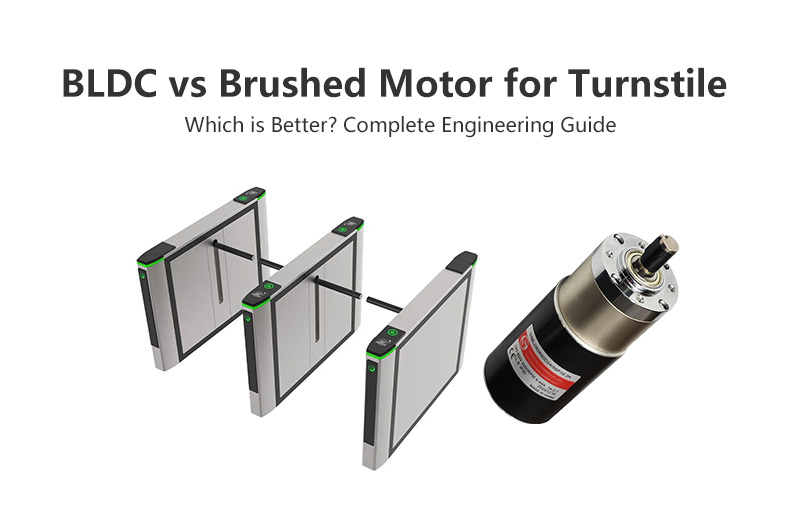
BLDC vs Brushed Motor for Turnstile: Which is Better? Complete Engineering Guide
Featured Snippet:
BLDC motors are generally better than brushed motors for turnstile systems due to their higher efficiency, longer lifespan, lower maintenance, and smoother operation. While brushed motors offer lower initial cost and simpler control, they suffer from wear, lower efficiency, and higher long-term maintenance. For modern high-traffic turnstiles, BLDC motors provide superior performance and total cost of ownership, making them the preferred choice for OEMs and system integrators.
For engineers, procurement managers, and OEM designers, choosing between BLDC vs brushed motor for turnstile is a critical decision that impacts system reliability, user experience, maintenance cost, and lifecycle performance. While brushed motors were widely used in early access control systems, modern turnstiles increasingly rely on BLDC motor technology due to its clear engineering advantages.
This guide provides a deep technical comparison of BLDC and brushed motors in turnstile applications, covering efficiency, torque density, thermal performance, control systems, reliability, and cost—helping you make the right decision for your project.
What Is a BLDC Motor and How Does It Work in Turnstiles?
A Brushless DC (BLDC) motor is an electronically commutated motor that replaces mechanical brushes with a controller. In turnstiles, BLDC motors are used to drive smooth and controlled barrier movement.
Key Characteristics
- Electronic commutation
- Permanent magnet rotor
- High efficiency and low noise
BLDC motors are widely used in modern flap barriers and swing gates due to their smooth operation and long lifespan.
👉For high-performance solutions, check our BLDC Motor for Turnstile
What Is a Brushed Motor and Its Role in Turnstiles?
A brushed DC motor uses mechanical brushes and a commutator to switch current in the rotor windings.
Key Characteristics
- Simple design
- Low initial cost
- Higher maintenance due to brush wear
Brushed motors are still used in low-cost or legacy turnstile systems but are gradually being replaced.
BLDC vs Brushed Motor for Turnstile: Key Differences
| Parameter | BLDC Motor | Brushed Motor |
|---|---|---|
| Efficiency | 85–92% | 60–75% |
| Lifespan | Long | Short |
| Maintenance | Low | High |
| Noise | Low | Higher |
| Control | Advanced | Simple |
The table clearly shows why BLDC motors dominate modern turnstile applications.
Efficiency Comparison: Why BLDC Motors Save Energy
Efficiency directly impacts operating cost in high-traffic turnstiles.
BLDC Efficiency Advantages
- No brush friction losses
- Optimized current control
- Higher electrical efficiency
Brushed Motor Limitations
- Energy loss due to brush contact
- Heat generation reduces efficiency
In large installations, energy savings from BLDC motors are substantial.
Torque Density and Performance Analysis
Torque density determines how compact and powerful a motor can be.
- BLDC motors provide higher torque density
- Brushed motors require larger size for same output
This makes BLDC motors ideal for compact turnstile designs.
Thermal Performance and Heat Management
Thermal performance affects reliability and lifespan.
- BLDC motors generate less heat
- Brushed motors produce heat due to friction
Better thermal performance leads to longer system life.
Control System Differences
Control systems define motion precision and smoothness.
BLDC Control
- FOC or trapezoidal control
- Smooth acceleration and deceleration
Brushed Motor Control
- Simple voltage control
- Less precise motion
Modern turnstiles require advanced control, favoring BLDC motors.
Reliability and Lifespan Comparison
Turnstiles operate continuously, requiring durable components.
- BLDC motors have no wear parts
- Brushed motors suffer from brush wear
This results in higher maintenance costs for brushed systems.
Cost Analysis: Initial vs Lifecycle Cost
| Cost Factor | BLDC Motor | Brushed Motor |
|---|---|---|
| Initial Cost | Higher | Lower |
| Maintenance | Low | High |
| Energy Cost | Lower | Higher |
| Total Cost | Lower long-term | Higher |
BLDC motors provide better ROI despite higher upfront cost.
How to Choose Between BLDC and Brushed Motor for Turnstile
Motor selection should match application requirements.
Selection Criteria
- Voltage: 24V / 48V systems
- Power: 50W–500W
- Speed & Torque: Based on gate type
- Cooling: Air cooling
- Controller: BLDC requires ESC/FOC
Application Recommendations
- High-traffic turnstiles → BLDC motor
- Low-cost systems → brushed motor
👉 Get OEM solution: Custom Motor Development
Applications in Turnstile Systems
- Metro stations
- Office buildings
- Factories
- Stadiums
BLDC motors are preferred in most modern applications.
Future Trends: Why BLDC Motors Are Replacing Brushed Motors
- Higher efficiency standards
- Smart control integration
- Lower maintenance requirements
These trends are accelerating BLDC adoption globally.
FAQ: BLDC vs Brushed Motor for Turnstile
1. Which motor is better for turnstiles?
BLDC motors are generally better due to efficiency, lifespan, and low maintenance.
2. Why are brushed motors still used?
They are cheaper and simpler, suitable for low-cost systems.
3. Do BLDC motors require controllers?
Yes, they require electronic controllers for commutation.
4. What is the typical voltage?
Most turnstile motors use 24V or 48V DC systems.
5. How to reduce maintenance?
Use BLDC motors to eliminate brush wear.
Conclusion: Which Motor Is Better for Turnstiles?
When comparing BLDC vs brushed motor for turnstile, BLDC motors clearly offer superior performance, efficiency, and long-term cost advantages. While brushed motors may still be used in low-cost applications, modern turnstile systems increasingly rely on BLDC technology.
Need help selecting the right motor?
✔ Request datasheet
✔ Get OEM motor solution
✔ Contact our engineers today
References
- IEEE Industrial Electronics Society
- IEC Motor Efficiency Standards
- Access Control System Engineering Reports
