
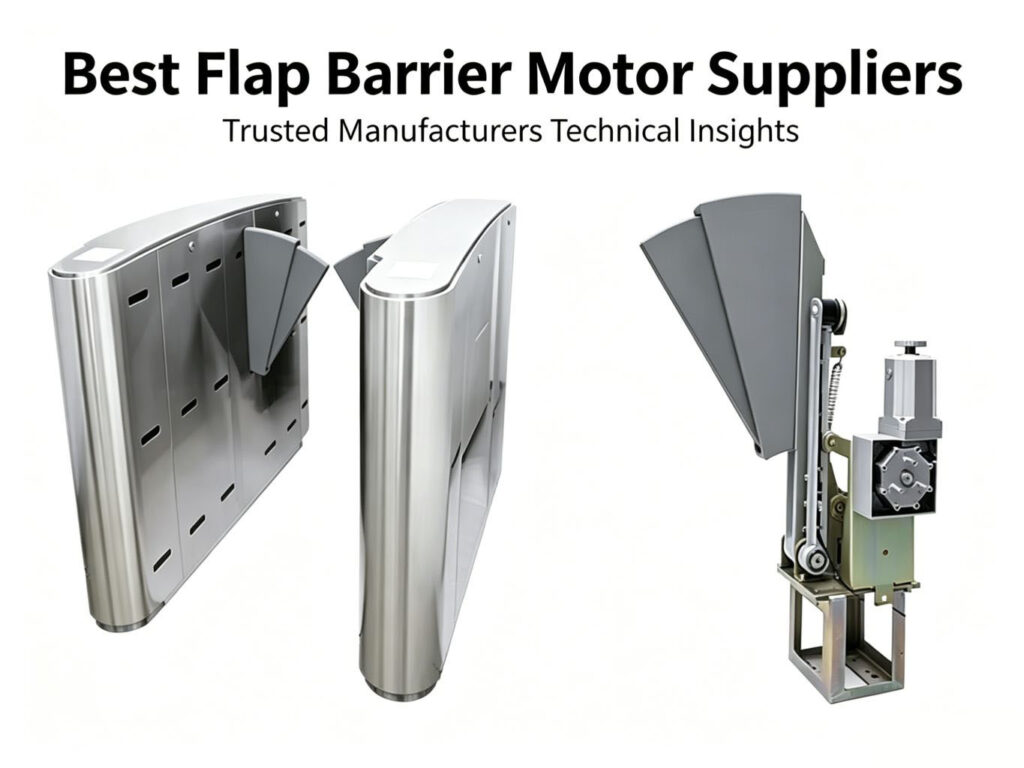
Best Flap Barrier Motor Suppliers (2026 OEM Guide)
Selecting the right flap barrier motor supplier is critical for OEM manufacturers, system integrators, and procurement teams building modern access control systems. A high-quality flap barrier motor directly affects opening speed, operational reliability, thermal stability, lifecycle cost, and long-term maintenance performance.
In 2026, most advanced flap barrier systems increasingly use high-efficiency BLDC motors instead of traditional brushed DC motors because of their superior torque density, lower maintenance requirements, smoother motion control, and improved energy efficiency. However, supplier selection involves more than motor specifications alone. Engineers must evaluate controller compatibility, OEM customization capability, production consistency, lifecycle reliability, and technical support responsiveness.
This engineering guide explains how to evaluate the best flap barrier motor suppliers, compares BLDC motors with alternative technologies, analyzes critical procurement criteria, and provides technical selection guidance for industrial access control applications.
What Is a Flap Barrier Motor?
A flap barrier motor is the core drive component used in flap barrier gate systems to control opening and closing movement. These motors convert electrical energy into controlled rotational motion, enabling smooth, fast, and reliable pedestrian access control.
Core Functions of a Flap Barrier Motor
Modern flap barrier systems require motors capable of:
- Rapid acceleration and deceleration
- Precise position control
- Continuous-duty operation
- Low-noise movement
- Anti-tailgating response
- Emergency fail-safe operation
The motor must operate consistently across millions of opening cycles while maintaining stable torque output and thermal efficiency.
Why Motor Quality Matters
Inferior motors often create:
- Panel vibration
- Excessive heat generation
- High failure rates
- Inconsistent motion
- Increased maintenance costs
For transportation systems, office buildings, industrial factories, and intelligent access infrastructure, motor reliability directly affects user experience and system uptime.
Why BLDC Motors Dominate Modern Flap Barrier Systems
BLDC motors have become the preferred solution for modern flap barrier systems because they provide an ideal balance between performance, efficiency, reliability, and OEM scalability.
High Efficiency Operation
BLDC motors typically achieve operational efficiencies between 85% and 92%, significantly reducing heat generation and energy consumption compared with traditional brushed motors.
This matters in:
- 24/7 transportation hubs
- Commercial office systems
- High-traffic industrial facilities
Superior Torque Density
Flap barrier systems require compact motors capable of delivering rapid acceleration without excessive cabinet size.
BLDC motors provide:
- High torque in compact structures
- Smooth low-speed performance
- Fast opening response
- Stable continuous-duty operation
Reduced Maintenance Requirements
Because BLDC motors eliminate brushes and mechanical commutation, they experience significantly lower wear rates.
This reduces:
- Downtime
- Maintenance labor
- Spare part inventory
- Lifecycle operating cost
Related motor solutions:
Bldc motor for flap barrier
BLDC Motor vs Brushed DC Motor for Flap Barriers
| Parameter | BLDC Motor | Brushed DC Motor |
|---|---|---|
| Efficiency | 85–92% | 60–75% |
| Maintenance | Low | High |
| Noise Level | Low | Higher |
| Torque Density | High | Moderate |
| Service Life | Long | Shorter |
| Thermal Performance | Excellent | Moderate |
| OEM Integration | Excellent | Basic |
| Industrial Reliability | Excellent | Limited |
Engineering Perspective
Brushed DC motors remain cheaper initially, but their higher maintenance frequency and lower efficiency increase lifecycle cost significantly.
For high-cycle flap barrier systems, BLDC motors generally deliver stronger long-term ROI and higher operational stability.
BLDC Motor vs Servo Motor for Access Control Systems
| Parameter | BLDC Motor | Servo Motor |
|---|---|---|
| System Cost | Moderate | Higher |
| Control Complexity | Moderate | Advanced |
| Position Accuracy | High | Very High |
| OEM Scalability | Excellent | Moderate |
| Reliability | Excellent | Excellent |
| Typical Application | Industrial Access Control | Precision Automation |
Which Technology Is Better?
Servo systems provide extremely precise motion control but often exceed the practical requirements of flap barrier systems.
Modern BLDC systems already provide:
- Smooth operation
- Fast response
- High torque stability
- Excellent speed control
For most OEM manufacturers, BLDC motors provide the best balance between performance and commercial scalability.
How to Evaluate the Best Flap Barrier Motor Suppliers
Selecting a motor supplier requires evaluating more than product specifications alone.
Manufacturing Consistency
OEM projects require stable batch-to-batch consistency for:
- Torque performance
- Thermal behavior
- Noise levels
- Encoder accuracy
- Electrical parameters
Inconsistent manufacturing causes integration problems and field failures.
Engineering Support Capability
The best suppliers provide:
- Motor customization
- Controller matching support
- CAD and dimensional drawings
- Thermal analysis assistance
- Application engineering consultation
OEM Customization Flexibility
Modern access systems often require:
- Custom shafts
- Special mounting dimensions
- Encoder integration
- Customized voltage ranges
- Communication protocol compatibility
Custom OEM solutions:
Custom bldc motor
Production Capacity
Large infrastructure projects require stable lead times and scalable manufacturing capacity.
Reliable suppliers maintain:
- Automated production systems
- Quality inspection procedures
- Supply chain stability
- Long-term component sourcing
Key Technical Specifications Buyers Should Compare
Procurement teams frequently focus only on price, but engineering specifications ultimately determine lifecycle value.
Voltage Range
Common flap barrier motor voltage configurations include:
- 24V compact systems
- 48V industrial systems
- 72V high-speed systems
Higher voltage systems generally reduce current demand and improve thermal efficiency.
Power Range
Typical power requirements range from:
- 40W for lightweight systems
- 100–200W for standard commercial barriers
- 300W+ for heavy-duty industrial systems
Speed and Torque
Motor selection depends heavily on:
- Opening speed targets
- Barrier panel weight
- Duty cycle
- Traffic flow density
High-speed systems require strong acceleration combined with stable deceleration control.
Thermal Management
Efficient thermal design extends motor lifespan and improves reliability.
Important thermal considerations include:
- Aluminum housing design
- Heat dissipation structure
- Continuous current capability
- Ambient operating temperature
How Reliability and Lifespan Affect OEM Procurement Decisions
Reliability is often more important than initial purchase cost in industrial access systems.
Why Lifespan Matters
Flap barrier systems frequently operate:
- 24 hours per day
- 365 days annually
- Millions of cycles per year
Motor failures create:
- Operational downtime
- Security risks
- Repair expenses
- Customer dissatisfaction
Key Reliability Indicators
Engineers should evaluate:
- Bearing quality
- Winding insulation class
- Rotor balance
- Encoder durability
- Controller protection algorithms
Predictive Maintenance Trends
Advanced BLDC systems increasingly include:
- Temperature monitoring
- Current diagnostics
- Vibration analysis
- Remote fault detection
These technologies reduce unexpected failures and improve system uptime.
Industrial Applications for Flap Barrier Motors
Different industries prioritize different motor characteristics.
Transportation Systems
Metro stations and airports require:
- High throughput
- Continuous-duty operation
- Fast anti-tailgating response
- Low maintenance
Commercial Office Buildings
Office installations prioritize:
- Quiet operation
- Smooth user experience
- Compact appearance
- Smart access integration
Industrial Facilities
Factories demand motors capable of operating under:
- Dust exposure
- Vibration
- Heavy usage
- Wide temperature ranges
Smart City Infrastructure
IoT-enabled access systems increasingly require motors compatible with:
- Cloud platforms
- Remote diagnostics
- AI monitoring systems
- Predictive maintenance software
How to Choose the Best Flap Barrier Motor Supplier for OEM Projects
Choosing the right supplier requires balancing engineering performance, production scalability, and long-term partnership capability.
Evaluate Technical Documentation
Professional suppliers provide:
- Detailed datasheets
- Torque-speed curves
- Thermal analysis reports
- CAD files
- Lifecycle testing data
Assess Controller Compatibility
Modern access systems require integration with:
- RFID systems
- Biometric devices
- Industrial PLCs
- CAN communication systems
Review OEM Engineering Support
Reliable engineering support accelerates:
- Prototype development
- Integration testing
- Mass production scaling
- Field troubleshooting
Consider Long-Term Supply Stability
Large infrastructure projects require suppliers capable of supporting multi-year production continuity and spare part availability.
Future Trends in Flap Barrier Motor Technology (2026 and Beyond)
The flap barrier motor industry continues evolving toward higher efficiency, smarter diagnostics, and more compact high-performance systems.
Advanced FOC Control Algorithms
Field-Oriented Control (FOC) technology increasingly improves:
- Motion smoothness
- Torque precision
- Energy efficiency
- Low-speed stability
Integrated Smart Controllers
Future systems will integrate:
- Cloud connectivity
- AI diagnostics
- Remote firmware updates
- Predictive maintenance analytics
Higher Torque Density Designs
Improved magnetic materials and optimized winding technologies continue increasing torque output while reducing motor size.
Sustainability Requirements
Global energy efficiency regulations are accelerating demand for:
- High-efficiency BLDC motors
- Lower standby power consumption
- Longer operational lifespan
- Reduced maintenance waste
FAQ: Best Flap Barrier Motor Suppliers
What is the best motor type for flap barriers?
BLDC motors are currently the preferred solution for most flap barrier systems because they provide excellent efficiency, torque density, reliability, low maintenance, and smooth motion control.
Why are OEM buyers choosing BLDC motors instead of brushed motors?
BLDC motors provide longer lifespan, reduced maintenance, lower noise, higher efficiency, and better thermal performance, making them more suitable for high-cycle industrial access systems.
How important is torque in flap barrier motors?
Torque directly affects acceleration performance, panel stability, and anti-tailgating response. Insufficient torque can cause slow opening speed and unstable movement under heavy-duty operation.
What voltage is commonly used in flap barrier systems?
24V, 48V, and 72V systems are commonly used. Higher voltage systems generally improve efficiency and reduce current load in high-performance installations.
How do I evaluate a reliable flap barrier motor supplier?
Buyers should evaluate manufacturing consistency, technical support capability, OEM customization flexibility, quality control systems, thermal design expertise, and long-term production stability.
Can flap barrier motors be customized for OEM projects?
Yes. Professional suppliers commonly provide customized shaft designs, voltage configurations, encoder integration, communication protocols, and controller matching for OEM access control systems.
Conclusion
The best flap barrier motor suppliers in 2026 are no longer evaluated solely by price. Modern OEM buyers increasingly prioritize efficiency, torque density, thermal stability, reliability, smart controller integration, and long-term engineering support.
BLDC motors continue dominating the flap barrier industry because they provide the optimal balance between performance, scalability, lifecycle cost, and industrial reliability. Compared with brushed DC and servo systems, modern BLDC solutions deliver excellent operational stability while maintaining commercially competitive OEM deployment costs.
For transportation hubs, smart office systems, industrial factories, and intelligent city infrastructure, selecting the right motor supplier directly affects system performance, maintenance cost, and long-term operational success.
Greensky Power provides customized industrial BLDC motor solutions for flap barriers, swing gates, intelligent access control systems, and high-cycle industrial automation applications worldwide.
✔ Request datasheet
✔ Get OEM solution
✔ Contact our engineers for technical consultation
References
1. https://ieeexplore.ieee.org/
2. https://www.motioncontroltips.com/
3. https://www.controleng.com/
4. https://www.nidec.com/en/technology/motor/basic/
5. https://www.ti.com/motor-drivers/brushless-dc-bldc-drivers/overview.html
6. https://www.analog.com/en/technical-articles/field-oriented-control-for-pmsms-utilizing-a-dynamic-voltage-vector.html
7. https://www.mdpi.com/topics/Brushless_DC_Motor
8. https://www.automationworld.com/
9. https://www.sciencedirect.com/topics/engineering/electric-motor
10. https://www.researchgate.net/publication/Brushless_DC_Motor_Applications
