
European Fixed-Rail Stairlift Application
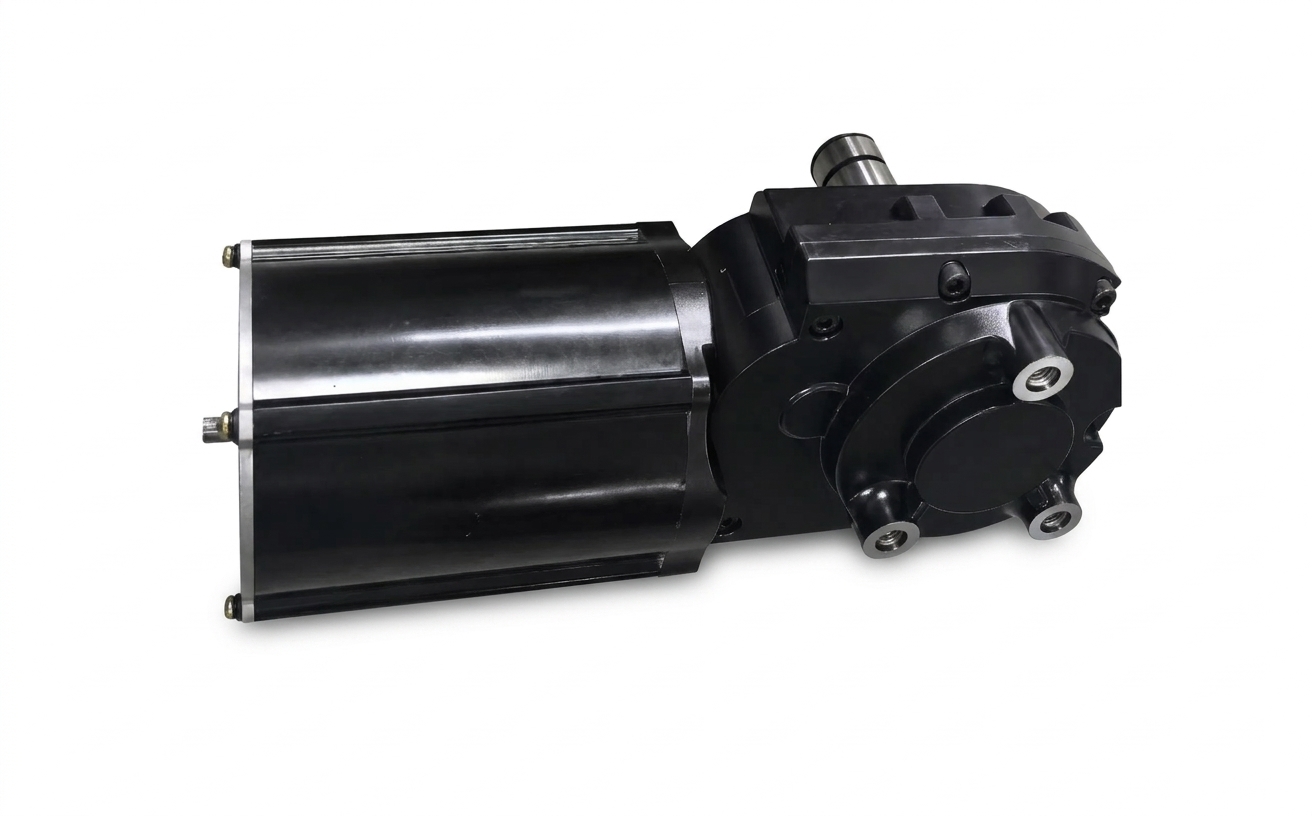
How a stairlift manufacturer’s drive requirements were met with the Greensky GSBLD60R550D24 brushless gear motor and a 1:112 self-sustaining reducer: 70 N·m rated torque, no generator effect on descent, manual winding below 5 N·m, and sealing rated for outdoor rails.
At a Glance
- Client
- European stairlift manufacturer
- Industry
- Accessibility & mobility equipment
- Market
- Europe (EU — EN 81-40)
- Products
- BLDC Gear Motor GSBLD60R550D24
- Drive train
- 1:112 self-sustaining reducer
- Outcome
- Self-locking, EN 81-40 aligned
Customer Background
Why the drive train — not the motor alone — decides whether a stairlift is safe to install.
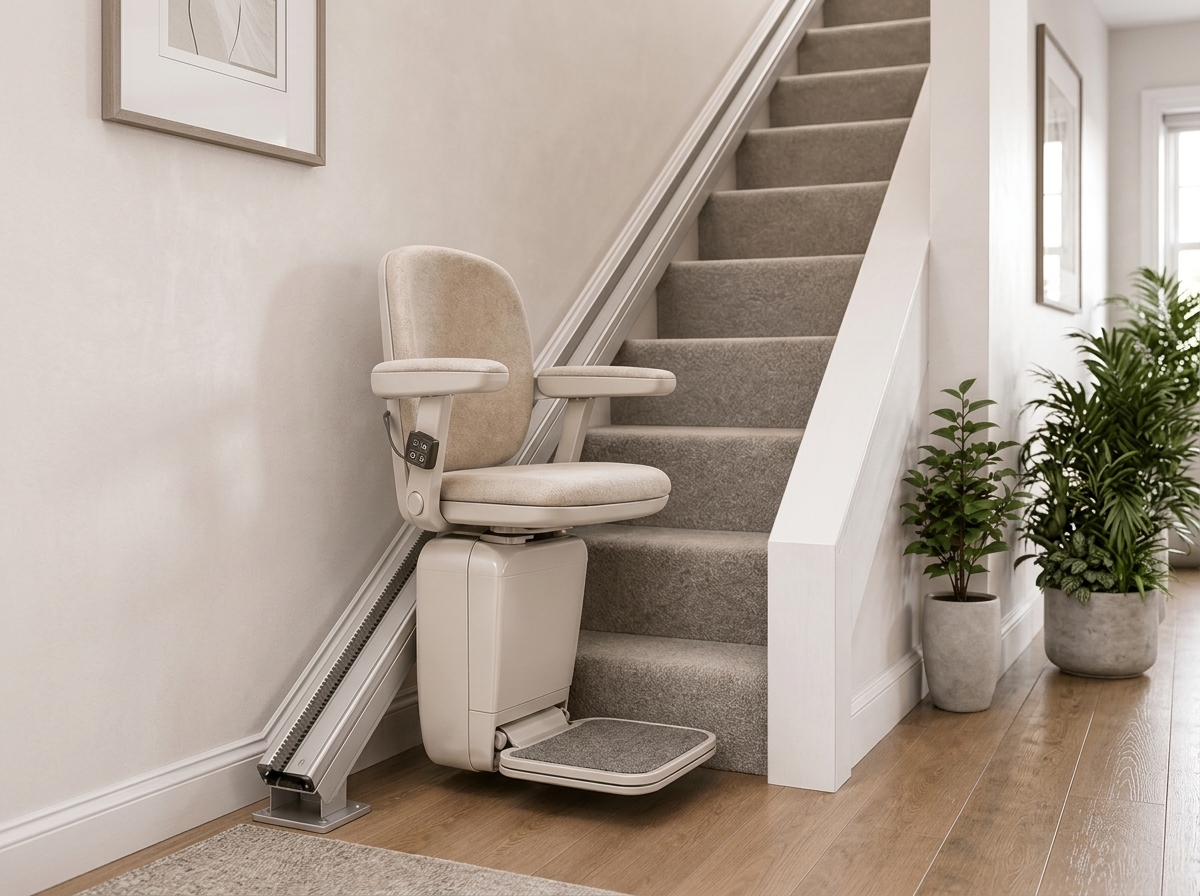
Our customer is a European manufacturer of fixed-rail seat stairlifts: a carriage guided directly by a rail, carrying one person up and down a straight or curved staircase in an inclined plane. The application sits in a well-defined standards envelope — permanently installed power-operated stairlifts for persons with impaired mobility are specified by ISO 9386-2, which limits rated speed and rail inclination and sets the safety, dimension and functional-operation rules for seated and standing users.
In Europe the binding product standard is EN 81-40:2020, harmonised under the Machinery Directive and covering construction, manufacturing, installation, maintenance and dismantling of electrically operated stairlifts. It governs the whole appliance, but the drive train carries a disproportionate share of the risk: it defines whether the carriage can hold position without power, whether it can be lowered safely, and whether it can be rescued by hand during a mains failure or a fault.
That is why this project did not start from a motor catalogue. The customer issued a drive requirement specification covering four groups — self-locking and safety behaviour, mechanical load and gear life, emergency manual control, and environmental and noise limits — and asked for a motor-plus-reducer package engineered against those figures.
The Engineering Challenges
Four requirement groups defined the target — each one a hard constraint, not a preference.
ASafety & self-locking
- Static self-sustaining: the reducer must hold the carriage by itself, with a maximum static holding torque that covers the maximum output-shaft torque at both specified load cases — 38 N·m and 70 N·m.
- No generator effect: at maximum load travelling downwards, the motor and gearbox system must not generate.
- Yield safety factor: the gearing structure must withstand at least 2.5× the rated load to yield, as required by EN 81-40.
BMechanical load & gear life
- Gear life: minimum 1500 hours at rated load — sized on gear strength, not on bearing catalogue life alone.
- Force on tooth: 2330 N tangential load on the tooth flank at rated load, friction included.
- Maximum axial force: 1000 N allowed on the reducer output shaft — the binding limit for bearing selection and shaft retention.
CEmergency manual control
- Hand winding: the drive must provide a mechanical means of moving the carriage when there is no power.
- Maximum operating torque: what the operator applies at the hand-winding shaft must stay at or below 5 N·m — an ergonomic limit, not a machine limit, and the reason the reduction ratio cannot simply be raised for more holding torque.
- Non-energised holding: the parked state must not depend on a powered brake to remain safe.
DEnvironment & noise
- Very low noise: with motor and reducer assembled inside the lift and running at rated load, overall sound pressure must stay below 55 dB — the drive is mounted close to the user’s ears.
- Temperature and humidity: operating range −15 °C to +45 °C, relative humidity 20% to 95% non-condensing.
- Basic protection: for outdoor rails the complete assembly, including reducer sealing and oil seal, must reach at least IP44 as defined in IEC 60529.
Products & Solution Adopted
A 24 V brushless drive matched to a self-sustaining reducer, specified from the output shaft backwards. It builds on the same brushless gear motor family Greensky supplies for other low-speed, high-torque applications.
BLDC Gear Motor GSBLD60R550D24
24 V brushless drive sized for one-person carriage duty, with the torque headroom needed to hold the load through the gearbox rather than through a powered brake.
Self-Sustaining Reducer, 1:112
Reduction stage selected so the drive holds the carriage statically with power removed, while keeping the load on the tooth flank and the axial load on the output shaft inside the specified limits.
Manual Winding & Sealed Assembly
Hand-winding interface on the drive train, with the reduction chosen so the crank stays within the operator’s limit; housing, reducer sealing and oil seal rated for outdoor installation.
The drive is built around the output shaft, because that is where this application’s limits live. The 1:112 reduction is what makes static self-sustaining possible without an energised brake: the gearing itself resists back-driving, so the carriage stays put when the power goes away — the behaviour EN 81-40 expects from a stairlift, and the reason the reducer was evaluated for torque hold at both specified load cases rather than at a single nominal figure. The same reduction ratio sets what the user feels at the hand-winding shaft, which is why the ratio is a compromise between holding capability and the 5 N·m rescue limit rather than a mechanical optimum.
Eliminating the generator effect on descent comes from the drive topology and control behaviour, not from adding a dissipation element: when the carriage descends at maximum load, the system must not feed energy back. Electrical and emergency-stop behaviour follows the machine-level requirements of IEC 60204-1, where the manual control function used for rescue is treated as part of the machine’s control system.
Duty rating for an intermittent travel profile — short runs, frequent stops, long idle periods — is classified under IEC 60034-1, and because the carriage drive participates in a safety function, its control path is specified to the performance level required by ISO 13849-1. All of this sits inside the EU framework now moving from the Machinery Directive to Regulation (EU) 2023/1230 on machinery, which repeals Directive 2006/42/EC and is phased in from 2027.
How We Implemented It
From the customer’s requirement document to a released, sealed drive assembly.
Requirement translation
The four requirement groups were converted into drive-level targets: holding torque at both specified load cases, tooth flank load, output-shaft axial limit, hand-crank torque, noise, temperature and enclosure rating.
Gearing and shaft design
Reduction ratio, gear geometry and output-shaft bearings were sized against the 2330 N tooth force and 1000 N axial limit, with the structure checked to the 2.5× yield requirement rather than to nominal load.
Self-locking and descent validation
Static self-sustaining behaviour was verified at both load cases, together with the no-generator-effect condition at maximum load travelling downwards.
Manual winding validation
The hand-winding interface was checked against the 5 N·m operator limit at the hand shaft, confirming the drive can be moved without power by one person.
Environmental qualification and release
Sealing of housing, reducer and oil seal qualified to IP44 for outdoor rails; assembly confirmed across the −15 °C to +45 °C range and 20–95% non-condensing humidity, with noise measured below 55 dB at rated load.
Requirements Met
The four headline figures the drive package was specified to deliver.
| Requirement | Specified limit | How the drive meets it | Reference |
|---|---|---|---|
| Rated voltage / power | 24 VDC / 550 W | Brushless drive sized for one-person carriage duty with torque headroom at the output shaft. | Customer requirement |
| Rated current / speed | 20 A / 18.5 ±15% r/min | Low-speed, high-torque operating point matched to the rail-carriage travel speed. | Customer requirement |
| Rated motor torque | 70 N·m | Torque delivered through the 1:112 reduction rather than by oversizing the motor frame. | Customer requirement |
| Gearbox reduction ratio | 1 : 112 | Self-sustaining ratio that holds the carriage statically with power removed. | Customer requirement |
| Static self-sustaining (holding) | 38 N·m / 70 N·m | Reducer resists back-driving at both specified load cases; holding does not depend on an energised brake. | Customer requirement |
| No generator effect | No generation at max load, descending | Drive behaviour on descent keeps the motor and gearbox system out of generating mode. | Customer requirement |
| Yield safety factor | ≥ 2.5× to yield | Gearing structure designed against yield at 2.5× rated load, not against nominal load. | EN 81-40:2020 |
| Gear design life | ≥ 1500 h at rated load | Gear strength sized for service life under continuous rated load, driven by tooth flank stress. | Customer requirement |
| Force on tooth | 2330 N tangential | Gear geometry and material selected for the flank load at rated load, friction included. | Customer requirement |
| Maximum axial force | 1000 N on output shaft | Output-shaft bearings and shaft retention rated to the axial limit imposed by the rail drive. | Customer requirement |
| Emergency manual control | Hand winding, ≤ 5 N·m | Mechanical winding interface on the drive train, with reduction chosen to keep manual rescue within one person’s effort. | Customer requirement |
| Acoustic noise | < 55 dB | Measured with motor and reducer assembled in the lift, running at rated load. | Customer requirement |
| Operating temperature | −15 °C to +45 °C | Drive train validated across the full ambient range for indoor and semi-outdoor rails. | Customer requirement |
| Operating humidity | 20% to 95%, non-condensing | Sealing and oil-seal specification covers high-humidity installations without condensation damage. | Customer requirement |
| Enclosure protection | IP44 minimum, outdoor use | Complete assembly including reducer sealing and oil seal, classified to the IP code. | IEC 60529 (IP code) |
| Scope of the appliance | Stairlift, inclined plane | Permanently installed, one person, carriage retained and guided directly by the rail. | ISO 9386-2:2000 |
The practical outcome for the customer is a drive package that can be specified as a unit: motor, self-sustaining reducer, manual winding interface and sealing qualified together against one requirement document. That removes the usual integration argument between a motor supplier and a gearbox supplier about who owns the holding behaviour — the question that decides most stairlift drive projects.
Why This Drive Suits Stairlift Duty
Four points that come up in every seat-stairlift drive specification.
1Self-locking is not a brake
- A powered brake holds only while it is energised and healthy; self-sustaining gearing holds with the power off.
- Choosing the ratio for self-locking changes what the drive does in a fault, not just how it performs in normal travel.
- Holding torque must be checked at the highest load case, not at nominal load — 70 N·m, not the smaller of the two specified cases.
2Manual rescue sets the ratio
- A higher reduction gives more holding capability but makes hand winding harder; the ergonomic limit is what caps the ratio.
- A rescue that needs two people or a tool is not a rescue function in the sense the standard intends.
- The winding interface belongs on the drive train, not on the controller.
3No generator effect on descent
- A descending load can back-drive the motor into generating mode; the specification rules that out at maximum load.
- The condition must be checked on descent under load — it does not show up in a static bench test.
- It has to be designed out in the drive topology, not managed afterwards with additional dissipation.
4Noise and sealing dimension the housing
- Below 55 dB is measured with the assembly installed in the lift at rated load — the enclosure affects the result as much as the motor.
- Outdoor rails require IP44 on the whole assembly, so reducer sealing and oil seal count as much as the motor housing.
- −15 °C to +45 °C and 20–95% non-condensing humidity rule out lubricants and seal materials chosen only for indoor duty.
Specifying a drive for a stairlift, platform lift or accessibility product?
Send us your holding torque, load cases, hand-winding limit, noise and IP requirement — we will propose a matched brushless motor and self-sustaining reducer package.
Start Your Application Case
Share your application, required torque, voltage, duty cycle and environment — our engineers respond within 24 hours with a tailored motor proposal.
Greensky Power Co., Ltd.
Email: mkt@greensky-power.com
Tel: +86 5718819 5488
Web: greensky-power.com
Customized Service: Yes