
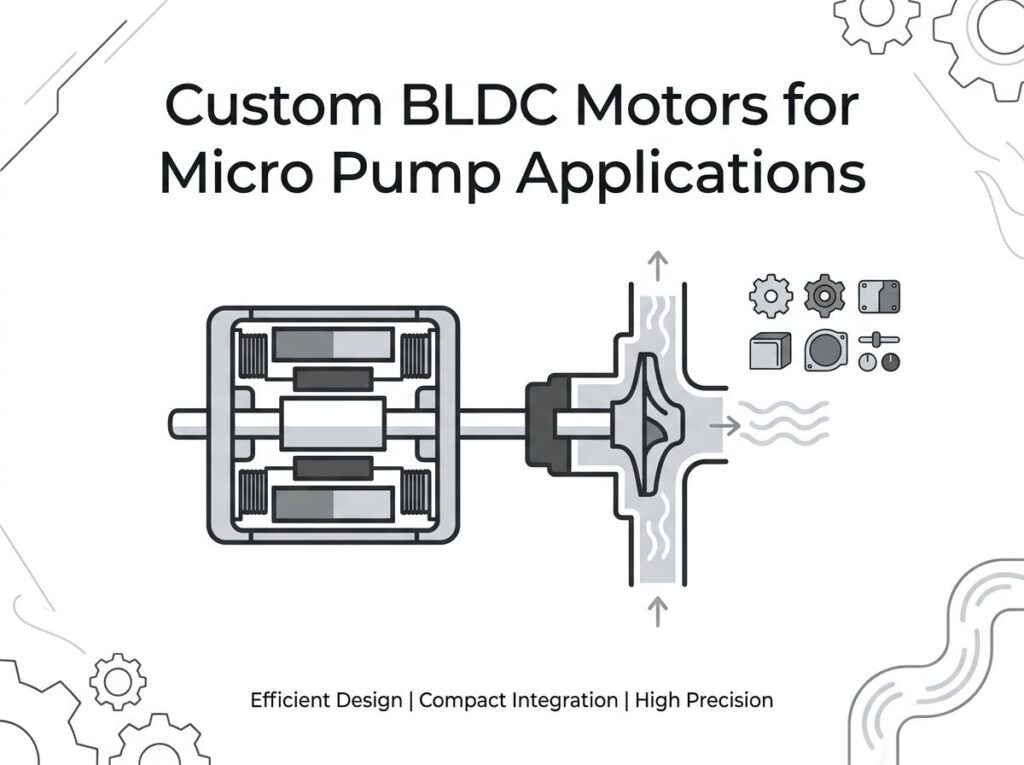
Custom BLDC Motors for Micro Pump Applications
Quick Answer
A custom BLDC pump motor is a brushless DC (or PMSM) drive motor whose winding, voltage, feedback and thermal design are tuned to a specific micro-pump duty rather than pulled from a catalogue. For OEM pump builders, customization pays off when the voltage platform, torque-at-speed, continuous-duty heat or envelope do not match a stock part: a motor wound for the exact load reaches IE4 efficiency, fits the pump head, and lowers total cost of ownership. Greensky co-engineers these custom pump motors with the pump head – motor, driver and feedback as one module.
In this guide
- What a custom BLDC pump motor is
- How customization is engineered
- Off-the-shelf vs custom-wound
- Engineering data: Kv/Kt, efficiency, thermal
- Best applications for custom pump motors
- Step-by-step specification process
- Common engineering mistakes
- Troubleshooting: problem to fix
- Why Choose GreenSky?
- References
- FAQ
What a custom BLDC pump motor is
A custom BLDC pump motor is a permanent-magnet brushless DC (BLDC) or synchronous PM (PMSM) motor whose electrical and mechanical parameters are selected for one pump application. The catalogue alternative is a general-purpose motor with fixed voltage, fixed winding and a generic torque-speed curve. In a micro pump – whether a magnetic gear pump, a magnetic-drive pump or a micro magnetic pump – the motor defines flow, pressure capability, noise and service life, so the motor is really part of the pump’s fluid design, not an afterthought.
Customization is not the same as private-labeling a stock part. It means the motor’s winding, magnet, bearing, feedback and driver are specified against the pump’s real duty: the fluid, the pressure differential, the speed range, the ambient, and the envelope. That is the distinction Greensky draws for custom drive programs and applies here to pump OEMs.
For an OEM pump motor program the business case is total cost of ownership, not unit price. A motor tuned to the load runs cooler, needs less oversizing, and ships as a ready-to-mount module – reducing the OEM’s assembly, firmware and warranty cost. The same logic applies to our OEM motor manufacturing guidance.
How customization is engineered
The co-engineering path from a pump requirement to a custom motor follows a fixed chain:
- Capture the duty. Fluid type and viscosity range, differential pressure, target flow, speed band, duty cycle (continuous S1 vs intermittent), ambient and enclosure.
- Derive the torque and speed target. Use the pump torque relationship
T = Δp·V / (2π·η_m) + T_viscand the flow relationQ = V × N, as covered in our gear-pump torque guide and motor-speed flow guide. - Choose Kv/Kt via the winding. Set the torque constant
Kt = 9.5493 / Kvso the motor sits on its efficient part of the curve at the operating point. - Match voltage and pole count. Align to the device bus (3.7-48 V) and pick pole pairs for smooth low-speed control and low cogging.
- Select bearings and sealing. Ceramic-hybrid bearings for chemical duty; IP rating for the environment.
- Add feedback and driver. Hall or encoder for closed-loop speed; integrate the driver so flow tracks RPM as in BLDC vs brushed comparison.
- Validate thermally. Confirm winding temperature stays inside its IEC insulation class under the worst-case ambient and viscosity.
Because viscosity moves the load across the duty cycle, the motor is always sized on the cold, high-viscosity extreme – the same principle we detail in the viscosity selection guide.
Off-the-shelf vs custom-wound
| Factor | Catalogue BLDC motor | Custom-wound BLDC pump motor |
|---|---|---|
| Fit to pump duty | Approximate | Exact – tuned to torque/speed |
| Efficiency at your operating point | May sit off-peak | Tuned to peak (up to IE4) |
| Voltage platform | Few fixed options | 3.7-48 V to your bus |
| Feedback | Fixed or none | Hall / encoder / FG per need |
| Thermal margin | Generic | Sized to your ambient + fluid |
| Envelope (flange/shaft) | Standard | Matched to pump head |
| Unit cost at volume | Lower | Higher, but lower system TCO |
| Lead time | Stock | Sampling then mass production |
What gets customized
| Parameter | Typical options | What it buys you |
|---|---|---|
| Winding turns | Sets Kv / Kt | Torque vs speed trade-off |
| Operating voltage | 3.7 / 5 / 12 / 24 / 48 V | Battery or PSU match |
| Pole pairs | 2-3 pairs | Cogging, control bandwidth |
| Magnet grade | Sintered NdFeB grades | Flux density, efficiency |
| Bearings | Ball / ceramic hybrid | Chemical life, speed |
| Feedback | Hall / encoder / FG | Closed-loop speed control |
| Driver | Built-in / external | Integration level |
| Housing / flange | Standard / custom | Fits the envelope |
| Interface | PWM / 0-5 V / I2C | System command |
| Sealing | IP54-IP68 | Environment resistance |
Engineering data: Kv/Kt, efficiency, thermal
Winding, Kv and Kt
The speed constant Kv (rpm/V) and torque constant Kt (N·m/A) are two faces of one coil: Kt = 9.5493 / Kv. More turns → lower Kv, higher Kt → more torque per amp and stronger low-speed torque, but a lower top speed. For a gear pump running at modest speed with high starting torque, wind for low Kv; for a high-RPM centrifugal coolant loop, wind for high Kv. Tuning Kv/Kt to the load is the dominant efficiency and heating lever – the same reason a generic motor often runs hot in a pump it was not designed for.
Efficiency and thermal class
| Quantity | Typical custom BLDC pump motor | Note |
|---|---|---|
| Efficiency class (IEC 60034-30-1) | IE4 super-premium (80-93%) | Magnet rotor removes rotor copper loss |
| Insulation class (IEC 60034-1) | B 130 / F 155 / H 180 °C | Cap on winding temperature |
| Thermal rise | ΔT = P_loss × (R_th1 + R_th2) | Windings + fluid shear |
| Duty | S1 continuous (24/7) | Pump duty is mostly continuous |
| Bearing life | L10h = (C/P)^3 × 10^6 / (60·n) | Ceramic hybrid extends in chemicals |
Inertia matching
For fast flow transients the motor rotor inertia should be close to the pump load inertia. A motor with far too much inertia slows the pump’s response; one with too little may overshoot. The pump head’s rotating inertia is known from the gear-pump geometry, so the custom motor’s rotor is sized to match – a step catalogue parts skip.
Best applications for custom pump motors
| Application | Why a custom motor wins | Typical spec |
|---|---|---|
| Medical / IVD analyzers | Precise, low-pulsation dosing; silent; long life | 12-24 V, encoder, IE4 |
| Analytical / chromatography | Stable mobile phase, low pulsation | Closed-loop FG, low cogging |
| Battery thermal management | Variable flow vs heat load, high RPM | High Kv, 12-48 V |
| Chemical dosing / inkjet | Viscous or corrosive fluid, ceramic bearings | Low Kv, ceramic hybrid |
| Fuel-cell H2 circulation | Sealless, continuous, clean | PMSM, IP-rated |
| Semiconductor / coolant | 24/7 duty, low NVH | S1, F-class, built-in driver |
These are the duty profiles where an off-the-shelf BLDC for a micro pump rarely fits and a co-engineered motor recovers efficiency, noise and reliability margin.
Step-by-step specification process
- Define the fluid and duty. Viscosity range, chemical class, differential pressure, flow, speed band, duty cycle (S1 vs intermittent).
- Compute torque and speed. Combine the pump torque and flow equations; note the cold-viscosity peak.
- Set Kv/Kt. Pick the winding so the operating point sits on the efficient region of the torque-speed curve.
- Fix the voltage and envelope. Match the device bus and the pump-head flange/shaft/length.
- Choose feedback and driver. Hall/encoder + soft-start for viscous cold starts; built-in driver for integration.
- Verify thermal and bearing life. Confirm ΔT stays under the IEC class and L10h clears the target life.
- Validate on the real pump. Run samples against the actual head and duty, then move to pilot and mass production.
This mirrors the RPM methodology in our motor speed and RPM guide and the feedback choices in Hall vs sensorless BLDC.
Common engineering mistakes
- Sizing on the warm nominal point. Cold, high-viscosity torque can be 4-6x; the motor must clear the cold peak, not the catalogue rating.
- Ignoring inertia mismatch. A heavy rotor slows flow response and hurts pulsation in analytical duties.
- Under-specifying thermal class. Continuous S1 duty in a sealed pump head needs F or H class, not a generic B.
- Skipping EMC at the motor. Long unshielded leads and unfiltered drivers fail pre-compliance; integrate filtering early.
- Open-loop on a viscous load. Without Hall/encoder feedback the motor cannot hold flow as viscosity changes.
- Treating the motor as a commodity. A generic motor forces pump oversizing, more heat and a larger power supply – higher TCO than a tuned custom part.
Troubleshooting: problem → cause → solution
| Problem | Cause | Solution |
|---|---|---|
| Motor overheats in the pump | Undersized Kt; low efficiency at op point | Rewind for lower Kv / higher Kt; choose IE4 |
| Excess cogging / pulsation | Pole-slot mismatch; open-loop | Add encoder; tune commutation |
| EMC fails pre-compliance | No filtering; long leads | Integrated driver with filtering; shielded cable |
| Bearing fails early on chemicals | Standard steel bearing | Ceramic hybrid; chemical-compatible lube |
| Slow flow response | Motor inertia >> load inertia | Match inertia; gear down if needed |
| Cold-start stall on viscous fluid | Stall torque < cold torque | Higher peak torque; soft-start ramp |
Why Choose GreenSky?
Greensky Power is a China-based B2B manufacturer of BLDC and PMSM drive motors and drive electronics for micro-pump and motion OEMs – not a reseller. For pump builders we act as the motor co-engineering partner:
- Custom winding and voltage. We tune Kv/Kt to your pump head across 3.7-48 V and 10-400 W, in 12-42 mm frames.
- Driver integration. Built-in or referenced driver with Hall/encoder closed-loop speed, soft-start, PWM / 0-5 V command and FG tach output – so flow tracks RPM without firmware burden.
- Thermal and duty design. Motors specified to IEC 60034-1 duty classes (S1 continuous) and insulation classes, validated against your real fluid and ambient.
- Chemical and environment readiness. Ceramic-hybrid bearings, IP-rated sealing, and materials matched to the wetted path.
- Compliance for export. CE / RoHS / REACH documentation, with the same disciplined approach we apply to CE-certified European OEM programs.
- Low-risk path to volume. Small engineering sample batches for fit, flow, noise and thermal validation, then scalable mass production.
If you are specifying a magnetic gear pump, a magnetic-drive pump or any micro-pump platform, send us the duty cycle and envelope – we return a co-engineered custom BLDC pump motor module, not a catalogue guess.
References
- IEC 60034-1:2022 — Rotating electrical machines — Rating and performance (duty cycles S1-S10, insulation classes B/F/H). https://webstore.iec.ch/publication/80825
- IEC 60034-30-1:2022 — Efficiency classes (IE1-IE5) for low-voltage AC motors; permanent-magnet BLDC/PMSM reach IE4. https://webstore.iec.ch/publication/69655
- NEMA MG 1-2024 — Motors and Generators, application and performance guidance for fractional and integral motors. https://www.nema.org/standards/view/mg-1-motors-and-generators
- U.S. DOE 10 CFR Part 431 — Energy efficiency program for electric motors (IE4 reference, 2027). https://www.ecfr.gov/current/title-10/chapter-II/subchapter-D/part-431
- International Energy Agency (IEA) — Energy Efficiency of Electric Motor Systems. https://www.iea.org/topics/energy-efficiency
- SKF — Bearing life and bearing selection for electric motors (L10h, ceramic hybrid). https://www.skf.com/us/products/bearings-units-housings
- Siemens — SIMOTICS and IE4/IE5 permanent-magnet motor efficiency notes. https://www.siemens.com/global/en/products/drives/motors.html
- maxon — BLDC motor and torque-constant (Kt/Kv) design notes. https://www.maxongroup.com/maxon/view/content/ec-motor
- FAULHABER — Brushless DC motor technology and customization for miniature drives. https://www.faulhaber.com/en/products/brushless-dc-motors/
- IEEE Xplore — Peer-reviewed papers on BLDC motor design and efficiency optimization. https://ieeexplore.ieee.org/
FAQ
When does a micro pump OEM need a custom BLDC motor instead of a catalogue part?
When the pump’s duty does not sit near a standard motor’s optimum – the voltage platform, torque-at-speed, continuous S1 heat or envelope is off. Customization also pays off when pulsation, EMC or bearing-chemical life are gating specs; then a motor tuned to the exact duty beats a generic one on efficiency and total cost of ownership.
What parameters can be customized on a BLDC pump motor?
Winding turns (sets Kv/Kt), voltage (3.7-48 V), pole count, magnet grade, bearing type, feedback (Hall/encoder/FG), driver integration, housing/flange/shaft, control interface (PWM/0-5 V/I2C), sealing (IP54-68) and thermal class. Each trades off torque, speed, efficiency, size and cost.
How does winding customization change motor performance?
Kt = 9.5493 / Kv. More turns raise Kt and lower Kv: more torque per amp and stronger low-speed torque, but lower top speed. Fewer turns do the opposite. Wind for low Kv on a high-torque gear pump; high Kv on a high-RPM centrifugal loop. Tuning Kv/Kt to the load is the biggest efficiency and heating lever.
Can the driver or controller be integrated with the custom motor?
Yes. Greensky supplies the BLDC/PMSM motor with a matched driver as one co-engineered module – built-in or referenced to your main PCB – with closed-loop speed control, soft-start for cold viscous fluids, PWM/0-5 V command, FG tach and EMC filtering.
What certifications apply to custom BLDC pump motors for export?
CE (LVD, EMC, RoHS, REACH) for Europe and component-level UL recognition depending on the end product; efficiency referenced to IEC 60034-30-1 (IE4 for permanent-magnet BLDC/PMSM). Greensky delivers CE/RoHS/REACH documentation and aligns the design to the OEM’s target market.
What is the typical development timeline and MOQ for a custom pump motor?
Specification review, winding/mechanical proposal, functional samples (few weeks with driver tuning), validation against the real pump load, then pilot and mass production. MOQ is project-based; sampling starts with a small engineering batch so the OEM validates fit, flow, noise and thermals before volume.
