
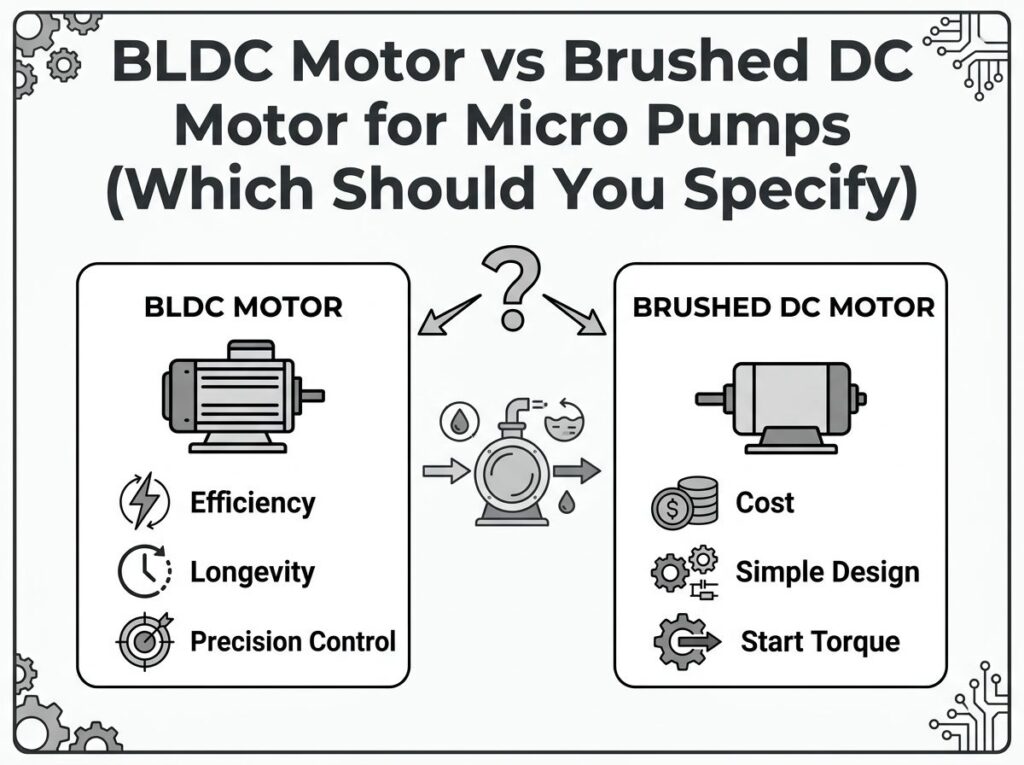
By GreenSky Power Engineering Team · Technical reference for OEM pump designers, instrument engineers and procurement specifying compact, low-flow, low-power micro-pump drives
BLDC Motor vs Brushed DC Motor for Micro Pumps: Which Should You Specify?
Quick Answer
For a micro pump, a brushless DC (BLDC) motor is the stronger choice on every axis that matters in compact fluid systems. It delivers longer service life (20,000–25,000 h vs 1,500–3,000 h for brushed, because there are no wearing carbon brushes — only bearings), higher efficiency (80–90% vs 60–75%, up to IE4), lower maintenance (no brush replacement, no carbon dust), better speed control (precise PWM / closed-loop across 100–4,000 rpm vs coarse voltage) and it is suited to continuous operation (IEC 60034-1 S1 duty, 24/7). The trade-off is a higher initial cost and the need for a commutation driver. A brushed motor still wins only when the device is cheap, disposable or runs only intermittently for a short life.
In this guide
- Quick Answer
- What Is the Difference? (Brushed vs Brushless Commutation)
- How Each Motor Works (Step by Step)
- Feature Comparison: BLDC vs Brushed DC
- Engineering Data: Life, Efficiency, Temperature & Torque
- Best Applications for BLDC Micro Pumps
- How to Choose: 7-Step Selection
- Common Engineering Mistakes
- Troubleshooting: Problem → Cause → Solution
- Why Choose GreenSky?
- References
- FAQ
What Is the Difference? (Brushed vs Brushless Commutation)
A micro pump moves fluid by displacement; the motor’s only job is to turn the pump head against pressure. Both brushed and brushless DC motors run on DC and do that job — but they switch the winding current (the commutation that keeps the rotor turning) in completely different ways, and that single difference drives every performance gap below.
- Brushed DC motor. Current is reversed mechanically: carbon brushes slide against a segmented commutator on the rotor. The contact is physical, continuous and wearing.
- Brushless DC (BLDC) motor. The brushes and commutator are gone. An electronic driver switches the three stator phases using rotor-position feedback — Hall sensors or sensorless back-EMF estimation — creating a rotating magnetic field with no contact.
Because commutation is the root of both wear and electrical noise, removing it is what gives BLDC its longer life, lower EMI, higher efficiency and finer control. The trade is added electronics: a BLDC needs a driver, whereas a brushed motor is “apply voltage and it spins.” This is the same motor-physics baseline we apply to an AGV traction motor, scaled to a few watts.
How Each Motor Works (Step by Step)
Brushed DC — mechanical commutation:
- The DC supply feeds current through the carbon brushes to the commutator.
- As the rotor turns, the commutator segments make and break contact, reversing current in the armature windings at the right moment.
- The reversed current keeps the magnetic field pushing the rotor forward — continuous rotation, but with sliding friction at every contact.
- That friction erodes the brushes, throws off conductive carbon dust and sparks at the commutator, slowly raising heat and EMI until the brushes are worn out.
BLDC — electronic commutation:
- The driver energizes the three stator phases in sequence to build a rotating field.
- Hall sensors (placed 120° apart) or sensorless back-EMF detection tell the driver where the permanent-magnet rotor is.
- The driver switches the phases in sync with rotor position — no brushes, no sliding contact, no spark.
- Because there is no friction to wear, the only remaining wear item is the bearing, and life extends to tens of thousands of hours under proper thermal management.
Note on efficiency nuance. Some precision brushed motors (e.g. iron-less core designs from Maxon) can be highly efficient because they avoid eddy-current losses. As a category for micro pumps, however, BLDC is consistently higher-efficiency and lower-maintenance because it removes brush friction entirely. Spec on the whole drive, not just the winding.
Feature Comparison: BLDC vs Brushed DC
| Parameter | BLDC (brushless) | Brushed DC |
|---|---|---|
| Commutation | Electronic (PCB driver, Hall / sensorless) | Mechanical (carbon brushes + commutator) |
| Service life | 20,000–25,000 h (bearing-limited) | 1,500–3,000 h (brush-limited) |
| Efficiency | 80–90% (up to IE4 super-premium) | 60–75% (friction & arcing losses) |
| Maintenance | None — only bearing end-of-life | Brush replacement; carbon-dust cleanup |
| EMI / arcing | Zero arcing, ultra-low EMI (shielded options) | Commutator sparking, high EMI |
| Speed control | Precise PWM / closed-loop, 100–4,000 rpm | Coarse voltage, poor low-rpm stability |
| Continuous operation | Suited to S1 24/7 duty | Best for intermittent / short-life |
| Noise & vibration | Low (no contact) | Higher (mechanical contact) |
| Initial cost | Higher (motor + driver) | Lower (2-wire, plug-and-play) |
| Total cost of ownership | Lower over product life | Higher (replacements, downtime) |
Engineering Data: Life, Efficiency, Temperature & Torque
Service life — the 5–10× gap
| Technology | Typical life | Limiting wear item | Source basis |
|---|---|---|---|
| Brushed DC | 1,500–3,000 h (some sources 500–1,500 h) | Carbon-brush erosion | Maxon / Faulhaber field data |
| BLDC | 20,000–25,000 h | Bearings only | Faulhaber (~5× brushed); Boyang >20,000 h |
A brushed pump’s life is set by how fast its brushes wear; a BLDC pump’s life is set by its bearings — which is why bearing grade (and our use of precision ball bearings) is the real lever on BLDC longevity, not the winding.
Efficiency and the IE4 ceiling
Brushless motors avoid the friction and arcing losses of brushes, so more input becomes hydraulic work — typically 80–90%. Against IEC 60034-30-1, permanent-magnet BLDC/PMSM motors reach IE4 (super-premium, ~93% at the 11 kW reference) and exceed it by 3–8 points because the magnet rotor removes rotor copper loss. A comparable brushed motor sits near 60–75%. The gap is widest at partial load and under continuous duty — precisely the micro-pump operating point. See our motor speed and efficiency notes for how duty affects realized efficiency.
| Efficiency class (IEC 60034-30-1) | Typical min. efficiency (11 kW, 4-pole ref.) | Relevance to micro-pump motors |
|---|---|---|
| IE1 Standard | 87.6% | Legacy; being phased out in most markets |
| IE2 High | 89.8% | Minimum legal in many markets |
| IE3 Premium | 91.4% | EU mandatory for new installations |
| IE4 Super Premium | 93.3% | BLDC/PMSM target class for Greensky micro-pump motors |
| IE5 Ultra Premium | ~94.6% | Emerging; BLDC/PMSM can exceed IE4 by 3–8 points |
Temperature limits and continuous (S1) duty
Per IEC 60034-1, insulation classes set the winding-temperature ceiling: Class B = 130 °C, F = 155 °C, H = 180 °C. For a pump that runs continuously, the relevant duty class is S1 (continuous duty) — the motor reaches thermal equilibrium and holds rated temperature. BLDC’s low losses let it sit at equilibrium comfortably for 24/7 service; a brushed motor’s friction keeps adding heat and carbon wear. We build our micro-pump motors to Class F for hot-fluid and continuous duty.
Torque, speed and starting
The BLDC torque constant still follows Kt = 9.5493 / Kv, and starting torque still comes from T = Kt × I — the same physics we use when sizing torque for a gear pump. BLDC needs a higher starting voltage but withstands more overload, and its electronic commutation gives a far wider stable speed range (micro-pump drives commonly 100–4,000 rpm) than a brushed motor on coarse voltage.
Best Applications for BLDC Micro Pumps
BLDC pays for itself wherever life, cleanliness, control or uptime decide the design:
- Medical & IVD analyzers. Ultra-low EMI protects optical detectors; zero carbon dust keeps the fluid path clean; 24/7 maintenance-free operation is non-negotiable. The sealless micro magnetic pump pairs naturally with BLDC.
- Analytical & metering instruments. Precise PWM/closed-loop flow is required for dosing and sampling accuracy.
- Electronics & laser thermal management. Continuous 24/7 coolant recirculation where a brushed motor would wear out — same drive logic as an AGV traction motor, scaled to watts.
- Battery-powered & portable devices. Higher efficiency stretches runtime; lower heat simplifies thermal design.
- Fuel cells & hydrogen loops. Leak-free sealless heads plus spark-free BLDC commutation for flammable fluids.
- Food-grade & clean-water systems. No carbon-particle contamination in the motor area; stable low noise.
How to Choose: 7-Step Selection
- Define duty. Continuous / long-life / 24-7 → BLDC. Short, intermittent, disposable → brushed may do.
- Set the lifetime target. If you need more than ~2,000 hours, BLDC is the only durable answer.
- Check EMI & cleanliness. Sensitive sensors, optical paths, cleanrooms or volatile fluids → BLDC (zero arcing, low EMI).
- Quantify speed-control need. Metering/dosing with tight flow tolerance → BLDC closed-loop PWM. On/off or coarse flow → brushed acceptable.
- Score the power budget. Battery or efficiency-limited → BLDC’s 80–90% wins; mains with no efficiency target → brushed tolerable.
- Compare TCO, not sticker price. Add brush replacements, downtime and warranty risk; BLDC usually wins for anything that runs often.
- Confirm integration. Brushed is 2-wire simple; BLDC needs a driver/Hall. If you want BLDC without the integration burden, choose a motor with a built-in driver — see our micro gear-pump motor range and BLDC selection guide.
| If your micro pump needs… | Choose | Why |
|---|---|---|
| Life > 2,000 h or 24/7 operation | BLDC | Bearing-limited 20,000+ h vs brush-limited 1,500–3,000 h |
| Low EMI / cleanroom / volatile fluid | BLDC | Zero arcing, ultra-low EMI, no carbon dust |
| Precise metering / dosing | BLDC | Closed-loop PWM with FG feedback, linear flow |
| Battery-powered / efficiency-limited | BLDC | 80–90% vs 60–75%, less heat |
| Cheap, disposable, very short life | Brushed | Lower purchase price; brushes never reach wear limit |
| Simplest 2-wire integration | Brushed | Runs from DC supply, no driver needed |
Direct drive or gearbox? If the BLDC’s efficient speed already meets flow, drive the pump head directly. For high torque at low speed (viscous fluid, precise low-flow metering) a reduction gearbox trades speed for torque by the ratio — the same trade-off covered in our gear-motor vs. direct-drive comparison.
Common Engineering Mistakes
- Specifying brushed for 24/7 duty. The brushes wear out in 1,500–3,000 h; the pump dies mid-life. Use BLDC for continuous operation.
- Ignoring EMI in medical/optical designs. Commutator sparking degrades nearby sensors and wireless modules. BLDC’s zero-arc, shielded option removes the problem at the source.
- Assuming BLDC “just runs.” It needs a commutation driver (Hall or sensorless). Budget for the controller and the wiring — and confirm Hall vs. sensorless for your environment.
- Forgetting the bearing is now the life limit. BLDC life is bearing-limited; a cheap bearing caps an otherwise 25,000 h motor. Spec the bearing grade for the duty.
- Judging on purchase price alone. Brushed looks cheaper until you add replacements and downtime. Compare TCO over the product life.
- Overspecifying BLDC for throwaway devices. A disposable, short-life consumer item may never approach brush wear limits — there, a brushed motor is the honest, cheaper choice.
Troubleshooting: Problem → Cause → Solution
| Problem | Likely cause | Solution |
|---|---|---|
| Premature pump failure in continuous duty | Brushed motor brush wear at 1,500–3,000 h | Switch to BLDC (bearing-limited, 20,000+ h) |
| Sensor noise / erratic readings near pump | Commutator arcing EMI (brushed) | Use BLDC; add shielding/CM chokes if needed |
| Carbon dust in cleanroom / fluid path | Brushed commutator wear particles | Use BLDC (no brushes, no carbon dust) |
| BLDC no-start / jerky motion | Hall fault, phase mismatch or wrong wiring order | Verify phase order and sensor wiring; test sensorless mode |
| BLDC overheats under load | Overload, blocked ventilation or wrong duty class | Check current vs rating; use Class F/H; confirm S1 duty |
| Flow unstable at low speed | Brushed poor low-rpm stability | Use BLDC closed-loop PWM with FG feedback |
Why Choose GreenSky?
BLDC and PMSM drive systems for OEM micro pumps
GreenSky Power designs and manufactures the BLDC and PMSM drive motors and drive electronics that turn miniature pump heads — including sealless magnetic gear pumps and conventional gear pumps — in medical, analytical, thermal and portable fluid systems. Our micro-pump motor series (12–48 V, 10–400 W, up to IE4, Class F insulation, built-in or external drivers, Hall or sensorless commutation) is built for the exact case this article makes: 20,000+ hour life, low EMI, precise PWM speed control and true 24/7 S1 operation. We work with OEMs on co-engineered commutation, thermal and torque sizing — from BLDC fundamentals through micro-pump motor selection to full drive integration, and support custom programs via our OEM manufacturing guide. Explore the micro gear-pump motor range →
References
- IEC 60034-1 — Rotating electrical machines: rating, duty cycles (S1–S10) and insulation limits. https://www.iec.ch/std/iec-60034-1
- IEC 60034-30-1 — Efficiency classes (IE1–IE5) for electric motors. https://www.iec.ch/std/iec-60034-30-1
- NEMA MG 1-2021 — Motors and Generators, duty and efficiency guidance. https://www.nema.org/standards/view/mg-1
- U.S. DOE, 10 CFR Part 431 — Energy conservation standards for electric motors. https://www.energy.gov/eere/amo/energy-conservation-standards-small-electric-motors
- IEA — Energy efficiency of motor-driven systems. https://www.iea.org/topics/energy-efficiency
- SKF — Bearing life, friction and applied torque handbook (the limiting wear item in BLDC motors). https://www.skf.com/group/products/bearings-units-housings
- Siemens — Motors and drives selection and constant-duty guidance. https://www.siemens.com/global/en/products/drives/motors.html
- Maxon — Brushed vs. brushless DC motors: life, efficiency and commutation notes. https://www.maxongroup.com/en/knowledge-and-support/blog/brushed-vs-brushless-dc-motors-17012
- Faulhaber — Brushless DC motors: service life >25,000 h, low noise, high speed. https://www.faulhaber.com/en/products/brushless-dc-motors/
- IEEE Xplore — Peer-reviewed papers on BLDC commutation, efficiency and micro-motor design. https://ieeexplore.ieee.org/search/searchresult.jsp?queryText=BLDC%20motor%20efficiency%20commutation%20micro%20pump
FAQ
Which lasts longer in a micro pump, BLDC or brushed?
BLDC. A brushed DC motor’s life is capped by carbon-brush wear at roughly 1,500–3,000 hours, while a brushless DC motor has no brushes — its only wearing part is the bearing — and typically reaches 20,000–25,000 hours, about 5–10× longer. For any micro pump expected to exceed ~2,000 hours or run continuously, BLDC is the clear choice.
Is a BLDC micro pump motor more efficient?
Yes. Brushless DC motors avoid the friction and arcing losses of brushes, so they convert more electrical input into hydraulic work — typically 80–90% efficiency, and up to IE4 super-premium levels, versus 60–75% for a comparable brushed motor. The efficiency gap is largest at partial load and under continuous duty, which is exactly where micro pumps live.
Does a BLDC motor need a controller?
Yes. A BLDC motor cannot run from a DC supply alone; it requires electronic commutation from a driver that switches the three phases based on rotor position (Hall sensors 120° apart, or sensorless back-EMF estimation). That driver is what enables precise PWM and closed-loop speed control — and is why BLDC carries a higher initial cost than a 2-wire brushed motor.
Can a brushed micro pump run 24/7?
Not reliably. Brushed motors are best for intermittent, short-life or disposable duty because the brushes wear out and generate carbon dust and EMI. For continuous (IEC 60034-1 S1) 24/7 operation, BLDC is the correct technology: it reaches thermal equilibrium and keeps running for tens of thousands of hours.
Is BLDC worth the higher upfront cost?
For long-life or continuous-duty systems, yes. The higher initial cost of the motor plus driver is offset by zero brush replacements, no downtime and far lower total cost of ownership — field data from micro-pump OEMs shows TCO reductions of 60% or more over the product life. For cheap disposable or very short-life devices, a brushed motor may still win on pure purchase price.
Which motor gives better speed control in a micro pump?
BLDC, by a wide margin. Brushed motors use coarse voltage adjustment with poor low-rpm stability; BLDC supports precise PWM or analog command with closed-loop feedback (FG signal), giving linear, pulseless flow directly proportional to speed across a broad 100–4,000 rpm range — essential for metering and dosing.
