
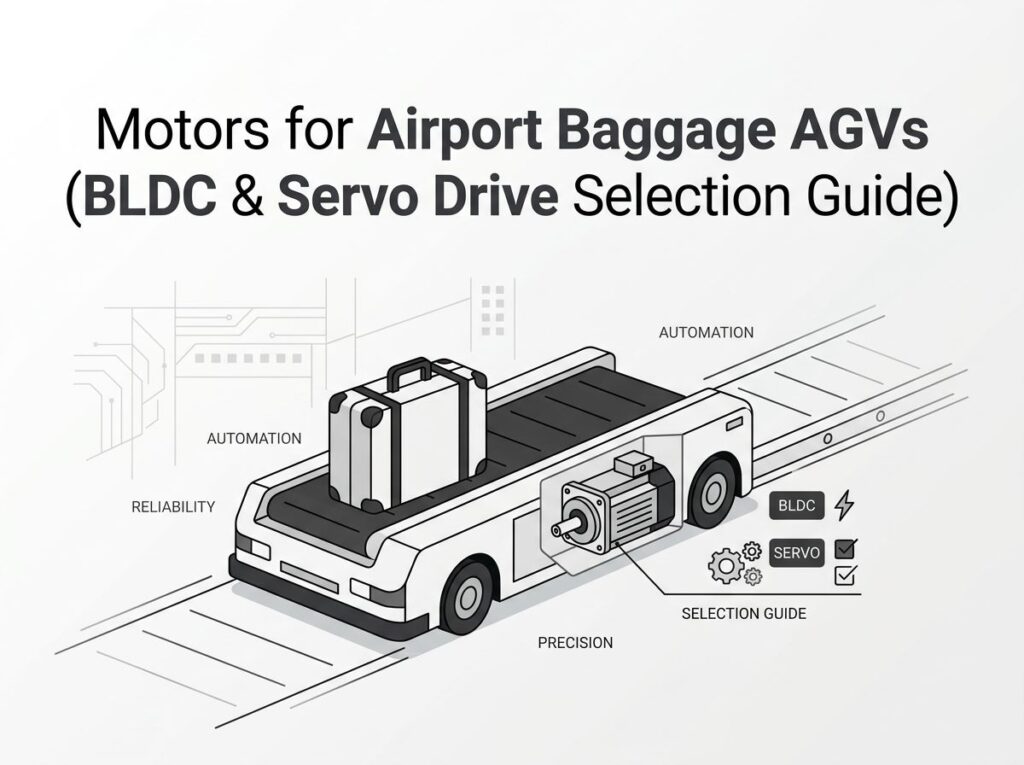
Motors for Airport Baggage AGVs: BLDC & Servo Drive Selection Guide
[ez-toc]
What Are Airport Baggage AGVs?
An airport baggage AGV is a battery-powered, autonomous or guided indoor/outdoor vehicle that moves checked luggage between check-in, screening, make-up belts, carousels and the aircraft. “Motors for airport baggage AGVs” therefore covers the full traction assembly—motor, controller, gearbox, encoder/feedback and brake—because at an airport these are specified and validated as one certified, high-availability system.
The operational scale is what separates this from a warehouse robot. The global baggage handling system (BHS) market reached roughly USD 8.4 billion in 2019 and is forecast at USD 14.8 billion by 2027 (about 7.2% CAGR), with the airport segment holding ~72% of spend. Mega hubs process 12,000–20,000 bags per hour at peak, and the two largest BHS integrators—Daifuku (~18% share) and Vanderlande (~15%)—now deploy autonomous Destination-Coded Vehicles (DCVs) running at 20–25 m/s with 99.7% tracking accuracy. Every bag those systems move, from curb to cargo door, depends on a drive motor that does not quit on the third shift.
How the Airport Baggage AGV Drive System Works
Regardless of payload, every baggage AGV shares the same drive chain. Selecting the motor means walking this chain and assigning the right component at each stage:
Step 1 — Battery supplies the bus
A Li-ion or LiFePO₄ pack delivers a nominal bus voltage (48/72 V for baggage tugs). Because P = V × I, a higher bus voltage means lower current for the same power, reducing cable size and copper loss. A 1 kW tug at 24 V draws ~42 A (8–10 AWG); at 48 V it draws ~22 A (14 AWG) and runs roughly 4× cooler in the harness. See our AGV battery-voltage selection guide for the full derivation.
Step 2 — Controller commutates the motor
For a BLDC motor, the controller switches current from rotor position (Hall sensors for block commutation, or encoder for sinusoidal/FOC). Maxon documents that block commutation shows ~14% torque ripple, while field-oriented control (FOC) delivers about 5% more continuous torque with smoother running—valuable when a tug starts loaded on an apron ramp. Sensorless schemes exist but hesitate at 0 RPM, which is unacceptable for a loaded start (see our Hall vs sensorless comparison).
Step 3 — Gearbox multiplies torque
A planetary gearbox trades speed for torque at 90–95% efficiency. Wheel torque is T_wheel = T_motor × ratio × η_gear. Geared BLDC hub and axle motors (e.g. 48 V, 750 W–1.5 kW, 8–15 N·m, IP65, 2500-line encoder, electromagnetic brake) are the workhorses of baggage tugs because the reduction and wheel are one sealed, serviceable unit.
Step 4 — Wheel meets the floor
The driven wheel converts motor torque into tractive force. Output torque at the contact patch must exceed roll/grade/acceleration demand with margin, or the tug stalls on a 3% apron grade. This is where the AGV torque calculation turns a payload into a motor spec.
Step 5 — Feedback closes the loop
Encoder + Hall signals let the controller hold speed against a 600 kg load, regenerate on braking, and report temperature/current to the fleet manager. In a BHS, that telemetry feeds predictive maintenance—a stalled tug is a missed flight, so early thermal warnings matter more than in any other AGV class.
Motor Topology Comparison
| Topology | Best baggage use | Voltage | Typical power | Feedback | Why / why not |
|---|---|---|---|---|---|
| Geared BLDC hub / axle motor | Baggage tugs, sortation carts, conveyor-fed DCVs | 48–72 V | 750 W–2 kW | Hall + incremental encoder | Sealed, compact, high start torque. The default for 300 kg–2 t. Lowest cost per N·m. |
| Integrated BLDC servo | Diverters, lifts, high-cycle make-up belts | 48 V | 400 W–1.5 kW | 17–24-bit absolute encoder | FOC smoothness, ±1 mm positioning, regenerative braking. Higher cost, best for precision handling. |
| Frameless / flat BLDC | Direct-drive wheels, thin lift/diverter actuators | 24–48 V | 100–500 W | Hall + resolver | Zero gearbox, silent, thin profile. Needs custom mechanical integration; used where space is tight. |
| Brushed DC | Not recommended | 24–48 V | — | — | Commutator wear and brush dust are unacceptable in 24/7 airport duty. Avoid. |
Engineering Data: Duty, Efficiency, Torque
IEC 60034-1 duty cycle — the airport is S1
A warehouse AMR waits at docks (intermittent, S3/S6). An airport baggage tug loops continuously, all shift, with minimal dwell—making it an S1 continuous-duty machine. The winding must reach thermal equilibrium and hold rated torque indefinitely. Sizing on an S3 (intermittent) nameplate here is the single most common cause of baggage-AGV motor failure.
| IEC 60034-1 class | Thermal behavior | Baggage AGV fit |
|---|---|---|
| S1 Continuous | Steady-state temperature reached; rated = continuous | Baggage tug, tarmac tug, 24/7 DCV — no derating |
| S3 Intermittent periodic | No full cooling; starting ignored | Occasional sortation cart with long idle |
| S4 Intermittent + starting | Start losses included | Frequent start-stop feeder cart |
| S6 Continuous periodic | Runs, alternates load/no-load | Conveyor-fed cart that never stops rotating |
Insulation class & temperature limits
| Insulation class | Winding limit | Airport guidance |
|---|---|---|
| Class B | 130 °C | Insufficient for enclosed 24/7 tugs |
| Class F | 155 °C | Minimum recommended for baggage AGVs |
| Class H | 180 °C | Preferred for tarmac tugs and hot aprons |
Apron ambient ranges from −30 °C (winter northern hubs) to +50 °C in direct sun. With a class F (155 °C) limit and a 10 °C ambient rise, the motor winding still has ~95 °C of headroom over a 50 °C environment—enough for continuous S1 only if copper loss is controlled. Overheating root causes and fixes are covered in our AGV motor overheating guide.
Efficiency & torque formulas
Fundamental relations used in every baggage-AGV sizing:
- Required tractive force:
F = m·g·Crr + m·g·sinθ + m·a(roll + grade + acceleration) - Wheel torque:
T_wheel = F · r - Motor torque:
T_motor = T_wheel / (ratio × η_gear) - Copper loss vs bus: at fixed power,
P_loss ≈ I²Rdrops as1/V²—the reason 48/72 V wins on a tug
Worked example — 1,000 kg baggage tug: gross mass 1,000 kg, 3% apron grade, 1.0 m/s, 0.5 m/s² acceleration, PU tire Crr 0.02, wheel radius 0.125 m, 2 driven wheels.
- F_flat = 1000 × 9.81 × 0.02 = 196 N
- F_grade = 1000 × 9.81 × 0.03 = 294 N (≈ sin 3%)
- F_acc = 1000 × 0.5 = 500 N
- F_total ≈ 990 N → T_wheel ≈ 990 × 0.125 = 124 N·m per axle pair
- With 25:1 gear at 92% η: T_motor ≈ 2.7 N·m per wheel
- Apply 1.5× safety factor → ~4 N·m continuous, landing on a 48 V, 750 W–1 kW BLDC per wheel
Reference manufacturer data (published specs)
| Manufacturer / line | Rating | Relevant spec | Airport-relevant note |
|---|---|---|---|
| Maxon IDX 70 + GB65 | 750 W BLDC | 3.46 N·m cont / 7.27 N·m peak, IP65, integrated temp sensor | Built for tough continuous logistics; GB65 right-angle box to 120 N·m cont |
| FAULHABER BP4 | 12–48 V BLDC | up to 158 mNm, 91% eff, −40 to +125 °C | 4-pole, dynamic start-stop, analog Hall option |
| Yaskawa Sigma-7 | 50 W–15 kW servo | 24-bit encoder, 350% overload, vibration suppression | >18 million units in field; SIL3 safety; low heat (−20% generation) |
Best Applications by Robot Type
| Airport robot | Payload | Recommended drive | Voltage / duty |
|---|---|---|---|
| Baggage tug (indoor) | 300–800 kg | Geared BLDC hub/axle ×2 | 48 V / S1 |
| Sortation cart | 150–400 kg | Geared BLDC or integrated servo | 48 V / S1–S6 |
| Autonomous luggage trolley collector | 200–500 kg | Geared BLDC differential pair | 48 V / S1 |
| Make-up / diverter actuator | — | Integrated BLDC servo | 48 V / S4 |
| Tarmac / apron tug | 1–2 t | Heavy geared BLDC or AC servo | 72 V / S1, class H |
| Conveyor-fed DCV | 30–80 kg/cart | Compact geared BLDC | 48 V / S6 |
Energy-efficient drives also matter to airports: BHS electrification programs target 12–15% lower conveyor/motor power per bag, and IoT predictive maintenance (now in ~33% of major airports) cuts downtime 18–22%. A right-sized S1 motor is the cheapest reliability upgrade in the whole system.
How to Select an Airport Baggage AGV Motor
- Fix the duty profile first. If the vehicle loops 24/7, specify IEC 60034-1 S1 and size for continuous torque—not peak. Intermittent carts may use S3/S6.
- Define gross mass and grade. Use the 1,000 kg example above; include cart + max baggage + a 3% apron grade minimum.
- Compute force, then wheel and motor torque.
T_motor = (m·g·Crr + m·g·sinθ + m·a)·r / (ratio·η). Add 1.5× safety factor. - Choose bus voltage by power. ≤500 W → 24 V; 500 W–2 kW → 48 V; ≥1.5 kW / heavy tarmac → 72 V. Lower current = cooler harness (see voltage guide).
- Pick topology by precision need. Plain haul → geared BLDC hub. Diverter/lift with ±1–2 mm → integrated servo (see BLDC vs servo).
- Spec the environment. IP65 minimum against dust and cleaning spray; insulation class F (155 °C) minimum, H (180 °C) for apron; operating range −30 to +50 °C.
- Require feedback + safety. Hall + encoder, electromagnetic brake for grade hold, integrated temperature sensor with controller trip, CANopen/EtherCAT for fleet telemetry.
- Validate thermally, then mechanically. Run the RMS-torque check over a real 24/7 cycle, confirm wheel-motor design (see our wheel-motor design guide) and verify speed/RPM headroom with our speed & RPM guide.
Common Engineering Mistakes
| # | Mistake | Consequence |
|---|---|---|
| 1 | Sizing on peak torque instead of RMS over 24/7 duty | Winding overheats, insulation ages fast |
| 2 | Using an S3 intermittent nameplate for an S1 tug | Chronic thermal trip, premature failure |
| 3 | Choosing 24 V for a >500 W tug | 42 A+ harness, I²R heating, thick cables |
| 4 | IP54 (not IP65) in a dusty/sprayed apron | Bearing contamination, shortened MTBF |
| 5 | Class B (130 °C) insulation on a sealed tug | No thermal headroom in summer sun |
| 6 | Sensorless control on traction | 0 RPM hesitation under loaded start |
| 7 | No brake on grade-hold stations | Rollback during charger/dock dwell |
Troubleshooting Table
| Problem | Likely cause | Solution |
|---|---|---|
| Motor trips on thermal after 4–6 h | S1 duty undersized / class B insulation | Re-size for continuous torque; move to class F/H; verify RMS |
| Stalls on 3% apron grade | Insufficient motor torque or 24 V bus | Increase ratio or move to 48/72 V; raise power class |
| Bearing fails early in dust | IP54 sealing, no purge | Specify IP65; consider SKF sealed/ceramic-hybrid bearing |
| Jerky low-speed docking | Block commutation ripple | Switch to FOC / encoder servo control |
| Hesitates at standstill under load | Sensorless commutation | Use Hall + encoder sensored control |
| Rollback at dock | No holding brake | Add electromagnetic brake; verify holding torque |
| Excess harness heating | Low bus voltage, high current | Raise to 48/72 V; reduce I²R loss |
| No early-warning before failure | No telemetry | Enable temp/current reporting over CANopen/EtherCAT |
FAQ
What type of motor is used in airport baggage AGVs?
Most use brushless DC (BLDC) motors with Hall sensors, a planetary gearbox, encoder and brake. Geared BLDC hub/axle motors (48 V, 750 W–1.5 kW, 8–15 N·m) are standard on tugs and sortation carts; integrated servo handles precision diverters and lifts. See the FAQ schema block above for the full answer.
Why is S1 continuous-duty rating critical for baggage AGVs?
Because the vehicle loops 24/7 with minimal dwell, it is an IEC 60034-1 S1 machine—the winding must hold rated torque indefinitely. An S3/S4 intermittent motor here overheats and fails. See FAQ schema for detail.
What reliability metrics should an airport baggage motor meet?
High MTBF, IP65 sealing, class F/H insulation, integrated temperature sensor with controller trip, and CANopen/EtherCAT telemetry for predictive maintenance. Hubs also want redundancy planning. Full answer is in the FAQ schema above.
How do I size a motor for a 1,000 kg baggage tug?
Force F = m·g·Crr + m·g·sinθ + m·a gives ~990 N; at r = 0.125 m that is ~124 N·m per axle, or ~2.7 N·m per wheel through a 25:1 gear. With 1.5× safety factor, a 48 V 750 W–1 kW BLDC per wheel fits. See FAQ schema for the worked answer.
Is 24 V or 48 V better for airport baggage AGVs?
Nearly always 48 V (72 V on heavy tugs). P = V × I means higher bus = lower current = smaller, cooler wiring. 24 V is reserved for sub-300 kg carts. See FAQ schema and our voltage guide.
Which manufacturers publish baggage-grade BLDC motor data?
Maxon (IDX 70, IP65, integrated temp sensor), FAULHABER (BP4/BX4, −40 to +125 °C, 91% eff) and Yaskawa (Sigma-7 servo, 24-bit encoder, >18 M units in field) are the references cited throughout this guide.
Why Choose GreenSky for Airport Baggage AGV Motors?
GreenSky Power is a Chinese B2B motor manufacturer supplying OEM-grade BLDC and geared servo drives built for continuous-duty material handling. For airport baggage AGVs we deliver:
- S1-rated BLDC and BLDC-servo motors from 22 mm to 120 mm frame, 12–72 V DC, with IP65 options and class F/H insulation for apron duty.
- Integrated planetary gearboxes and electromagnetic brakes for grade-hold and compact tugs—see our gear vs direct-drive guide.
- Hall + encoder sensored control (no 0-RPM hesitation) validated against Hall vs sensorless trade-offs.
- Custom engineering to your payload, grade and 24/7 duty—rated per IEC 60034-1 and built under an ISO 9001 system, with CANopen/EtherCAT telemetry for fleet predictive maintenance.
Talk to our AGV drive engineers →Get Free Quote
References
- IEC 60034-1:2022 (Ed. 15) — Rotating electrical machines: duty cycle classifications (S1–S10) and thermal behaviour. webstore.iec.ch/publication/86035
- IEC 60034-30-1:2014 — Efficiency classes (IE1–IE5) for low-voltage AC motors, the basis for IE3/IE4 baggage-drive targets. webstore.iec.ch/publication/6799
- NEMA MG 1-2021 — Motors and Generators: standard for motor construction, testing and application including duty/thermal. nema.org/standards/view/mg-1-2021
- U.S. DOE, 10 CFR Part 431 — Energy efficiency program for electric motors (IE4 mid-range compliance). ecfr.gov/title-10/part-431
- IEEE — “IMULE: A Prototype System Based on AGV for Baggage Handling inside Airports” (2018). ieeexplore.ieee.org/document/8493173
- IEEE Transactions on Intelligent Vehicles (2024) — “Multi-Risk-RRT: An Efficient Motion Planning Algorithm for Robotic Autonomous Luggage Trolley Collection at Airports”, DOI 10.1109/TIV.2023.3349171. doi.org/10.1109/TIV.2023.3349171
- Siemens — Airport Logistics and SIMOTICS drive systems for baggage handling (energy-efficient conveyors and motors). siemens.com/airport-logistics
- SKF — Rolling bearing reliability, contamination and sealing guidance for motors in dusty environments. skf.com/group/products/rolling-bearings
- IEA — Motor Systems: energy-efficiency opportunities in industrial and logistics drives. iea.org/reports/motor-systems
- IEEE — “A dynamic dispatching method in the unmanned airport baggage transportation system”, 2022 23rd IEEE Int’l Conf. on Mobile Data Management (MDM). doi.org/10.1109/MDM55031.2022.00078
