
BLDC vs Servo Motors for AGVs: Torque, Precision, Cost — Which to Choose?
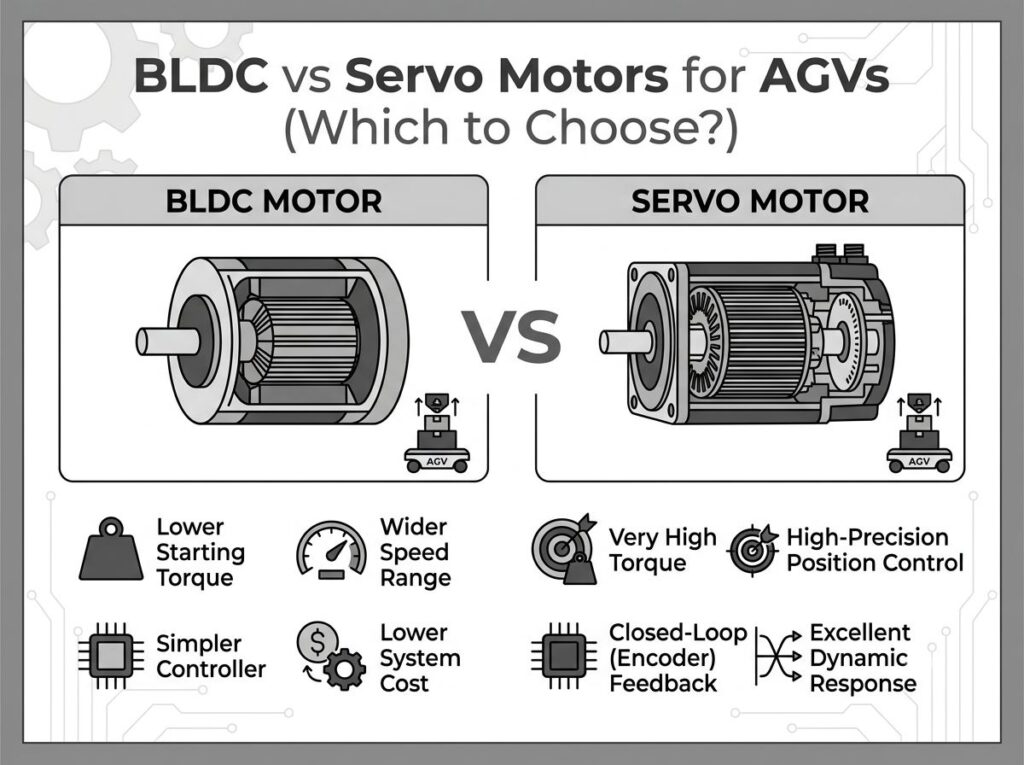
Choosing between BLDC and servo motors for AGV drive systems is a decision that shapes vehicle performance, battery runtime, positioning accuracy, and total cost of ownership across the fleet. The comparison is not as straightforward as it first appears — because a “servo motor” is not a distinct motor technology but a control architecture that can be applied to a BLDC motor itself.
This guide breaks down the three motor configurations that actually compete in AGV drive systems — standard BLDC, BLDC servo, and AC servo — and compares them across the parameters that matter for automated guided vehicle platforms: torque behavior, positioning accuracy, efficiency, control complexity, and cost. For a broader comparison covering non-AGV applications, see our BLDC Motor vs Servo Motor guide.
The Real Question: Standard BLDC vs BLDC Servo vs AC Servo
The phrase “BLDC vs servo” contains a common misconception. A servo motor is any motor operating in a closed-loop control system with position, velocity, or torque feedback — and the motor inside that system can itself be a BLDC motor. The meaningful comparison for AGV engineers is therefore not “BLDC vs servo” but rather three distinct configurations:
1. Standard BLDC Motor (Hall-Only Feedback)
A permanent-magnet brushless motor using Hall-effect sensors for commutation only. The Hall sensors generate six discrete commutation states per electrical revolution — sufficient for speed control but inadequate for precise position holding. This configuration dominates cost-sensitive AGV platforms: simple transport carts moving between two points where ±5–10 mm positioning is acceptable.
2. BLDC Servo Motor (Encoder Feedback, Closed-Loop)
The same BLDC motor hardware augmented with a high-resolution encoder (typically 2,500–10,000 PPR incremental or 17–23 bit absolute) and a closed-loop servo drive. The drive processes position, velocity, and current loops at high bandwidth, enabling precise torque control, smooth low-speed operation, and accurate positioning (±0.1–1 mm at the wheel). This is the dominant configuration for modern warehouse AGVs and AMRs in the 50–2,000 kg payload range.
3. AC Servo Motor (Mains-Powered, Industrial Precision)
A permanent-magnet synchronous motor designed for AC mains operation via a dedicated servo drive. AC servo systems offer the highest positioning accuracy (±0.001° at the motor shaft), fastest dynamic response, and 300% instantaneous overload capacity. In the AGV context, AC servo is used only for heavy-load platforms (>2 tons) or applications requiring sub-millimeter docking precision — and only where the vehicle architecture can accommodate AC-DC conversion from the battery bus.
| Parameter | Standard BLDC | BLDC Servo | AC Servo |
|---|---|---|---|
| Feedback | Hall sensors (commutation only) | Encoder (position + velocity) | High-res encoder (17–23 bit) |
| Control loop | Open-loop position, speed-only | Closed-loop (position/velocity/torque) | Closed-loop (3-loop, high bandwidth) |
| Position accuracy (motor shaft) | ±1 mechanical revolution | < 0.1° | < 0.01° |
| Speed regulation | ±5% (open loop) | ±1% (closed loop) | ±0.1% (closed loop) |
| Power source | DC bus / battery | DC bus / battery (24–110V) | AC mains via servo drive |
| Power range | 10W – 5kW | 100W – 2kW | 50W – 50kW+ |
| Relative system cost | 1× | ~2× | ~5× |
| AGV fit | Simple transport AGC, point-to-point | Warehouse AGV, AMR, forklift AGV | Heavy-load AGV (>2 ton), precision docking |
Control Architecture Differences for AGV Drive
The control architecture determines how the motor responds to varying loads, how accurately it can position the vehicle, and how smoothly it operates at low speeds — all critical for AGV docking, cornering, and load-handling maneuvers.
Standard BLDC: Trapezoidal Commutation
Standard BLDC motors use six-step trapezoidal commutation driven by Hall sensor transitions. The controller switches current between phase windings in a fixed sequence based on Hall state changes. This produces adequate speed regulation for constant-velocity travel but introduces torque ripple at low speeds (typically 5–15% of rated torque), which can cause jerky movement during slow docking approaches.
For simple transport AGVs running at fixed speeds between pickup and dropoff points, this level of control is sufficient. The AGV arrives at a station, hits a mechanical stop or proximity sensor, and halts — no precision positioning required.
BLDC Servo: Field-Oriented Control (FOC)
BLDC servo systems replace six-step commutation with Field-Oriented Control (FOC), which continuously calculates the optimal current vector based on real-time encoder feedback. FOC produces smooth torque output across the entire speed range, including near-zero speed, eliminating the torque ripple that plagues standard BLDC at low RPM.
For AGV applications, this translates directly to smoother docking approaches, more consistent cornering behavior, and better wheel synchronization in differential-drive configurations. The closed-loop velocity control also compensates automatically for load variations — when the AGV picks up a heavy payload, the servo drive increases current to maintain the commanded speed without operator intervention.
AC Servo: Three-Loop Cascade Control
AC servo systems implement a cascade of three control loops: current (torque) loop, velocity loop, and position loop. Each loop runs at a different update rate — the current loop may execute at 16 kHz or higher, the velocity loop at 4–8 kHz, and the position loop at 1–4 kHz. This cascade structure provides the fastest dynamic response and highest positioning accuracy available.
In AGV applications, this level of control is typically overkill for traction drive — the wheel-tire interface introduces compliance and slip that masks the servo’s inherent precision. AC servo becomes justified for AGV lifting axes (fork positioning), steering axes requiring sub-degree accuracy, or heavy-load platforms where sustained high torque with thermal stability is critical.
| Control Characteristic | Standard BLDC | BLDC Servo | AC Servo |
|---|---|---|---|
| Commutation method | Six-step trapezoidal | FOC (sinusoidal) | FOC (sinusoidal) |
| Torque ripple at low speed | 5–15% of rated | < 2% of rated | < 1% of rated |
| Current loop bandwidth | N/A (no current loop) | 2–8 kHz | 8–16 kHz |
| Velocity loop bandwidth | N/A | 0.5–2 kHz | 2–4 kHz |
| Load disturbance recovery | Slow (speed drops on load change) | Fast (closed-loop compensation) | Very fast (cascade response) |
| Low-speed smoothness | Poor (cogging + torque ripple) | Good (FOC smoothing) | Excellent |
Side-by-Side Comparison Table
The following table consolidates the key parameters AGV engineers need to evaluate when choosing between standard BLDC, BLDC servo, and AC servo configurations:
| Parameter | Standard BLDC | BLDC Servo | AC Servo |
|---|---|---|---|
| Efficiency | 85–92% | 85–92% (motor) / 80–88% (system) | 90–95% (motor) / 75–85% (system with AC-DC conversion) |
| Service life | 10,000–20,000+ h | 10,000–20,000+ h | 10,000–20,000+ h |
| Positioning accuracy (at wheel) | ±5–10 mm | ±0.5–2 mm | ±0.1–0.5 mm |
| Speed range | Wide (0–6,000+ RPM) | Very wide (stable at near-zero) | Very wide (stable at near-zero) |
| Noise level | 48–55 dB | 48–55 dB | 50–60 dB |
| Peak torque | 150–200% rated | 200–300% rated | 300% rated |
| Torque density | High | High | Very high (especially peak) |
| Maintenance | None (bearing-limited) | None (bearing-limited) | None (bearing-limited) |
| Motor cost (relative) | 1× | 1.2–1.5× | 3–4× |
| Drive cost (relative) | 1× | 2–3× | 5–8× |
| System cost (motor + drive + encoder) | 1× | ~2× | ~5× |
| Typical AGV voltage | 24V / 48V | 24V / 48V | 48V + DC-AC conversion / 72V |
| Communication | PWM, RS485 | CANopen, RS485, EtherCAT | EtherCAT, PROFINET |
| Best AGV payload | < 300 kg (simple transport) | 50–2,000 kg (warehouse/forklift) | > 2,000 kg (heavy industrial) |
Torque Density and Dynamic Response
Torque behavior is one of the most decisive factors in AGV motor selection. The motor must deliver sufficient continuous torque for sustained travel, adequate peak torque for acceleration and slope climbing, and consistent torque output across the operating speed range.
Continuous Torque
All three configurations use similar BLDC/PMSM motor hardware, so continuous torque density is comparable — typically 0.5–2.0 N·m per kg of motor mass depending on frame size and cooling design. The differentiator is thermal management: BLDC servo and AC servo drives can monitor winding temperature via embedded sensors and implement current derating to prevent insulation damage, while standard BLDC controllers typically lack this protection.
Peak Torque and Overload
Peak torque — the short-term maximum available during acceleration — varies significantly by configuration:
| Configuration | Peak Torque (% of rated) | Duration | AGV Impact |
|---|---|---|---|
| Standard BLDC | 150–200% | 2–5 seconds | Adequate for flat-ground acceleration |
| BLDC Servo | 200–300% | 3–10 seconds | Handles slope starts with full payload |
| AC Servo | 300% | 5–15 seconds | Heavy-load acceleration on steep ramps |
For AGVs that must climb slopes with full payload, the peak torque duration matters as much as the peak value. A 300% overload for 15 seconds (AC servo) allows sustained hill-climbing; a 150% overload for 2 seconds (standard BLDC) may trigger thermal shutdown mid-ramp.
Dynamic Response
Dynamic response — how quickly the motor adjusts torque when load conditions change — affects AGV behavior during payload pickup, wheel slip events, and sudden direction changes. BLDC servo systems with FOC typically achieve torque settling times of 5–20 ms, compared to 50–200 ms for standard BLDC with six-step commutation. AC servo systems can achieve sub-5 ms response through higher-bandwidth current loops.
In practice, this means a BLDC servo AGV picking up a 500 kg payload will maintain commanded speed within 50–100 ms, while a standard BLDC AGV may show a visible speed dip lasting 200–500 ms before the controller compensates.
Positioning Accuracy and Repeatability
AGV positioning accuracy at the docking station is determined by the motor’s position control capability, the encoder resolution, the gearbox backlash, and the wheel-to-floor interface. The motor configuration sets the upper bound on achievable accuracy.
Accuracy by Configuration
| Configuration | Motor Shaft Accuracy | Typical Wheel-Side Accuracy* | Suitable AGV Docking Precision |
|---|---|---|---|
| Standard BLDC (Hall only) | ±60° (electrical) | ±5–10 mm | Mechanical stop / proximity sensor |
| BLDC Servo (2500 PPR incremental) | ±0.144° | ±1–2 mm | QR code / reflective marker |
| BLDC Servo (17-bit absolute) | ±0.003° | ±0.5–1 mm | Laser positioning / vision docking |
| AC Servo (23-bit absolute) | ±0.00004° | ±0.1–0.5 mm | Precision mechanical docking |
*Wheel-side accuracy assumes a 200 mm drive wheel with a 20:1 planetary gearbox. Actual values depend on gearbox backlash, tire compliance, and floor conditions.
Repeatability vs. Absolute Accuracy
AGV docking applications typically prioritize repeatability — the ability to return to the same position consistently — over absolute accuracy. BLDC servo systems with incremental encoders achieve repeatability of ±0.5–1 mm at the wheel, which is sufficient for most warehouse docking stations. Absolute encoders add the benefit of position retention after power loss, eliminating the need for homing sequences on startup.
For a deeper comparison of motor positioning technologies, including how closed-loop stepper motors fit into the accuracy spectrum, see our Servo Motor vs Stepper Motor analysis.
Efficiency and Battery Runtime
In battery-powered AGV systems, motor efficiency directly translates to runtime per charge cycle. A 10% efficiency improvement can extend operating time by 30–60 minutes per shift, reducing the number of battery swaps or charging stops needed across a fleet.
Motor Efficiency Comparison
| Configuration | Motor Efficiency | System Efficiency (motor + drive) | Battery Runtime Impact |
|---|---|---|---|
| Standard BLDC | 85–92% | 75–85% | Baseline |
| BLDC Servo | 85–92% | 72–82% | ~5% shorter (drive overhead) |
| AC Servo (with DC-AC conversion) | 90–95% | 65–78% | ~10–20% shorter (conversion losses) |
The motor efficiency figures for standard BLDC and BLDC servo are nearly identical because they use the same motor hardware. The difference lies in the drive electronics: BLDC servo drives consume more power than simple BLDC controllers due to the computational overhead of FOC algorithms and the encoder interface circuitry.
AC servo systems suffer additional efficiency penalties in AGV applications because the battery DC voltage must be inverted to AC for the servo drive, then rectified back to DC internally — adding 5–15% conversion loss. For a 48V AGV battery system, this means an AC servo configuration may deliver 10–20% shorter runtime than an equivalent BLDC servo configuration.
Operating-Point Efficiency
AGV motors rarely operate at their peak efficiency point. In warehouse applications, the motor spends significant time at partial load during cruise and high torque during acceleration. BLDC servo systems with FOC maintain high efficiency across a wider operating range than standard BLDC with six-step commutation, because FOC optimizes the current vector for each operating point rather than using fixed commutation angles.
For AGV fleet managers, the practical takeaway: BLDC servo provides the best balance of efficiency and performance for battery-powered vehicles. The ~5% drive overhead compared to standard BLDC is offset by improved operating-point efficiency and reduced energy waste during low-speed maneuvering.
System Cost Analysis
Motor system cost for AGV applications includes the motor itself, the drive/controller, the encoder, and integration costs (wiring, connectors, mounting). The cost differential between configurations is substantial and directly affects BOM decisions for AGV manufacturers.
Cost Breakdown by Configuration
| Cost Component | Standard BLDC | BLDC Servo | AC Servo |
|---|---|---|---|
| Motor (42mm frame, 200W) | $30–60 | $35–70 | $80–150 |
| Motor (80mm frame, 1kW) | $100–200 | $120–250 | $300–600 |
| Drive/controller | $20–80 | $80–250 | $200–800 |
| Encoder | Included (Hall) | $30–100 | $100–300 |
| Wiring + connectors | $5–15 | $15–40 | $30–80 |
| System total (200W class) | $55–155 | $160–460 | $410–1,330 |
| System total (1kW class) | $125–295 | $245–640 | $630–1,780 |
Cost figures are indicative ranges for OEM volume pricing from Chinese motor suppliers. Actual pricing varies with specifications, certifications, and order quantities.
Cost-Performance Ratio for AGV Applications
For most AGV manufacturers, the BLDC servo configuration occupies the sweet spot of cost-performance ratio. At approximately 2× the system cost of standard BLDC, it delivers closed-loop positioning, smooth low-speed operation, and load compensation — capabilities that are essential for modern AGV/AMR platforms with navigation, docking, and multi-vehicle coordination requirements.
The jump from BLDC servo to AC servo (approximately 2.5× additional cost) is justified only when the AGV requires sub-millimeter docking precision, sustained heavy-load operation, or integration with industrial servo networks (EtherCAT, PROFINET). For standard warehouse logistics, the additional precision and dynamic response of AC servo is largely wasted at the wheel-tire interface.
Total Cost of Ownership Over 5 Years
| Cost Category | Standard BLDC | BLDC Servo | AC Servo |
|---|---|---|---|
| Initial procurement (per motor system) | 1× | ~2× | ~5× |
| Energy cost (battery charging over 5 years) | Baseline | ~5% higher (drive overhead) | ~15% higher (conversion losses) |
| Maintenance cost | Low | Low | Medium (more components) |
| Downtime cost (positioning failures) | Higher (docking misses) | Low | Very low |
| 5-year TCO (fleet of 50 AGVs) | 1× | ~1.8× | ~4× |
For custom motor configurations optimized for specific AGV platforms, see our custom electric motor services.
Encoder and Feedback Requirements
The encoder is the component that transforms a standard BLDC motor into a BLDC servo motor. Encoder selection affects positioning accuracy, startup behavior, and system cost.
Encoder Types for AGV Applications
| Encoder Type | Resolution | Cost (relative) | AGV Use Case |
|---|---|---|---|
| Hall sensors | 6 states/rev | 1× | Commutation only (standard BLDC) |
| Incremental (2500 PPR) | 10,000 counts/rev | 5–10× | Standard BLDC servo (speed + position) |
| Absolute (single-turn, 17-bit) | 131,072 counts/rev | 15–25× | Precision AGV docking |
| Absolute (multi-turn, 23-bit) | 8,388,608 counts/rev × 4096 turns | 30–50× | Heavy AGV with lift axis tracking |
Upgrading Standard BLDC to BLDC Servo
AGV manufacturers who already use standard BLDC motors can often upgrade to BLDC servo by adding an encoder to the motor’s rear shaft and switching to a closed-loop controller. This retrofit is possible on approximately 70% of BLDC motor families that have a rear shaft mounting boss for encoder attachment. For motors without this provision, a BLDC motor with factory-integrated encoder should be specified from the outset.
The upgrade path is relevant for AGV platforms that started with simple point-to-point transport and later require precision docking as application requirements evolve. The motor hardware remains the same — only the feedback and control elements change.
Voltage Platform Considerations
AGV motor voltage must match the vehicle’s battery bus voltage. The choice of voltage platform affects available motor power, current draw, wiring requirements, and drive component selection.
| Voltage Platform | Typical AGV Payload | BLDC Servo Power Range | AC Servo Feasibility |
|---|---|---|---|
| 24V | 50–300 kg | 50–400W | Not practical (conversion losses) |
| 48V | 300–2,000 kg | 200W–2kW | Marginal (DC-AC conversion overhead) |
| 72V | 1,000–3,000 kg | 1–3kW | Practical (heavy AGV platforms) |
| 80V+ | > 2,000 kg | 2–5kW | Standard (industrial AGV) |
BLDC servo motors operate directly from the DC battery bus — no power conversion is needed. This is a fundamental advantage over AC servo in AGV applications. AC servo drives require DC-to-AC inversion from the battery, adding cost, weight, and conversion losses. For this reason, BLDC servo is the default choice for battery-powered AGVs up to approximately 2 kW per motor; AC servo becomes viable only at higher power levels where the DC-AC conversion overhead is a smaller fraction of total power.
For BLDC motor product specifications available at 24V and 48V platforms, see our BLDC motor product page.
Gearbox Matching for AGV Drive
Both BLDC and BLDC servo motors require planetary gearboxes to multiply torque and reduce speed for AGV wheel drive. The gearbox selection is independent of motor configuration — the same planetary gearbox works with standard BLDC, BLDC servo, or AC servo (with appropriate mounting).
Gearbox Selection Criteria
| Criterion | Specification | AGV Impact |
|---|---|---|
| Ratio | 10:1 – 50:1 (typical 15:1 – 25:1) | Determines wheel speed and output torque |
| Backlash | 5–15 arc-min (planetary) | Affects positioning repeatability |
| Efficiency | 90–95% (single-stage planetary) | Reduces available wheel torque by 5–10% |
| Noise | 48–55 dB (helical planetary) | Critical for hospital/office AGVs |
| IP rating | IP54 minimum, IP65 recommended | Bearing protection from dust/moisture |
For a detailed comparison of planetary vs spur gearbox characteristics relevant to AGV drive systems, see our Spur Gear Motor vs Planetary Gear Motor guide. For gearbox product options, visit our gearbox product page.
Payload-Based Motor Selection Matrix
The following matrix provides motor configuration recommendations based on AGV payload class and application precision requirements:
| AGV Type | Payload | Recommended Configuration | Voltage | Motor Power | Encoder | Gearbox |
|---|---|---|---|---|---|---|
| Light AGC / transport cart | < 100 kg | Standard BLDC | 24V | 50–150W | Hall sensors | Spur or planetary (10:1–20:1) |
| Compact AMR | 50–150 kg | BLDC Servo | 24V | 100–250W | Incremental 2500 PPR | Helical planetary (15:1–25:1) |
| Warehouse AGV | 150–500 kg | BLDC Servo | 24V / 48V | 200–500W | Incremental or 17-bit absolute | Planetary (15:1–30:1) |
| Heavy warehouse AGV | 500–1,000 kg | BLDC Servo | 48V | 400W–1kW | 17-bit absolute | Planetary (20:1–40:1) |
| Forklift AGV | 1,000–2,000 kg | BLDC Servo (traction) + AC Servo (lift) | 48V | 1–2kW (traction) / 1–3kW (lift) | 17–23 bit absolute | Planetary (traction) / worm (lift) |
| Heavy industrial AGV | > 2,000 kg | AC Servo | 72V / 80V | 2–5kW+ | 23-bit absolute | Industrial planetary / hub |
For a comprehensive motor selection guide covering all motor types for AGV applications (including stepper and brushed DC), see our Motor for AGV Complete Selection Guide.
Application Scenarios: When to Choose Which
Scenario 1: Simple Transport AGC (Point-to-Point)
Recommendation: Standard BLDC
AGVs moving carts between two fixed points on magnetic tape or QR code guidance, with mechanical stops at docking stations, do not benefit from closed-loop positioning. Standard BLDC with Hall sensors provides adequate speed control at the lowest system cost. The 5–10 mm positioning variation is absorbed by the mechanical stop.
| Parameter | Specification |
|---|---|
| Motor | Standard BLDC, 24V, 50–150W |
| Feedback | Hall sensors |
| Controller | Simple PWM speed controller |
| System cost per axis | $55–155 |
| Docking method | Mechanical stop / proximity sensor |
Scenario 2: Warehouse AMR with Navigation
Recommendation: BLDC Servo
Autonomous mobile robots using SLAM navigation, laser positioning, or vision-based docking require smooth low-speed control and accurate positioning. BLDC servo with FOC provides the necessary low-speed smoothness for controlled approach to docking stations, and closed-loop velocity control compensates for payload weight variations during pick-and-place cycles.
| Parameter | Specification |
|---|---|
| Motor | BLDC servo, 24V/48V, 100–500W |
| Feedback | Incremental encoder 2500 PPR or 17-bit absolute |
| Controller | FOC servo drive with CANopen/RS485 |
| System cost per axis | $160–460 |
| Docking method | QR code / laser / vision positioning |
Scenario 3: Forklift AGV with Precision Pallet Handling
Recommendation: BLDC Servo (traction) + BLDC Servo (lift/steering)
Forklift AGVs require precise pallet engagement — the fork insertion point demands ±1–2 mm repeatability. BLDC servo on the traction axis provides accurate approach velocity and positioning; BLDC servo on the lift axis provides controlled fork height positioning with brake holding for safety.
| Parameter | Specification |
|---|---|
| Traction motor | BLDC servo, 48V, 400W–1kW |
| Lift motor | BLDC servo with brake, 48V, 200–500W |
| Feedback | 17-bit absolute encoder (both axes) |
| Controller | CANopen multi-axis servo drive |
| System cost (3 axes) | $500–1,500 |
| Docking method | Laser / vision with mechanical fork guide |
Scenario 4: Heavy Industrial AGV (> 2 Tons)
Recommendation: AC Servo (or high-power BLDC servo if 72V DC bus available)
Heavy industrial AGVs transporting automotive components, steel coils, or large assemblies require sustained high torque, 300% overload capacity for slope climbing, and sub-millimeter positioning for automated assembly line integration. AC servo provides the thermal stability and dynamic response needed, though at significant cost premium.
| Parameter | Specification |
|---|---|
| Motor | AC servo, 72V/80V, 2–5kW |
| Feedback | 23-bit absolute encoder |
| Controller | EtherCAT servo drive |
| System cost per axis | $630–1,780 |
| Docking method | Precision mechanical docking with vision assist |
Five-Step Decision Framework
Use the following framework to determine the right motor configuration for your AGV platform:
Step 1: Identify the Power Source
Battery or DC bus → BLDC family (standard BLDC or BLDC servo). AC mains → AC servo. This immediately rules out AC servo for most AGV applications unless the vehicle has a DC-AC conversion system.
Step 2: Determine Positioning Accuracy Requirement
If the AGV docks against a mechanical stop (±5–10 mm acceptable) → standard BLDC. If the AGV uses QR code, laser, or vision docking (±1–2 mm required) → BLDC servo. If sub-millimeter precision is required for assembly integration → AC servo.
Step 3: Match Power Level to Configuration
Below 2 kW per motor on DC bus → BLDC servo is the clear choice. Above 3 kW → AC servo if AC-DC conversion is acceptable, or high-power BLDC servo at 72V. Between 2–3 kW → both work; decide based on precision needs.
Step 4: Evaluate Dynamic Requirements
Frequent start-stop cycles with payload variations → BLDC servo (closed-loop compensation). Slope climbing with full load → verify peak torque duration. Sustained high-speed cruise → standard BLDC (simpler, adequate).
Step 5: Validate with Budget
Apply the cost ratio (1× / 2× / 5×) to your BOM. For a fleet of 50 AGVs with 2 motors each, the difference between standard BLDC and BLDC servo is approximately $10,500–$30,500. The difference between BLDC servo and AC servo is approximately $31,500–$89,500. Verify that the performance improvement justifies the cost increment for your application.
| Step | Question | If Yes → | If No → |
|---|---|---|---|
| 1 | Battery-powered AGV? | BLDC family | Consider AC servo |
| 2 | Precision docking required (±1–2 mm)? | BLDC servo or AC servo | Standard BLDC adequate |
| 3 | Power > 2 kW per motor? | AC servo (or 72V BLDC servo) | BLDC servo |
| 4 | Frequent start-stop with payload changes? | BLDC servo (closed-loop needed) | Standard BLDC may suffice |
| 5 | Budget allows 5× cost premium? | AC servo justified | BLDC servo is optimal |
For motor controller products compatible with both BLDC and servo configurations, see our motor controller product page. For AGV vs AMR platform differences that affect motor selection, see our AGV vs AMR guide.
Frequently Asked Questions
Is a BLDC servo motor the same as a brushless servo motor?
Yes. “BLDC servo motor” and “brushless servo motor” refer to the same configuration: a BLDC motor with an encoder and closed-loop servo drive. The terms are used interchangeably in the AGV industry. The key distinction is between a standard BLDC motor (Hall sensors only, open-loop position) and a BLDC servo motor (encoder feedback, closed-loop position/velocity/torque control).
Can I use a standard BLDC motor for AGV docking?
Yes, if the docking precision requirement is ±5–10 mm and the AGV uses a mechanical stop or proximity sensor for final positioning. Standard BLDC motors provide adequate speed control for constant-velocity travel. However, if the AGV uses QR code, laser, or vision-based docking requiring ±1–2 mm precision, a BLDC servo motor with encoder feedback is necessary.
Why not use AC servo motors for all AGVs?
AC servo motors require AC mains power, which means a battery-powered AGV must include a DC-AC inverter — adding cost, weight, and 5–15% conversion losses that reduce battery runtime. For most AGV applications (50–2,000 kg payload, ±0.5–2 mm docking precision), BLDC servo operating directly from the 24V or 48V battery bus provides equivalent performance at roughly half the system cost of AC servo. AC servo is justified only for heavy industrial AGVs (>2 tons) requiring sub-millimeter precision.
How much more does a BLDC servo system cost compared to standard BLDC?
A BLDC servo system typically costs approximately 2× the price of a standard BLDC system of equivalent power. The cost difference comes from the encoder ($30–100), the FOC servo drive ($80–250 vs. $20–80 for a simple BLDC controller), and additional wiring. For a 200W class AGV motor system, the difference is approximately $100–300 per axis.
Can I upgrade a standard BLDC motor to BLDC servo later?
In many cases, yes. If the BLDC motor has a rear shaft with a mounting boss for an encoder, you can add an incremental or absolute encoder and switch to a closed-loop FOC controller. This upgrade path works for approximately 70% of BLDC motor families. For motors without a rear shaft provision, a motor with factory-integrated encoder must be specified from the start.
What encoder resolution do I need for AGV docking?
For standard warehouse AGV docking (±1–2 mm at the wheel), an incremental encoder with 2,500 PPR (10,000 counts/rev with quadrature) is sufficient. For precision docking (±0.5–1 mm), a 17-bit absolute encoder (131,072 counts/rev) is recommended. Multi-turn absolute encoders are needed only for applications tracking position across multiple rotations, such as lift axes.
References
- HKT ROBOT. “Brushless Servo Motor for AGV: Key Specs and Selection Guide.” Available at: https://agvmotor.com/blogs/knowledge/brushless-servo-motor-for-agv
- Shenghe Motor (NBHZHL). “BLDC vs Servo Motor — Which One Should You Use?” Available at: https://www.nbshzl-motor.com/blog/bldc-vs-servo-motor/
- Lean Motor. “BLDC Motor vs Servo Motor: How to Choose the Right Drive Solution.” Available at: https://www.leanmotor.com/bldc-motor-vs-servo-motor.html
- Volcano Motors. “BLDC Motor vs Servo Motor: Differences, Applications, and Selection Guide.” Available at: https://www.volcanomotors.com/bldc-motor-vs-servo-motor-differences-applications-and-selection-guide/
- Topband Motor. “How to Choose Between AGV DC Brushless and DC Brushless Servo Motors.” Available at: https://www.topbandmotor.com.cn/News/How-to-choose-between-AGV-DC-brushless-and-DC-brushless-servo-motors.html
- Dunkermotoren. “AGV/AMV/AMR Gear Motors — BLDC Drive Solutions for Mobile Robotics.” Available at: https://www.dunkermotoren.com/en/industries/warehouse-automation/agv-gear-motor
- GreenSky Power. “BLDC Motor vs Servo Motor: What’s the Difference? Complete Engineering Comparison Guide.” Available at: https://greensky-power.com/bldc-motor-vs-servo-motor/
- GreenSky Power. “How to Choose a Motor for AGV Applications: Complete Selection Guide.” Available at: https://greensky-power.com/how-to-choose-a-motor-for-agv-applications/
- Etonm Motor. “Brushless DC Motor Vs. Servo Motor: Key Differences Explained.” Available at: https://etonmmotor.com/brushless-dc-motor-vs-servo-motor/
- Hao, W. “BLDC Motor vs. DC Servo Motor: Core Technology Comparison and Selection Guide.” LinkedIn, July 2025. Available at: https://www.linkedin.com/pulse/bldc-motor-vs-dc-servo-core-technology-comparison-selection-wendy-hao-fvshc
