
24 Volt DC Motors
High-performance 24 V DC motors for automation, robotics, medical equipment and industrial applications, with motor diameters from 3.25 in to 6 in and NEMA, IEC or custom mounting. 24 V is the voltage that halves the current of a 12 V system while staying inside the safety extra-low-voltage band — which is why it is the default in industrial control, AGVs and medical devices, and why the published current-draw table on this page is actually correct.
Custom 24 V DC Motors, Built to Your Application
If your company is in need of 24 Volt DC motors you have come to the right place. Greensky Power produces DC motors for many companies’ detailed applications, with motor diameters from 3.25 in to 6 in.
A Greensky Power 24 Volt electric motor is designed according to your detailed application description. Our DC motors are built with speed control compatibility, which offers variable speeds, and every motor can be manufactured with NEMA, IEC or custom mounting arrangements.
Greensky Power Company Limited has been a leading manufacturer of China-made, custom-crafted DC motors designed for OEMs. The 24 V range spans brushed, brushless, geared and stepper machines from 5 W to 500 W, which is why the series section below reads as a set of choices rather than a single part number.
Why Choose 24V DC Motors?
Safety & compliance
24 V systems sit inside the safety extra-low-voltage band, so they remove the shock hazard that higher DC voltages carry in an industrial environment. That is why 24 V is the control-voltage standard in machine building.
Energy efficiency
Optimized for battery-powered applications with high efficiency and low standby consumption. A brushless 24 V motor in this range runs at 85–92%, which matters most in a device that runs for hours on a pack.
Simplified wiring
Half the current of a 12 V motor for the same power means smaller cable, smaller connectors and smaller fuses — and a quarter of the loss in the cable for the same conductor. Installation cost drops with the harness, not just with the motor.
The published description lists these three reasons together because they reinforce each other: the safety band, the battery efficiency and the smaller harness are all consequences of the same choice of voltage.
24V DC Motor Series
Three families cover the range, each with a different strength. The figures below are as published, and the comparison table further down puts them side by side.

24V Brushless DC Motors
Power 50–500 W · Speed 1000–5000 RPM · Efficiency >85%. Long service life, no brush wear, and the efficiency to run continuously on a battery.
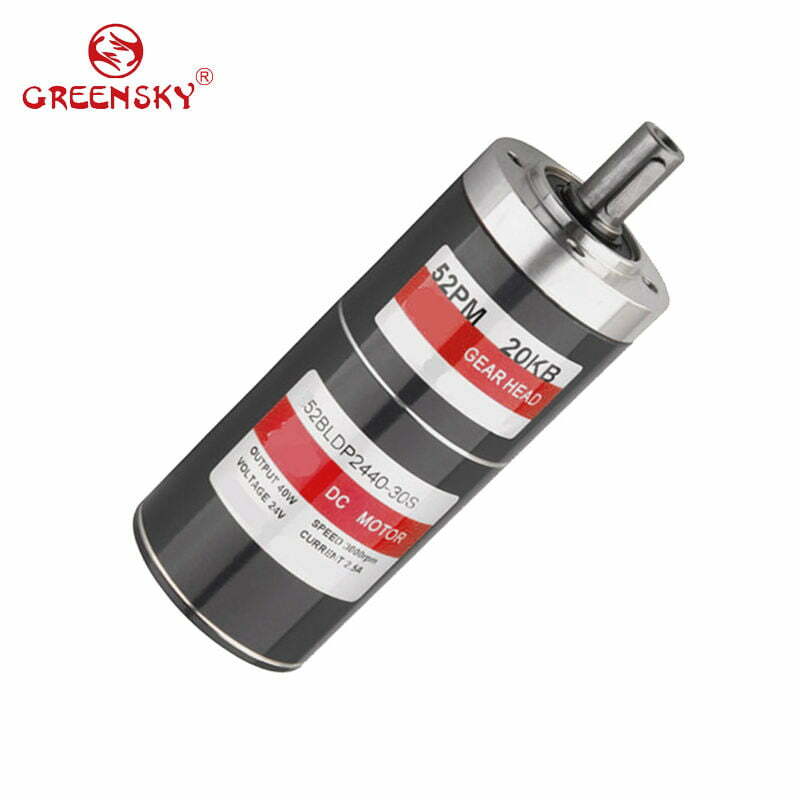
24V DC Gear Motors
Power 10–250 W · Torque 5–100 N·m · Ratios 5:1 to 200:1. High torque density from a planetary stage, for conveyors, lifts and actuators.

24V Stepper Motors
Power 5–100 W · Step angles 1.8° or 0.9° · Holding torque 0.1–2.5 N·m. Precise positioning where the shaft has to stop exactly where you tell it.
Technical Specifications Comparison
| Motor type | Power range | Speed range | Efficiency | Typical applications |
|---|---|---|---|---|
| Brushless DC | 50–500 W | 1000–5000 RPM | 85–92% | Robotics, automation, medical |
| Brushed DC | 5–250 W | 1000–8000 RPM | 70–85% | Automotive, consumer goods |
| DC gear motor | 10–250 W | 10–500 RPM | 75–90% | Conveyors, lifts, actuators |
| Stepper motor | 5–100 W | 0–1000 RPM | 60–75% | 3D printers, CNC, positioning |
These are published ranges, not single ratings. Efficiency in particular depends on the operating point, so the figure that matters is the efficiency at the speed and torque you actually run — not the best point in the table.
24 V Is the Middle of the Map, and That Is the Point
For the same shaft power, current is inversely proportional to voltage. At 24 V a motor draws half the current of the same motor on 12 V, and twice the current of one on 48 V. The chart shows what that means for a 1 HP load at a realistic 72% efficiency.
| Supply voltage | Current at 1 HP | What it means |
|---|---|---|
| 12 V | 86 A | Heavy cable and large connectors; the harness dominates |
| 24 V | 43 A | The balanced choice — the published table on this page |
| 48 V | 21.5 A | Smallest harness, but needs a 48 V supply and drive |
24 V halves the harness of 12 V
A 1 HP 24 V motor draws about 43 A, so a 10 mm² run keeps voltage drop near 1.3% over two metres — where the same 1 HP at 12 V needs 16 mm² for about 3.1%. The saving is in copper and in the heat it no longer produces.
24 V is the industrial standard
Control panels, AGVs, PLC I/O and machine safety run on 24 V DC by convention. Using a 24 V motor means the drive and the controls share one supply, one fuse philosophy and one set of spares.
24 V stays in the safety band
24 V DC sits below the safety extra-low-voltage ceiling, so the shock risk that comes with higher DC buses disappears. That is the reason 24 V, not 36 V or 60 V, won the industrial argument.
How Do I Calculate My Estimated Current Draw in Amperes?
The published chart below gives estimated amperes for a Greensky 24 V DC motor at each horsepower step. Unlike the same table appearing on a 12 V page, these figures are correct at 24 V — and the arithmetic proves it.
| Rated output | Amps as published | Shaft power | Input at 24 V | Implied efficiency |
|---|---|---|---|---|
| 1/10 HP | 4 A | 74.6 W | 96 W | 77.7% — sensible |
| 1/5 HP | 8 A | 149 W | 192 W | 77.7% — sensible |
| 1/4 HP | 11 A | 187 W | 264 W | 70.6% — sensible |
| 1/2 HP | 21 A | 373 W | 504 W | 74.0% — sensible |
| 3/4 HP | 32 A | 560 W | 768 W | 72.9% — sensible |
| 1.0 HP | 43 A | 746 W | 1,032 W | 72.3% — sensible |
| 1.5 HP | 65 A | 1,119 W | 1,560 W | 71.7% — sensible |
| 2.0 HP | 86 A | 1,492 W | 2,064 W | 72.3% — sensible |
The published amperes are reproduced exactly as they appear. What we have added is the efficiency column that confirms they are correct for 24 V, and the warning that the same column must not be carried over to a 12 V build unchanged. Our sales engineers are ready to run these numbers for your specific application.
Cable and Fuse Sizing at 24 V
At 24 V the current is low enough that the cable stops dominating the design — but it still has to be sized for voltage drop, not just for the current rating on the jacket.
| Copper cross-section | Drop over a 2 m run at 43 A | As a share of 24 V | Verdict for a 1 HP build |
|---|---|---|---|
| 4 mm² | 0.75 V | 3.1% | Usable for short, intermittent runs |
| 6 mm² | 0.50 V | 2.1% | A solid general-purpose choice |
| 10 mm² | 0.30 V | 1.3% | The sensible default for continuous duty |
| 16 mm² | 0.19 V | 0.8% | Long runs or where the supply already sags |
| 25 mm² | 0.12 V | 0.5% | Beyond what most 24 V machines need |
Half the current of 12 V
For the same 1 HP, a 24 V motor draws about 43 A where a 12 V motor draws about 86 A. The cable cross-section for the same percentage drop is roughly a quarter, not half, because loss scales with current squared.
Compounded by temperature
These figures are at 20 °C. Copper resistance rises with temperature, so a cable running 43 A continuously is worse than the table says. Treat the numbers as a floor, not a target.
The fuse protects the cable
Size the fuse for the cable and for stall current, not for running current. A 24 V motor can pull several times its rated amps at stall, and a fuse chosen at rated amps will open on every hard start.
This table is arithmetic on standard copper resistivity, not a substitute for your local wiring code. Local regulations set minimum conductor sizes and overcurrent protection, and they take precedence over any calculation on a web page.
Industry Applications
Industrial robotics
Joint actuators and positioning systems, where a brushless 24 V motor gives the torque and the life a robot needs over millions of cycles.
Medical equipment
Infusion pumps, surgical tools and beds, where 24 V sits in the safety extra-low-voltage band and the motor runs quietly and predictably.
Automotive systems
Seat adjustment, wipers and HVAC, where a brushed 24 V motor is the cost-effective answer and the 24 V bus already exists in the vehicle.
Packaging machinery
Conveyors, fillers and sealers, where a geared 24 V motor provides the torque to start a loaded line and the smoothness to keep it running.
The same 24 V label serves very different duties across these four. Send the load and the speed, not just the application name, and the right motor and drive fall out of the comparison table above.
How to Choose a 24 V DC Motor
Determine requirements
- Required torque and speed
- Duty cycle and environment
- Control method (speed, position)
Select motor type
- BLDC for high efficiency and life
- Brushed for cost-sensitive applications
- Stepper for precise positioning
- Gear motor for high torque
Consider options
- Feedback sensors (encoder, Hall)
- IP protection rating
- Mounting configuration
- Brake options
If you are unsure of the type of motor you presently use in an ongoing application, we can load test that motor for you to determine its specifications, and work directly with your engineers to match it.
Motor Range and Interface
What is fixed across the 24 V range, what is set per order, and the documents available today.
| Parameter | Value |
|---|---|
| Rated voltage | 24 V DC |
| Power range | 5 – 500 W across the range |
| Motor diameter | 3.25 – 6 in, as published |
| Motor types | Brushed DC, brushless DC, gear motor, stepper |
| Efficiency | 60–92% by type, as published |
| Mounting | NEMA, IEC or custom arrangement |
| Speed control | Variable speed compatible |
| Safety class | Within the SELV band (below 120 V DC) |
| Insulation class | Not specified — confirm before design freeze |
| Duty type | Not specified — confirm before design freeze |
| Ingress protection | Not specified — confirm before design freeze |
| Certification | ISO 9001 quality system as published; certificate number on request |
| Warranty, MOQ and lead time | Quoted per order |
There is no single datasheet covering every 24 V build, because almost every unit is configured per order. The documents above give the range and the wiring conventions; the drawing issued against your application is the controlling document. If a download does not start in a mobile in-app browser, open this page in the system browser and tap again.
Electrical and mechanical interface — confirm before design freeze
What to ask for · its current status · why it matters on a real machine| Item | Status | Why it is on this list |
|---|---|---|
| Rated current and stall current | Not specified — confirm before design freeze | Rated current sizes the cable; stall current sizes the fuse and the drive. At 24 V the rated figure is half of a 12 V motor’s, but the stall figure can still be several times rated. |
| Lead colours and polarity | Confirmed on the drawing per model | On a brushed motor, swapping the leads reverses rotation — either the feature you wanted or a machine running backwards. On a brushless build the lead order is not interchangeable. |
| Duty type and rated ambient | Not specified — confirm before design freeze | Continuous duty at elevated ambient derates the published output. A motor that runs all shift on a hot line needs a different rating from one that cycles. |
| Insulation class and temperature rise | Not specified — confirm before design freeze | Insulation class sets how hot the winding may run and therefore how much continuous torque the frame can carry. |
| Speed control method | Variable speed compatible as published; method to confirm | Voltage control, PWM and a matched brushless controller behave differently at low speed. PWM frequency can be audible and can heat the motor if set badly. |
| Feedback option | Encoder or Hall per model; to be specified | Closed-loop speed or position needs feedback, and the encoder resolution and Hall sequence have to match the drive you intend to use. |
| Gear ratio, backlash and output bearing load | Not specified — confirm per model | With a gearbox fitted, the useful rating moves to the output shaft, and the radial load the output bearing accepts limits overhung loads. |
| Ingress protection | Not specified — confirm if exposed to dust or water | Brushed motors have openings for brush access and cooling. If the machine sees wash-down, the enclosure has to be agreed rather than assumed. |
| Shaft, flange and mounting drawing | Issued against your drawing per order | NEMA, IEC or custom is a statement of intent, not a dimension. The pilot, hole pattern and shaft end have to be drawn before a bracket can be made. |
Customization Options
Winding and voltage window
Wound for your real 24 V supply, including the minimum the battery reaches under load, so the motor still makes torque when the pack is low.
Gearbox integration
Planetary ratio matched to your output speed and torque, with backlash and output bearing load written into the specification.
Feedback and control
Encoder, Hall or a matched brushless controller, set against your machine’s speed or position loop rather than a generic default.
Shaft, flange and labelling
Shaft end, pilot, hole pattern, lead length, connector and nameplate content set per order, including your brand.
We support
- Prototype development — a working sample on your machine before tooling is committed
- Small batch production — pilot runs for field trials and internal validation
- Large scale OEM manufacturing — volume production with your labelling and packaging
Samples are built on the same line as production, so the unit you approve is the unit you receive. Drawings, test reports and change notices ship with the order.
What to send with an RFQ
- Continuous torque, peak torque and peak duration
- Output speed after any gearbox, and the range to control
- 24 V supply, and the minimum it reaches under load
- Duty cycle, ambient, and dust or water exposure
- Motor type preference from the comparison table, or the motor you are replacing
- Annual volume, sample quantity, market of sale and labelling
Our Manufacturing Capabilities
Greensky supports OEM and ODM development for DC motor application manufacturers.
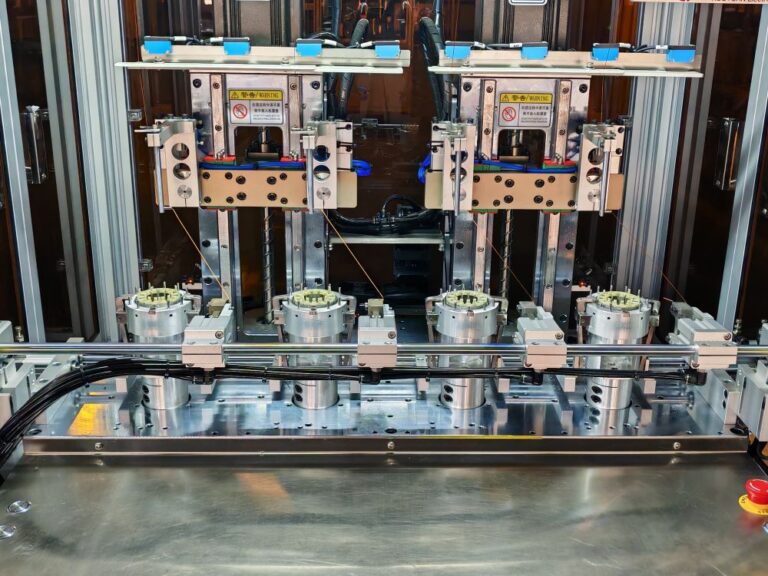
Motor Production Line
Advanced production lines ensure consistent quality and high production capacity for global DC motor application manufacturers.
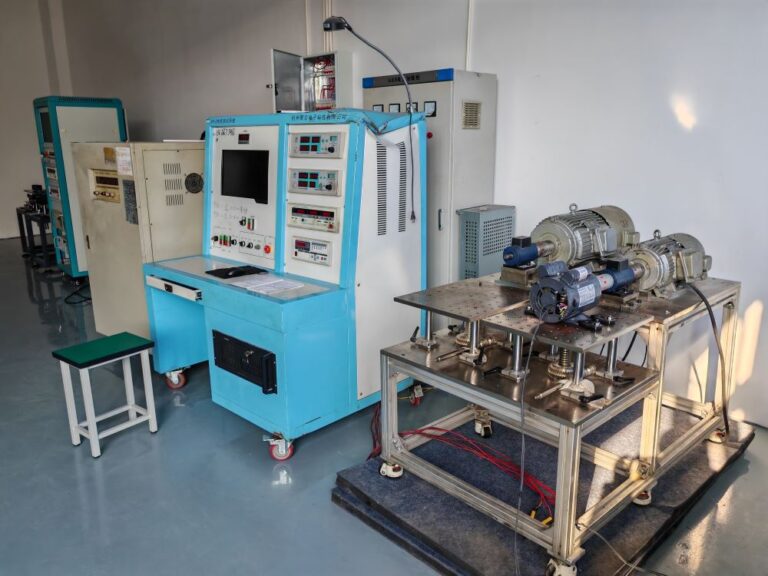
Motor Testing Laboratory
Professional testing equipment verifies torque, efficiency, durability and performance before shipment.
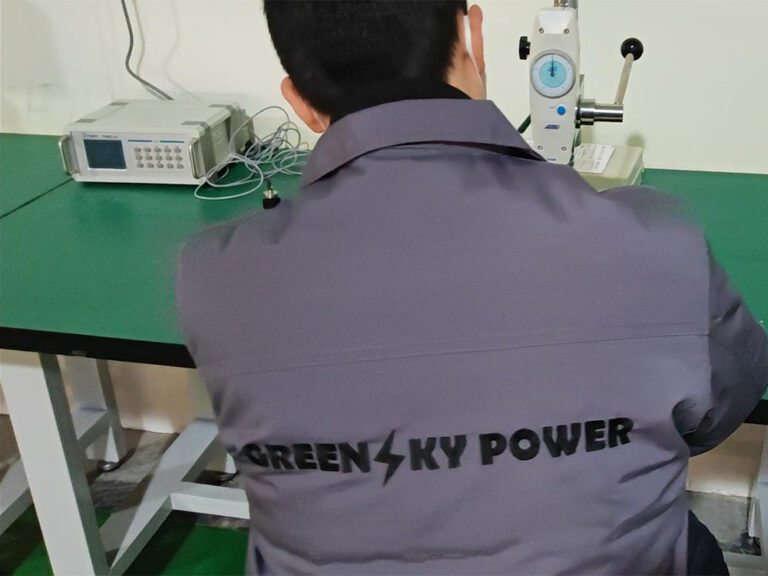
Quality Inspection
Strict inspection procedures ensure each motor meets international standards and customer specifications.

OEM Production
Flexible OEM manufacturing supports custom DC motor solutions for application manufacturers.
Safety and Standards for a 24 V DC Motor
24 V is the voltage where three separate boundaries meet, and each one answers a different question.
Safety extra-low voltage
IEC 60364-4-41 sets the requirements for protection against electric shock, and it is where the safety extra-low-voltage concept lives. 24 V DC sits comfortably inside the SELV band, which is the electrical-safety reason this voltage became the industrial control standard.
Motor safety standard
UL 1004-1 covers rotating electrical machines, both AC and DC, rated 1,000 V or less — so a 24 V DC motor is within its scope. It is the construction and test standard that sits behind the motor, independent of the installation’s SELV status.
Rating and duty
IEC 60034-1:2022 supplies the rating, duty type and temperature-rise definitions that make any performance claim verifiable. The published 5–500 W and the efficiency table become checkable numbers only once the duty and ambient are attached.
Two things 24 V does not change
The Low Voltage Directive 2014/35/EU still does not apply, because its DC scope begins at 75 V and 24 V is below that. And the US energy-efficiency rules in 10 CFR Part 431 still do not apply, because they cover polyphase AC squirrel-cage induction motors, not DC machines — so a 24 V DC motor has no IE efficiency class, and no supplier can honestly give it one. The SELV band is about shock safety, not about either of those.
ISO 9001 quality system, and how to read it
This page describes an ISO 9001 quality system as published. Two things are worth checking when it is quoted: the edition, because ISO 9001:2026 is current and the 2015 edition was withdrawn on 16 September 2026, and the certified scope, because a scope limited to assembly does not cover winding or magnet bonding. Certificate number and scope are supplied against the specific model and order rather than printed here.
Why Choose Greensky as Your Motor Manufacturer
Greensky Power Company Limited has been a leading manufacturer of China-made, custom-crafted DC motors designed for OEMs, working with application manufacturers worldwide to develop reliable motor solutions.
- Strong R&D team — winding, magnetics and drive design in house
- Advanced manufacturing equipment — automated winding and assembly lines
- Strict quality control — incoming, in-process and outgoing inspection on every batch
- OEM customization capability — from a first sample to annual volume
- Global export experience — motors shipped to more than 50 countries

Need 24V DC Motors for Your Project?
Talk with our sales engineers
- Load — continuous torque or force and radius, plus the peak and its duration.
- Speed — output speed after any gearbox, and the range you need to control.
- Type — brushless, brushed, gear or stepper, from the comparison table.
- Supply and duty — 24 V nominal, the minimum under load, hours per day and ambient.
- Interface — shaft, flange and mounting drawing, feedback or brake needs.
- Order plan — sample quantity, annual volume, market of sale and labelling.
Send an inquiry
Send a load case and a mounting drawing — we reply with a motor proposal within 24 hours.
FAQ – 24 Volt DC Motors
1. How many amps does a 24 V DC motor draw per horsepower?
About 43 A per horsepower of shaft output at a realistic 72% efficiency. The published current-draw table on this page confirms it: 43 A at 1 HP gives an input of 1,032 W against 746 W of output, which is 72.3% — a normal figure for a small to mid-size DC motor. The same numbers read at 12 V would imply 141–155% efficiency, which is impossible, so do not carry this column over to a 12 V build unchanged.
2. Why choose 24 V over 12 V or 48 V?
It is the middle of the map and it is usually the right place to be. For the same power, 24 V draws half the current of 12 V, which means roughly a quarter of the cable loss for the same conductor, and it stays inside the safety extra-low-voltage band that 48 V-plus DC systems leave. It is also the control-voltage standard in machine building, so the motor, the drive and the controls share one supply.
3. Is a 24 V DC motor safe to touch?
24 V DC sits inside the safety extra-low-voltage band defined in IEC 60364-4-41, which is why it is the standard control voltage in industrial panels and the reason it is used in medical equipment. That does not mean it is harmless — the conductors can still carry tens of amps, and a short circuit can burn — but the electric-shock hazard that higher DC buses carry is removed.
4. Which motor type should I choose at 24 V?
It depends on the duty. Brushless gives 85–92% efficiency and long life, so it is the choice for continuous or high-cycle use. Brushed is simpler and cheaper, which suits cost-sensitive intermittent duty. A gear motor multiplies torque for conveyors and actuators, and a stepper gives precise positioning for CNC and 3D printing. The comparison table on this page puts the four side by side.
5. What certifications does a 24 V DC motor need?
UL 1004-1 covers rotating electrical machines, both AC and DC, rated 1,000 V or less, so a 24 V motor is within scope. It is outside the EU Low Voltage Directive, whose DC scope begins at 75 V, and outside 10 CFR Part 431, which covers polyphase AC induction motors — so no IE efficiency class applies. The safety angle is covered by the SELV band rather than by either of those. For the quality system, confirm the ISO 9001 edition and scope, since the 2015 edition was withdrawn on 16 September 2026.
6. How do I size the cable and fuse for a 24 V motor?
Size the cable for voltage drop, not just current. At 1 HP and 43 A over two metres, 10 mm² copper keeps drop near 1.3% of 24 V, which is a sensible default for continuous duty; 6 mm² gives 2.1%, which is fine for lighter use. Size the fuse for the cable and for stall current rather than running current, because a 24 V motor can pull several times its rated amps at stall. Local wiring codes take precedence.
7. Can you match a motor I can no longer identify?
Yes — that is what the load test service is for. If you are unsure of the type of motor you presently use in an ongoing application, we can load test that motor to determine its specifications and work with your engineers to match it. Send the physical unit or a complete set of measurements, and we build the replacement to the torque and speed the machine actually needs.
Need 24V DC Motors for Your Project?
Our engineering team can help you select the optimal motor solution for your application. Contact us for a customized 24 Volt DC motor quotation, or see the BLDC motors manufacturer page for the wider brushless range.
Professional response guaranteed within 24 hours. Factory Add.: Quanxi Industry Zone, Wuyi, Zhejiang, China · Office Add.: 1509 Binsheng Rd, Hangzhou, Zhejiang, China · E-mail: mkt@greensky-power.com · TEL: +86 571 8819 5488 · Fax: +86 571 8819 4366