
12 Volt DC Motors
If your company is in need of a 12 Volt DC Motors you have come to the right place. Greensky Power produces DC motors for many companies’ detailed applications, with motor diameters from 3.25 in to 6 in, NEMA, IEC or custom mounting arrangements, and speed-control compatibility for variable speed. This page also does the part most supplier pages skip: it takes the published horsepower-to-amps chart, checks it against physics, and shows what your cable and fuse actually have to carry at 12 V.
Custom 12 V DC Motors, Built to Your Application
A Greensky Power electric 12 Volt DC motor is designed according to your detailed application description. Our DC motors are built with speed control compatibility, which offers variable speeds, and every motor can be manufactured with NEMA, IEC or custom mounting arrangements — so the unit drops onto your existing bracket instead of forcing a redesign.
Motor diameter ranges from 3.25 in to 6 in across the range. Within that envelope the variables are the winding, the magnet grade, the brush and commutator system on a brushed build, the gear ratio where a gearbox is fitted, and the shaft and flange. That is why the specification below is deliberately short on numbers and long on what has to be confirmed: almost everything on a custom 12 V motor is fixed per order.
Greensky Power Company Limited has been a manufacturer of China-made, custom-crafted DC motors designed for OEMs. Because we build both brushed and brushless machines, the honest starting question is not which motor we prefer but which one your duty needs.
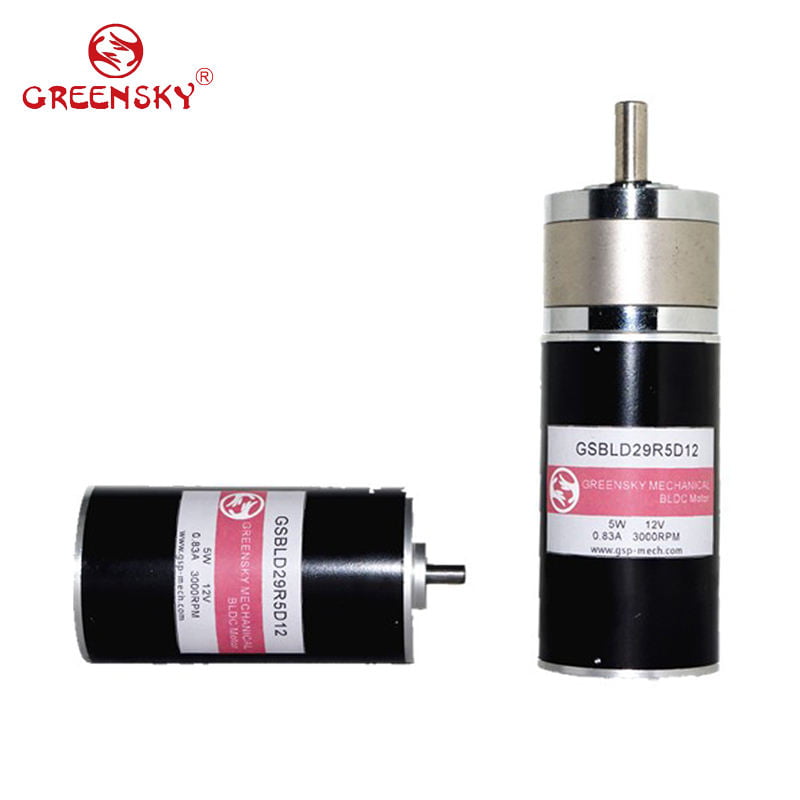
Are There Other Options Than a 12 Volt DC Motor?
Greensky Power offers numerous types of DC motors, all based on the company’s specific needs and voltages. The published list is below, and each entry is followed by when it is the right answer rather than the 12 V option.
24 Volt DC Motors
The direct alternative. Moving from 12 V to 24 V halves the current for the same power, which halves the cable and roughly quarters the loss in it. If your load is above about 1 HP, this is usually the better engineering choice, not a bigger 12 V motor.
Hydraulic Pump Motors
Where the machine already has hydraulics, driving the pump electrically can be cheaper than adding an electric actuator. High starting torque and a defined duty matter more than nominal power here.
Variable Speed Motors
Speed control compatibility is already built into the 12 V range, but a dedicated variable-speed build adds the drive matching and the feedback that closed-loop control needs.
Solar Powered Motors
Designed around a panel and battery rather than a mains supply, where the operating point moves with irradiance and the motor has to run efficiently well below nominal voltage.
Brushed or brushless, at 12 V
A brushed permanent-magnet motor is the simplest and cheapest way to get torque from 12 V: two leads, reverse the polarity to reverse direction, and control speed by voltage or PWM. The brushes are a wear item, so life is finite and predictable. A brushless motor moves that wear into electronics: longer life and better efficiency, but it needs a controller and it will not run on two wires.
Where the gearbox earns its place
At 12 V a small motor spins fast and pulls little torque. A planetary stage trades speed for torque, so the same electrical input can drive a gate, a pump or a conveyor that would stall a direct-drive unit. The price is efficiency, backlash and a new set of limits — gear ratio, output bearing load and duty all become part of the specification.
Our sales engineers can talk with you and guide you toward the style of DC motor that fits your application best. Send the load, the speed and the supply you have; we will tell you whether 12 V is the right decision or whether the honest answer is to move up a voltage class.
How Do I Calculate My Estimated Current Draw in Amperes?
The published chart below gives estimated amperes for a Greensky 12 V DC motor at each horsepower step. Before you size a battery or a cable from it, read the arithmetic underneath — because as printed, the chart cannot be describing 12 V.
| Rated output | Amps as published | Shaft power | Implied efficiency if read at 12 V | Amps at 12 V, derived at 72% |
|---|---|---|---|---|
| 1/10 HP | 4 A | 74.6 W | 155% — not possible | 8.6 A |
| 1/5 HP | 8 A | 149 W | 155% — not possible | 17.3 A |
| 1/4 HP | 11 A | 187 W | 141% — not possible | 21.6 A |
| 1/2 HP | 21 A | 373 W | 148% — not possible | 43.2 A |
| 3/4 HP | 32 A | 560 W | 146% — not possible | 64.8 A |
| 1.0 HP | 43 A | 746 W | 145% — not possible | 86.3 A |
| 1.5 HP | 65 A | 1,119 W | 143% — not possible | 129.5 A |
| 2.0 HP | 86 A | 1,492 W | 145% — not possible | 172.7 A |
| Rated output | Published amps | Amps at 12 V |
|---|---|---|
| 1/10 HP | 4 A | 8.6 A |
| 1/4 HP | 11 A | 21.6 A |
| 1/2 HP | 21 A | 43.2 A |
| 1.0 HP | 43 A | 86.3 A |
| 2.0 HP | 86 A | 172.7 A |
The published amperes are reproduced exactly as they appear on this page and have not been altered. What we have added is the arithmetic that shows they belong to a 24 V supply rather than 12 V: at 72% efficiency, 1 HP at 12 V draws about 86 A, not 43 A. Sizing a battery, a fuse or a cable from the published column on a 12 V system would leave every one of them at roughly half the current they will actually see. Our sales engineers are ready to talk you through this for your specific application, and we would rather raise it here than have you discover it on a test bench.
Cable and Fuse Sizing at 12 V
At 12 V the current is high enough that the cable stops being a detail and becomes the design constraint. Voltage drop is what actually stops a 12 V machine: the motor is specified at 12 V, so every volt lost in the run is a volt the motor does not get.
| Copper cross-section | Resistance per metre | Drop over a 2 m run at 86 A | As a share of 12 V | Verdict for a 1 HP build |
|---|---|---|---|---|
| 4 mm² | 0.00438 Ω/m | 1.51 V | 12.6% | Unusable — the motor is starved and the cable runs hot |
| 6 mm² | 0.00292 Ω/m | 1.01 V | 8.4% | Marginal; only for short runs or intermittent duty |
| 10 mm² | 0.00175 Ω/m | 0.60 V | 5.0% | Acceptable for many machines, tight for continuous duty |
| 16 mm² | 0.00109 Ω/m | 0.38 V | 3.1% | The sensible default for a 1 HP 12 V drive |
| 25 mm² | 0.0007 Ω/m | 0.24 V | 2.0% | Long runs, or where the supply is already low |
| 35 mm² | 0.0005 Ω/m | 0.17 V | 1.4% | Beyond what most 12 V machines need; specify it for 2 HP |
Compounded by temperature
These figures are at 20 °C. Copper resistance rises with temperature, so a cable carrying 86 A continuously is worse than the table says. Treat the numbers as a floor, not a target.
The fuse protects the cable
Size the fuse for the cable and the motor’s stall current, not for its running current. A 12 V motor can pull several times its rated amps at stall, and a fuse chosen at rated amps will open on every hard start.
Run the numbers at your length
Drop is proportional to run length and current and inversely proportional to cross-section. Halve the run and you halve the drop; double the voltage to 24 V and you halve the current, which halves the drop again.
This table is arithmetic on standard copper resistivity, not a substitute for your local wiring code. Local regulations set minimum conductor sizes and overcurrent protection for low-voltage DC circuits, and they take precedence over any calculation on a web page. Confirm the final sizes against the code that applies where the machine is installed.
12 V, 24 V or 48 V — Where 12 V Stops Making Sense
Twelve volts is the right choice more often than a supplier will admit, and the wrong choice more often than a catalogue implies. The dividing line is not preference, it is current.
| What changes | 12 V | 24 V | 48 V |
|---|---|---|---|
| Current for the same power | Reference | Half | A quarter |
| Cable cross-section for the same drop | Reference | About a quarter | About a sixteenth |
| Loss in the cable | Reference | About a quarter | About a sixteenth |
| Practical ceiling for a sensible build | Around 1/2 to 3/4 HP before the cable becomes the problem | Around 1.5 to 2 HP | Well beyond this frame range |
| Where it wins | Vehicle and battery systems, solar, portable equipment, existing 12 V infrastructure | Trucks, larger battery packs, industrial machines | Scooters, e-bikes, higher-power drives |
| What it costs you | Heavy cable, big fuses, and connector and terminal heating | Needs two batteries in series or a different supply | Needs a supply and a drive your machine may not have |
| Electrical safety regime in the EU | Below 75 V DC, so outside the Low Voltage Directive | Also below 75 V DC | Also below 75 V DC; the directive starts at 75 V |
The last row surprises people in both directions. A 12, 24 or 48 V DC motor sits below the 75 V DC threshold at which the EU Low Voltage Directive begins, so the directive does not apply to it — but that is not the same as “no rules”. EMC, RoHS and the machinery or vehicle rules for the finished product still apply, and they are assessed by whoever puts the machine on the market.
Motor Range and Interface
What is fixed across the 12 V range, what is set per order, and the documents available today.
| Parameter | Value |
|---|---|
| Rated voltage | 12 V DC (24 V in the wider range) |
| Motor diameter | 3.25 – 6 in, as published |
| Rated output | 1/10 – 2.0 HP, as published (see the current-draw table) |
| Mounting | NEMA, IEC or custom arrangement |
| Speed control | Variable speed compatible |
| Motor type | Brushed PMDC or brushless, to be specified per model |
| Gearbox | Planetary option; ratio to be specified per model |
| Insulation class | Not specified — confirm before design freeze |
| Duty type | Not specified — confirm before design freeze |
| Ingress protection | Not specified — confirm before design freeze |
| Brush life / service interval | Not specified — depends on duty and load |
| Certification | Not stated on this page — confirm per model and market |
| Warranty, MOQ and lead time | Quoted per order |
There is no single datasheet covering every 12 V build, because almost every unit is configured per order. The documents above give the range and the wiring conventions; the drawing issued against your application is the controlling document. If a download does not start in a mobile in-app browser, open this page in the system browser and tap again.
Electrical and mechanical interface — confirm before design freeze
What to ask for · its current status · why it matters on a real machine| Item | Status | Why it is on this list |
|---|---|---|
| Lead colours and polarity | Confirmed on the drawing per model | On a brushed motor, swapping the two leads reverses rotation — which is either the feature you wanted or a machine that runs backwards. On a brushless build the lead order is not interchangeable at all. |
| Rated current and stall current | Not specified — confirm before design freeze | Rated current sizes the cable; stall current sizes the fuse and the drive. A 12 V motor can draw several times its rated amps at stall, and only one of those numbers is usually published. |
| Duty type and rated ambient | Not specified — confirm before design freeze | A motor rated 1 HP continuously and one rated 1 HP for short bursts are different machines. Continuous duty at elevated ambient derates the published output, so both belong in the enquiry. |
| Insulation class and temperature rise | Not specified — confirm before design freeze | Insulation class sets how hot the winding may run and therefore how much continuous torque the frame can carry. It is the number that decides life at 12 V, where current is high. |
| Speed control method | Variable speed compatible as published; method to confirm | Voltage control, PWM and a matched brushless controller behave differently at low speed. PWM frequency in particular can be audible and can heat the motor if set badly. |
| Brush type and service interval | Not specified — depends on duty and load | Brushes are the wear item on a brushed 12 V motor. Knowing whether they are replaceable, and at what interval, decides whether the machine is serviceable or disposable. |
| Gear ratio, backlash and output bearing load | Not specified — confirm per model | With a gearbox fitted the useful rating moves to the output shaft, and the radial load the output bearing accepts limits overhung pulley or pinion loads. |
| Shaft, flange and mounting drawing | Issued against your drawing per order | NEMA, IEC or custom is a statement of intent, not a dimension. The pilot, hole pattern and shaft end have to be drawn before a bracket can be made. |
| Ingress protection | Not specified — confirm if exposed to dust or water | A brushed motor has openings for brush access and cooling. If the machine sees dust, wash-down or weather, the enclosure has to be agreed rather than assumed. |
What If I Don’t Know What Kind of Motor I Need?
If you are unsure of the type of motor you presently use in an ongoing application, we are able to load test that motor for you to determine its specifications. We work directly with your engineers to make the replacement match the original rather than approximate it.
That service matters most where the original motor is unmarked or obsolete. A load test recovers the torque and speed the machine actually needs, which is often lower than the motor that was originally fitted — and a smaller motor on a 12 V supply draws less current, which relaxes the cable and fuse sizing in the sections above.
What to send for a first proposal
- Load — continuous torque or the force and radius it acts at, plus the peak and how long it lasts
- Speed — output speed after any gearbox, and the range you need to control through
- Supply — 12 V nominal, and the real minimum your battery or supply reaches under load
- Duty — hours per day, starts per hour, and the ambient around the motor
- Interface — shaft, flange and mounting drawing, or the motor you are replacing
- Volume — sample quantity, annual volume, market of sale and labelling

Where 12 V DC Motors Are the Right Answer
Vehicle and battery systems
Where 12 V already exists, a 12 V motor needs no converter. The design constraint becomes the cable run from the battery, not the motor.
Solar and off-grid
A single panel and battery bank suit 12 V directly. Efficiency at low irradiance matters more than peak output here.
Portable equipment
Battery-powered tools, mobility aids and field equipment, where 12 V is the standard pack and weight matters.
Industrial actuation
Gates, dampers, small conveyors and pumps below about half a horsepower, where a 12 V brushed gearmotor is the cheapest reliable answer.
Above roughly 3/4 HP on 12 V, the cable and connector usually cost more than the step up to 24 V would. That is not a sales argument for a bigger motor — it is the arithmetic in the two sections above, and we would rather tell you before you build the harness.
Why Choose Our 12 V DC Motors
Built to your application
Each motor is designed from your application description rather than pulled from a catalogue, with winding, magnets, shaft and flange fixed per order.
Speed control compatible
Variable speed is built in, so the same motor can be voltage-controlled, PWM-driven or paired with a matched brushless controller.
Three mounting standards
NEMA, IEC or a fully custom arrangement, so the motor fits the bracket you already have instead of demanding a new one.
3.25 to 6 inch frames
A published diameter range that covers small actuation through to a 2 HP drive, in one supplier relationship.
Brushed and brushless
Both technologies in house, so the recommendation is driven by duty and life rather than by what happens to be in stock.
Load testing service
Send the motor you cannot identify and we will test it to recover its specifications, then build the match.
Customization Options
We provide customized DC motor solutions based on project requirements. These are the changes that come up most often on a 12 V OEM programme.
Winding and voltage window
Wound for your real supply, including the minimum the battery reaches under load, so the motor still makes torque when the pack is low.
Gearbox integration
Planetary ratio matched to your output speed and torque, with backlash and output bearing load written into the specification.
Shaft and flange
Diameter, keyway, flat, thread, pilot and hole pattern, drawn to your bracket rather than adapted with a coupling.
Leads, connectors and labelling
Lead length, connector type, colour code and nameplate content set per order, including your brand and the rating text your market requires.
We support
- Prototype development — a working sample on your machine before tooling is committed
- Small batch production — pilot runs for field trials and internal validation
- Large scale OEM manufacturing — volume production with your labelling and packaging
Samples are built on the same line as production, so the unit you approve is the unit you receive. Drawings, test reports and change notices ship with the order.
Reducing 12 V current at the design stage
- Add a gearbox rather than raising motor power — same torque, less current
- Choose the winding for your real load point, not for peak capability
- Keep the battery close, or move to 24 V and halve the current
- Specify the duty honestly; a motor sized for continuous duty runs cooler at the same current
Each of these lowers the current your harness has to carry, and at 12 V the harness is usually the most expensive part of the drive.
Our Manufacturing Capabilities
Greensky supports OEM and ODM development for DC motor application manufacturers.
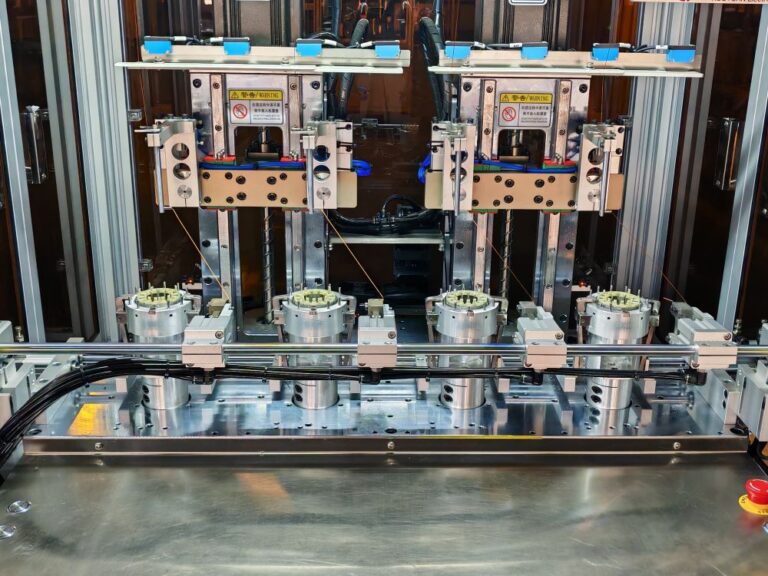
Motor Production Line
Advanced production lines ensure consistent quality and high production capacity for global DC motor application manufacturers.
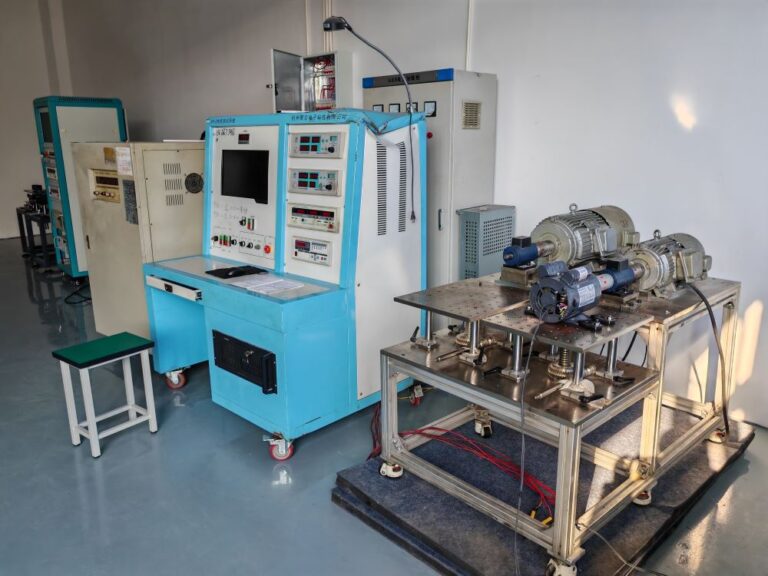
Motor Testing Laboratory
Professional testing equipment verifies torque, efficiency, durability and performance before shipment — the same bench used for load testing an unknown motor.
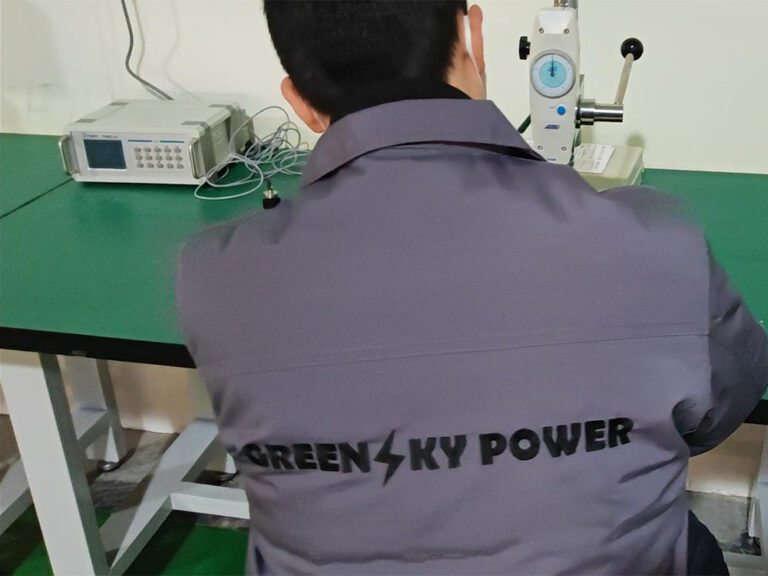
Quality Inspection
Strict inspection procedures ensure each motor meets international standards and customer specifications.

OEM Production
Flexible OEM manufacturing supports custom DC motor solutions for application manufacturers.
Which Standards Actually Apply to a 12 V DC Motor
Three questions come up on every 12 V programme, and two of the three answers are “not the one you expected”. Knowing the boundaries saves a pointless test programme and prevents a claim you cannot support.
Motor safety: UL 1004-1 is in scope
UL 1004-1 applies to rotating electrical machines and linear motors, both AC and DC, rated 1,000 V or less — so a 12 V DC motor is squarely inside it. It is the general construction and test standard for motors, and it excludes machines for hazardous locations and hermetic motor-compressors.
US efficiency rules: not applicable
10 CFR Part 431 sets the US energy-efficiency requirements for electric motors, but subpart B covers polyphase AC, 60 Hz, squirrel-cage induction motors, and explicitly excludes small motors and DC machines. A 12 V DC motor therefore has no IE efficiency class, and no supplier can honestly give it one.
Rating and duty: IEC 60034-1
IEC 60034-1:2022 is the framework for rating, duty type and temperature rise. It is what turns “1 HP” into a defined claim: at what duty, at what ambient, with what permissible winding temperature. Those three are exactly the items a 12 V motor datasheet usually leaves out.
What the EU Low Voltage Directive says about 12 V
The Low Voltage Directive 2014/35/EU applies to equipment rated 50–1,000 V AC or 75–1,500 V DC. A 12, 24 or 48 V DC motor is below the DC threshold, so the directive does not apply — and a supplier who lists it for this product is describing a test that was not required. What does still apply to the finished machine is EMC, RoHS and, where relevant, the machinery or vehicle rules; those are assessed by whoever places the product on the market.
What we can supply, and what we cannot
- Drawings and test data for the motor we build for you
- Material and substance declarations for the RoHS file
- Certification scope and certificate numbers per model, on request
- The duty, ambient and temperature rise stated in writing
We do not print a certificate number here that we cannot tie to a specific part. Where a market requires a system-level approval, that certificate belongs to the machine you build, with our motor documents forming part of the technical file.
Why Choose Greensky as Your Motor Manufacturer
Greensky Power Company Limited has been a leading manufacturer of China-made, custom-crafted DC motors designed for OEMs, working with application manufacturers worldwide to develop reliable motor solutions.
- Strong R&D team — winding, magnetics and drive design in house
- Advanced manufacturing equipment — automated winding and assembly lines
- Strict quality control — incoming, in-process and outgoing inspection on every batch
- OEM customization capability — from a first sample to annual volume
- Global export experience — motors shipped to more than 50 countries

Talk With Our Sales Engineers
Tell us about your needs
- Load — continuous torque or force and radius, plus the peak and its duration.
- Speed — output speed after any gearbox, and the range you need to control.
- Supply — 12 V nominal and the minimum it reaches under load.
- Duty and environment — hours per day, starts per hour, ambient, dust or water exposure.
- Interface — shaft, flange and mounting drawing, or the motor you are replacing.
- Order plan — sample quantity, annual volume, market of sale and labelling.
Send an inquiry
Send a load case and a mounting drawing — we reply with a motor proposal within 24 hours.
FAQ – 12 Volt DC Motors
1. How many amps does a 12 V DC motor draw per horsepower?
At a realistic 72% efficiency, a 12 V motor draws about 86 A per horsepower of shaft output — roughly 8.6 A at 1/10 HP, 21.6 A at 1/4 HP, 43.2 A at 1/2 HP and 172.7 A at 2 HP. The horsepower-to-amps chart published on this page shows 43 A at 1 HP, which is about half of that. Read as 12 V the published figures imply 141–155% efficiency, which is impossible; solve for the voltage that makes them sensible and it comes out at 23.5–25.9 V. The published column is in effect a 24 V table. Use the 12 V column on this page for a 12 V build, and confirm against the nameplate of the motor you actually buy.
2. Why does the current matter so much more at 12 V than at 24 V or 48 V?
Because power is voltage times current, so halving the voltage doubles the current for the same load. That has two consequences. The cable has to carry twice as much, which means a larger cross-section; and the loss in that cable is current squared times resistance, so it goes up four times for the same cable. In practice a 12 V build at 1 HP needs around 16 mm² copper to keep voltage drop near 3% over two metres, where the same 1 HP at 24 V would need roughly a quarter of that.
3. How do I size the cable and the fuse?
Size the cable for voltage drop, not just for current: at 12 V a 5% drop is 0.6 V that the motor never sees. The table on this page gives drop for a 1 HP build over two metres, from 12.6% on 4 mm² down to 1.4% on 35 mm². Size the fuse for the cable and for stall current rather than running current, because a 12 V motor can draw several times its rated amps at stall. Local wiring codes set minimum sizes and take precedence over any calculation here.
4. Brushed or brushless at 12 V?
A brushed permanent-magnet motor is simpler and cheaper: two leads, reverse polarity to reverse direction, speed by voltage or PWM, and no controller needed. Its limit is brush wear, so life is finite and predictable. A brushless motor moves the wear into electronics, giving longer life and better efficiency, but it needs a controller and will not run on two wires. For intermittent duty on a cost-sensitive machine, brushed usually wins; for continuous duty, high cycle counts or sealed environments, brushless does.
5. Can you match a motor I can no longer identify?
Yes — that is what the load test service is for. If you are unsure of the type of motor you presently use in an ongoing application, we can load test that motor to determine its specifications and work with your engineers to match it. Send the physical unit or a complete set of measurements; the test recovers torque and speed at the actual duty, which is often lower than the motor originally fitted.
6. Which certifications does a 12 V DC motor actually need?
For the US market, UL 1004-1 covers rotating electrical machines, both AC and DC, rated 1,000 V or less, so a 12 V motor is within its scope. It is not, however, within the scope of 10 CFR Part 431: those US efficiency rules cover polyphase AC, 60 Hz squirrel-cage induction motors and exclude DC machines and small motors — which means no IE efficiency class applies, and a claim otherwise should be questioned. For the EU, a 12 V DC motor sits below the 75 V DC threshold of the Low Voltage Directive, so that directive does not apply, but EMC and RoHS still do for the finished product. IEC 60034-1 supplies the rating, duty and temperature-rise definitions that make any performance claim verifiable.
7. What frame sizes and mountings are available?
Motor diameter ranges from 3.25 in to 6 in, and every motor can be built with NEMA, IEC or a custom mounting arrangement. Speed control compatibility comes as standard, so variable speed does not require a special version. What has to be defined per order is the shaft, pilot, hole pattern, lead length and connector, plus the winding for your actual supply voltage under load.
Looking for 12 Volt DC Motor Solutions?
Contact us for a customized 12 Volt DC motor quotation, or see the BLDC motors manufacturer page for the wider brushless range. Greensky Power is committed to becoming your reliable long-term motor manufacturing partner — standard models or fully customized OEM solutions.
Professional response guaranteed within 24 hours. Factory Add.: Quanxi Industry Zone, Wuyi, Zhejiang, China · Office Add.: 1509 Binsheng Rd, Hangzhou, Zhejiang, China · E-mail: mkt@greensky-power.com · TEL: +86 571 8819 5488 · Fax: +86 571 8819 4366