
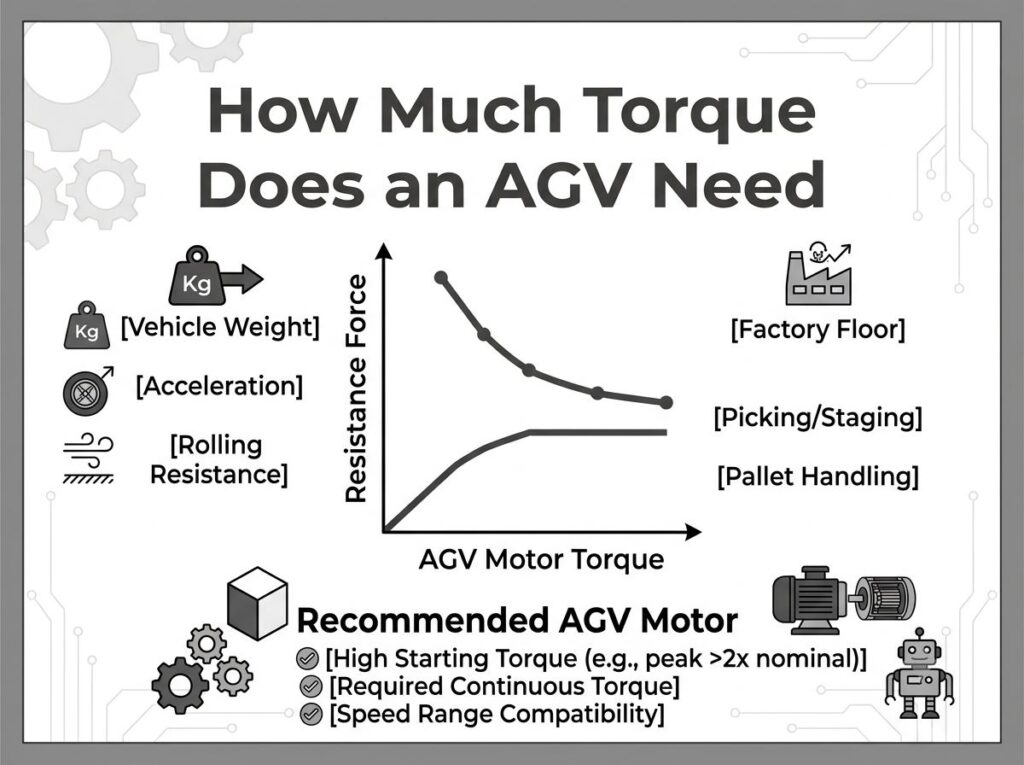
AGV需要多少扭矩? 具有工程标准的基于有效负载的答案
工程师设计自动导引车 (AGV) 和自主移动机器人 (抗菌药物耐药性) 在项目早期定期提出一个问题: 驱动电机实际需要多少扭矩? 答案从来不是一个数字. 这取决于车辆质量, 加速目标, 倾斜角, 轮径, 地板摩擦力, 从动轮数量, 变速箱速比, 以及电机必须承受的热占空比. 本指南按有效负载类别细分问题, 提供可立即应用的力模型公式, 并将这些建议纳入国际电机标准 (国际电工委员会 60034-1, 一氧化氮镁 1) 以及来自 Maxon 的制造商技术数据, 福尔哈伯, 和安川.
无论您正在构建一个 50 kg 室内 AMR 或 60 吨重载转运车, 在发出询价之前,以下方法将帮助您获得可靠的电机扭矩规格.
为什么扭矩大小决定 AGV 的成功或失败
扭矩过小导致电机在负载下失速, 持续运行期间过热, 以及无法爬上坡道. 扭矩过大浪费电池容量, 增加车轮在光滑地板上的滑动, 并增加了 BOM 成本,但没有提高性能. 在生产环境中, AGV 的可靠性很少受到控制软件的限制——它受到电机扭矩之间的机械相互作用的限制, 车轮牵引力, 和地板条件 [1].
扭矩要求不是单一值,而是整个操作条件下的曲线. 在平坦的环氧树脂上平稳移动的 AGV 可能会在平坦的环氧树脂上失速 3% 坡道. 处理直线巡航的电机在原地旋转期间可能会发生故障, 在差速驱动配置中,通常需要两到五倍的直线扭矩 [5].
| 健康)状况 | 扭矩太低 | 扭矩过高 | 尺寸正确 |
|---|---|---|---|
| 从静止状态加速 | 失速, 电机过热, 导航超时 | 车轮打滑, 编码器反馈丢失 | 顺利启动, 稳定的速度斜坡 |
| 坡道攀爬 (3–5% 等级) | 车辆停在斜坡上, 回滚风险 | 电流消耗过大, 电池耗尽 | 坡度保持一致的速度 |
| 原地旋转 (差动驱动) | 无法完成转弯, 脚轮阻力 | 轮胎划伤, 地板损坏 | 可预测的转弯, 磨损最小 |
| 持续经营 (8+ 小时) | 热跳闸, 绕组绝缘劣化 | 能源浪费, 控制器成本过大 | 绝缘等级内温度稳定 |
快速回答: 按有效载荷等级划分的扭矩
如果您在深入研究公式之前需要大致了解, 下表将典型 AGV 有效负载等级映射到每轮连续扭矩, 推荐电机类型, 电压平台, 和变速箱速比. 这些值假设 2 从动轮, 光滑混凝土上的聚氨酯轮胎 (肌酐= 0.02), 0.5 米/秒²加速度, 平地板, 和安全系数 1.5. 他们是起点, 非最终规格 - 始终使用下一节中的力模型进行验证.
| 有效负载等级 | 总质量 (千克) | 每轮连续扭矩 (牛顿·米) | 电机类型 | 电压 | 变速箱比 | 典型电机功率 |
|---|---|---|---|---|---|---|
| 微型AMR (货架扫描, 存货) | 30–80 | 0.5–2.0 | BLDC 22–42 毫米 | 12-24伏直流电 | 10:1–20:1 | 30–100W |
| 轻型AMR (货到人) | 80–200 | 2.0–5.0 | BLDC 42–57 毫米 | 24 在直流电 | 15:1–30:1 | 100–300 瓦 |
| 中型AGV (托盘, 排序) | 200–500 | 5.0–15.0 | BLDC 57–86 毫米 | 24–36V 直流 | 20:1–50:1 | 300–800 瓦 |
| 重型AGV (流水线, 医院) | 500–3,000 | 15.0–60.0 | BLDC 86–115 毫米 | 48 在直流电 | 30:1–80:1 | 800–2,000 瓦 |
| 重载转运车 (钢, 铸造厂) | 3,000–60,000 | 60.0–300.0+ | 2× BLDC 115–120 毫米 (双电机) | 48-72V 直流 | 30:1–80:1 (带制动变速箱) | 2× 1.5–3 千瓦 |
表中扭矩值 2 每个从动轮. 对于两轮差速驱动, 总牵引扭矩是每轮值的两倍. 对于 4 轮驱动配置, 将每个车轮的值除以 2 (假设负载分布相等). 请务必根据您的具体操作条件使用以下公式重新计算.
力模型: 四个电阻元件
AGV驱动扭矩由车辆必须克服的总阻力决定. 力模型将其分解为四个部分, 每个对应一个物理阻力源. 此分解遵循 MDPI 工程论文集有关机器人运动的电机参数计算的论文中描述的方法 [9] 与东方汽车采用的尺寸确定方法一致 [3] 和 iNetic Motion [4].
1. 滚动阻力 (F卷)
滚动阻力是使轮胎和地板在接地处变形所需的力. 这取决于轮胎材质, 地板表面, 和正常负载. 光滑环氧树脂上的聚氨酯轮胎具有最低的滚动阻力; 粗糙混凝土上的橡胶轮胎具有最高的.
| 轮子材质 | 楼层类型 | CRR 范围 | AGV 典型应用 |
|---|---|---|---|
| 聚氨酯 (肖氏硬度 92A–95A) | 光滑环氧树脂 | 0.010–0.015 | 洁净室, 电子厂 |
| 聚氨酯 | 抛光混凝土 | 0.015–0.025 | 仓库, 配送中心 |
| 聚氨酯 | 有接缝的混凝土 | 0.020–0.035 | 制造车间 |
| 橡皮 | 环氧地坪 | 0.020–0.030 | 医院, 食品加工 |
| 橡皮 | 粗糙混凝土 / 沥青 | 0.035–0.060 | 室外换乘通道 |
| 尼龙 / 伏尔科兰 | 钢轨 / V型轨道 | 0.005–0.010 | 重载导轨式AGV |
公式: F卷 =米×克×CRR × 余弦(我)
在哪里 米 是车辆总质量 (千克), 克 = 9.81 米/秒², CRR 是滚动阻力系数, 和 我 是倾斜角. 在平坦的地面上, 因斯(0°) = 1, 所以这个词简化为 米×克×CRR.
2. 加速力 (FACC)
牛顿第二定律: 将车辆质量从静止加速到目标速度所需的力. 这通常是启动期间最大的分力.
公式: FACC =米×a
在哪里 一个 是目标加速度 (米/秒²). AGV 加速度通常为 0.3–0.8 m/s² 以确保稳定性. AMR 可能达到 1.0 米/秒². 紧急减速可能需要 1.5–2.0 m/s², 产生最高的瞬态力.
| AGV类型 | 正常加速度 (米/秒²) | 紧急减速 (米/秒²) | 笔记 |
|---|---|---|---|
| 微型AMR | 0.5–1.0 | 1.5–2.0 | 轻载载荷, 快速启停 |
| 轻型AMR (货到人) | 0.4–0.8 | 1.0–1.5 | 速度与负载稳定性的平衡 |
| 中型AGV (托盘) | 0.3–0.6 | 0.8–1.2 | 防止制动时托盘移位 |
| 重型AGV (流水线) | 0.2–0.5 | 0.5–1.0 | 平滑斜坡对于精密负载至关重要 |
| 重载转运车 | 0.1–0.3 | 0.3–0.5 | 液体负载 (熔融金属) 要求超低冲击 |
3. 等级阻力 (F年级)
当 AGV 在坡道上运行时 — 装卸码头接近, 地板过渡, 或倾斜的传输路径 - 重力添加平行于斜坡的分量. 即使在中等等级上,这种力量也可能很大.
公式: F年级 = m × g × sin(我)
| 坡 | 角度 (度数) | F年级 每 1000 千克 (否) | 典型场景 |
|---|---|---|---|
| 1% | 0.57° | 98 | 底板公差, 几乎察觉不到 |
| 3% | 1.72° | 294 | 装卸码头引道坡道 |
| 5% | 2.86° | 490 | 仓库楼层过渡 |
| 8% | 4.57° | 783 | 停车库坡道 |
| 10% | 5.71° | 977 | 室外换乘通道, 陡坡 |
一个 1,200 kg AGV 上 3% 坡道必须克服 353 单独的坡度阻力N——几乎等于其在平地上的滚动阻力. 如果您的 AGV 遇到坡道, 坡度阻力常常成为主要的力分量.
4. 转动阻力 (F转动) — 仅差动驱动
在差动驱动 AGV 中 (两个动力轮, 多个脚轮), 原地旋转产生最高的扭矩需求. 脚轮必须旋转, 产生显着的耐擦洗性. 现场数据的工程近似 [5]:
公式: F旋转 = (2 × F卷 × √(W² + L²)) / W
在哪里 W 是轮距宽度, L 是车辆长度. 在实践中, 旋转扭矩为直线扭矩的2-5倍, 它通常决定电机的峰值扭矩额定值.
核心扭矩公式和变量
结合四个力分量, 总驱动力和车轮扭矩计算如下. 该公式与 MDPI Engineering Proceedings 论文中描述的方法一致 [9] 和 AGV 驱动轮尺寸指南 [2].
总驱动力
F全部的 =F卷 + FACC + F年级
(转动阻力作为峰值条件单独评估, 不添加到持续力中。)
每轮扭矩
时间车轮 = (F全部的 × r车轮) / n驾驶
在哪里 r车轮 是 已加载 车轮半径 (不是标称半径 — 聚氨酯轮胎在负载下压缩 2–5 毫米), 和 n驾驶 是共享牵引力的从动轮数量.
电机侧连续扭矩
时间马达 = (时间车轮 × 顺丰) / (我×n克)
其中 SF 是安全系数 (1.25–1.5(室内), 2.0 用于重工业, 2.5 对于安全关键的), 一世 是变速箱减速比, 和 或者克 是变速箱效率.
| 变速箱类型 | 阶段 | 效率 (或者克) | 典型比率范围 | 间隙 |
|---|---|---|---|---|
| 行星式 (精确) | 1 阶段 | 0.94–0.96 | 3:1–10:1 | < 5 弧分 |
| 行星式 (精确) | 2 阶段 | 0.88–0.92 | 10:1–50:1 | < 5 弧分 |
| 行星式 (精确) | 3 阶段 | 0.82–0.86 | 50:1–200:1 | < 7 弧分 |
| 正齿轮 (平行线) | 1 阶段 | 0.90–0.93 | 2:1–8:1 | 10–30 弧分 |
| 蜗轮 (直角) | 1 阶段 | 0.60–0.75 | 5:1–60:1 | 不适用 (自锁) |
适用于 AGV 应用, 两级行星齿轮箱是最常见的选择,因为它们提供了最佳的效率平衡, 扭矩密度, 和强烈反对. 深入比较变速箱类型, 看看我们的 正齿轮电机与. 行星齿轮马达 分析. 由于效率低,AGV 通常避免使用蜗轮变速箱 (这会浪费电池容量) 和自锁行为 (防止滑行和再生制动).
电源检查
P车轮 =F全部的 × v
P马达 =P车轮 / (或者克 × n马达)
在哪里 v 是目标行驶速度 (多发性硬化症), 和h马达 是电机效率 (0.85额定负载下 BLDC 为 –0.92). 该功率数字应包括 30-50% 的浪涌余量, 制动保持, 和斜坡启动.
工作示例: 150 千克 AMR 和 1,200 公斤AGV
例子 1: 150 公斤AMR (货到人机器人)
| 步 | 范围 | 价值 | 计算 |
|---|---|---|---|
| 1 | 毛重 (米) | 150 千克 | 100 公斤有效负载 + 50 公斤底盘 |
| 2 | 加速 (一个) | 0.5 米/秒² | 典型的货对人 AMR |
| 3 | 倾斜角度 (我) | 0° (平坦的) | 室内仓库, 没有坡道 |
| 4 | CRR | 0.015 | 抛光混凝土上的 PU 轮胎 |
| 5 | 负载轮半径 (r) | 0.10 米 | 200 标称毫米, 5 毫米压缩 |
| 6 | 从动轮 (n) | 2 | 差动驱动 |
| 7 | F卷 | 22.1 否 | 150 × 9.81 × 0.015 |
| 8 | FACC | 75.0 否 | 150 × 0.5 |
| 9 | F年级 | 0 否 | 平坦的地面 |
| 10 | F全部的 | 97.1 否 | 22.1 + 75.0 + 0 |
| 11 | 时间车轮 (每轮) | 4.86 牛顿·米 | (97.1 × 0.10) / 2 |
| 12 | 应用安全系数 | 6.55 牛顿·米 | 4.86 × 1.35 (室内的) |
| 13 | 变速箱速比 (一世) | 20:1 | 2-行星级 |
| 14 | 变速箱效率 (或者克) | 0.90 | 2-行星级 |
| 15 | 时间马达 (连续的) | 0.36 牛顿·米 | 6.55 / (20 × 0.90) |
| 16 | 行驶速度 (v) | 1.5 多发性硬化症 | 货到人目标 |
| 17 | P马达 (和 40% 利润) | 226 W → 选择 250 W | (97.1 × 1.5) / (0.90 × 0.88) × 1.4 |
结果: 一个 150 kg AMR 大约需要 0.36 N·m 每个驱动轮的连续电机扭矩 20:1 行星齿轮箱. 一个 24在 BLDC 电机中 200-300 W 范围内,框架尺寸为 42-57 mm 是合适的. 这 完整的 AGV 电机选型指南 提供额外的有效负载类别和电机型号建议.
例子 2: 1,200 公斤AGV (装配线运输)
| 步 | 范围 | 价值 | 计算 |
|---|---|---|---|
| 1 | 毛重 (米) | 1,200 千克 | 1,000 公斤有效负载 + 200 公斤底盘 |
| 2 | 加速 (一个) | 0.5 米/秒² | 装配零件顺利启动 |
| 3 | 倾斜角度 (我) | 1.72° (3% 年级) | 装卸码头方法 |
| 4 | CRR | 0.020 | 工业混凝土上的 PU 轮胎 |
| 5 | 负载轮半径 (r) | 0.10 米 | 200 标称毫米, 已加载 |
| 6 | 从动轮 (n) | 2 | 后差速器驱动 |
| 7 | F卷 | 235.4 否 | 1,200 × 9.81 × 0.020 × 余弦(1.72°) |
| 8 | FACC | 600.0 否 | 1,200 × 0.5 |
| 9 | F年级 | 353.2 否 | 1,200 × 9.81 × 罪恶(1.72°) |
| 10 | F全部的 | 1,188.6 否 | 235.4 + 600.0 + 353.2 |
| 11 | 时间车轮 (每轮) | 59.4 牛顿·米 | (1,188.6 × 0.10) / 2 |
| 12 | 应用安全系数 | 80.2 牛顿·米 | 59.4 × 1.35 |
| 13 | 变速箱速比 (一世) | 30:1 | 2-行星级, 重负 |
| 14 | 变速箱效率 (或者克) | 0.88 | 2-行星级 |
| 15 | 时间马达 (连续的) | 3.04 牛顿·米 | 80.2 / (30 × 0.88) |
| 16 | 行驶速度 (v) | 1.0 多发性硬化症 | 装配线节奏 |
| 17 | P马达 (和 50% 利润) | 2,144 W → 选择 2× 1.5 千瓦 | (1,188.6 × 1.0) / (0.88 × 0.90) × 1.5 |
结果: 这 1,200 kg AGV 大约需要 3.04 N·m 每轮连续电机扭矩 30:1 变速箱. 1–2 kW 范围内的 48V BLDC 电机 (86–115 毫米框架) 是合适的. 注意等级电阻 (353 否) 贡献 30% 总力 - 如果 AGV 仅在平坦地面上运行, 所需扭矩降至 2.2 N·m 和功率 1,540 W. 这凸显了为什么您必须根据 最坏情况工作点, 不是平均数.
更深入地处理扭矩计算方法, 包括差速驱动转动扭矩和惯量匹配, 看看我们的 AGV电机扭矩计算指南 具有全力模型和标准参考.
基于有效负载的电机选择矩阵
下表综合了工作示例中的计算结果,并将其扩展到整个有效负载范围. 假设两轮差速驱动, 光滑混凝土上的聚氨酯轮胎, 0.5 米/秒²加速度, 并包括平地和 3% 年级情景.
| 范围 | 有效负载等级 | ||||
|---|---|---|---|---|---|
| 微型AMR | 轻型AMR | 中型AGV | 重型AGV | 转运车 | |
| 毛重 (千克) | 50 | 150 | 500 | 1,200 | 5,000 |
| 目标速度 (多发性硬化症) | 1.5 | 1.5 | 1.0 | 1.0 | 0.5 |
| F全部的 平坦的 (否) | 32 | 97 | 246 | 835 | 2,453 |
| F全部的 3% 年级 (否) | 81 | 243 | 529 | 1,189 | 3,923 |
| 每轮 T (平坦的) (牛顿·米) | 1.6 | 4.9 | 12.3 | 41.8 | 122.6 |
| 每轮 T (年级) (牛顿·米) | 4.1 | 12.2 | 26.5 | 59.4 | 196.2 |
| 安全系数 | 1.5 | 1.35 | 1.5 | 1.5 | 2.0 |
| 时间马达 续. (牛顿·米) | 0.3 | 0.7 | 1.8 | 3.4 | 14.5 |
| 电机功率 (W) | 50–100 | 200–300 | 500–800 | 1,000–2,000 | 2× 1,500–3,000 |
| 电机架 (毫米) | 22–42 | 42–57 | 57–86 | 86–115 | 115–120 (双重的) |
| 电压 (在直流电) | 12–24 | 24 | 24–36 | 48 | 48–72 |
| 变速箱速比 | 10:1–20:1 | 15:1–30:1 | 20:1–50:1 | 30:1–80:1 | 30:1–80:1 |
对于这些标准有效载荷类别之外的定制电机规格, GreenSky Power 提供定制电动机设计 框架尺寸从 22 毫米至 120 毫米, 电压范围为 12V 至 72V DC, 和集成变速箱解决方案.
热验证: 国际电工委员会 60034-1 工作周期
仅靠扭矩并不能保证电机的生存. 电机必须在实际工作周期内的热限制内维持所需的扭矩. 国际电工委员会 60034-1:2022 (版 15, 三月出版 2026) 定义了十个占空比分类, 其中五个与 AGV 应用最相关 [7].
| IEC等级 | 描述 | 热行为 | AGV应用匹配 | 扭矩降额 |
|---|---|---|---|---|
| S1 | 连续运行 | 达到稳态温度 | 输送式AGV, 24/7 线路操作 | 无 — 额定扭矩 = 连续扭矩 |
| S2 | 短时值班 | 在运行之间冷却至环境温度 | 批量运输, 两次移动之间长时间闲置 | 对于短脉冲,可以超过 S1 扭矩 1.5–2 倍 |
| S3 | 间歇性周期性工作 | 循环之间没有显着的冷却 | 货对人 AMR, 循环拾放 | 取决于占空比 % (ed = 准时 / 总循环) |
| S4 | 间歇性有起始影响 | 包括起始损失 | AGV频繁启停 (装配线供料器) | 启动电流加热绕组; 与 相比 降额 10–20%. S1 |
| S5 | 间歇式电动制动 | 制动能量增加热量 | 坡道上具有再生制动功能的 AGV | 制动能量必须消耗或再生 |
大多数 AGV 应用属于 S3 或 S4 职责. 关键区别: 如果您的 AGV 频繁启动和停止 (典型周期: 10 秒动, 20 秒加载), 电机绕组在循环之间没有完全冷却, 并且连续额定扭矩必须涵盖整个周期的 RMS 扭矩, 不仅仅是巅峰.
有效值扭矩计算
用于间歇工作, 计算一个完整周期的 RMS 扭矩:
时间有效值 = √[(T₁²×t₁ + T22×t2 + … + 时间n²×tn) / (t₁ + t2 + … + tn)]
电机的额定连续扭矩必须超过T有效值 在工作环境温度下. 如果T有效值 超过额定扭矩, 电机会过热——即使峰值扭矩完全在电机的能力范围内.
环境温度引起的热降额
数据表中的电机额定扭矩是在 25°C 环境条件下指定的 (根据 Maxon 标准规范 100/101) [11]. 在较高环境温度下, 允许的连续扭矩减小.
| 环境温度 | 额定电流 (%) | 额定扭矩 (%) | 笔记 |
|---|---|---|---|
| 25℃ (目录基线) | 100% | 100% | Maxon/Faulhaber 目录值 |
| 40℃ (IEC标准环境) | 85–90% | 85–90% | 典型工业环境 |
| 50℃ | 70–75% | 70–75% | 铸造厂, 钢厂, 热仓 |
| 60℃ | 50–55% | 50–55% | 极端环境; 升级至F/H级 |
如果您的 AGV 在 40°C 环境下运行 (常见于无空调仓库), 您必须将电机降额 10–15%. 电机额定为 5 25°C 时连续 N·m 在 40°C 时仅提供 4.25–4.50 N·m. 适用于高温环境, 指定F级 (155℃) 或H级 (180℃) 绝缘, 这允许 100% 环境温度高达 50°C 时的额定电流 [12].
一氧化氮镁 1 AGV电机的扭矩分类
一氧化氮镁 1-2021 根据扭矩特性和启动负载惯量将电机分为四种设计类型. 虽然 NEMA 标准主要用于交流感应电机, 扭矩分类框架有助于理解 AGV 启动条件下的电机行为. IEC 设计 N 和设计 H 分类大致相当于 NEMA 设计 B 和 C, 分别 [8].
| NEMA设计 | 堵转扭矩 (% 满载的) | 上拉扭矩 (% 满载的) | 击穿扭矩 (% 满载的) | IEC 等效标准 | AGV 适用性 |
|---|---|---|---|---|---|
| 设计A | 100–200% | 100–140% | 200–250% | — | 启动扭矩低; 不适合 AGV (负载可能在启动时停止) |
| 设计B (最常见的) | 150–200% | 100–140% | 200–250% | IEC设计N | 通用型; 适合带变速箱的 AGV (变速箱倍增启动扭矩) |
| 设计C | 200–250% | 140–200% | 190–225% | IEC设计H | 高启动扭矩; 适用于负载较重、启动频繁的AGV |
| 设计D | 275%+ | — | 不适用 (高滑差) | — | 最高启动扭矩; 用于具有飞轮效应的重载转运车 |
适用于 AGV 中使用的 BLDC 电机, NEMA 设计分类不太直接适用,因为 BLDC 电机采用电子换向,其扭矩-速度曲线由控制器确定, 不是转子设计. 然而, 堵转的概念 (开始) 扭矩映射到 BLDC 电机 额定峰值扭矩, 在热保护激活之前,通常为 30-60 秒连续扭矩额定值的 2-3 倍.
NEMA 扭矩分类与 BLDC 电机选择之间的关系在我们的文章中进行了讨论 BLDC 电机与. 伺服电机 比较, 其中涵盖了电子换向如何改变扭矩-速度包络线.
峰值与. 连续扭矩: 为什么大多数尺码错误都发生在这里
AGV 电机选择中最常见的错误是在未验证连续热性能的情况下根据峰值扭矩确定尺寸. 电机数据表显着宣传峰值扭矩,因为它是较高的数字, 但峰值扭矩仅在有限的时间内可用 (通常为 30–60 秒) 在绕组达到其热极限之前.
| 范围 | 定义 | 典型 BLDC 比率 (峰值/连续) | AGV 尺寸规则 |
|---|---|---|---|
| 连续扭矩 (额定) | 电机可以在不超过绝缘等级温度的情况下无限期地提供扭矩 | 1.0× (基线) | 必须超过T有效值 占空比的 |
| 峰值扭矩 (最大限度) | 退磁或热跳闸前的最大扭矩 | 2.0–3.0× | 必须超过最坏情况瞬态 (加速度, 斜坡启动, 转动) |
| 堵转扭矩 | 零速扭矩 (电机在额定电压下保持静止) | 3.0–5.0× | 切勿在摊位上操作; 导致快速过热 |
| 扭矩常数 (Kt) | 单位电流扭矩 (牛·米/A) | — | 用于计算所需电流: 我=T / Kt |
Maxon 规定电机常数的公差高达 ±10%,并随电机温度而变化 — 目录值适用于 25°C, 热电机产生的扭矩较小 [11]. Faulhaber 的直流电机技术信息指出,为了实现最佳电机运行, 所需速度应高于空载速度的一半, 并且负载扭矩应小于最大连续扭矩 [12]. 安川的 SigmaSelect 选型软件可生成伺服系统功能和应用要求之间的比较报告, 明确分离峰值和连续工作点 [13].
实用规则: 调整连续扭矩以覆盖占空比的 RMS 扭矩 (包括环境温度降额), 然后验证峰值扭矩是否涵盖了最坏情况的瞬态. 如果您所选电机的峰值/连续比小于2.0×, 即使连续扭矩看起来足够,您也可能需要更大的电机.
变速箱匹配: 反射扭矩和惯量
变速箱的作用不仅仅是降低速度和增加扭矩. 它还会改变电机所看到的负载惯量, 影响控制稳定性和加速响应.
反射惯性
反映到电机轴的负载惯量除以齿轮箱速比的平方:
Ĵ反映 = J加载 / i²
在哪里 Ĵ加载 是车轮处的车辆惯性, 一世 是变速箱速比. 一个 20:1 变速箱将反射惯量降低了一个因子 400, 使电机的惯量更小. 这对于惯量比影响调节稳定性的伺服控制 AGV 至关重要.
| 控制类型 | 推荐J加载/Ĵ马达 比率 | 超标的后果 |
|---|---|---|
| 伺服 (闭环, FOC) | < 5:1 | 振荡, 调整难度, 可听见的噪音 |
| 步进机 (开环) | < 10:1 | 丢失的脚步, 低速共振 |
| 带霍尔传感器的 BLDC (速度环) | < 10:1 | 反应迟缓, 负载下速度下降 |
适用于使用带霍尔传感器反馈的 BLDC 电机的 AGV 应用, 惯性比低于 10:1 通常是可以接受的,因为速度控制环不需要位置环的精度. 适用于需要精确定位的应用 (例如, AGV对接), 考虑升级到 带编码器反馈的电机控制器 并以低于以下的惯量比为目标 5:1.
AGV 驱动器的齿轮箱选择
用于AGV驱动系统, 选择齿轮箱比率以使电机的运行速度处于其效率最佳点 (BLDC 电机通常为 1,500–3,000 RPM). 以下 1,000 转速, 扭矩脉动和齿槽效应变得明显; 多于 3,500 转速, 轴承寿命缩短且噪音增加 [12].
我们的 支线 vs. 行星齿轮箱比较 详细分析了为什么行星齿轮箱是 AGV 应用的首选——更高的扭矩密度, 较低的间隙, 和同轴输出,简化轮毂集成. 适用于需要直角输出的应用 (例如, 转向驱动装置), 我们的 变速箱产品页面 列出 NMRV 蜗杆变速箱和斜齿螺旋选项.
牵引力验证: 防止车轮打滑
计算所需扭矩是必要的,但还不够. 扭矩必须可通过轮底接触传递. 如果施加的扭矩超过摩擦极限, 车轮打滑——编码器反馈变得不可靠, 直接影响导航精度 [1].
牵引力极限公式
F最大牵引力 = μ × N驾驶
其中μ为轮子与地板之间的静摩擦系数, 和N驾驶 是从动轮上的法向力 (不是车辆总重量——仅是驱动轮承受的重量).
| 轮子材质 | 地板材质 | 米 (静止的) | 笔记 |
|---|---|---|---|
| 聚氨酯 (邵氏 95A) | 环氧地坪 | 0.6 | 标准仓库组合 |
| 聚氨酯 | 具体的 | 0.7 | 制造车间 |
| 橡皮 | 环氧地坪 | 0.8 | 更高的抓地力, 地板磨损更快 |
| 橡皮 | 具体的 | 0.9 | 最大抓地力, 重型应用 |
| 尼龙 | 钢轨 | 0.3–0.4 | 导轨式AGV; 低摩擦, 需要高法向力 |
验证规则: 每轮牵引力 (F全部的 / n驾驶) 不得超过F最大牵引力. 如果是的话, 要么增加从动轮的数量, 添加镇流器以增加驱动轮上的法向力, 或选择更高摩擦力的轮胎胶料.
适用于差动驱动 AGV, 原地旋转条件最有可能导致打滑,因为所有牵引力都集中在原地枢转的两个车轮上. 如果计算出的F旋转 超过牵引力极限, AGV 会擦洗而不是干净地旋转, 造成轮胎磨损和位置误差.
阅读电机数据表: 麦克森, 福尔哈伯, 和安川
电机制造商以不同格式提供扭矩数据. 了解如何阅读这些数据表对于准确选择 AGV 电机至关重要.
麦克森: 速度-扭矩线和电机常数
Maxon 的目录指定了速度-扭矩线, 对于空心杯直流电机和带无槽绕组的 BLDC 电机来说是线性的. 关键参数是 [11]:
- 扭矩常数 (k米) in mNm/A — 电流与扭矩之间的比例关系. 适用于空心杯 Maxon 电机, 扭矩和电流严格成正比, 通过测量电流使电机充当扭矩传感器.
- 速度-扭矩梯度 (Δn/ΔM) 以 rpm/mNm 为单位 — 每单位扭矩增加速度下降多少. 值越小意味着电机越硬. 对于大多数电机来说,梯度是恒定的,等于空载速度与失速扭矩的比率.
- 额定扭矩 (最大连续扭矩) — 电机在 25°C 环境温度下无限期提供的扭矩,且不超过其耐热等级.
- 堵转扭矩 — 零速时的扭矩. 从来没有一个工作点; 导致快速过热.
Maxon 指出,电机常数的公差高达 ±10%,并随温度变化. 热电机较弱——速度-扭矩梯度随着电机升温而增加. 这意味着尺寸处于 25°C 连续扭矩额定值边缘的电机在 40°C 环境温度下可能动力不足.
福尔哈伯: 工作范围和热限制
Faulhaber 的直流电机技术信息 [12] 在速度-扭矩图上定义电机的工作范围, 受:
- 最大连续扭矩 (热极限线) — 扭矩无限期可持续.
- 最大速度 (机械极限) ——由轴承和换向能力决定.
- 最大输出功率线 — 通常在 50% 失速扭矩和 50% 空载速度.
Faulhaber 建议运行电机时要求速度高于标称电压下空载速度的一半, 并且负载扭矩小于最大连续扭矩. 这确保电机在其有效范围内运行并避免过多的铜损.
安川: SigmaSelect 选型方法
安川的 SigmaSelect 软件 [13] 采用系统级方法来选择伺服电机. 用户输入:
- 应用程序负载数据 (大量的, 摩擦, 外力)
- 机械传动参数 (变速箱速比, 效率, 惯性)
- 运动曲线 (速度, 加速度, 停留时间)
然后软件会生成一份报告来比较伺服系统的能力 (峰值扭矩, 连续扭矩, 速度, 热容量) 违反应用程序的要求 (有效扭矩, 峰值扭矩, 最大速度). 这种报告格式很有价值,因为它明确区分了峰值和连续工作点,并包含热裕度计算. 而安川的 SigmaSelect 是专为交流伺服电机设计的, 该方法直接适用于 AGV 中使用的 BLDC 伺服系统.
七种常见的扭矩选型错误
| # | 错误 | 结果 | 正确的做法 |
|---|---|---|---|
| 1 | 使用标称车轮直径代替负载半径 | 扭矩被低估 5–10% | 减去轮胎压缩 (2–5 毫米(PU)) 从标称半径 |
| 2 | 忽略斜坡扭矩,因为斜坡是 “短的” | AGV 在坡道上失速; 电机过流跳闸 | 始终包含 F年级 最坏情况计算, 甚至为了 3% 成绩 |
| 3 | 仅根据峰值扭矩确定尺寸 | 电机在持续运行期间过热 | 计算T有效值 在工作周期内; 验证连续评级 |
| 4 | 将所有驱动轮视为同等的牵引力贡献者 | 内轮轮流受到的法向力较小, 纸条 | 考虑车削过程中的载荷传递; 验证每个车轮的牵引力 |
| 5 | 电机侧扭矩缺少变速箱效率 | 电机尺寸缩小 10–18% (1–2级行星) | 始终将车轮扭矩除以 (我×n克), 不只是我 |
| 6 | 在 25°C 下使用目录扭矩,无需热降容 | 环境温度为 40°C 时电机因热保护而跳闸 | 应用每个表的降额系数 11; 指定绝缘等级 |
| 7 | 未验证牵引力限制 | 车轮打滑, 编码器反馈丢失, 导航错误 | 比较每轮牵引力与 μ × N驾驶 |
6-步进扭矩选择工作流程
以下工作流程将本指南中的方法整合为 AGV 电机选择的实用序列. 它与东方电机 AGV 选型工具所使用的方法兼容 [3], iNetic Motion 的计算器 [4], 和安川的 SigmaSelect [13].
| 步 | 行动 | 输入 | 输出 | 常见错误 |
|---|---|---|---|---|
| 1 | 定义车辆参数 | 毛重, 目标速度, 加速度, 最大坡度, 轮径, # 从动轮 | 用于计算的锁定输入集 | 使用宣传册有效负载而不是总质量 (机壳 + 电池 + 有效负载) |
| 2 | 计算阻力 | CRR, 倾斜角, 加速度, 大量的, 克 | F卷, FACC, F年级, F全部的 | 使用错误的CRR 对于实际的车轮/地板组合 |
| 3 | 计算车轮和电机扭矩 | F全部的, r车轮, n驾驶, 安全系数, 变速箱速比, 或者克 | 时间车轮, 时间马达 (连续的) | 忘记安全系数或变速箱效率 |
| 4 | 选择电机类型和机座尺寸 | 时间马达, 目标速度, 电压平台 | 电机型号, 框架尺寸, 电压, 额定功率 | 按峰值扭矩选择; 忽略连续热额定值 |
| 5 | 热验证 | 占空比曲线, 环境温度, 绝缘等级 | 时间有效值, 降额连续扭矩, 热裕度 | 不应用环境降额; 使用 S1 等级执行 S4 任务 |
| 6 | 牵引力和惯性验证 | 米, 否驾驶, Ĵ加载, Ĵ马达, 变速箱速比 | 滑差裕度, 惯量比, 控制稳定性评估 | 不检查就地旋转牵引力 (最高的滑倒风险) |
适用于需要精确定位的 AGV 应用 (对接, 托盘搬运), 还评估 伺服电机对比. 步进电机 权衡, 并考虑 直接驱动对比. 齿轮马达 轮毂驱动配置比较. 我们的 BLDC 与. AGV 伺服电机 分析提供三层比较 (标准无刷直流电机, 无刷直流伺服, 交流伺服) 特定于 AGV 驱动系统.
常问问题
典型的AGV需要多少扭矩?
这取决于有效负载. 一个 150 kg AMR 每个车轮需要大约 0.4–0.7 N·m 的连续电机扭矩 (与一个 20:1 变速箱). 一个 1,200 kg AGV 需要 3–5 N·m. 5吨转运车需要10-15 N·m. 章节中的快速参考表 2 提供五个有效负载类别的值.
AGV电机扭矩公式是什么?
时间马达 = (F全部的 × r车轮 × 顺丰) / (n驾驶 × i × n克), 其中 F全部的 =F卷 + FACC + F年级, SF是安全系数, i 是变速箱速比, 和h克 是变速箱效率.
AGV扭矩应该采用什么安全系数?
1.25–1.5(对于光滑地板上的室内 AMR). 1.5–2.0 适用于具有坡道或频繁启动的工业 AGV. 2.5 适用于安全关键型应用 (医疗的, 食品加工, 熔融金属运输). 安全系数涵盖测量不确定度, 摩擦变化, 以及电机使用寿命期间的退化.
坡度角度如何影响AGV扭矩?
电阻等级为F级年级 = m × g × sin(我). 一个 3% 坡道 (1.72°) 添加 294 每 N 1,000 质量公斤. 对于一个 1,200 公斤AGV, 作用在 a 上的坡度力 3% 斜坡等于 353 N——几乎匹配滚动阻力. 始终根据操作环境中最坏情况的坡度确定尺寸.
我应该根据峰值扭矩还是连续扭矩来确定尺寸?
两个都. 连续扭矩必须超过占空比的 RMS 扭矩 (热验证). 峰值扭矩必须超过最坏情况瞬态 (从静止状态加速, 斜坡启动, 原地旋转). 对于 BLDC 电机,峰值扭矩通常是连续的 2–3 倍, 可用时间为 30–60 秒.
AGV电机扭矩适用哪些IEC标准?
国际电工委员会 60034-1:2022 定义占空比分类 (S1–S10). 大多数 AGV 在 S3 下运行 (间歇性周期性) 或S4 (具有启动影响的间歇性). 电机的额定扭矩必须超过工作环境温度下的RMS扭矩, 根据 IEC 计算热降额 60034-1 耐热等级限制.
下一步
如果您已准备好 AGV 参数 - 总质量, 目标速度, 加速度, 坡, 车轮直径 - 我们的工程团队可以运行扭矩计算并推荐电机, 变速箱, 和控制器组合. 联系绿天电力 符合您的规格, 或浏览我们的 完整的电机产品目录 用于 BLDC 电机, 行星齿轮箱, 和 电机控制器 适用于AGV驱动系统.
所有 GreenSky Power 电机均经过测试 国际电工委员会 60034 和国标 1032 检测标准, 每批货物均附有测功机测试报告. 适用于 AGV 特定应用, 我们提供 定制电机设计 带集成编码器, 制动, 和变速箱选项.
参考
- 诚实电驱动设备有限公司, 有限公司. (2026). 扭矩, 牵引力, 和踏: AGV 驱动轮的工程因素. 从 https 检索://www.hagvwheel.com/engineering-factors-in-agv-drive-wheels.html
- AGV驱动轮. (2026). 如何计算 AGV 驱动轮扭矩和电机尺寸. 从 https 检索://agvdrivewheel.com/blog/how-to-calculate-agv-drive-wheel-torque-and-motor-sizing
- 东方汽车. (2026). AGV:自动引导车辆选型工具. 从 https 检索://www.orientalmotor.com/motor-sizing/agv-sizing.html
- 智能运动. (2026). 自动导引车 & 适用于机器人和移动出行的 AMR 电机计算器. 从 https 检索://ineticmotion.com/agv-motor-calculator/
- 一控智能装备 (双控). (2026). 差动驱动轮 AGV 电机选型指南: 扭矩计算和惯量匹配. 从 https 检索://en.bicontrols.com/news_detail/104.html
- 一控智能装备 (双控). (2025). AGV驱动电机的扭矩计算与优化: 实现汽车制造中的灵活物流. 从 https 检索://en.bicontrols.com/news_detail/50.html
- 国际电工委员会. (2026). 国际电工委员会 60034-1:2022 — 旋转电机 — 零件 1: 评级和表现. 版 15. 日内瓦: 国际电工委员会. 检索自 https://www.iec.ch/government-regulators/electric-motors
- 工程工具箱. (2026). 电动机 — IEC 和 NEMA 标准扭矩. 从 https 检索://www.engineeringtoolbox.com/iec-nema-standards-torques-d_741.html
- 西迪基, F. 一个。, 等人. (2022). “机器人运动的电机参数计算。” 工程论文集, 20(1), 8. MDPI. 从 https 检索://www.mdpi.com/2673-4591/20/1/8
- DF机器人. (2025). 如何计算移动机器人的电机扭矩. 从 https 检索://wiki.dfrobot.com/tutorial/20135
- 麦克森集团. (2025). 电机数据和仿真 — maxon 支持. 标准规格 100 (直流电机) / 101 (EC电机). 从 https 检索://support.maxongroup.com/hc/en-us/articles/360013761160-电机数据和仿真
- 博士. 弗里茨·福尔哈伯有限公司 & 钴. 千克. (2022). 技术资料: 直流电机. 从 https 检索://www.faulhaber.com/fileadmin/Import/Media/EN_TECHNICAL_INFORMATION.pdf
- 安川美国, 公司. (2025). SigmaSelect 伺服选型软件 — 产品概述. 从 https 检索://www.yaskawa.com/products/motion/sigma-7-servo-products/software-tools/sigmaselect
- 佛罗里达大学, 机械设计实验室. (2015). 适用于 EML2322L 的有用电机/扭矩方程. 从 https 检索://web.mae.ufl.edu/designlab/motors/Useful Equations.pdf
- AGV电机. (2025). AGV/AMR 设计计算器: 从参数计算到选型指南的要点. 从 https 检索://agvmotor.com/blogs/knowledge/agv-amr-design-calculator-key-points-from-parameter-calculations-to-selection-guidelines