
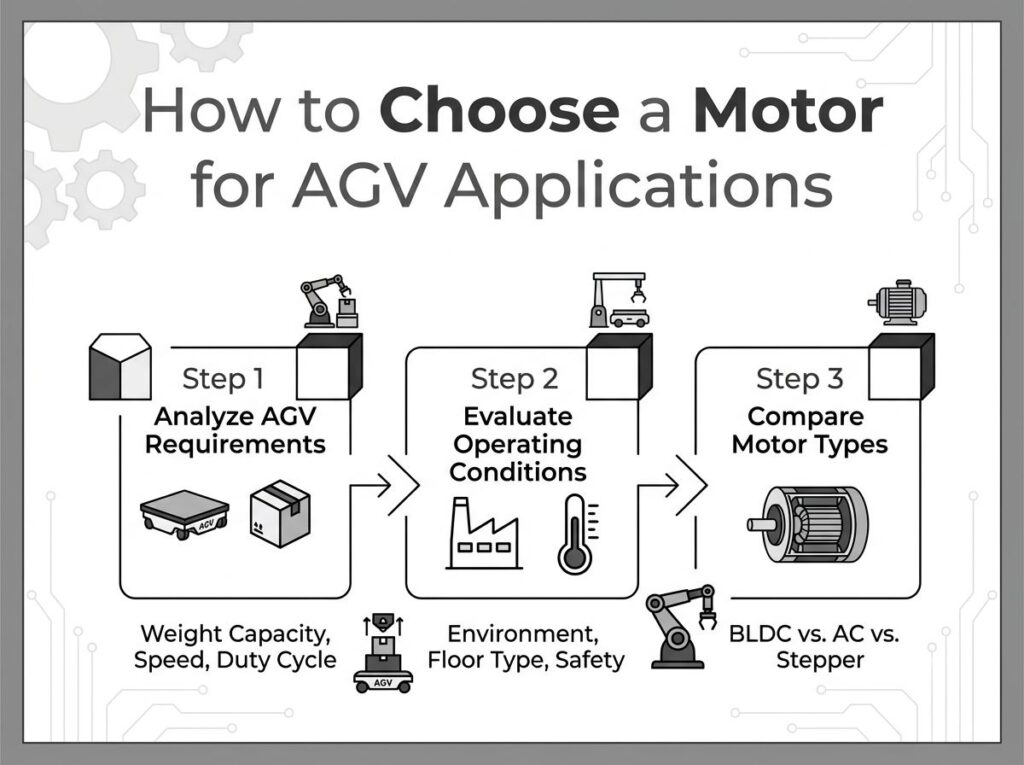
如何为 AGV 应用选择电机: 完整的选择指南 - 类型, 扭矩计算 & 规格
选择正确的 AGV用电机 (自动导引车) 系统是移动机器人中最重要的设计决策之一. 驱动电机直接决定牵引性能, 电池运行时间, 定位精度, 热行为, 和维护间隔——所有这些都会影响多年部署的总拥有成本.
本指南整合了全球 AGV/AMR 制造商使用的选择方法. 它涵盖了电机类型比较, 扭矩计算公式, 变速箱匹配, 基于负载的规模调整, 环境保护, 和控制器集成——使用工业电机平台的参考数据.
什么是AGV电机?
AGV电机是一种提供推进力的电动机, 转向, 自动导引车和自主移动机器人的升力和升力. 与依靠主电源以固定速度运行的工业电机不同, AGV 电机由电池电压供电 (通常为 24V 或 48V 直流), 必须处理频繁的启停循环, 并且需要闭环反馈来保证定位精度.
电机作为包括变速箱的集成驱动系统的一部分工作, 编码器, 制动, 和电机控制器. 每个组件必须与车辆的有效负载相匹配, 轮径, 目标速度, 坡度要求, 和运行环境. 不匹配的电机(即使是具有足够额定功率的电机)也会导致过热, 车轮打滑, 定位漂移, 或轴承过早失效.
AGV 电机的主要功能
| 功能 | 描述 | 电机要求 |
|---|---|---|
| 牵引力 / 驾驶 | 推动车辆前进, 落后, 和上坡 | 低转速下的高连续扭矩; 足够的峰值扭矩以加速 |
| 转向 | 通过差速或铰接转向控制方向 | 左/右电机之间精确的速度匹配; 响应式扭矩控制 |
| 起重 / 叉 | 升高和降低叉车 AGV 上的负载 | 高保持扭矩; 集成制动器确保断电安全 |
| 定位 | 以可重复的精度将车辆停在停靠站 | 闭环编码器反馈; 低速平稳性 |
AGV电机类型: 无刷直流, 伺服, 步进机, 和有刷直流
AGV驱动领域四大电机技术竞争. 每个都有不同的效率, 成本, 维护, 和控制特性,使其适合特定的有效负载类别和精度要求.
1. 无刷直流 (无刷直流) 电机——主导选择
BLDC 电机凭借其高效率的结合,已成为 AGV 和 AMR 的主流驱动解决方案 (85–92%), 使用寿命长 (10,000–20,000+小时), 和低噪音. 他们使用电子换向而不是机械电刷, 消除有刷电机中的主要磨损部件.
适用于 AGV 应用, BLDC 电机通常与行星齿轮箱配对,以倍增车轮扭矩. 集成 BLDC 行星齿轮电机(电机和变速箱作为一个单元提供)是 50-500 kg 有效负载范围的仓库 AMR 和物流 AGV 最常见的配置.
AGV 部署的主要优势:
- 电池效率: 85–92% 效率对比. 60有刷直流电 –75%, 直接延长每次充电的运行时间
- 免维护运行: 无需更换电刷; 轴承寿命是限制因素
- 低噪声: 48–55 dB(典型值), 适用于医院、办公环境
- 闭环控制: 与 FOC 霍尔传感器和编码器兼容 (磁场定向控制)
- 热管理: 较低的电阻损耗减少了封闭机箱中的热量产生
- 外形紧凑: 42mm高扭矩密度, 56毫米, 和 80mm 框架尺寸
BLDC 电机产品规格和配置, 看看我们的 BLDC 电机产品页面.
2. 直流伺服电机 — 适用于精密应用
直流伺服电机采用闭环控制,配合高分辨率编码器反馈,实现毫米级定位精度 (可重复误差 < ±0.1 mm,带 17 位绝对值编码器). 他们提供 300% 与标准 BLDC 电机相比,具有瞬时过载能力和卓越的动态响应.
伺服电机通常指定用于重载 AGV (>1 吨有效载荷), 高速精准对接 (≥2 m/s,停止精度 ±5 mm), 以及S曲线避障、多轴同步运动等复杂路径控制场景.
3. 步进电机 — 用于轻载精度
步进电机提供开环位置控制,无需编码器反馈, 使轻载 AGV 和 AGC 具有成本效益 (自动引导车) 定位精度要求适中的场合 (±1–5毫米). 它们在零速下提供高保持扭矩,并与步进驱动器简单集成.
然而, 步进器在较高速度下会迅速失去扭矩,并且在负载突然变化时容易失步. 闭环步进器变体 (带编码器反馈的混合步进器) 解决需要更高可靠性的应用的这些限制. 伺服和步进电机特性的详细比较, 看看我们的 伺服电机与步进电机指南.
4. 有刷直流电机 — 传统选项
有刷直流电机因其简单的两线控制和较低的前期成本而继续用于低成本 AGV 平台 (30–比 BLDC 便宜 50%). 它们提供高启动扭矩并对 PWM 速度控制做出良好响应.
权衡是重要的: 电刷磨损将使用寿命限制为 2,000–5,000 小时, 效率为 60–75%, 电刷电弧产生电噪声和声噪声. 适用于多班制 AGV 车队, 更换电刷的维护成本很快就超过了最初节省的费用.
电机类型对照表
| 范围 | 无刷直流电机 | 直流伺服电机 | 步进电机 | 有刷直流电机 |
|---|---|---|---|---|
| 效率 | 85–92% | 90–95% | 70–80% | 60–75% |
| 使用寿命 (小时) | 10,000–20,000+ | 10,000–20,000+ | 10,000+ | 2,000–5,000 |
| 定位精度 | ±0.5–2毫米 (带编码器) | ±0.1毫米 | ±1–5毫米 (开环) | ±5–10 毫米 |
| 速度范围 | 宽的 (0–6,000+ 转速) | 很宽 (0–10,000+ RPM) | 狭窄的 (扭矩下降至以上 1,000 转速) | 宽的 (0–5,000 转/分) |
| 噪音水平 | 48–55 分贝 | 50–60 分贝 | 55–65 分贝 | 60–70 分贝 |
| 成本 (相对的) | 中等的 | 高的 | 低-中 | 低的 |
| 维护 | 没有任何 (轴承限制) | 没有任何 (轴承限制) | 没有任何 | 更换电刷 |
| 过载能力 | 150–200% | 300% | 不推荐 | 200–300% |
| 典型电压 | 24五 / 48五 | 48五 / 72五 | 12五 / 24五 | 24五 / 48五 |
| 最佳AGV应用 | 仓库AMR, 物流AGV (50–500公斤) | 叉车AGV, 重载 (>1 吨) | 自动增益控制, 轻型车 (<100 千克) | 低成本平台, 遗留系统 |
AGV驱动电机的扭矩计算
扭矩计算是AGV电机选型的基础. 根据目录数据估算扭矩而不计算实际轮侧要求会导致电机尺寸过小 (过热, 摊位) 或超大电机 (浪费电池容量, 成本较高).
车轮扭矩公式
每个驱动轮所需的扭矩是滚动阻力扭矩和加速扭矩之和:
时间车轮 = (米×克×μ×r) + (米×a×r)
| 象征 | 范围 | 典型值 | 单元 |
|---|---|---|---|
| 米 | 总质量 (车辆 + 最大有效负载) | 50–2,000 | 千克 |
| 克 | 重力加速度 | 9.81 | 米/秒² |
| 米 | 滚动摩擦系数 | 0.01–0.03 (光滑的地板) | 无量纲 |
| r | 车轮半径 | 0.05–0.15 | 米 |
| 一个 | 目标加速度 | 0.3–1.0 | 米/秒² |
工作示例: 150 公斤仓库AMR
对于一个 150 公斤 AMR 与 75 毫米车轮半径 (150 毫米直径), 仓库地面光滑 (米= 0.02), 和 0.5 米/秒²加速度:
- 滚动阻力矩: 150 × 9.81 × 0.02 × 0.075 = 2.21 牛顿·米
- 加速扭矩: 150 × 0.5 × 0.075 = 5.63 牛顿·米
- 车轮总扭矩 (两个轮子): 7.84 牛顿·米
- 每台电机 (双驱动): 3.92 牛顿·米
- 安全系数1.5~2.0×: 5.9每个电机 –7.8 N·m
不同操作场景的扭矩要求
AGV 驱动电机根据所执行的操作面临不同的扭矩需求. 来自汽车制造物流应用的数据显示了两轮差速 AGV 的以下模式:
| 设想 | 扭矩需求 | 关键考虑因素 |
|---|---|---|
| 直线行程 | ~30 牛·米 (例子: 重型AGV) | 一致的扭矩来克服摩擦; 恒速稳定性 |
| 圆弧车削 | 36.8 牛顿·米 / 9.9 牛顿·米 (内/外轮) | 负载分布不均匀; 需要独立的每轮扭矩控制 |
| 零转向 (枢) | 每个车轮 ~16.2 N·m | 高电阻; 电机必须克服轮胎擦洗扭矩 |
| 爬坡 (5°) | 1.5–2× 平地扭矩 | 必须验证持续爬升的热裕度 |
| 紧急制动 | 峰值再生扭矩 | 制动电阻或再生电容必须吸收能量 |
将 1.5–2.0× 的安全系数应用于计算扭矩,以解决地板不规则问题, 车轮磨损, 有效载荷分布不对称, 和瞬态加速度峰值. 用于爬坡 AGV, 验证电机能够在预期的爬升持续时间内承受较高的扭矩而不超过其热极限.
电压和功率规格
AGV 电机采用直流电池供电, 24V 和 48V 是主要电压平台. 电压的选择会影响电机电流消耗, 接线规, 控制器尺寸, 和电池配置.
电压平台比较
| 范围 | 24V系统 | 48V系统 |
|---|---|---|
| 典型有效载荷 | 50–300公斤 | 300–2,000+ 公斤 |
| 电机功率范围 | 50-400W | 400W–2kW+ |
| 额定功率下的电流 (例子) | 400W 时 ~17A | 800W 时 ~17A |
| 接线规 | 10–12 AWG | 14–16 AWG |
| 电池配置 | 2S 磷酸铁锂₄ / 12带锂离子电池 | 4S 磷酸铁锂₄ / 24带锂离子电池 |
| 安全等级 | 自己 (安全超低电压) | 接近 ELV 极限 |
| 最适合 | 紧凑型 AMR, 光AGC | 叉车 AGV, 重型平台 AGV |
按负载等级调整功率大小
| 有效负载等级 | 推荐电机功率 | 电压 | 电机机座尺寸 |
|---|---|---|---|
| 光 (< 300 千克) | 150-400W | 24五 | 42毫米无刷直流电机 |
| 中等的 (300–800公斤) | 400瓦–1kW | 48五 | 56毫米无刷直流电机 |
| 重的 (800–1,500 公斤) | 1–1.5kW | 48五 | 80mm BLDC 或伺服 |
| 很重 (> 1,500 千克) | ≥1.5kW伺服 | 48五 / 72五 | 带行星齿轮箱的伺服 |
确定电机功率时, 验证电机的连续额定扭矩 (不仅仅是峰值扭矩) 超过占空比内计算出的 RMS 扭矩. 峰值扭矩涵盖加速瞬变; 连续扭矩决定了电机是否能够在不热停机的情况下持续运行.
AGV 电机齿轮箱选型
变速箱倍增电机扭矩并降低输出速度以满足车轮转速要求. 对于电机旋转 3,000 RPM 和车轮需要 100 转速, 一个 30:1 需要减速比. 变速箱类型直接影响扭矩密度, 反弹, 噪音, 和成本.
AGV 应用的齿轮箱类型比较
| 范围 | 行星齿轮箱 | 正齿轮箱 | 谐波传动 |
|---|---|---|---|
| 扭矩密度 | 高的 | 低-中 | 非常高 |
| 间隙 | 5–15 弧分 | 15–30 弧分 | < 1 弧分 |
| 噪音水平 | 低的 (斜齿轮) | 更高 (直牙) | 很低 |
| 效率 | 90–95% | 92–96% | 80–85% |
| 成本 (相对的) | 1× | 0.5–0.8× | 4–6× |
| 使用寿命 | 10,000–20,000 小时 | 5,000–10,000 小时 | 8,000–15,000 小时 |
| 典型比率范围 | 3:1 – 100:1 | 3:1 – 50:1 | 50:1 – 300:1 |
| 最佳 AGV 适配 | 轮驱动 (所有有效负载类别) | 低成本AGC, 轻型推车 | 转向, 举起 (很少用于牵引) |
适用于 AGV 轮驱动应用, 行星齿轮箱提供扭矩密度的最佳平衡, 耐用性, 和成本. 5-15 弧分的齿隙足以提供牵引力 - 当车轮本身的轮胎变形达到几毫米时,亚弧分的精度是不必要的. 更深入地比较正齿轮与行星齿轮电机的特性, 看看我们的 正齿轮电机与行星齿轮电机分析.
AGV 应用的常见齿轮比
| AGV类型 | 轮速 (转速) | 电机转速 (转速) | 齿轮比 |
|---|---|---|---|
| 紧凑型AMR (1–2 米/秒) | 120–250 | 3,000–4,000 | 15:1 – 25:1 |
| 仓储AGV (1.5–2 米/秒) | 150–300 | 3,000 | 10:1 – 20:1 |
| 叉车AGV (0.5–1.5 m/s) | 60–180 | 2,500–3,000 | 15:1 – 40:1 |
| 重型AGV (0.3–0.8 m/s) | 40–100 | 2,000–3,000 | 20:1 – 50:1 |
适用于与 AGV 驱动系统兼容的变速箱产品选项, 看看我们的 变速箱产品页面.
按有效负载等级划分的电机选型
AGV电机规格应根据车辆总质量选择 (机壳 + 电池 + 最大有效负载). 以下矩阵提供了电机选择的起点, 具有取决于驱动器布局的特定配置 (2WD 与 4WD), 地板条件, 和坡度要求.
AGV电机选型矩阵
| 有效载荷 | 电机类型 | 车架尺寸 | 变速箱 | 电压 | 大约. 扭矩/电机 | 典型速度 |
|---|---|---|---|---|---|---|
| 50–150公斤 | BLDC 行星式 | 42毫米 | 精密行星轮 (螺旋状的) | 24五 | 3–6 牛·米 | 1.0–2.0 米/秒 |
| 100–300公斤 | BLDC 行星式 | 56毫米 | 重型行星轮 | 24五 / 48五 | 6–15牛·米 | 1.0–2.0 米/秒 |
| 300–500公斤 | BLDC 行星式 | 56–80毫米 | 工业行星 | 48五 | 15–30牛·米 | 0.8–1.5 m/s |
| 500–1,000 公斤 | BLDC 或伺服 | 80毫米+ | 工业行星 | 48五 | 30–60 牛·米 | 0.5–1.2 m/s |
| 1,000–2,000 公斤 | 直流伺服 | 伺服框架 | 行星式 + 中心 | 48五 | 60–120牛·米 | 0.3–1.0 米/秒 |
| > 2,000 千克 | 直流伺服 (双重的) | 大型伺服 | 轮毂变速箱 | 48五 / 72五 | >100 牛顿·米 | 0.3–0.8 m/s |
笔记: 有效负载范围重叠,因为正确的选择取决于驱动器配置 (从动轮数量), 地板摩擦系数, 最大倾斜角, 和占空比. 4WD 配置将扭矩分配给四个电机, 对于相同的有效负载,允许更小的单个电机尺寸.
适用于针对特定 AGV 平台定制的定制电机配置, 看看我们的 定制电动机服务.
环保与噪音
IP等级要求
| 防护等级 | 防护等级 | 推荐AGV环境 |
|---|---|---|
| IP44 | 固体物体 > 1毫米; 无防水保护 | 干净的, 仅限干燥的室内环境 (不推荐用于生产) |
| IP54 | 防尘; 溅水 | 室内仓库 AGV 的最低要求 |
| IP65 | 防尘; 水射流 | 推荐用于任何部署的 AGV > 12 真实环境中的几个月 |
| IP66+ | 防尘; 强大的水射流 | 冲洗环境 (食物, 制药公司, 户外的) |
正确的密封可解决 AGV 服务中两种最常见的 BLDC 电机故障模式: 轴承污染和绕组腐蚀. 适用于在食品加工或制药环境中运行的 AGV, 除了 IP66+ 密封之外,可能还需要不锈钢外壳和食品级润滑脂.
噪音要求
| 应用环境 | 最大噪音水平 | 装备要求 |
|---|---|---|
| 医院 / 办公室走廊 | < 55 分贝(一个) @1m | 螺旋行星 + 磨齿齿轮 |
| 仓库 / 物流中心 | < 65 分贝(一个) | 标准行星式 (可以接受) |
| 户外的 / 重工业 | < 75 分贝(一个) | 噪音很少成为限制因素 |
最有效的降噪方法是使用螺旋 (有角度的) 齿轮代替直齿 (支线) 牙齿. 与粉末金属齿轮相比,磨削齿轮齿形进一步降低了 3–5 dB 的噪音.
制动, 编码器, 和控制器集成
AGV 电机不是孤立运行的——它必须与制动器集成 (用于安全保持), 编码器 (反馈), 和一个电机控制器 (用于换向和运动控制). 这些组件之间的不匹配是 AGV 性能问题的常见根源.
制动要求
| 刹车功能 | 要求 | 需要时 |
|---|---|---|
| 停车等待 | 关闭电源时保持车辆静止 | 所有 AGV (安全要求) |
| 紧急停止 | 参与其中 < 100急停信号毫秒 | 所有 AGV (安全标准) |
| 斜坡保持 | 无需电源即可在斜坡上保持位置 | AGV 在坡道或斜坡上运行 |
| 断电安全 | 故障安全 (断电时制动) | 所有具有提升或斜坡操作功能的 AGV |
编码器和反馈选项
| 反馈类型 | 解决 | AGV 用例 |
|---|---|---|
| 霍尔传感器 | 60–120 脉冲/转 (仅换向) | 基本速度控制, 低成本AGC |
| 增量式编码器 | 1,000–10,000 脉冲/转 | 标准AGV速度/位置控制 |
| 绝对编码器 (单匝) | 17–23位 | 精准定位, 对接 |
| 绝对编码器 (多圈) | 17–23位 + 12–16 圈 | 连续位置跟踪,无需归位 |
控制器通信协议
AGV 电机控制器必须与车辆的中央控制系统接口. 常见的通信协议包括:
| 协议 | 使用案例 | AGV 适用性 |
|---|---|---|
| CANopen | 多轴协调, 车队管理 | AGV/AMR 行业标准 |
| Modbus RTU | 简单的速度/扭矩命令 | 基本AGV平台 |
| RS485 | 点对点电机控制 | 小型 AGV 车队 |
| EtherCAT | 高速同步多轴 | 先进的 AMR 平台 |
| 脉宽调制 / 模拟 | 直接速度/电压控制 | 遗留系统或简单系统 |
适用于与AGV驱动系统兼容的电机控制器产品, 看看我们的 电机控制器产品页面.
驱动器配置: 2西数, 4西数, 微分, 和枢纽
驱动电机的数量和位置影响扭矩分配, 转向方式, 和电机尺寸. 每种配置对电机选择都有不同的影响.
| 配置 | 电机数量 | 转向方式 | 每轮电机扭矩 | 最适合 |
|---|---|---|---|---|
| 差动驱动 (2西数 + 脚轮) | 2 | 左/右速度差 | 高的 (每个承载约 50% 的负载) | 紧凑型 AMR, 轻型AGV |
| 4WD 滑移转向 | 4 | 速度差 (滑移转向) | 低的 (每个承载约 25% 的负载) | 户外AGV, 重型平台 |
| 4西数 + 转向 | 4 驾驶 + 1 转向 | 铰接式转向电机 | 低的 (牵引力) + 转向电机 | 叉车 AGV, 精准对接 |
| 轮毂电机 (直接轮内) | 2–4 | 差速器或铰接式 | 直接车轮扭矩 (无变速箱) | 空间有限的紧凑型 AGV |
电机选择受配置的影响
在差动驱动配置中, 每个电机必须提供大约一半所需的总车轮扭矩. 在四轮驱动配置中, 每个电机提供大约四分之一的, 允许更小的框架尺寸. 然而, 4WD 系统需要电机之间更紧密的速度同步,以防止滑移转向期间车轮打滑.
轮毂电机配置通过将齿轮减速集成到轮毂内来消除外部变速箱. 这简化了机械布局,但使电机更换更加复杂. 直接驱动与变速箱方法的比较, 看看我们的 直驱电机与齿轮电机指南.
七步AGV电机选型框架
以下框架综合了 AGV 制造商和电机供应商的最佳实践,形成结构化的选择流程:
步 1: 定义车辆参数
记录总质量 (机壳 + 电池 + 最大有效负载), 轮径, 驱动轮数量, 目标速度, 和最大倾斜角度. 这些参数是后续所有计算的输入.
步 2: 计算所需的车轮扭矩
应用扭矩公式: 时间车轮 = (米×克×μ×r) + (米×a×r). 应用 1.5–2.0× 的安全系数来考虑现实条件. 除以驱动轮数量即可得到每个电机的扭矩.
步 3: 选择电机类型
大多数仓库/物流 AGV 选择 BLDC (50–500公斤). 选择重载伺服 (>1 吨) 或精准对接 (±0.1毫米). 考虑将步进器用于轻型 AGC (<100 千克) 具有中等精度需求. 请参阅 电机类型部分 多于.
步 4: 确定电压平台
对于以下负载使用 24V 300 千克. 上述负载使用 48V 300 kg或24V电机电流连续超过20A时. 验证电池配置支持所选电压.
步 5: 选择变速箱和传动比
计算所需的齿轮比: 电机转速 ÷ 所需车轮转速. 选择用于 AGV 牵引的行星齿轮箱 (最佳扭矩密度和噪音). 验证变速箱连续扭矩额定值超过计算的车轮扭矩.
步 6: 明确环境保护
室内仓库最低 IP54. 建议任何 AGV 采用 IP65 等级 >12 月部署. IP66+ 适用于冲洗环境. 为噪声敏感应用选择斜齿轮.
步 7: 集成刹车, 编码器, 和控制器
指定驻车/紧急/坡道保持电磁制动器. 根据定位精度要求选择编码器分辨率. 控制器通讯协议与AGV中央控制系统匹配 (CANopen, MODBUS, EtherCAT).
| 步 | 关键输出 | 常见错误 |
|---|---|---|
| 1. 车辆参数 | 总质量, 车轮尺寸, 速度, 坡 | 忘记总质量中的电池重量 |
| 2. 扭矩计算 | 每台电机所需 N·m (有安全系数) | 使用峰值扭矩代替 RMS 进行连续工作 |
| 3. 电机类型 | 无刷直流 / 伺服 / 步进器 / 拉丝的 | 简单运输 AGV 的超规格伺服系统 |
| 4. 电压 | 24电压或48V | 为重负载选择 24V, 造成电流过大 |
| 5. 变速箱 | 类型, 比率, 额定扭矩 | 扭矩计算中忽略变速箱效率 |
| 6. 环境的 | 防护等级, 噪音等级 | 为有地板清洗的环境指定 IP54 |
| 7. 一体化 | 制动, 编码器, 控制器规格 | 控制器协议与 AGV 系统不匹配 |
总拥有成本分析
价格最低的电机很少是 AGV 部署生命周期内成本最低的电机. TCO 分析应考虑四个成本类别:
| 成本类别 | 无刷直流行星齿轮电机 | 有刷直流电机 | 影响 |
|---|---|---|---|
| 初始采购 | 更高 (1.3–2×拉丝) | 较低的基线 | BLDC 前期成本更高 |
| 能源成本 (电池充电) | 20% 降低 (90% 与 75% 效率) | 更高的消费 | 多年部署的化合物 |
| 维护费用 | 接近于零 (4–8年单班制) | 每 2,000–5,000 小时更换一次电刷 | 劳动 + 刷子服务停机 |
| 停机成本 | 降低 (更长的平均无故障时间) | 更高 (更频繁的故障) | 舰队 50+ AGV: $200–$500/小时计划外停机 |
对于一支舰队 50 AGV 运行 24/7, 与有刷直流替代品相比,投资更高质量的 BLDC 行星齿轮电机通常可以在 5 年部署期内降低 30-50% 的总拥有成本. 仅节能一项—— 90% 与. 75% 效率——可以在前 12-18 个月内抵消较高的初始采购成本.
用于支持长寿命 AGV 部署的电机测试和质量验证流程, 看看我们的 电动机测试标准 页.
针对特定应用的电机建议
仓库AMR (50–200公斤)
| 范围 | 推荐 |
|---|---|
| 电机类型 | 带集成行星齿轮箱的 BLDC |
| 框架尺寸 | 42毫米 |
| 电压 | 24五 |
| 齿轮比 | 15:1 – 25:1 |
| 反馈 | 增量式编码器 + 霍尔传感器 |
| 防护等级 | IP65 |
| 制动 | 电磁, 24五 |
| 噪声目标 | < 55 分贝(一个) @1m |
叉车AGV (500–1,500 公斤)
| 范围 | 推荐 |
|---|---|
| 电机类型 | 无刷直流 (牵引力) + 伺服 (提升/转向) |
| 框架尺寸 | 80毫米+ (牵引力); 伺服框架 (举起) |
| 电压 | 48五 |
| 齿轮比 | 20:1 – 40:1 (牵引力); 50:1+ (举起) |
| 反馈 | 绝对编码器 (多圈) |
| 防护等级 | IP65 |
| 制动 | 双刹车 (保持 + 紧急情况) |
重型平台AGV (> 1,500 千克)
| 范围 | 推荐 |
|---|---|
| 电机类型 | 带工业行星齿轮箱的直流伺服 |
| 配置 | 4WD 或双轮毂电机 |
| 电压 | 48五 / 72五 |
| 齿轮比 | 30:1 – 50:1 |
| 反馈 | 17-位绝对编码器 |
| 防护等级 | IP66 |
| 控制器 | CANopen / EtherCAT |
光自动增益控制 / 大车 (< 100 千克)
| 范围 | 推荐 |
|---|---|
| 电机类型 | 步进或小型 BLDC |
| 电压 | 12五 / 24五 |
| 齿轮比 | 10:1 – 20:1 |
| 反馈 | 霍尔传感器 (无刷直流) 或开环 (步进器) |
| 防护等级 | IP44 (室内洁净环境) |
| 制动 | 选修的 (仅低坡度) |
适用于使用步进电机的轻型 AGC 应用, 看看我们的 步进电机产品页面. AGV 与 AMR 平台差异背景下的电机比较, 看看我们的 AGV 与 AMR 指南.
常见问题解答
AGV用什么电压的电机?
最常见的 AGV 电机电压为 24V 和 48V DC. 24V 系统用于紧凑型 AMR 和轻型 AGV (50–300 公斤有效负载), 而 48V 系统是中型到重型 AGV 的标准配置 (300–2,000+ 公斤). 12V 有时用于非常轻型的 AGC, 和 72V 适用于超重型工业 AGV. 电压选择由电池平台驱动并影响电机电流消耗, 接线要求, 和控制器尺寸.
AGV电机需要多大扭矩?
AGV 电机扭矩取决于车辆总质量, 车轮半径, 滚动摩擦, 目标加速度, 和倾斜角度. 对于一个 150 kg AMR,车轮半径为 75mm,可在光滑地板上行驶 (μ=0.02) 和 0.5 米/秒²加速度, 计算出的车轮扭矩约为 7.8 总牛顿·米 (3.9 双驱动每电机 N·m). 安全系数为 1.5–2.0 倍, 设计目标为每台电机 5.9–7.8 N·m. 重型 AGV (>1 吨) 每个电机可能需要 30–120 N·m,具体取决于配置.
AGV 的 BLDC 或伺服电机 — 哪个更好?
由于效率平衡,BLDC 电机是 50-500 kg 有效负载范围内大多数 AGV 和 AMR 应用的首选, 成本, 和免维护运行. 伺服电机更适合重载 AGV (>1 吨), 需要 ±0.1 mm 定位精度的应用, 或需要频繁进行高动态机动的场景 300% 过载能力. 适用于标准仓储物流, 配备行星齿轮箱和编码器反馈的 BLDC 以较低的成本提供足够的性能.
AGV电机采用什么齿轮比?
常见的 AGV 变速箱速比范围为 10:1 至 50:1, 和 15:1–25:1 典型的仓库 AMR. 该比率的计算方式为电机转速 ÷ 所需车轮转速. 例如, 电机运行在 3,000 车轮需要的转速 150 RPM 需要 20:1 比率. 行星齿轮箱因其高扭矩密度而成为 AGV 牵引的标准选择, 低间隙 (5–15 弧分), 和低噪音.
AGV电机的使用寿命是多长?
精心设计的 BLDC 行星齿轮电机配有 IP65 密封和优质轴承,在首次维护前通常可持续运行 10,000–20,000 小时. 这相当于 4-8 年的单班运行或 2-4 年的 24/7 连续运行. 有刷直流电机在需要更换电刷之前可持续运行 2,000–5,000 小时. AGV 服务中 BLDC 电机最常见的故障模式是轴承污染和绕组腐蚀——这两种故障都可以通过适当的密封来解决.
步进电机可以用于AGV吗?
步进电机可用于轻型 AGV 和 AGC (< 100 公斤有效负载) 定位精度要求适中的场合 (±1–5毫米) 并且速度低. 它们具有成本优势和简单的集成. 然而, 步进器在较高速度下会失去扭矩, 在负载突然变化的情况下容易出现失步的情况, 不适合重负载或连续运行. 闭环 (杂交种) 带有编码器反馈的步进器解决了其中一些限制.
参考
- 旋转电机. “如何为 AMR 和 AGV 机器人选择合适的 BLDC 齿轮电机。” 可用于: https://www.twirlmotor.com/how-to-select-the-right-bldc-gear-motor-for-amr-and-agv-robots/
- DMK电机 (贝乌德米克). “适用于 AMR/AGV 的高性能 AGV 电机。” 可用于: https://www.dmkmotor.com/agv-motor/
- X-TEAM 无刷直流电机. “如何为 AGV 选择合适的 BLDC 电机?” 可用于: https://www.x-teamrc.com/how-to-choose-a-suitable-bldc-motor-for-agv/
- 港电机器人 (AGV汽车网). “适用于 AGV/AMR 应用的 AGV 电机。” 可用于: https://agvmotor.com/blogs/knowledge/agv-motor-for-agv-amr-applications
- MyTen科技. “AGV的动力心脏: 电机选型指南及核心技术分析。” 可用于: https://myten-tech.com/news/components-introduction-and-selection/agvs-power-heart-motor-selection-guide-and-core-technology-analysis/
- 东方汽车. “AGV — 自动引导车辆选型工具。” 可用于: https://www.orientalmotor.com/motor-sizing/agv-sizing.html
- 日出电机. “BLDC 电机指南: 从 AGV 发电站到医疗精度。” 可用于: https://www.sunrisemotor-cn.com/The-Guide-to-BLDC-Motors:-From-AGV-Powerhouses-to-Medical-Precision.html
- 邓克发动机. “AGV/AMV/AMR 齿轮电机。” 可用于: https://www.dunkermotoren.com/en/industries/warehouse-automation/agv-gear-motor
- YIKONG (双向控制). “AGV驱动电机的扭矩计算与优化: 在汽车制造中实现灵活的物流。” 可用于: https://en.bicontrols.com/news_detail/50.html
- 日本电产电机株式会社. “AGV 电机 — 可靠且坚固的 AGV/AMR 电机平台。” 可用于: https://moen.nidec.com/automation/Products/AGV-Solutions/AGV-Motors