
Metal or plastic fan for electric motor?
Start with the cooling requirement, then choose the material. A shaft-mounted fan moves air across the frame fins so the motor can dissipate heat and keep winding temperature within its insulation class. The choice depends on three conditions: the temperature of the air entering the fan, its operating speed, and the chemicals or moisture present at the site.
Quick Answer
For a standard totally enclosed motor rated up to about 55 kW, operating at 40 °C ambient on a fixed supply, glass-filled polyamide or PBT is the usual starting point. These moulded fans are generally quieter and better balanced than stamped steel. Metal fans suit three cases: air above roughly 120 °C, frames too large for a moulded impeller, or sites where creep or embrittlement could limit service life. The examples include large 2-pole machines, hot process areas and long service intervals. Aluminium is selected for balance, steel for cost and stainless steel for chemical resistance. First size the fan for the required airflow; an undersized fan can overheat the motor regardless of material.
- What the fan does
- Temperature at the fan
- Plastic fans: polymers and operating limits
- Metal fans: iron, aluminium and stainless steel
- Speed and the fan laws
- Noise: blade-passing frequency and material
- Breakage, cowls and ignition risk
- Corrosion, UV and moisture
- The flywheel fan
- Tooling and volume
- Replacing a fan correctly
- Six common mistakes
- References
- FAQ
What the fan does
A totally enclosed fan-cooled motor releases its losses through the frame into the surrounding air. The fan keeps air moving across the frame so the temperature difference can carry heat away. Without the fan, the same motor may lose roughly a third of its continuous output because natural convection over the fins removes much less heat than forced convection.
The external fan on a standard TEFC motor uses about 1 to 3 percent of rated output. For a 7.5 kW motor, that is 75 to 225 W of shaft power for cooling, which is then transferred to the airstream as heat. Designers may overlook this load; during a failure investigation, its effect on cooling is harder to ignore.
It is a wear part
A fan runs continuously and is usually one of the least expensive components on the shaft. It can be damaged if the motor is dropped, stored on its cowl or run with a blocked guard. When the fan is treated as trim, it may be replaced with whatever is on hand. A mismatched replacement can leave the repaired motor running 15 K hotter than before.
The cowl is part of the cooling system
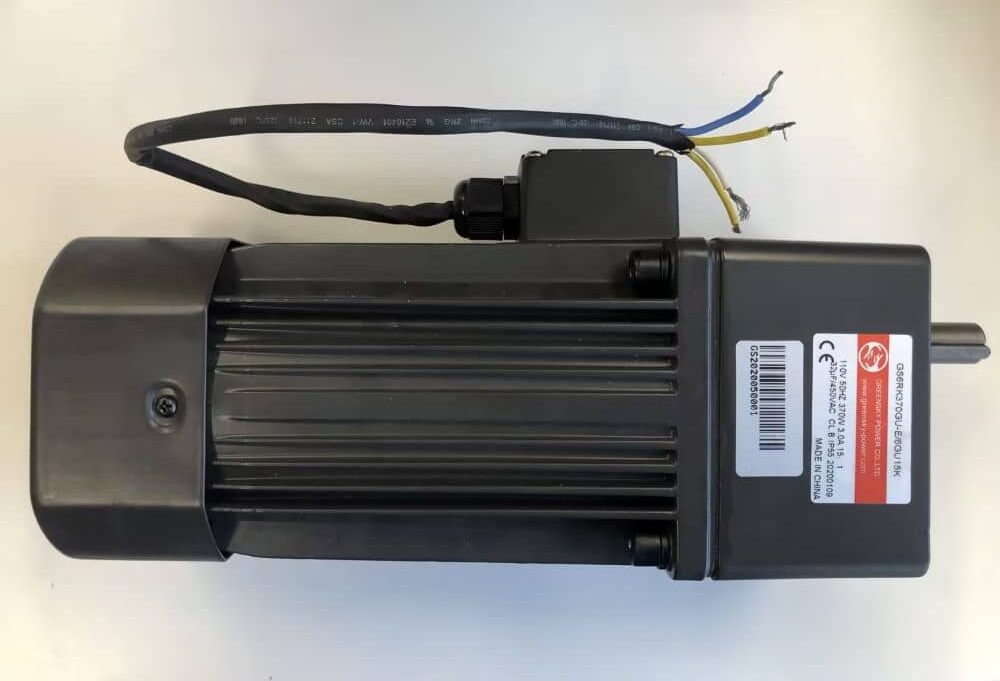
This is the baseline cooling arrangement for a general purpose motor. Check the rating conditions before changing any part of the cooling circuit.
The impeller and cowl work as one aerodynamic unit. Tip clearance, the inlet bellmouth and the outlet area all affect airflow. A fan without its cowl, or with the wrong cowl, can lose much of its pressure. Changing either the impeller or cowl without checking the other changes the motor’s cooling performance and may affect its thermal rating.
A field check does not require an anemometer. Run the motor at rated load until the frame temperature stabilises, record the rise above ambient and compare it with the manufacturer’s figure. A rise 15 to 20 K above expectation points to the cooling circuit, for example a missing or distorted cowl, a fan fitted backwards or an impeller that has crept. Measurements before and after a fan change show whether the replacement improved cooling.
Temperature at the fan
The external fan on a TEFC motor sits outside the frame and draws air from the room, so its inlet temperature is close to ambient. Heat from the winding has already passed through the frame before the fan removes it; the fan does not contact the winding.
The fan is exposed to ambient air, radiant heat from the frame, which may be at 70 to 90 °C, and centrifugal loading. These conditions affect material selection. A motor in a 25 °C machine shop and the same motor in a 55 °C plant room may need different fan specifications, even though the nameplate does not distinguish between those sites.
The nameplate identifies the cooling method, not the fan material. A designation such as IC 411 means frame-surface cooling with a shaft-mounted fan; IC 416 means a separately driven fan. The letters after IC describe the cooling circuit. They do not specify the material. The other nameplate fields are explained in how to read a motor nameplate.
Plastic fans: polymers and operating limits
Plastic impellers are common below roughly 55 kW. Injection moulding can produce smooth, repeatable and well-balanced blades at low unit cost. Polymer also damps vibration instead of transmitting it to the bearing housing. The specific polymer matters; “plastic” covers materials with different properties.
| Polymer | Typical continuous service | Strengths | Where it fails |
|---|---|---|---|
| PP, polypropylene | 90–100 °C | Cheapest, good chemical resistance, tough | Creeps under load when warm; UV embrittlement unless stabilised |
| PA66-GF30, glass-filled polyamide | 105–120 °C | Stiff, impact resistant, the usual motor fan grade | Absorbs moisture and swells; hydrolyses in hot humid air |
| PBT, polybutylene terephthalate | 120–140 °C | Dimensionally stable, low moisture uptake, good at temperature | More brittle on impact; higher cost |
| PPS, polyphenylene sulfide | 180–200 °C | For high-temperature and oven-duty motors | Cost, and tooling wear from the filled compound |
Creep in thermoplastics
A common complaint is that a fan “loses its wind” after a couple of years and deforms again soon after being bent back. This is creep. Under continuous centrifugal load and elevated temperature, a thermoplastic can take a permanent set. The blades flatten, their effective angle decreases and airflow drops. Bending the blades back does not restore the material’s modulus, so any improvement may last weeks rather than years.
Creep depends on both stress and temperature, and it accelerates in hot conditions. This can give a plastic fan a shorter service life than a metal fan on the same machine. The issue is whether the polymer can maintain its shape at the operating temperature over time.
Metal fans: iron, aluminium and stainless steel
Metal fans are used when temperature, inertia, size or site conditions exceed the limits of a polymer design. Steel, aluminium, cast iron and stainless steel each have different failure modes, which matter alongside expected service life.
| Material | Made by | Best for | Failure mode |
|---|---|---|---|
| Stamped steel | Press tool, blades welded or riveted to a hub | Low cost, high volume, moderate temperature | Fatigue crack at the blade-to-hub joint; corrosion if uncoated |
| Die-cast aluminium | Die casting, machined bore | Good balance, light, large diameters | Pitting in chloride or alkaline air; sparking if it rubs steel |
| Cast iron | Sand casting | Large frames, hot and dirty duty | Mass and cost; brittle if struck |
| Stainless steel | Pressed or fabricated, welded | Chemical, coastal, food and washdown | Cost; weld decay if the grade is wrong |
Common metal fan fracture points
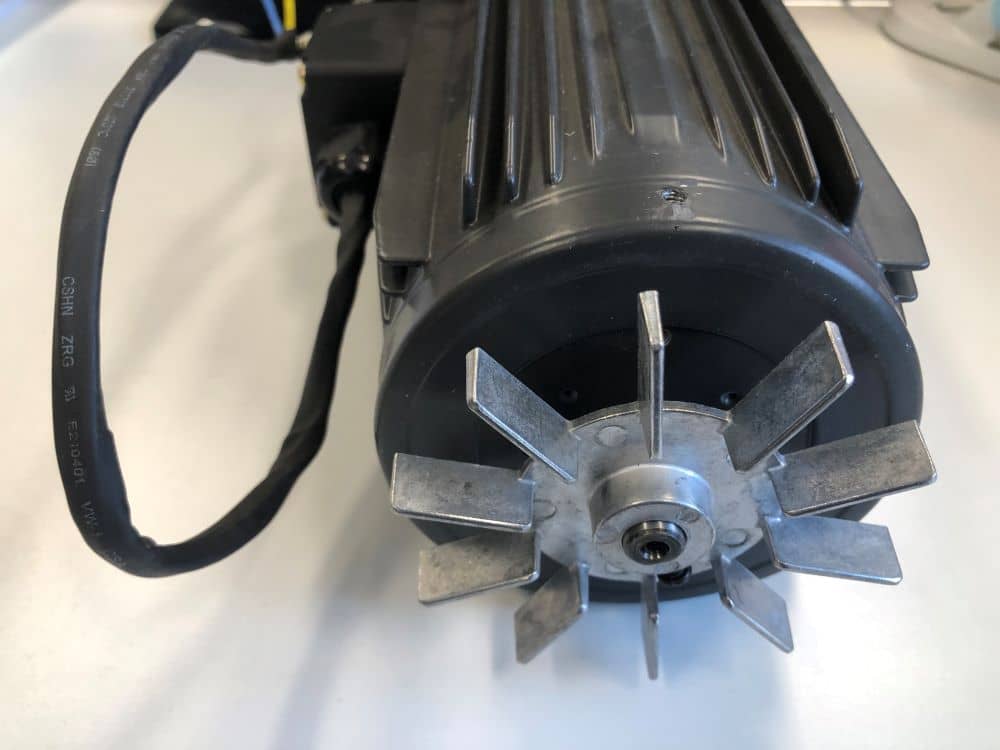
In stamped and welded impellers, cracks tend to start at the blade-to-hub joint, where stress is concentrated. Repeated starts and stops, imbalance after a blade is bent, or poor weld penetration can initiate a crack. It may grow unnoticed until the blade separates at speed.
Fan material and guarding need to be considered together. A 15 g fragment leaving a 200 mm fan at 2,900 rpm travels at about 30 m/s and carries roughly 7 J. That can injure an eye, particularly if the cowl has been removed during maintenance.
Speed and the fan laws
Under the fan laws, airflow varies with speed, pressure with speed squared, and power with speed cubed. These relationships explain why a cooling problem may come from fan speed rather than material.
| Speed relative to rated | Airflow | Pressure | Fan power |
|---|---|---|---|
| 100% | 100% | 100% | 100% |
| 75% | 75% | 56% | 42% |
| 50% | 50% | 25% | 12.5% |
| 25% | 25% | 6% | 1.6% |
The fan-law estimates show the cooling trade-off when a standard motor runs slowly on a drive. At half speed, the fan moves half the air at a quarter of the pressure and uses one-eighth of the power, while losses at constant torque remain unchanged. Winding temperature can rise as cooling falls. Deep turn-down may therefore require a separately ventilated motor, rather than a different impeller.
Speed also determines the mechanical load on the fan. Tip speed is π × diameter × rpm ÷ 60. A 200 mm fan at 2,900 rpm runs at about 30 m/s; at 1,450 rpm, the same fan runs at about 15 m/s. Centrifugal stress at the blade root rises with the square of tip speed, so the 2-pole version carries four times the stress of the 4-pole version. This is why large 2-pole machines often use aluminium or steel, while smaller 4-pole machines use plastic.
Fan operating point
A fan does not deliver one fixed airflow. Its operating point is where the fan curve meets the system resistance curve. The cowl, fin passages and frame surface all contribute to that resistance. A crushed cowl, blocked guard or rag at the inlet raises resistance and moves the operating point down the fan curve, reducing airflow even though fan speed stays the same.
A larger impeller does not automatically provide more cooling. Its diameter raises pressure and power, but greater clearance to the cowl can increase recirculation around the blade tips and reduce the gain. Tip clearance is especially sensitive in a small axial fan. An impeller sitting 3 mm farther out on the shaft than specified can lose a meaningful amount of airflow without looking obviously wrong.
The comparison between a normal motor and one built for a drive is set out in VFD motor versus normal motor, and the control behaviour that produces these speeds in how a variable-speed motor works.
Noise: blade-passing frequency and material
Fan noise is strongly affected by blade-passing frequency and tip speed. Blade-passing frequency is the number of blades multiplied by revolutions per second. It produces the tonal sound often described as motor “whine”.
| Fan | Blades | Speed | Blade passing frequency | Tip speed |
|---|---|---|---|---|
| 200 mm, 4-pole | 7 | 1,450 rpm | 169 Hz | 15.2 m/s |
| 200 mm, 2-pole | 7 | 2,900 rpm | 338 Hz | 30.4 m/s |
| 240 mm, 2-pole 60 Hz | 9 | 3,500 rpm | 525 Hz | 44.0 m/s |
| 240 mm, 4-pole | 11 | 1,450 rpm | 266 Hz | 18.2 m/s |
Fan sound power scales roughly with the sixth power of tip speed. On that basis, halving tip speed reduces sound level by about 18 dB. This relationship helps explain why a 2-pole machine can be 10 to 15 dB louder than a 4-pole motor of the same output. Changing fan material alone is unlikely to close that gap; speed and blade count are the main variables to consider for a quieter motor.
Blade shape and count
Flat radial blades are common in small motors because pressed sheet is inexpensive and produces pressure well. Their abrupt wakes also make them one of the noisier common geometries. Backward-curved and aerofoil sections can be quieter at the same flow, and a twisted blade with a changing angle along its span can reduce noise further.
Injection moulding can form a twisted aerofoil and a fillet at the blade root, shapes that are difficult to produce in a stamping. A moulded plastic impeller may therefore have an aerodynamic advantage because of its shape, not simply its material. When comparing a moulded aerofoil with a stamped flat blade, account for geometry before assigning the difference to plastic.
What plastic can offer
At the same geometry and speed, a moulded impeller is typically a few decibels quieter than a stamped one. Its surface is smoother, and the polymer damps blade vibration instead of transmitting it to the endshield. This can help, although it is a secondary effect. A plastic fan alone may not resolve noise caused by a 2-pole motor.
The wider range of noise sources, including magnetic, aerodynamic, mechanical and resonance between them, is covered in how to reduce electric motor noise.
Breakage, cowls and ignition risk
Material selection also affects two safety issues: fragment containment and ignition risk. The requirements depend on the application.
The cowl is a guard
A fan cowl protects fingers, tools and clothing from the rotating impeller and may contain a fragment if a blade fails. Removing it for a “quick check” is a common way to turn maintenance into an injury. The cowl’s protection is part of the machine’s IP rating, so opening or removing it invalidates the enclosure claim as well as affecting cooling.
Hazardous areas
In a flammable atmosphere, material selection has to account for ignition sources. Aluminium rubbing against steel can generate sparks, so an aluminium impeller is unsuitable for Ex applications. Plastic avoids that contact spark but can accumulate static; an Ex installation needs an antistatic grade with controlled surface resistivity or a conductive path to earth.
Use only the certified replacement fan for equipment installed in a hazardous area. Fan material, impeller-to-cowl clearance and antistatic properties are part of the certification. A visually identical fan moulded from an ordinary polymer grade can defeat that certification. Equipment for explosive atmospheres falls under the ATEX directive in Europe, and the fan is within its scope.
Corrosion, UV and moisture
| Environment | What attacks the fan | Practical choice |
|---|---|---|
| Coastal or salt-spray | Chloride pitting of aluminium; rust on coated steel | Stainless, or a UV-stabilised engineering polymer |
| Chemical plant, acid or alkali mist | Aluminium and mild steel both corrode | PP or PVDF for chemistry, stainless for temperature |
| Outdoor, uncovered | UV embrittlement of unstabilised PP; thermal cycling | UV-stabilised grade, or painted steel |
| Washdown, food | Trapped water and detergents; corrosion at the hub | Stainless or sealed polymer, smooth surfaces |
| Hot and humid | Hydrolysis of polyamide; condensation | PBT rather than PA; drain paths in the cowl |
Moisture and UV exposure are easy to overlook. The terms enclosure, ingress and ambient are explained in electric motor basics. Polyamide absorbs moisture from the air, which can change its dimensions and stiffness during the first months of service. At elevated humidity, hydrolysis can degrade it chemically. An outdoor fan may survive its first summer and fail in its third because UV damage accumulates and can remain invisible until the blade becomes brittle.
The same sealing questions apply to the whole enclosure rather than the fan alone. Shaft seals, breathers and cable entries for outdoor and washdown equipment are set out in waterproof motor design.
The flywheel fan
A heavy fan can be a deliberate design choice. On a reciprocating compressor, punch press or other machine with a strongly pulsating load, a high-inertia fan acts as a flywheel. It smooths speed ripple and can reduce current pulsation and mechanical shock in the drive train.
The trade-off appears during starting. Added inertia lengthens acceleration and increases the energy dissipated in the rotor. On a direct-started machine with a marginal supply, it may extend the start beyond the protection limit. On a variable-speed drive, the same inertia resists the acceleration ramp, so a flywheel fan and a fast ramp may be incompatible.
The fan also uses running power. Windage rises with the cube of speed, and a heavier impeller does not move more air by itself. A flywheel can smooth speed ripple, but its inertia and windage add costs when efficiency is the priority.
Tooling and volume
Material selection also affects tooling cost. Production volume often determines which option is economical.
A plastic impeller needs an injection mould. It is a significant one-off cost that pays back only across thousands of parts. A stamped steel impeller needs a less expensive press tool that amortises over a smaller batch, although a welded assembly adds labour per piece. Aluminium die casting sits between the two: it has expensive tooling, low unit cost at volume, and requires machining the bore.
A lower-cost fan that reduces airflow also changes the motor’s temperature rise. Temperature rise is measured under the methods described in electric motor testing standards. A small per-unit saving may not offset a 10 K loss of thermal margin.
A manufacturer may use different fan materials for the same motor sold at 500 units a year and at 50,000 units a year. Both choices can be reasonable. Below a few thousand units annually, tooling can dominate unit price, making a stamped fan less expensive even though it is heavier and louder.
Replacing a fan correctly
Matching a fan to a motor involves more than diameter, and the part may not show every required dimension. A cooling fan mounts on a motor to cool it; a fan motor is a motor that drives a fan. This article covers the cooling fan.
- Diameter and blade count: the pair sets the flow at a given speed.
- Blade angle and rotation direction: a fan fitted to run backwards still turns and moves roughly half the air.
- Hub bore, keyway or set screw, and axial position: the impeller must sit at the same distance from the endshield, because that distance sets the tip clearance to the cowl.
- Balance: a replacement impeller is balanced as moulded or as stamped. A re-used impeller that has lost a blade is out of balance, and tightening it will not correct that.
Replace a cracked or deformed cowl, since its shape affects tip clearance and airflow. Check the fan after bearing replacement as well. If it was levered off and pressed back on, it may no longer run true, causing vibration once per revolution rather than a temperature problem. Bearing and alignment practices are covered in maintenance of three-phase asynchronous motors.
Six common mistakes
| Mistake | What happens | Correct approach |
|---|---|---|
| Choosing material before airflow | A good polymer on an undersized fan still overheats the motor | Size the fan to the losses, then choose the material |
| Assuming the fan sees winding heat | The temperature limit is set against the wrong number | It sees ambient plus radiant heat from the frame |
| Fitting a same-diameter fan in the wrong rotation | Roughly half the airflow, and no obvious symptom | Match blade angle and direction, not just diameter |
| Cutting the cowl to clear a coupling | Loses pressure and the IP rating at the same time | Change the fan or the frame, not the guard |
| Adding a heavy fan to smooth a pulsating load | Longer starts, higher starting current, slower ramp on a drive | Treat inertia as a design parameter with a cost |
| Substituting an “equivalent” fan in an Ex area | Certification defeated with no visible change | Replace with the certified part number only |
One more mistake occurs during a rebuild: reusing the old fan without checking its condition. After years of heat and load, it may have crept, relaxed or work-hardened. Reinstalling it preserves its end-of-life shape, not its original geometry. Since a fan is relatively inexpensive, replacing it during a motor rebuild is often sensible.
References
- International Electrotechnical Commission. (2022). IEC 60034-1:2022 — Rotating electrical machines, Part 1: Rating and performance. IEC. https://webstore.iec.ch/en/publication/65446
- International Electrotechnical Commission. (2021). IEC 60034-9:2021 — Noise limits. IEC. https://webstore.iec.ch/en/publication/66184
- International Electrotechnical Commission. (2014). IEC 60034-2-1:2014 — Standard methods for determining losses and efficiency from tests. IEC. https://webstore.iec.ch/en/publication/121
- International Electrotechnical Commission. (2025). IEC 60034-30-1:2025 — Efficiency classes of line operated AC motors (IE code). IEC. https://webstore.iec.ch/en/publication/91195
- International Electrotechnical Commission. (2013). IEC 60529:1989+AMD2:2013 — Degrees of protection provided by enclosures (IP code). IEC. https://webstore.iec.ch/en/publication/2452
- National Electrical Manufacturers Association. (2021). NEMA MG 1 — Motors and Generators. NEMA. https://www.nema.org/standards
- European Parliament and Council. (2014). Directive 2014/34/EU on equipment and protective systems intended for use in potentially explosive atmospheres. EUR-Lex. https://eur-lex.europa.eu/eli/dir/2014/34/oj
- European Parliament and Council. (2014). Directive 2014/35/EU on electrical equipment designed for use within certain voltage limits. EUR-Lex. https://eur-lex.europa.eu/eli/dir/2014/35/oj
- European Parliament and Council. (2019). Regulation (EU) 2019/1781 laying down ecodesign requirements for electric motors and variable speed drives. EUR-Lex. https://eur-lex.europa.eu/eli/reg/2019/1781/oj
- U.S. Department of Energy. (2024). Motor Systems — Advanced Manufacturing Office. DOE. https://www.energy.gov/eere/amo/motor-systems
FAQ
Q: Is a plastic fan quieter than a metal fan?
Usually, a moulded fan is a few decibels quieter at the same geometry and speed. Its surface is smoother, and the polymer damps vibration instead of transmitting it to the endshield. This is a secondary effect. Blade count, tip speed and tip clearance have a larger influence; the article estimates that a 2-pole motor is 10 to 15 dB louder than a 4-pole motor of the same output, regardless of fan material.
Q: At what temperature does a plastic motor fan fail?
The limit depends on the polymer. The article gives approximate continuous-service ranges of 90 to 100 °C for polypropylene, 105 to 120 °C for glass-filled polyamide, and 120 to 140 °C for PBT. Since the fan sits outside the frame, it receives ambient air rather than winding temperature. It is also exposed to radiant heat from the frame, and creep accelerates as site temperature rises.
Q: Why do metal fan blades break?
Fatigue cracks usually start at the blade-to-hub joint, where stamped and welded impellers concentrate stress. Start-stop cycles or imbalance can make a crack grow from that point. A 15 g fragment leaving a 200 mm fan at 2,900 rpm carries about 7 J, which is why the cowl functions as a guard.
Q: Can I fit a plastic fan to a motor that had a metal one?
Only if the airflow matches. Diameter, blade count, angle and rotation direction all affect flow. A fan of the same diameter running in the wrong direction may move roughly half the air. A lighter impeller also shortens acceleration and lowers starting current, which can matter on a direct-started machine with a marginal supply.
Q: Does a heavier metal fan help a motor run more smoothly?
A high-inertia flywheel fan can smooth speed pulsation on a reciprocating load and is used on some compressors and presses. It adds acceleration time, starting energy and windage. On a variable-speed drive, the additional inertia resists the acceleration ramp.
Q: Why does my motor overheat at low speed on a VFD?
The shaft-mounted fan follows the fan laws. At half speed, it delivers half the airflow and one-quarter of the pressure, while losses at constant torque remain the same. Cooling falls faster than the motor load does. Deep turn-down may require a separately ventilated motor, designated IC 416, with its own constant-speed fan.
Greensky Power supplies TEFC and separately ventilated motors with moulded PA66-GF and PBT impellers, plus cast aluminium or stainless steel fans for high-temperature, coastal and hazardous-area applications. Send the frame size, air temperature at the fan and duty details to the engineering team to confirm the impeller and cowl as a matched set.