
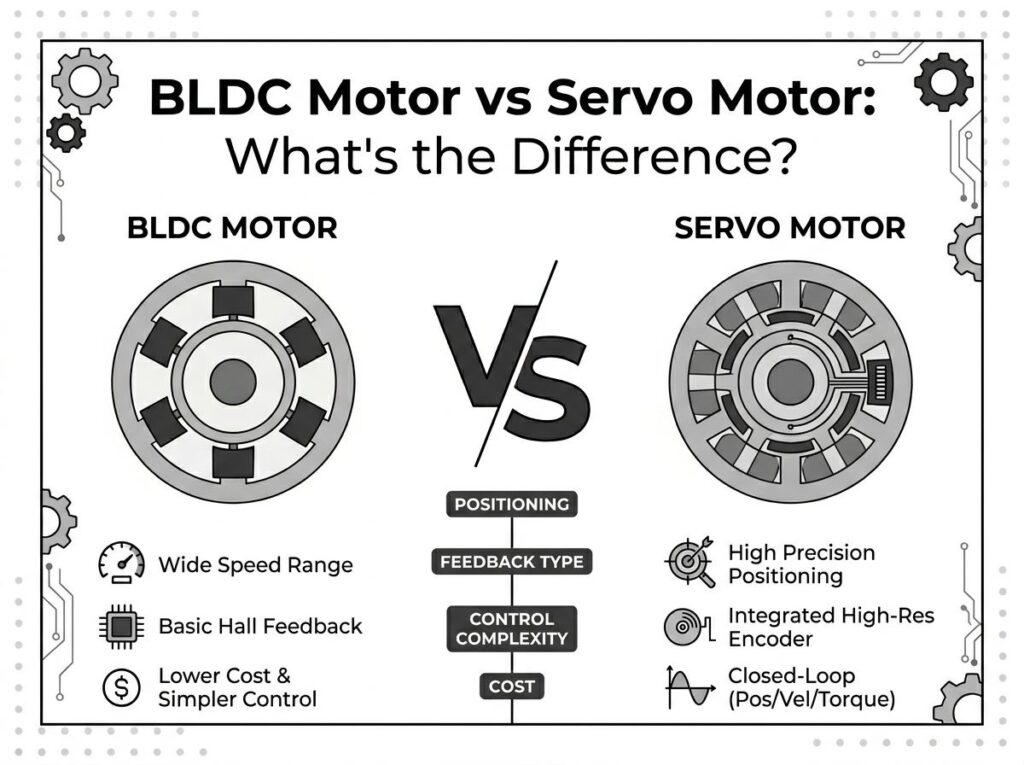
BLDCモーターとサーボモーターの比較: 違いは何ですか?
Selecting the right motor technology is one of the most important decisions in modern equipment design. Whether developing a robotic arm, an automated guided vehicle (無人搬送車), an industrial conveyor, a lawn mower, or a precision manufacturing machine, engineers must carefully evaluate performance requirements, 複雑さを制御する, 正確さ, 効率, とシステムの総コスト.
Among the most commonly compared technologies are Brushless DC (BLDC) motors and servo motors. While both are widely used in motion control applications, they are not direct equivalents. 実際には, one of the biggest misconceptions in the motor industry is assuming that a servo motor is simply another type of motor.
The reality is that a BLDC motor is a motor technology, while a servo motor is a complete motion control system that combines a motor, feedback device, and controller to achieve highly precise positioning and dynamic performance.
This guide provides a detailed engineering comparison of BLDC motors and servo motors, helping OEM manufacturers, エンジニア, and procurement teams determine which solution best fits their application requirements.
BLDCモーターとサーボモーターの比較
BLDC motors and servo motors are both used for precise motion control, but a BLDC motor is a motor type, while a servo motor is a complete motion control system that includes a motor, エンコーダ, and controller. Servo motors provide higher positioning accuracy and dynamic response, whereas BLDC motors offer lower cost and simpler implementation.
一般的に, servo systems are preferred for robotics, CNC装置, and precision automation, while BLDC motors are often selected for lawn mowers, HVAC システム, パンプス, industrial drives, and cost-sensitive OEM products.
BLDCモーターとは?
ブラシレスDCモーター (BLDCモーター) is an electronically commutated motor that eliminates the brushes and commutator used in traditional DC motors. Instead of mechanical switching, electronic controllers energize stator windings according to rotor position.
BLDC motors have become one of the fastest-growing motor technologies due to their high efficiency, コンパクトサイズ, 長寿命, and excellent power density.
BLDC Motor Structure
A typical BLDC motor consists of:
- 永久磁石ローター
- Laminated stator core
- Multi-phase stator windings
- Hall-effect sensors (オプション)
- 電子コントローラー
- Power inverter stage
ブラシ付きモーターとは異なります, no physical contact exists between stationary and rotating electrical components.
電子整流
The key innovation behind BLDC motors is electronic commutation.
The motor controller continuously monitors rotor position and energizes stator windings in a sequence that generates a rotating magnetic field. The rotor follows this field and produces rotational motion.
Electronic commutation provides several advantages:
- ブラシの磨耗なし
- メンテナンス要件の軽減
- Reduced electrical noise
- より高い効率
- Longer operational life
ホールセンサー
Many BLDC motors use Hall-effect sensors to determine rotor position.
These sensors detect magnetic field changes as the rotor rotates and provide position feedback to the controller.
Hall sensors enable:
- Reliable startup performance
- Accurate commutation timing
- Improved low-speed control
- Enhanced torque production
Modern sensorless BLDC systems can estimate rotor position through back-EMF detection, eliminating the need for Hall sensors in certain applications.
BLDC モーター コントローラー
The controller acts as the brain of the motor system.
Functions include:
- 速度規制
- Current control
- Torque management
- Protection functions
- PWM generation
- Communication interfaces
The simplicity of BLDC control is one reason these motors are widely used in commercial products requiring a balance between performance and affordability.
Common BLDC Applications
- 電動芝刈り機
- ロボット芝刈り機
- HVAC 送風機
- ウォーターポンプ
- Industrial fans
- AGV
- Turnstile systems
- 電動自転車
- 医療機器
- Consumer appliances
サーボモーターとは?
One of the most misunderstood concepts in motion control is the definition of a servo motor.
Many people believe that a servo motor is a specific motor type. 実際には, a servo system is a complete closed-loop motion control solution.
Servo System Architecture
A servo system consists of:
Servo System =
モーター
+
エンコーダ
+
コントローラ
The motor itself may be:
- PMSM motor
- BLDCモーター
- AC synchronous motor
- Direct drive motor
The defining characteristic is not the motor technology but the use of continuous feedback and closed-loop control.
Core Components of a Servo System
1. モーター
The motor generates rotational motion and torque.
Modern industrial servo systems most commonly use PMSM motors because of their smooth torque characteristics and high efficiency.
2. エンコーダ
The encoder continuously measures:
- Position
- スピード
- Direction
- Angular displacement
Encoder feedback allows the controller to make real-time corrections.
3. Servo Drive
The servo drive processes feedback signals and adjusts current, 電圧, and switching patterns to achieve target motion profiles.
The drive ensures:
- 正確な位置決め
- Stable speed control
- Dynamic torque response
- Accurate acceleration and deceleration
Why Servo Systems Are Different
Unlike standard BLDC motor systems that may operate open-loop or semi-closed-loop, servo systems constantly compare commanded motion with actual motion.
If an error occurs, the controller immediately compensates.
This feedback mechanism enables:
- Micron-level positioning
- High-speed dynamic response
- Exceptional repeatability
- Precise trajectory control
Typical Servo Applications
- 産業用ロボット
- CNCマシニングセンター
- Semiconductor equipment
- 包装機械
- Automated assembly systems
- Medical robots
- Precision inspection equipment
- Aerospace motion systems
BLDC vs Servo Motor: 主な違い
Although BLDC motors and servo systems can sometimes use similar motor technologies internally, their intended functions and performance levels differ significantly.
| 特徴 | BLDCモーター | サーボモーター |
|---|---|---|
| 位置フィードバック | オプション | Required |
| Accuracy | 中くらい | 非常に高い |
| 速度制御 | 良い | 素晴らしい |
| トルク制御 | 良い | 素晴らしい |
| 料金 | より低い | より高い |
| 複雑 | より低い | より高い |
| 制御方法 | Open Loop / Semi Closed Loop | Closed Loop |
| エンコーダ | オプション | Mandatory |
| 代表的な用途 | 芝刈り機, パンプス, 空調設備 | ロボット工学, CNC, 精密自動化 |
The most important distinction is that servo systems prioritize precision and feedback control, while BLDC systems prioritize efficiency, シンプルさ, and cost effectiveness.
Working Principle Comparison
Understanding the operating principles of BLDC motors and servo systems helps clarify why their performance characteristics differ.
BLDC モーターの仕組み
BLDC motors rely on electronic commutation to replace mechanical brushes.
The controller energizes stator windings in a predefined sequence based on rotor position information.
Key operating characteristics:
- 電子整流
- Hall sensor feedback (オプション)
- PWM speed control
- Open-loop or semi-closed-loop operation
Most BLDC applications focus on maintaining speed rather than achieving precise position control.
How Servo Systems Work
Servo systems continuously monitor actual motor position and compare it with commanded position.
Any deviation immediately triggers corrective action by the controller.
This closed-loop architecture enables:
- High-precision positioning
- Accurate trajectory tracking
- Rapid response to load changes
- Superior torque control
The encoder serves as the critical feedback device that makes servo control possible.
Open Loop vs Closed Loop
| 制御タイプ | BLDC | サーボ |
|---|---|---|
| Open Loop Operation | 一般 | いいえ |
| Closed Loop Operation | オプション | 標準 |
| Feedback Dependency | 低い | 高い |
| Position Correction | 限定 | 継続的 |
Position Accuracy Comparison
For engineers evaluating motion control systems, position accuracy is often the most important factor.
This is where servo systems demonstrate their greatest advantage.
BLDC Position Accuracy
Standard BLDC motors are typically designed for speed control and torque generation rather than precision positioning.
Without encoder feedback, positional accuracy is inherently limited.
Typical BLDC characteristics include:
- Moderate positioning capability
- Good speed regulation
- Suitable for continuous rotation applications
- Limited positioning precision
Servo Position Accuracy
Servo systems are specifically engineered for accurate positioning.
High-resolution encoders enable the controller to track rotor movement continuously and apply corrections in real time.
Typical servo advantages include:
- Sub-degree positioning accuracy
- Excellent repeatability
- Precise trajectory control
- High-speed response
- Minimal positioning error
This capability explains why robotics, CNCマシン, semiconductor equipment, and automated manufacturing systems overwhelmingly rely on servo technology.
パートに進む 2: トルク比較, Speed Control Comparison, 効率の比較, コスト比較, ロボット工学の応用, 無人搬送車 & AMR Applications, 芝刈り機の用途, Industrial Automation Selection Guide, OEMバイヤーがGreensky Powerを選ぶ理由, よくある質問, Internal Link Strategy, および参考文献.
トルク比較
Torque is one of the most critical parameters when evaluating motion control systems. It determines a motor’s ability to accelerate loads, overcome resistance, maintain position, and perform dynamic movements under varying operating conditions.
In mechanical systems, torque can be expressed as:
τ = rFsin(私)
どこ:
- t = トルク (N・m)
- r = Distance from pivot point (メートル)
- ふ = 加えられる力 (N)
- 私 = Angle between force and lever arm
例えば:
t = (3)(6)sin(90°) = 18 N・m
Only the force component perpendicular to the lever arm contributes to torque generation.
連続トルク
Continuous torque represents the amount of torque a motor can produce indefinitely without overheating.
| 特性 | BLDCモーター | サーボモーター |
|---|---|---|
| Continuous Torque Density | 高い | 非常に高い |
| 熱管理 | 良い | 素晴らしい |
| Long-Term Stability | 良い | 素晴らしい |
ピークトルク
Peak torque refers to the maximum short-duration torque a motor can deliver.
Servo motors are specifically designed to provide significantly higher peak torque during acceleration, 位置決め, and sudden load changes.
This is especially important in robotics, CNC装置, and automated assembly systems.
ストールトルク
Stall torque is the torque produced when the motor shaft is not rotating.
Servo systems generally offer superior stall torque management because encoder feedback allows precise current regulation while maintaining shaft position.
Torque Performance Summary
| Torque Factor | BLDC | サーボ |
|---|---|---|
| 連続トルク | 高い | 非常に高い |
| ピークトルク | 良い | 素晴らしい |
| Stall Torque Control | 限定 | 素晴らしい |
| Torque Accuracy | 適度 | 非常に高い |
| トルクリップル | より高い | より低い |
For demanding motion-control applications, servo systems typically outperform standard BLDC motors in torque control and dynamic response.
Speed Control Comparison
Speed regulation is another major difference between BLDC motors and servo systems.
BLDC Speed Control
BLDC motors typically use:
- オープンループ制御
- Semi-closed-loop control
- PWM speed regulation
- Hall sensor commutation
Speed control performance is generally sufficient for applications where exact positioning is not required.
Examples include:
- 芝刈り機
- ファン
- パンプス
- HVAC システム
- コンベヤー
Servo Speed Control
Servo systems utilize full closed-loop control.
The controller continuously compares:
- Commanded speed
- Actual speed
- 負荷条件
- Position feedback
Real-time corrections enable highly stable speed regulation even under rapidly changing loads.
Speed Control Comparison Table
| 要素 | BLDC | サーボ |
|---|---|---|
| Speed Stability | 良い | 素晴らしい |
| 動的応答 | 良い | 素晴らしい |
| Load Compensation | 限定 | Automatic |
| Low-Speed Control | 適度 | 素晴らしい |
BLDC vs Servo Efficiency Comparison
Efficiency directly affects operating costs, バッテリー寿命, 熱性能, and overall equipment reliability.
Both technologies offer significantly higher efficiency than brushed DC motors.
BLDC モーターの効率
- Typically 85–95%
- Low rotor losses
- Excellent battery utilization
- 高い電力密度
Servo Motor Efficiency
Modern servo systems often use PMSM motors internally, 有効にする:
- 90–98% efficiency
- 最適化された電流制御
- Reduced harmonic losses
- Superior energy utilization
Efficiency Comparison Table
| モーターの種類 | 標準的な効率 |
|---|---|
| ブラシ付き DC モーター | 70–85% |
| 誘導電動機 | 80–93% |
| BLDCモーター | 85–95% |
| Servo Motor System | 90–98% |
For most commercial equipment, BLDC efficiency is already excellent. しかし, servo systems maintain an advantage in precision applications requiring maximum performance.
BLDC vs Servo Cost Comparison
Cost is often the decisive factor for OEM buyers.
Although servo systems provide superior performance, they require additional hardware and software components.
| Cost Item | BLDC | サーボ |
|---|---|---|
| モーター | より低い | より高い |
| コントローラ | より低い | より高い |
| エンコーダ | オプション | Required |
| ドライブエレクトロニクス | よりシンプルに | More Complex |
| Total System Cost | より低い | より高い |
For applications where ultra-high precision is unnecessary, BLDC motors often provide the best return on investment.
Which Is Better for Robotics?
Robotics is one of the highest-value markets for motion control technologies.
Most robotic systems require:
- 正確な位置決め
- Smooth trajectory control
- 速い加速
- 高い再現性
- Closed-loop feedback
こうした要件があるため、, servo systems dominate industrial robotics.
Why Servo Motors Win in Robotics
- Encoder feedback
- Micron-level positioning capability
- 優れた動的応答性
- High precision trajectory control
- Excellent repeatability
ロボット工学部門の優勝者: サーボモーター
Which Is Better for AGV and AMR?
無人搬送車 (AGV) and Autonomous Mobile Robots (AMRs) occupy a unique middle ground.
When BLDC Is Preferred
- Cost-sensitive AGVs
- Warehouse transportation
- Basic navigation systems
- Long battery life requirements
When Servo Is Preferred
- High-speed navigation
- Precision docking
- 協働ロボット
- Advanced autonomous systems
Many modern AGVs successfully utilize BLDC drive motors with encoder feedback, creating a hybrid solution between traditional BLDC and servo architectures.
Winner for AGVs: Depends on navigation precision requirements.
Which Is Better for Lawn Mowers?
Lawn mowers require:
- 高トルク出力
- 屋外耐久性
- バッテリー効率
- コスト競争力
- 確実な動作
Unlike robotics, lawn mowers rarely require sub-degree positioning accuracy.
その代わり, manufacturers prioritize efficiency, 信頼性, and affordability.
Why BLDC Motors Are Ideal for Lawn Mowers
- システムコストの削減
- Excellent efficiency
- 高い始動トルク
- Simple electronic architecture
- Proven outdoor reliability
This is one reason why modern cordless lawn mowers and robotic lawn mowers increasingly rely on BLDC technology.
芝刈り機の優勝者: BLDCモーター
Which Is Better for Industrial Automation?
Industrial automation encompasses a wide range of equipment types.
| 応用 | Recommended Solution |
|---|---|
| コンベヤー | BLDC |
| 包装機 | サーボ |
| Turnstiles | BLDC |
| CNC Equipment | サーボ |
| Industrial Fans | BLDC |
| Pick-and-Place Systems | サーボ |
一般的に, the choice depends on whether the application prioritizes precision or cost efficiency.
How to Choose Between BLDC and Servo Motors
The following selection guide can simplify motor technology decisions.
| 応用 | Best Choice |
|---|---|
| ロボット工学 | サーボ |
| CNC | サーボ |
| 芝刈り機 | BLDC |
| 空調設備 | BLDC |
| ポンプ | BLDC |
| 改札口 | BLDC |
| 無人搬送車 | Depends |
Choose a servo system when precision, 位置決め精度, and dynamic response are critical.
Choose a BLDC motor when efficiency, 信頼性, シンプルさ, and lower cost are primary priorities.
OEMバイヤーがGreensky Powerを選ぶ理由
Greensky Power specializes in customized motion solutions for OEM manufacturers worldwide.
コア製品ポートフォリオ
- BLDCモーター
- ギアモーター
- 遊星歯車モーター
- Worm Gear Motors
- Customized Motor Solutions
OEM Engineering Capabilities
- Encoder Integration
- Controller Matching
- Planetary Gearbox Design
- ラピッドプロトタイピング
- Custom Performance Optimization
サービスを提供する主要産業
- 芝生設備
- HVAC システム
- 産業オートメーション
- ロボット工学
- 医療機器
- Security Systems
よくある質問
Is a servo motor a BLDC motor?
必ずしもではありません. A servo motor is a complete closed-loop control system. Many modern servo motors use PMSM or BLDC motor technology internally.
Which motor is better for robotics?
Servo motors are generally preferred because they provide superior positioning accuracy, dynamic response, and repeatability.
Which motor is cheaper?
BLDC motors typically have lower motor costs, controller costs, and overall system costs.
Do BLDC motors need encoders?
いいえ. Many BLDC motors operate successfully using Hall sensors or sensorless control methods. Encoders are optional unless precise positioning is required.
Can a BLDC motor be used as a servo motor?
はい. When combined with an encoder and a closed-loop controller, a BLDC motor can function as part of a servo system.
関連記事
参照
- https://www.ieee.org
- https://ieeexplore.ieee.org
- https://www.energy.gov
- https://www.iea.org
- https://www.iec.ch
- https://www.mathworks.com
- https://www.microchip.com
- https://www.ti.com
- https://www.日本電産.com
- https://www.siemens.com
- https://グローバル.abb
- https://www.weg.net