
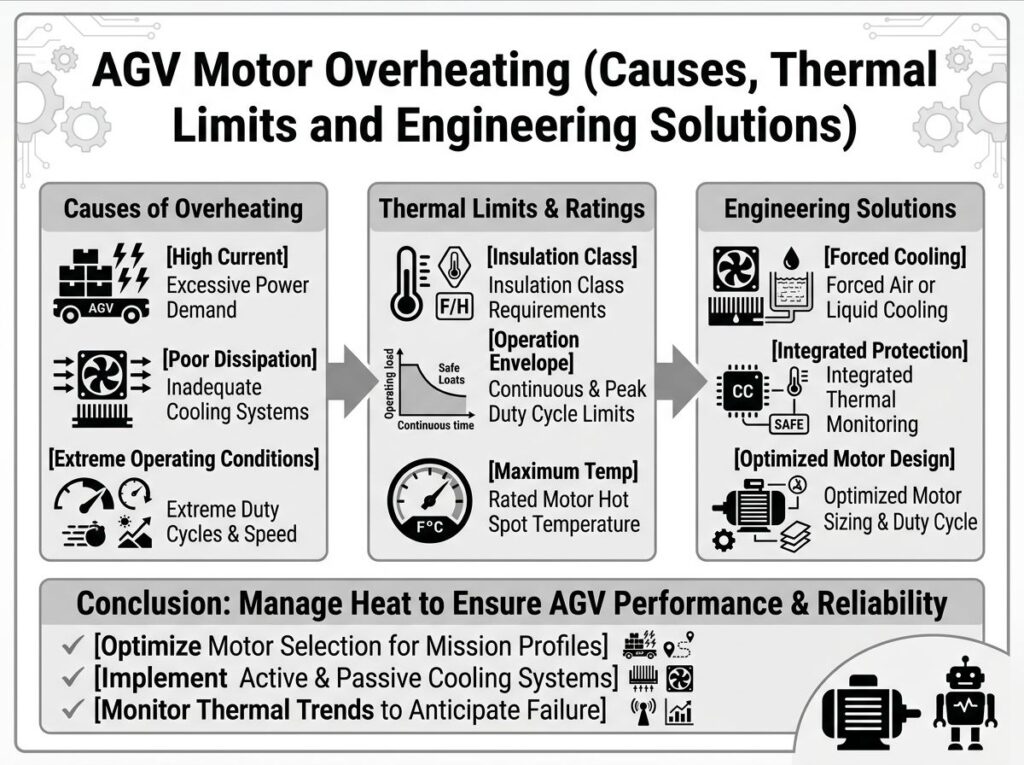
AGV Motor Overheating: 原因, Thermal Limits and Engineering Solutions
簡単な回答
AGV motor overheating is almost always a sizing, duty-cycle, or cooling-system problem—not a defective motor. The four dominant causes are chronic overload (RMS torque above rated), the wrong IEC duty class (running an S1 motor on an S3/S4 stop-start cycle), insufficient cooling airflow or a weak battery that forces high current, and bearing or gear friction. Keep the winding below its insulation limit—155 °C for Class F, 180 °C for Class H—by matching duty cycle, derating for ambient temperature, and enabling thermal and current-limit protection.
ページの内容
トグルWhat Is AGV Motor Overheating?
An AGV traction motor converts electrical energy into motion, but no motor is 100% 効率的. A typical BLDC motor runs at 85–91% efficiency, つまり 9–15% of input power becomes heat. “過熱” is the condition where that heat is generated faster than the motor can shed it, so the winding temperature climbs past the limit set by its 絶縁クラス.
The danger is not the warmth itself—it is the rate of insulation aging. Both MGはありません 1 と IEC 60034-1 define insulation life using the Arrhenius rule: 毎 10 °C above the rated limit halves the winding’s service life. A motor designed for 20,000 hours at its maximum temperature may last only ~5,000 hours if run 20 °C hot. Worse, neodymium magnets begin to permanently demagnetize around 160 ℃ (マクソン, 2024), and the winding varnish softens above that point—damage that cooling cannot reverse.
How Heat Builds Up in an AGV Motor
Overheating is the net result of four heat sources versus the motor’s ability to dissipate them. Understanding each step prevents guessing:
ステップ 1 — Copper loss (I²R)
The dominant source under load. 巻線抵抗 R converts current to heat: P_cu = I² × R. When battery voltage sags, the controller raises current to hold torque, and loss climbs with the square of that current.
ステップ 2 — Iron loss (hysteresis + eddy)
Core laminations heat from repeated magnetic reversal, worst during high-frequency start-stop and PWM switching. This is why frequent-stop AGVs run hotter than steady towing AGVs.
ステップ 3 — Driver / switching loss
The inverter’s power stage dissipates energy during PWM switching and conduction. Poorly tuned controllers or low PWM duty factor at high load add measurable winding heat (Faulhaber technical manual).
ステップ 4 — Mechanical friction
Bearing drag, gear-mesh loss, and wheel misalignment become heat. A single misaligned bearing can push the outer ring past 95 °C on its own (SKF).
ステップ 5 — The balance: thermal steady state
The motor reaches equilibrium when heat generated equals heat dissipated. If the load profile never lets it cool—typical of S3/S4 AGV cycles—the temperature ratchets upward until something trips or fails.
Overheating Cause vs Symptom vs Fix
| Root Cause | Typical Symptom | First-Line Fix |
|---|---|---|
| Chronic overload (実効値トルク > 評価された) | Steady climb to trip; insulation ages fast | Re-size motor or gear ratio; raise duty rating |
| Wrong duty class (S1 motor on S3/S4 cycle) | Overheats only after repeated stops | Specify S3/S4 nameplate; add rest or derate |
| High ambient (>40 °C warehouse) | Premature trip even at rated load | 10–15% derate; use Class F/H insulation |
| Weak / sagging battery | Current spikes, hot windings under load | Verify pack capacity; set under-voltage limit |
| Poor cooling / 遮断された空気の流れ | Case hot to touch; サーマルトリップ | Clear vents; add fan or heatsink |
| Bearing wear or misalignment | Outer ring >95 ℃; noise/vibration | Re-align; re-grease; ベアリングを交換する |
| Disabled thermal / current-limit protection | Motor destroyed with no warning | Enable PTC/KTY sensor and I²t limiting |
| Gearbox inefficiency (ワーム <70%) | Motor works harder for same output | 惑星に切り替える (90–95% 効率) |
エンジニアリングデータ: Limits, 数式, ディレーティング
Insulation classes (IEC 60034-1 / MGはありません 1)
| クラス | 最高巻取温度 | Max temp rise (ΔT) | AGV recommendation |
|---|---|---|---|
| B | 130 ℃ | 80 K | Light, cool, intermittent duty only |
| ふ | 155 ℃ | 105 K | Minimum for warehouse AGVs |
| H | 180 ℃ | 125 K | Foundries, hot warehouses (>50 ℃) |
アン “F/B” rating (Class F insulation with Class B rise) keeps the 155 °C ceiling but limits rise to 80 K—an extra 25 °C margin that roughly doubles insulation life (モーションコントロールのヒント / MGはありません 1).
Key formulas an AGV engineer should keep handy
Winding temperature from resistance (IEEE 112 / MGはありません 1):
T₂ = (R₂ / R₁) × (234.5 + T₁) − 234.5 (銅; add ~10 °C for hotspot)
RMS torque for intermittent duty (IEC 60034-1):
T_rms = √[ (T₁²·t₁ + T₂²·t₂ + …) / (t₁ + t₂ + …) ]
もし T_rms exceeds the rated continuous torque at operating ambient, モーター will overheat even when peak torque looks safe. This single check catches most AGV sizing errors.
Thermal derating with ambient (マクソン / Faulhaber catalog baseline at 25 ℃):
| アンビエント | 定格電流 | 定格トルク | 注記 |
|---|---|---|---|
| 25 ℃ (カタログ) | 100% | 100% | ベースライン |
| 40 ℃ (IEC standard) | 85–90% | 85–90% | Typical warehouse |
| 50 ℃ | 70–75% | 70–75% | Hot plant |
| 60 ℃ | 50–55% | 50–55% | Upgrade to Class H |
Duty cycle matters more than power
Most AGVs run S3 (断続的、周期的) またはS4 (with starting). An S1 “継続的な” motor on an S4 cycle never gets its cooling rest, so temperature climbs past the insulation limit (Fabrico; IEC 60034-1). Sizing by nameplate watts alone—ignoring duty—is the classic burnout mistake.
What the manufacturers specify
- マクソン: standard DC/BLDC motors cap at ~85–100 °C ambient, 100–125 °C winding; the HD range (SmCo magnets) 到達する 200 周囲℃ / 240 ℃巻線. Electronics cut out at ~100 °C PCB temperature (Maxon high-temperature guide).
- Faulhaber BX4 / BP4: operating range −40 to 100–125 °C, winding max 125–150 °C, thermal resistance Rth1 1.1–2.3 K/W, winding thermal time constant τw1 7–22 s. Integrated drives use I²t limiting to hold the model temperature under the thermal ceiling (Faulhaber technical manual).
- Yaskawa Sigma-7: ambient −5 to 55 ℃ (60 °C with derating); ~20% lower heat generation than prior generations; overheat alarms A.861 (motor overheat) と A.862 (overload overheat) with explicit “reduce ambient to 40 °C or less” guidance (Yaskawa Sigma-7 manual).
- シーメンス: SIMOTICS 1FL6 loses ~10% power between 30 と 40 ℃; full derating tables combine ambient temperature with installation altitude (Siemens DT Configurator documentation).
Bearing temperature thresholds (SKF)
Normal bearing outer-ring temperature ≤ ambient + 45 ℃ (例えば. 30 °C room → ≤75 °C). Warning zone 75–95 °C; danger >95 °C — stop and inspect. Roughly 40% of bearing overheating is lubrication-related, 30% fit/mounting, the rest load and misalignment.
Where Overheating Happens Most
- High-frequency pick-and-place AMRs (S4 duty): starting losses never dissipate; size for RMS torque and enable current limiting.
- Heavy-load towing / forklift AGVs on long ramps: continuous high current plus regenerative braking heat; specify Class F/H and verify battery capacity.
- Hot, un-air-conditioned warehouses (>40 ℃): apply the 10–15% derate or the motor trips at rated load.
- Sealed or buried drives (under-deck, enclosed chassis): no natural airflow; forced cooling or heatsinking is mandatory.
- アウトドア / dusty sites: clogged vents and bearing contamination raise both winding and bearing temperatures.
How to Select a Motor That Won’t Overheat
- Define the real duty cycle. Log start-stop frequency and rest time; classify as S1, S3 (% 時間通りに), またはS4. Never assume S1.
- Calculate RMS torque over one full cycle using the formula above; the motor’s continuous rating must exceed it at operating ambient.
- Add a thermal margin. Choose Class F minimum; Class H for hot environments. Prefer an “F/B” rating for longevity.
- Derating for ambient. If the site runs above 40 ℃, multiply rated torque by 0.85–0.90 (40 ℃) or 0.50–0.55 (60 ℃).
- Right voltage bus. Size the battery so bus voltage stays at rated (例えば. 48 V) under load—voltage sag forces current up and heat with it. 私たちのを参照してください AGV battery voltage guide.
- Choose efficient gearing. 惑星 (90–95%) beats worm (60–75%); lower losses mean lower winding temperature. マッチ speed and rpm to the wheel.
- Enable protection. Connect the PTC/KTY thermal sensor, set under-voltage and current-limit thresholds, and use I²t limiting in the drive.
- Plan cooling and maintenance. Ensure airflow to the motor; schedule bearing greasing and infrared temperature checks (シーメンス / SKF guidance).
よくあるエンジニアリングの間違い
- Sizing by peak, not RMS torque—the motor passes the peak test but cooks over the cycle.
- Assuming the nameplate duty is S1 when the AGV actually runs S3/S4.
- Ignoring ambient derating—a 40 °C warehouse silently removes 10–15% of capacity.
- Disabling thermal or current-limit protection—removes the only early-warning before failure.
- Undersizing the battery—voltage sag drives current (and I²R loss) upward.
- Choosing a worm gearbox for a hot, continuous job—30-point efficiency loss becomes pure heat.
- Skipping bearing alignment—a single misaligned bearing can exceed 95 °C alone.
トラブルシューティング表 (問題→原因→解決策)
| 問題 | 考えられる原因 | 解決 |
|---|---|---|
| Motor trips after repeated stops | S4 starting losses; no cool-down | Re-specify S4 duty; reduce cycle frequency or add rest |
| Hot even at light load | Misaligned / failing bearing | Re-align shaft; re-grease or replace bearing (SKF) |
| Overheats only under heavy load | Weak battery, voltage sag | Verify pack capacity; set under-voltage limit ~44–45 V |
| Trips in summer, fine in winter | アンビエント >40 ℃, no derate | Apply 10–15% derate; upgrade to Class H |
| Winding burns with no alarm | Thermal sensor disabled / not wired | Connect PTC/KTY; enable I²t limiting |
| Excess heat at gearbox | Worm drive inefficiency | 惑星に切り替える; check lubrication |
| Uneven heating, two motors | Speed mismatch “tug-of-war” | Monitor per-wheel speed; balance torque (yk-control) |
| Smoke / burnt odor | Sustained overload + no protection | Power down; inspect winding, バッテリー, protector settings |
よくある質問
What temperature is too hot for an AGV motor?
For a Class F (155 ℃) insulated traction motor, the winding must stay below 155 ℃ (100 K rise over 40 周囲℃). In the field, a case temperature above 90 °C—or a bearing outer ring above 95 °C—is the stop-and-inspect threshold per IEC 60034-1 and SKF.
Why does my AGV motor overheat only at startup?
Start-up heating signals a duty-cycle mismatch (IEC S4) or mechanical binding. Frequent starts add locked-rotor current spikes the winding never sheds. Check brake release, wheel alignment, and whether the nameplate is S1 while your cycle is actually S4.
Can a weak battery cause AGV motor overheating?
はい. When pack voltage sags below rated (例えば. 48 V), the controller draws higher current to hold torque and I²R loss climbs. Field data from a 48 V AGV showed a smoking motor traced to low battery energy plus disabled under-voltage and current-limit protection.
What insulation class should an AGV motor use?
クラスF (155 ℃) is the practical minimum for warehouse AGVs; specify Class H (180 ℃) for foundries or ambient above 50 ℃. アン “F/B” rating buys an extra 25 °C margin and roughly doubles insulation life.
How much does high ambient temperature derate an AGV motor?
A motor rated at 25 °C delivers about 85–90% of rated current at 40 °C and 50–55% at 60 ℃. Un-air-conditioned 40 °C warehouses therefore need a 10–15% torque derating versus catalog values.
How do I stop an AGV motor from overheating?
Confirm duty cycle (S1/S3/S4) matches the load, size for RMS torque, use Class F/H insulation, enable under-voltage and current-limit protection, keep the thermal sensor connected, and verify battery capacity and cooling airflow before blaming the motor.
Why Choose GreenSky?
GreenSky Power designs AGV traction motors and drive wheels built around real duty cycles—not catalog watts. Our BLDC and geared-motor platforms are rated to IEC 60034-1 S1/S3/S4 duty classes, use Class F or H insulation for hot-warehouse operation, and ship with integrated thermal sensors and I²t current limiting so protection is never “optional.”
Need a motor that stays cool under your exact load profile? Use our AGV motor selection guide また talk to our OEM engineering team for a duty-cycle-matched quotation.
参照
- IEC 60034-1:2022 — 回転電機 - 一部 1: 評価と性能. IEC. webstore.iec.ch/publication/75455
- IEC 60034-30-1:2014 — 回転電機 - 一部 30-1: 直動式ACモーターの効率クラス (IE-code). IEC. webstore.iec.ch/publication/67040
- MGはありません 1-2021 — モーターと発電機. 全国電気製造者協会. nema.org/standards/view/mg-1
- IEEE規格 112-2017 — Standard Test Procedure for Polyphase Induction Motors and Generators. IEEE. doi.org/10.1109/IEEESTD.2018.8274591
- 私たち. DOE — 10 CFRパート 431: Energy Efficiency Program for Commercial and Industrial Equipment — Electric Motors. ecfr.gov/current/title-10/part-431
- 国際エネルギー機関 (IEA) — Energy Efficiency of Electric Motor Systems. iea.org/energy-system/industry/electric-motors
- SKF — Bearing overheating: causes, symptoms and handling. SKF knowledge base. skf.com
- シーメンス — Influence of ambient temperature and altitude on motor selection (DT Configurator derating). cache.industry.siemens.com
- Kang, J. 他. (2025) — Thermal Analysis of Outer Rotor BLDC Motor Considering Airflow Ventilation Cooling. IEEE Access, 巻. 13. doi.org/10.1109/ACCESS.2025.3586240
- Wu, Z. 他. (2024) — A Transient-State Lumped Parameter Thermal Model for Brushless Wound Field Switched Flux Machines. IEEEトランス. 交通機関の電化, 10(1). doi.org/10.1109/TTE.2023.3253170
Manufacturer thermal data cited in-body: マクソン “DC motors at high temperatures” (maxongroup.com), Faulhaber BX4/BP4 technical manuals (faulhaber.com), Yaskawa Sigma-7 Product Manual A.861/A.862 (yaskawa.com).