
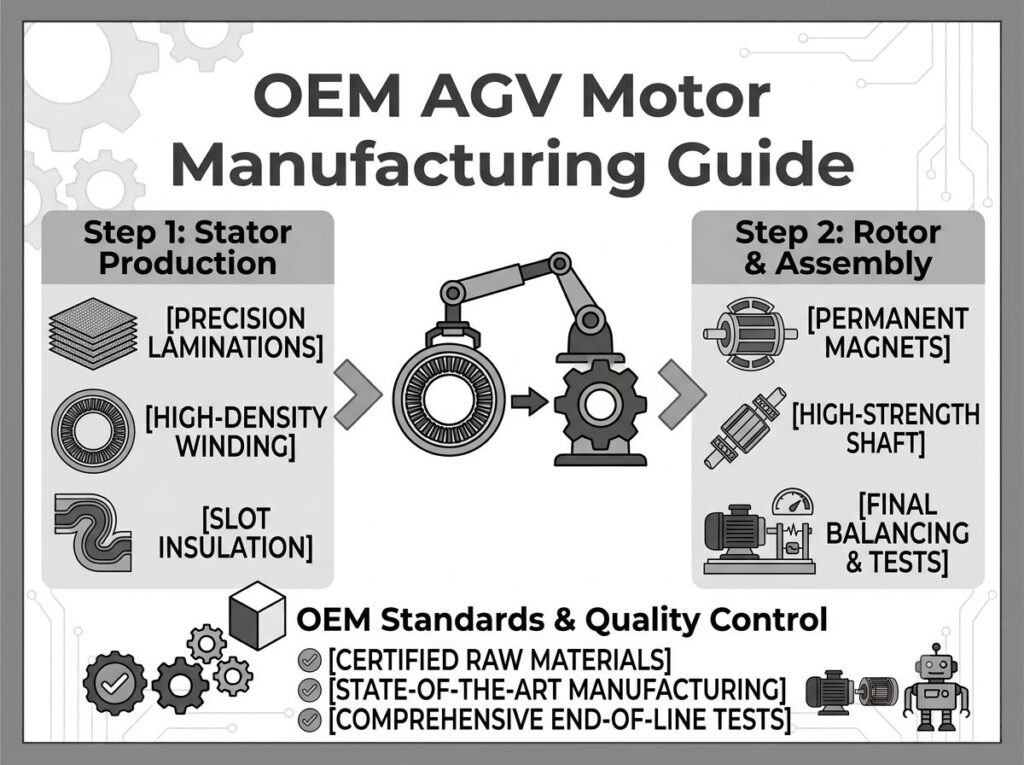
OEM AGV Motor Manufacturing Guide: From Design Specification to Mass Production Quality Control
Nội dung trang
chuyển đổiTrả lời nhanh
OEM AGV motor manufacturing is a multi-stage process spanning requirement analysis, electromagnetic design, prototyping, 100% end-of-line testing, and scalable mass production — all governed by IEC 60034-1:2022 (thermal class, duty cycle S1–S10) Và KHÔNG CÓ MG 1-2021 (efficiency tolerance, vibration limits). A qualified OEM partner must demonstrate in-house winding capability, CNC precision machining, ISO 9001-certified quality management, and full compliance with DOE 10 CFR Part 431 efficiency regulations effective June 2027. Dành cho các ứng dụng dành riêng cho AGV, the manufacturer must support S3/S4 intermittent duty cycle validation, encoder integration (500–4096 PPR), and environmental protection up to IP65, with prototype lead times of 7–14 days and mass production scalability from 500 ĐẾN 50,000+ units per month.
What Is OEM AGV Motor Manufacturing?
OEM (Original Equipment Manufacturer) AGV motor manufacturing refers to the end-to-end process of designing, sản xuất, thử nghiệm, and delivering custom electric motors specifically engineered for Automated Guided Vehicles (Agvs) và Robot di động tự động (AMR). Unlike catalog motor distribution, true OEM manufacturing involves deep engineering collaboration — from electromagnetic simulation and winding optimization to gearbox integration, encoder calibration, and fleet-wide quality consistency.
OEM vs. ODM vs. Catalog Supply: Three Manufacturing Tiers
| Tham số | Catalog Supply | OEM Manufacturing | ODM (Original Design) |
|---|---|---|---|
| Design origin | Manufacturer standard catalog | Customer specification, manufacturer executes | Manufacturer designs from customer requirements |
| Customization depth | Label/shaft/connector only | Winding, Vôn, mô-men xoắn, mã hoá, xếp hạng IP | Full electromagnetic + mechanical design |
| Tooling investment | Không có | Low–medium (fixtures, winding programs) | Cao (new lamination die, housing mold) |
| Prototype lead time | 3–7 days (from stock) | 7–14 days | 4–8 weeks |
| MOQ | 1–50 units | 100–2,000 units | 2,000–10,000 units |
| Unit cost vs. catalog | Baseline | −15% to −25% at volume | −30% to −45% at full scale |
| IP ownership | nhà sản xuất | Customer (per NDA terms) | Negotiable |
Key Motor Types in AGV OEM Manufacturing
| Loại động cơ | Typical Voltage | Dãy công suất | Frame Sizes | Ứng dụng AGV |
|---|---|---|---|---|
| BLDC (DC không chổi than) | 24V / 48V / 72V | 50W–3,000W | 42mm–120mm | Drive wheel, chỉ đạo, lift |
| BLDC with Planetary Gear | 24V / 48V | 100W–2,000W | 57mm–110mm | Traction drive (mô-men xoắn cao, tốc độ thấp) |
| Động cơ phụ (Closed-loop BLDC) | 24V / 48V | 100W–1,500W | 60mm–90mm | Lắp ghép chính xác, chỉ đạo |
| Bước (Hybrid) | 12V / 24V | 10W–100W | 42mm–86mm | Bơm, valve, auxiliary axes |
| Integrated Wheel Motor | 48V / 72V | 200W–5,000W | Custom hub | Ổ đĩa vi sai, omnidirectional |
How OEM AGV Motor Manufacturing Works: Step-by-Step Process
A qualified OEM motor manufacturer follows a structured 8-stage process from initial specification to volume shipment. Each stage has defined deliverables, quality gates, and standard-compliant verification points.
Stage 1: Phân tích yêu cầu & Sự chỉ rõ
The manufacturer collects the AGV system specification: vehicle mass (50–5,000 kg), tốc độ mục tiêu (0.5–2,0 m/s), đường kính bánh xe, điện áp pin (24V/48V/72V), acceleration profile, duty cycle pattern, môi trường hoạt động (nhiệt độ, độ ẩm, xếp hạng IP), and navigation precision requirements. This stage outputs a Motor Specification Document (MSD) defining rated torque, tốc độ định mức, mô-men xoắn cực đại, continuous current, encoder resolution, and mechanical interface drawings.
Stage 2: Electromagnetic Design & Simulation
Engineers perform finite element analysis (FEA) to optimize the motor’s magnetic circuit — slot/pole combination, winding topology (distributed vs. concentrated), air gap, magnet grade (N42SH–N52SH), and lamination material (50PN470–50PN600 silicon steel). Key simulation outputs include torque–speed curve, efficiency map, cogging torque, thermal distribution, and demagnetization margin. Per IEEE ECCE 2023 nghiên cứu, fractional-slot concentrated winding (FSCW) configurations such as 18-slot/16-pole achieve higher slot fill factor and lower cogging torque compared to distributed windings for robotic applications [1].
Stage 3: Mechanical Design & Tooling
This stage defines the housing (aluminum die-cast or CNC-machined), shaft material (40Cr or SUS304), bearing selection (per SKF E2 energy-efficient bearing recommendations), flange interface, and mounting dimensions. CNC machining centers achieve dimensional tolerances of ±0.01mm on critical bearing seats and shaft journals. Manufacturers with in-house CNC capability (like GreenSky Power) eliminate subcontractor delays and maintain full process traceability.
Stage 4: Winding & Stator Assembly
The stator winding stage is the most quality-critical process in motor manufacturing. Two production methods dominate:
| Winding Method | Process | Slot Fill Factor | Consistency | Typical Use |
|---|---|---|---|---|
| Manual/Semi-auto winding | Operator-guided, tension controlled | 35–45% | ±15% resistance variation | Small batch, prototype |
| Automatic CNC winding | Programmed flyer/guide, closed-loop tension | 50–65% | ±3% resistance variation | Mass production |
| Needle winding (FSCW) | Direct inter-slot insertion | 60–75% | ±2% resistance variation | High-volume BLDC |
| Formed wire (hairpin) | Pre-formed rectangular conductors | 70–80% | ±1% resistance variation | EV traction, hiệu quả cao |
Maxon’s proprietary马鞍形 (diamond cross) winding and Faulhaber’s斜绕形 (rhombic) winding represent the highest tier of coreless winding technology, achieving copper fill factors above 70% with micron-level precision. These methods require custom-built winding machines developed in-house, as documented in Maxon’s quality philosophy: “We produce all important components on machines developed in-house” [2].
Stage 5: Rotor Assembly & Magnetization
The rotor assembly involves pressing magnets onto the rotor hub, dynamic balancing to ISO 1940-1 Grade 2.5 or better, and air gap verification. Magnet grade selection directly impacts torque density: N42SH magnets offer Br ≥ 1.28T with maximum operating temperature of 150°C, while N52SH extends to Br ≥ 1.43T at 150°C for high-performance applications. Rotor balancing quality directly affects vibration per NEMA MG 1 Phần 7.
Stage 6: End-of-Line Testing (100% Inspection)
Every production unit undergoes comprehensive testing before shipment. The testing protocol must comply with IEC 60034-1 Và KHÔNG CÓ MG 1 yêu cầu:
| Test Category | Standard Reference | Pass Criteria | Test Method |
|---|---|---|---|
| Winding resistance | IEC 60034-1 §11.2 | ±5% of design value across phases | 4-wire Kelvin measurement |
| Insulation resistance | IEC 60034-1 §9.2 | ≥ 100 MΩ at 500V DC | Megger test, 1 tối thiểu |
| Dielectric withstand | IEC 60034-1 §9.3 | 1000V + 2×U_N, 1 tối thiểu, no breakdown | Hi-pot test |
| No-load characteristics | KHÔNG CÓ MG 1 §12.47 | Speed and current within ±10% of nominal | Dynamometer, điện áp định mức |
| Load characteristics | IEEE 112 Method B | Efficiency ≥ NEMA nominal − 20% loss tolerance | Dynamometer, rated load |
| Temperature rise | IEC 60034-1 §8 (resistance method) | Within thermal class limit (Class F: 105K rise at 40°C ambient) | Resistance method, ΔT = (R₂−R₁)/R₁ × (235+T₁) |
| Rung | KHÔNG CÓ MG 1 Phần 7 | Grade A: ≤ 0.15 in/s peak velocity; Grade B: ≤ 0.10 in/s | Accelerometer on bearing housing |
| Encoder signal | Manufacturer specification | Phase alignment ±90° ±5°, amplitude within spec | Oscilloscope, quadrature check |
| Tiếng ồn | iso 1680 | ≤ 55 DB(MỘT) at 1m for indoor AGV | Sound level meter, anechoic chamber |
Stage 7: Pilot Production & Process Validation
Before mass production, a pilot batch (typically 30–100 units) validates process stability. Statistical Process Control (SPC) charts track critical parameters: winding resistance, air gap dimension, torque constant Kt, and no-load current. The process capability index Cpk must reach ≥ 1.33 for all critical-to-quality (CTQ) dimensions before mass production release. Siemens’ Digital Twin approach to manufacturing validation has demonstrated 60% quality improvement and 50% production yield increase in motor manufacturing by simulating production processes before physical execution [3].
Stage 8: Mass Production & Supply Chain Management
Mass production requires stable raw material sourcing, flexible batch sizing, and consistent quality across batches. Key supply chain metrics include:
| Metric | Industry Benchmark | World-class Standard |
|---|---|---|
| On-time delivery rate | ≥ 95% | ≥ 99% |
| Defect rate (DPPM) | ≤ 5,000 | ≤ 500 |
| Raw material inventory turnover | 7–14 days | ≤ 7 ngày |
| Production capacity utilization | 70–80% | 80–90% |
| thời gian dẫn (order to shipment) | 3–4 weeks | 2–3 weeks |
So sánh: OEM Manufacturing Approaches by Motor Technology
| Tham số | BLDC with Gearbox | Integrated Servo (BLDC) | Stepper with Gearbox | Hub/Wheel Motor |
|---|---|---|---|---|
| Typical frame size | 42–110mm | 60–90mm | 42–86mm | Custom (120–250mm) |
| Winding complexity | Trung bình (concentrated) | Cao (concentrated + mã hoá) | Thấp (bipolar) | Cao (large diameter, many poles) |
| Tooling cost | $5,000–$20,000 | $8,000–$30,000 | $3,000–$10,000 | $20,000–$80,000 |
| Testing complexity | Tiêu chuẩn (8–10 tests) | Extended (12–15 tests, vòng khép kín) | Nền tảng (5–7 tests) | Extended (10–12 tests, waterproofing) |
| IEC 60034-1 chu kỳ nhiệm vụ | S3 (intermittent) | S4 (with starting) | S3 (intermittent) | S1 (liên tục) or S3 |
| Efficiency class achievable | IE3–IE4 | IE4–IE5 | IE2–IE3 | IE3–IE4 |
| Typical MOQ | 200–1,000 | 500–2.000 | 500–2.000 | 300–1,000 |
| Unit cost (200W class) | $35–$80 | $60–$150 | $15–$40 | $80–$200 |
Engineering Data: Tiêu chuẩn, Hiệu quả, and Formulas
IEC 60034-1:2022 Thermal Class Limits for AGV Motors
| Thermal Class | Max Hotspot (° C.) | Allowable Rise (K) at 40°C Ambient | AGV Application Suitability |
|---|---|---|---|
| Class A (105) | 105° C. | 60K | Not recommended (insufficient margin) |
| Lớp b (130) | 130° C. | 80K | Light-duty AMR, intermittent operation |
| Class F (155) | 155° C. | 105K | Standard for AGV traction motors |
| Class H (180) | 180° C. | 125K | AGV hạng nặng, high-ambient environments |
| Class N (200) | 200° C. | 145K | Specialty (outdoor, xưởng đúc) |
Temperature rise calculation per IEC 60034-1 resistance method: ΔT = (R₂ − R₁) / R₁ × (235 + T₁) − (T₂ − T₁), where R₁ = cold resistance at ambient T₁, R₂ = hot resistance at ambient T₂, Và 235 is the copper temperature coefficient constant [4].
IEC 60034-1 Phân loại chu kỳ nhiệm vụ cho các ứng dụng AGV
| Lớp IEC | Sự miêu tả | Ứng dụng AGV phù hợp | Giảm mô-men xoắn |
|---|---|---|---|
| S1 | Chạy liên tục, steady-state | AGV kiểu băng tải, 24/7 vận hành đường dây | None — rated = continuous |
| S2 | Nhiệm vụ ngắn hạn, cools between runs | Vận chuyển hàng loạt, long idle periods | 1.5–2× S1 torque for short bursts |
| S3 | Định kỳ không liên tục, no starting influence | AMR từ hàng hóa tới người, chọn và đặt theo chu kỳ | Phụ thuộc vào chu kỳ nhiệm vụ % (ed = đúng giờ / tổng chu kỳ) |
| S4 | Không liên tục với ảnh hưởng bắt đầu | AGV khởi động-dừng thường xuyên (trung chuyển dây chuyền lắp ráp) | Dòng khởi động làm nóng cuộn dây; derate by RMS method |
| S5 | Intermittent with starting + phanh | AGV with frequent regenerative braking | Braking energy must be dissipated or recovered |
KHÔNG CÓ MG 1 Efficiency Tolerance Rules
Per NEMA MG 1 §12.58, the full-load efficiency of a motor shall not be less than the minimum value associated with the nominal efficiency. The minimum efficiency represents 20% higher losses than the nominal value. Ví dụ, a motor with 94.5% nominal efficiency has a minimum guaranteed efficiency of 93.6% [5].
| Công suất động cơ | IEC 60034-1 Tolerance | KHÔNG CÓ MG 1 Tolerance | Net Effect |
|---|---|---|---|
| ≤ 150 kW | −15% of (1 − η) | −20% of losses | IEC tighter for η < 93%; NEMA tighter for η > 93% |
| > 150 kW | −10% of (1 − η) | −20% of losses | NEMA generally tighter |
DOE 10 CFR Part 431 Compliance Timeline
| Motor Category | Compliance Date | Required Efficiency |
|---|---|---|
| General purpose motors, 1–500 HP | Tháng sáu 1, 2016 (effective) | NEMA Premium (IE3) |
| > 500 HP (≤ 750 HP) | Tháng Mười 14, 2024 | IE4 (Siêu cao cấp) |
| Air-over motors | Tháng Mười 14, 2025 | IE3–IE4 (varies by class) |
| Expanded scope motors (SNEM) | Tháng Mười 14, 2026 | IE3 minimum |
| Inverter-only motors, động cơ đồng bộ | Tháng Mười 14, 2026 | IE3 minimum |
| All ESEM types | Tháng Một 1, 2029 | IE3–IE4 (varies by type) |
DOE projects the 2027 rule will save businesses $8.8 tỷ and prevent 92 million metric tons of CO₂ emissions over 30 năm [6]. Importers must verify compliance documentation, request DOE compliance certificates, and confirm motor nameplate data matches the DOE database.
Key Manufacturing Engineering Formulas
| Tham số | Công thức | Ứng dụng |
|---|---|---|
| Hằng số mô-men xoắn | Kt = T / TÔI (Nm/A) | Verify motor performance matches specification |
| Back-EMF constant | Ke = V / Ồ (V·s/rad) | SI units: Ke = Kt (in Nm/A and V·s/rad) |
| Hiệu quả | η = P_out / P_in = (T × ω) / (V × I) | Compare against NEMA MG 1 nominal efficiency tables |
| mô-men xoắn RMS (chu kỳ nhiệm vụ) | T_rms = √[S(Tᵢ² × tᵢ) / Σtᵢ] | Verify motor can sustain intermittent AGV duty (S3/S4) |
| Thermal rise (resistance method) | ΔT = (R₂−R₁)/R₁ × (235+T₁) − (T₂−T₁) | IEC 60034-1 temperature rise verification |
| Process capability | Cpk = min[(USL−μ)/3σ, (μ−LSL)/3σ] | Mass production quality assurance (target Cpk ≥ 1.33) |
| Slot fill factor | SFF = (N × A_wire) / A_slot × 100% | Winding process quality indicator |
Manufacturer Benchmark Data: Maxon, Faulhaber, Yaskawa
| nhà sản xuất | Winding Technology | Quality Certifications | Key Manufacturing Metrics |
|---|---|---|---|
| Maxon | Diamond-cross (马鞍形), single-shot winding, in-house machines | iso 9001, TRONG 9100 (hàng không vũ trụ), iso 13485 (thuộc về y học), IATF 16949 (auto) | >8% revenue in R&Đ.; 1,200m² cleanroom (GMP class); 20,000-hour long-term test capability; 8 global production sites with uniform standards [2] |
| Faulhaber | Rhombic (斜绕形), hexagonal winding (SXR series), self-designed equipment | iso 9001, iso 14001 | 100% functional testing; copper fill factor >70%; r&D centers in Germany, Thụy sĩ, Hoa Kỳ; custom motors from design to production in-house [7] |
| Yaskawa | Concentrated winding, servo-grade, 24-bit encoder integration | iso 9001, iso 14001 | Sigma-7: 3.1 kHz speed loop bandwidth; 350% overload for 3–5s; 20% heat reduction vs. previous gen; 30% energy saving via DC bus sharing; SGM7D/F/E direct-drive series rated 1.3–240 Nm [8] |
SKF Bearing Technology for AGV Motor Manufacturing
SKF Energy Efficient (E2) deep groove ball bearings reduce bearing friction by 30–50% compared to standard bearings, directly contributing to motor efficiency gains. SKF Explorer series bearings achieve 30–50% longer service life through ultra-pure bearing steel (oxygen content minimized), proprietary heat treatment, and super-finished raceways (Ra < 0.05μm). For AGV motors operating in contaminated or high-moisture environments, SKF sealed-for-life bearings eliminate relubrication maintenance, addressing the fact that qua 40% of motor maintenance costs relate to poor lubrication [9].
Best Applications for Each Manufacturing Approach
OEM BLDC with Planetary Gearbox — Best For
| Loại AGV | Payload | Tốc độ | Key Motor Requirements |
|---|---|---|---|
| Warehouse pallet AGV | 500–2,000 kg | 1.0–1,5 m/s | 48V, 400–750W, IP54, S3 duty, incremental encoder 1000 PPR |
| Assembly line AGV | 200–1,000 kg | 0.5–1,0 m/s | 24V/48V, 200–500W, frequent start-stop (S4 duty), brake option |
| AMR nhẹ (hàng hóa tới người) | 50–200 kg | 1.5–2,0 m/s | 24V, 100–200W, compact frame (42–57mm), tiếng ồn thấp < 50 DB |
OEM Integrated Servo — Best For
| Loại AGV | Độ chính xác | Key Motor Requirements |
|---|---|---|
| Precision docking AMR | ±0.5–1 mm | 17-bit absolute encoder, Kiểm soát FOC, 3.1 kHz bandwidth |
| Omnidirectional AGV (McCanum) | ±1–2 mm | 4-axis coordinated servo, CANopen/EtherCAT, 200W/axis |
| Cold storage AGV | ±2–5 mm | Class H insulation, −30°C operation, IP65, condensation protection |
OEM Hub/Wheel Motor — Best For
| Loại AGV | Payload | Key Motor Requirements |
|---|---|---|
| Heavy-duty transfer cart | 2,000–10,000 kg | 72V, 1,500–3,000W/hub, direct drive or high-ratio planetary, IP65 |
| Differential drive AGV | 200–1,000 kg | 48V, 400–750W/hub, integrated encoder, differential steering |
| Outdoor AGV (Hải cảng, yard) | 1,000–5,000 kg | 48V/72V, IP67, wide temperature range (−20 to +55°C), corrosion resistance |
Hướng dẫn lựa chọn: How to Evaluate an OEM AGV Motor Manufacturer
Selecting the right OEM motor manufacturing partner requires a structured 7-step evaluation process that goes beyond price comparison to assess engineering depth, quality systems, and supply chain resilience.
Bước chân 1: Assess In-House Manufacturing Capability
Verify the manufacturer owns (not outsources) the following critical processes:
| Process | In-House (Preferred) | Outsourced (Risk) | Verification Method |
|---|---|---|---|
| CNC machining (nhà ở, shaft) | 3–5 axis CNC centers | Subcontractor, variable lead time | Factory audit, machine list |
| Stator winding | Automatic CNC winding machines | Manual winding, inconsistent quality | Production line tour, SPC data |
| Motor assembly | Semi-automatic assembly line | Manual bench assembly | Process flow documentation |
| End-of-line testing | Dynamometer, megger, hi-pot, rung động | Basic electrical check only | Test equipment list, báo cáo thử nghiệm |
| Controller PCB (không bắt buộc) | SMT line, firmware development | External controller supplier | PCB assembly area, firmware revision control |
Bước chân 2: Verify Quality Management System Certifications
Require documentary evidence of active certifications, not just claims. Check certificate validity dates and scope coverage:
| chứng nhận | Scope | Importance for AGV Motors |
|---|---|---|
| iso 9001:2015 | Quality management | Mandatory baseline — process control, traceability, corrective action |
| iso 14001:2015 | Environmental management | RoHS/REACH compliance for export to EU |
| CE (LVD + EMC) | EU safety compliance | Required for EU market access (IEC 60034-1 compliance basis) |
| UL/CSA | North American safety | Required for U.S./Canada installation, DOE compliance verification |
| IATF 16949:2016 | Automotive quality | Indicates highest process maturity (PPAP, APQP) |
| IEC 60034-1 báo cáo thử nghiệm | Thermal class, chu kỳ nhiệm vụ, tolerances | Third-party verified motor performance data |
Bước chân 3: Evaluate Engineering Design Capability
Request sample motor design documentation including: electromagnetic FEA results, thermal simulation, torque–speed curve, efficiency map, and BOM. A capable OEM partner should provide within 2–3 weeks a complete Design Verification Plan (DVP) covering:
- Electromagnetic simulation (JMAG, ANSYS Maxwell, or Motor-CAD)
- Thermal network model (lumped-parameter or CFD)
- Mechanical stress analysis (shaft, nhà ở, bearing loads)
- Encoder integration drawings and signal interface specification
- Compliance matrix (IEC 60034-1, KHÔNG CÓ MG 1, DOE requirements)
Bước chân 4: Phát triển nguyên mẫu & Validation
Issue a prototype purchase order for 3–10 units. The prototype stage must include:
| Deliverable | Timeline | Acceptance Criteria |
|---|---|---|
| Design review meeting | Week 1–2 | Design FEA results approved by customer engineering |
| Prototype motors (3–10 units) | Week 3–5 | All dimensions within tolerance, functional test passed |
| DVP test report | Week 5–7 | All tests passed per IEC 60034-1 and NEMA MG 1 |
| Design freeze | Week 7–8 | Customer sign-off on final specification |
Bước chân 5: Pilot Production & Process Validation
Run a pilot batch of 30–100 units to validate mass production process stability. Require SPC data on all CTQ parameters and verify Cpk ≥ 1.33. This stage identifies process weaknesses before committing to full production volume.
Bước chân 6: Mass Production & Đảm bảo chất lượng
Define mass production quality requirements including: 100% end-of-line testing protocol, AQL sampling plan for batch-level type tests (typically AQL 0.65 for critical defects, AQL 1.0 for major defects), and traceability system (unique serial number per motor linking to test data, material lot, and operator ID).
Bước chân 7: Supply Chain & After-Sales Assessment
| Yêu cầu | Sự chỉ rõ | Verification |
|---|---|---|
| Monthly production capacity | ≥ 5,000 các đơn vị (scalable to 50,000+) | Production records, capacity plan |
| On-time delivery rate | ≥ 97% | 12-month delivery history |
| Spare parts availability | 2% of order quantity, 3-year stock | Spare parts policy document |
| Sự bảo đảm | ≥ 12 months from shipment | Warranty terms in contract |
| Hỗ trợ kỹ thuật | Response within 24 giờ, on-site within 72 giờ | SLA agreement |
Common Engineering Mistakes in OEM AGV Motor Manufacturing
| # | Sai lầm | Kết quả | Cách tiếp cận đúng |
|---|---|---|---|
| 1 | Specifying S1 (liên tục) duty when AGV operates in S3/S4 intermittent mode | Oversized motor, wasted cost and battery capacity | Calculate RMS torque over actual duty cycle per IEC 60034-1 S3/S4 formulas |
| 2 | Ignoring efficiency tolerance band (KHÔNG CÓ MG 1 20% loss rule) | Motor arrives with 93.6% efficiency when 94.5% was expected | Specify nominal efficiency, verify minimum efficiency in acceptance test |
| 3 | Selecting Class B insulation for AGV traction motors | Premature insulation failure under continuous thermal stress | Specify Class F (155° C.) minimum; Class H for high-ambient environments |
| 4 | Omitting encoder signal quality testing in end-of-line protocol | Field failures from EMI-induced position errors, navigation drift | Add quadrature signal oscilloscope check and phase alignment verification |
| 5 | Accepting manual winding for production volumes >1,000 units/month | ±15% resistance variation causes torque inconsistency across fleet | Require automatic CNC winding with SPC monitoring (±3% variation) |
| 6 | Not specifying bearing brand/grade for AGV motors | Premature bearing failures (40%+ of motor maintenance costs) | Specify SKF E2 or equivalent energy-efficient bearings with sealed-for-life option |
| 7 | Skip prototype DVP to save 2 weeks of lead time | Design defects discovered at mass production stage — costly rework and delay | Always require 3–10 prototype units with full DVP before pilot production |
| 8 | No traceability system (serial number → test data → material lot) | Cannot identify root cause of field failures or isolate affected batches | Implement laser-marked serial numbers linked to MES/ERP database |
| 9 | Not verifying DOE compliance for U.S. market motors | Non-compliant motors cannot be legally installed; DOE fines up to $500/day/unit | Request DOE compliance certificate, verify nameplate data against DOE database |
| 10 | Outsourcing critical winding process to uncontrolled subcontractors | Inconsistent slot fill factor, unpredictable thermal performance, quality drift | Require in-house winding capability; audit winding line during factory visit |
Troubleshooting Table: Manufacturing Quality Issues
| Problem | Likely Cause | Giải pháp | Applicable Stage |
|---|---|---|---|
| Phase resistance imbalance >5% | Inconsistent winding tension or turn count | Recalibrate automatic winding machine tension control; verify turn counter | Winding & cuộc họp |
| Efficiency below NEMA minimum | High iron loss (lamination grade), excessive copper loss (low fill factor), or bearing friction | Verify lamination material (50PN470 or better), improve slot fill factor, check bearing preload | End-of-line testing |
| Temperature rise exceeds thermal class limit | Inadequate impregnation, poor thermal path, or undersized motor for actual duty | Verify vacuum impregnation process; add thermal interface material; recalculate RMS torque | Type testing / cánh đồng |
| Encoder signal noise or dropout | EMI from motor PWM, poor cable shielding, or encoder mounting tolerance | Add twisted-pair shielded cable, verify encoder mounting runout <0.02mm, install ferrite beads | Tích hợp / cánh đồng |
| Excessive vibration (exceeds NEMA MG 1 Phần 7 Grade A) | Rotor unbalance, bearing clearance, or resonance at operating speed | Improve rotor balancing to ISO 1940 G2.5; check bearing fit; verify frame stiffness | End-of-line testing |
| Torque ripple higher than specification | Cogging torque from slot/pole combination, non-uniform air gap, or magnet grade variation | Optimize slot/pole combination (FSCW), verify air gap uniformity ±0.02mm, check magnet Br | Thiết kế / prototype |
| Bearing failure within warranty period | Contamination during assembly, incorrect grease, or shaft current damage | Implement clean assembly environment, use sealed bearings, add shaft grounding ring for VFD | Assembly / cánh đồng |
| Motor fails dielectric withstand test | Insulation damage during winding, insufficient impregnation, or pinhole in enamel wire | Verify wire quality (IEC 60317 cấp), improve impregnation cycle, add intermediate insulation test | Winding / end-of-line |
| Production batch efficiency drift >2% | Lamination material lot variation, winding machine drift, or environmental change | Implement SPC on critical parameters, verify incoming material certificates, seasonal calibration | Mass production |
| Noise exceeds 55 DB(MỘT) specification | Bearing noise, cogging torque, or electromagnetic excitation at switching frequency | Use low-noise bearings (ABEC-5+), optimize PWM frequency above 16 kHz, apply skewing | End-of-line testing |
Câu hỏi thường gặp: OEM AGV Motor Manufacturing
1. What certifications should an OEM AGV motor manufacturer have?
At minimum, iso 9001 quality management certification is required. Đối với các ứng dụng AGV, also look for CE (EU LVD/EMC), RoHS Tuân thủ, Và IEC 60034-1 compliance for thermal class and duty cycle ratings. Manufacturers serving North America should meet KHÔNG CÓ MG 1 efficiency standards and DOE 10 CFR Part 431 Tuân thủ. iso 14001 environmental management and IATF 16949 automotive-grade certification indicate higher process maturity.
2. How long does OEM AGV motor development take from specification to mass production?
A typical OEM AGV motor development cycle spans 12–20 weeks: requirement analysis and design (2–4 weeks), prototype manufacturing (2–3 weeks), design verification testing (2–3 weeks), pilot production and process validation (3–4 weeks), and mass production ramp-up (3–6 weeks). Manufacturers with in-house winding, CNC machining, and testing capabilities can compress this to 8–12 weeks.
3. What is the minimum order quantity (MOQ) for custom AGV motors?
MOQ varies by customization level. For parameter customization (Vôn, tốc độ, torque on existing frame sizes), MOQ is typically 100–500 units. For structural customization (custom shaft, mặt bích, nhà ở), MOQ ranges from 500–2,000 units. For fully custom motor designs requiring new tooling, MOQ starts at 2,000–5,000 units. Prototype quantities of 3–10 units are usually available for engineering validation.
4. What testing should every AGV motor undergo before shipment?
Every AGV motor should undergo 100% end-of-line testing bao gồm: electrical performance (sức chống cự, inductance, trở lại EMF), no-load and load characteristics (tốc độ, mô-men xoắn, hiện hành), insulation resistance and dielectric withstand (per IEC 60034-1), temperature rise verification, encoder signal quality, vibration and noise measurement (per NEMA MG 1 Phần 7), and visual inspection. Batch-level type tests should also include duty cycle thermal validation per IEC 60034-1 S1–S5 classifications.
5. How do IEC 60034-1 and NEMA MG 1 differ for AGV motor manufacturing?
IEC 60034-1 provides duty cycle classifications (S1–S10), giới hạn cấp nhiệt (B/F/H), and efficiency tolerances (−15% of (1−η) for motors ≤150 kW). KHÔNG CÓ MG 1 defines efficiency using IEEE 112 Method B testing with a 20% loss tolerance band, Design A–D letters for starting characteristics, and Part 7 vibration limits. For AGV motors, IEC 60034-1 S3/S4 duty cycle ratings are most relevant, while NEMA MG 1 efficiency tables apply if selling to the U.S. market under DOE regulations.
6. What are the most common quality failures in AGV motor manufacturing?
The five most common quality failures are: (1) winding insulation breakdown from inadequate impregnation or thermal stress, (2) bearing failures from contamination or misalignment during assembly, (3) encoder signal instability from EMI or poor mounting, (4) efficiency deviation exceeding NEMA MG 1 20% tolerance band, Và (5) thermal class non-compliance under continuous S1 duty. Implementing 100% end-of-line testing and statistical process control (SPC) on critical dimensions reduces defect rates below 0.5%.
Why Choose GreenSky Power as Your OEM AGV Motor Manufacturer?
GreenSky Power has been a professional electric motor manufacturer specializing in motion control solutions since 2011. Our OEM manufacturing capabilities are built on four pillars that directly address the engineering requirements outlined in this guide:
| Capability | GreenSky Specification |
|---|---|
| r&Đội D | 8 PhD-level engineers; 10% of annual revenue reinvested in R&Đ. |
| Chế tạo | In-house CNC machining, automatic winding, motor assembly, and controller PCB production |
| Testing facilities | High-low temperature chambers, CMM, những căn phòng im lặng, dynamometers — 100% individual motor testing |
| Quality certifications | iso 9001, CE, Energy Efficiency certified |
| Product range | BLDC (12V–220V, 30W–5,000W), bước đi, hộp số, motor controller — frame sizes 22mm–130mm |
| OEM/ODM support | Custom voltage, mô-men xoắn, tốc độ, shaft, mặt bích, mã hoá, communication protocol, xếp hạng IP |
| thời gian dẫn | Sample 7–10 days; production 2–3 weeks; 4–8 weeks for tooling-driven ODM |
| Sự bảo đảm | 1-year standard warranty with 24/7 hỗ trợ kỹ thuật |
Our AGV motor solutions cover drive wheel motors, steering motors, lifting motors, and conveyor motors with voltages from 24V to 72V and power from 100W to 3,000W. We support the full OEM development cycle from lựa chọn động cơ through prototype, pilot, and mass production — including custom case studies for European AGV manufacturers requiring 48V 750W BLDC solutions with integrated encoders.
For engineering teams evaluating motor architectures, our technical resources include comparisons of BLDC vs. động cơ servo, BLDC vs. servo for AGVs specifically, ổ đĩa trực tiếp vs. động cơ bánh răng approaches, and detailed guides on AGV torque calculation Và motor efficiency and battery runtime — all referencing IEC 60034-1 and NEMA MG 1 tiêu chuẩn.
We also provide comprehensive gear motor vs. direct drive motor selection guidance for AGVs, AGV motor torque calculation, Và AGV motor speed and RPM selection resources to support your engineering decisions.
Tài liệu tham khảo
- Metwly, M.Y., Clark, L., Xie, B., & He, J. (2023). “Optimally Designed BLDC Motor Equipped with Different Winding Layouts for Robotic Arms.” 2023 IEEE Energy Conversion Congress and Exposition (ECCE), pp. 6093–6098. DOI: 10.1109/ECCE53617.2023.10362061. Available at: https://ieeexplore.ieee.org/document/10362061/authors
- Tập đoàn Maxon. “The maxon Quality Mindset.” Quality certifications, in-house manufacturing, and cleanroom capabilities. Available at: https://www.maxongroup.com.cn/en-us/company/quality
- Siemens AG. “Outperform Your Competition with a Digital Twin.” Comprehensive Digital Twin approach for manufacturing optimization. Available at: https://www.siemens.com/global/en/products/automation/topic-areas/digital-enterprise/digital-twin.html
- EconoTest Engineering Team. “Motor Thermal Testing: Nhiệt độ tăng, Winding Insulation & Test Procedures.” IEC 60034-1 thermal testing methodology. Available at: https://econotests.com/articles/motor-thermal-testing-temperature-rise-guide
- Bishop, T. (EASA). “How Precise Are Motor Nameplate Ratings?” KHÔNG CÓ MG 1 and IEC 60034-1 tolerance comparison. Available at: https://www.ecmweb.com/motors/how-precise-are-motor-nameplate-ratings
- ABB. “Hiểu được 2027 DOE Motor Standards.” DOE 10 CFR Part 431 Tuân thủ, IE3/IE4 efficiency requirements. Available at: https://new.abb.com/news/detail/132268/understanding-the-2027-doe-motor-standards
- Faulhaber Group. “FAULHABER Drive Systems — Reliable & Combinable.” SXR series hexagonal winding technology and manufacturing capabilities. Available at: https://www.faulhaber.com/en/
- Yaskawa Mỹ, Inc. “SIGMA-7 SERVO SYSTEMS.” SGM7D/F/E direct-drive motor specifications and Sigma-7 SERVOPACK capabilities. Available at: https://www.yaskawa.com/delegate/getAttachment?documentId=BL.Sigma-7.01
- SKF Group. “SKF Energy Efficient Deep Groove Ball Bearings for Electric Motors.” E2 bearing friction reduction and efficiency gains. Available at: https://www.skf.com/binary/57-121274/E2-Electric-motors-offer-sheet_13279_EN.pdf
- CHÚNG TA. Sở năng lượng. “Energy Conservation Program: Energy Conservation Standards for Electric Motors.” 10 CFR Part 431, Direct Final Rule. Available at: https://www.energy.gov/sites/default/files/2023-10/electric-motors-ecs-dfr.pdf