
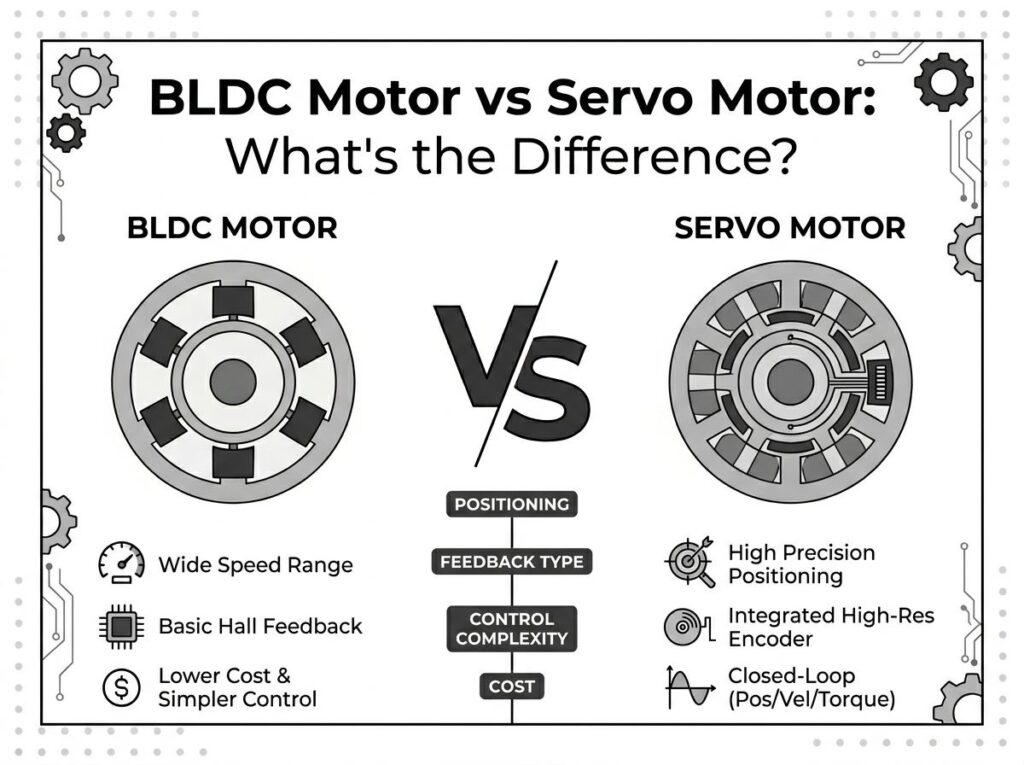
Động cơ BLDC và động cơ servo: Sự khác biệt là gì?
Lựa chọn công nghệ động cơ phù hợp là một trong những quyết định quan trọng nhất trong thiết kế thiết bị hiện đại. Cho dù phát triển một cánh tay robot, một chiếc xe có hướng dẫn tự động (AGV), băng tải công nghiệp, một máy cắt cỏ, hoặc một máy sản xuất chính xác, các kỹ sư phải đánh giá cẩn thận các yêu cầu về hiệu suất, kiểm soát độ phức tạp, sự chính xác, hiệu quả, và tổng chi phí hệ thống.
Trong số các công nghệ được so sánh phổ biến nhất là Brushless DC (BLDC) động cơ và động cơ servo. Trong khi cả hai đều được sử dụng rộng rãi trong các ứng dụng điều khiển chuyển động, chúng không tương đương trực tiếp. Trong thực tế, một trong những quan niệm sai lầm lớn nhất trong ngành công nghiệp ô tô là cho rằng động cơ servo chỉ đơn giản là một loại động cơ khác.
Thực tế động cơ BLDC là một công nghệ động cơ, trong khi động cơ servo là một hệ thống điều khiển chuyển động hoàn chỉnh kết hợp động cơ, thiết bị phản hồi, và bộ điều khiển để đạt được khả năng định vị chính xác cao và hiệu suất động.
Hướng dẫn này cung cấp sự so sánh kỹ thuật chi tiết giữa động cơ BLDC và động cơ servo, giúp các nhà sản xuất OEM, Kỹ sư, và nhóm mua sắm xác định giải pháp nào phù hợp nhất với yêu cầu ứng dụng của họ.
Động cơ BLDC và động cơ servo
Động cơ BLDC và động cơ servo đều được sử dụng để điều khiển chuyển động chính xác, nhưng động cơ BLDC là loại động cơ, trong khi động cơ servo là một hệ thống điều khiển chuyển động hoàn chỉnh bao gồm một động cơ, mã hoá, và bộ điều khiển. Động cơ servo cung cấp độ chính xác định vị cao hơn và phản ứng động, trong khi động cơ BLDC có chi phí thấp hơn và thực hiện đơn giản hơn.
Nói chung, hệ thống servo được ưa thích cho robot, thiết bị CNC, và tự động hóa chính xác, trong khi động cơ BLDC thường được lựa chọn cho máy cắt cỏ, Hệ thống HVAC, máy bơm, ổ đĩa công nghiệp, và các sản phẩm OEM nhạy cảm với chi phí.
Động cơ BLDC là gì?
Động cơ DC không chổi than (động cơ BLDC) là một động cơ chuyển mạch điện tử giúp loại bỏ chổi than và cổ góp được sử dụng trong động cơ DC truyền thống. Thay vì chuyển mạch cơ học, bộ điều khiển điện tử cung cấp năng lượng cho cuộn dây stato theo vị trí rôto.
Động cơ BLDC đã trở thành một trong những công nghệ động cơ phát triển nhanh nhất nhờ hiệu suất cao, Kích thước nhỏ gọn, tuổi thọ dài, và mật độ năng lượng tuyệt vời.
Cấu trúc động cơ BLDC
Một động cơ BLDC điển hình bao gồm:
- Rôto nam châm vĩnh cửu
- Lõi stator nhiều lớp
- Cuộn dây stato nhiều pha
- Cảm biến hiệu ứng Hall (không bắt buộc)
- Bộ điều khiển điện tử
- Giai đoạn biến tần nguồn
Không giống như động cơ chải, không có tiếp xúc vật lý nào tồn tại giữa các bộ phận điện đứng yên và quay.
Chuyển mạch điện tử
Cải tiến quan trọng đằng sau động cơ BLDC là chuyển mạch điện tử.
Bộ điều khiển động cơ liên tục giám sát vị trí rôto và cấp điện cho cuộn dây stato theo trình tự tạo ra từ trường quay. Rôto đi theo từ trường này và tạo ra chuyển động quay.
Chuyển mạch điện tử cung cấp một số lợi thế:
- Không bị mòn bàn chải
- Yêu cầu bảo trì thấp hơn
- Giảm tiếng ồn điện
- Hiệu quả cao hơn
- Tuổi thọ hoạt động dài hơn
Cảm biến Hall
Nhiều động cơ BLDC sử dụng cảm biến hiệu ứng Hall để xác định vị trí rôto.
Những cảm biến này phát hiện sự thay đổi từ trường khi rôto quay và cung cấp phản hồi vị trí cho bộ điều khiển..
Cảm biến Hall cho phép:
- Hiệu suất khởi động đáng tin cậy
- Thời gian đi lại chính xác
- Cải thiện khả năng kiểm soát tốc độ thấp
- Tăng cường sản xuất mô-men xoắn
Các hệ thống BLDC không cảm biến hiện đại có thể ước tính vị trí rôto thông qua phát hiện EMF ngược, loại bỏ sự cần thiết của cảm biến Hall trong một số ứng dụng.
Bộ điều khiển động cơ BLDC
Bộ điều khiển đóng vai trò là bộ não của hệ thống vận động.
Chức năng bao gồm:
- Điều chỉnh tốc độ
- Kiểm soát hiện tại
- Quản lý mô-men xoắn
- Chức năng bảo vệ
- Tạo ra xung điện xung
- Giao diện truyền thông
Sự đơn giản của điều khiển BLDC là một lý do khiến các động cơ này được sử dụng rộng rãi trong các sản phẩm thương mại đòi hỏi sự cân bằng giữa hiệu suất và khả năng chi trả.
Các ứng dụng BLDC phổ biến
- Máy cắt cỏ chạy điện
- Máy cắt cỏ robot
- Máy thổi HVAC
- Máy bơm nước
- Quạt công nghiệp
- Agvs
- Hệ thống cửa quay
- Xe đạp điện
- Thiết bị y tế
- Thiết bị tiêu dùng
Động cơ servo là gì?
Một trong những khái niệm bị hiểu lầm nhiều nhất trong điều khiển chuyển động là định nghĩa về động cơ servo.
Nhiều người cho rằng động cơ servo là một loại động cơ cụ thể. Trong thực tế, hệ thống servo là một giải pháp điều khiển chuyển động vòng kín hoàn chỉnh.
Kiến trúc hệ thống servo
Một hệ thống servo bao gồm:
Hệ thống trợ lực =
động cơ
+
Bộ mã hóa
+
Bộ điều khiển
Bản thân động cơ có thể:
- Động cơ PMSM
- Động cơ BLDC
- Động cơ đồng bộ AC
- Động cơ dẫn động trực tiếp
Đặc điểm xác định không phải là công nghệ động cơ mà là việc sử dụng phản hồi liên tục và điều khiển vòng kín.
Các thành phần cốt lõi của hệ thống servo
1. động cơ
Động cơ tạo ra chuyển động quay và mô men xoắn.
Các hệ thống servo công nghiệp hiện đại thường sử dụng động cơ PMSM vì đặc tính mô-men xoắn mượt mà và hiệu suất cao..
2. Bộ mã hóa
Bộ mã hóa đo liên tục:
- Chức vụ
- Tốc độ
- Phương hướng
- Chuyển vị góc
Phản hồi của bộ mã hóa cho phép bộ điều khiển thực hiện các chỉnh sửa theo thời gian thực.
3. Ổ đĩa servo
Bộ điều khiển servo xử lý tín hiệu phản hồi và điều chỉnh dòng điện, Vôn, và chuyển đổi mô hình để đạt được cấu hình chuyển động mục tiêu.
Ổ đĩa đảm bảo:
- Định vị chính xác
- Kiểm soát tốc độ ổn định
- Phản ứng mô-men xoắn động
- Tăng tốc và giảm tốc chính xác
Tại sao hệ thống servo lại khác nhau
Không giống như các hệ thống động cơ BLDC tiêu chuẩn có thể vận hành vòng hở hoặc nửa kín, hệ thống servo liên tục so sánh chuyển động được điều khiển với chuyển động thực tế.
Nếu xảy ra lỗi, bộ điều khiển ngay lập tức bù đắp.
Cơ chế phản hồi này cho phép:
- Định vị cấp độ micro
- High-speed dynamic response
- Exceptional repeatability
- Precise trajectory control
Typical Servo Applications
- Industrial robots
- trung tâm gia công CNC
- Semiconductor equipment
- Máy đóng gói
- Automated assembly systems
- Medical robots
- Precision inspection equipment
- Aerospace motion systems
BLDC vs Servo Motor: Sự khác biệt chính
Although BLDC motors and servo systems can sometimes use similar motor technologies internally, their intended functions and performance levels differ significantly.
| Tính năng | động cơ BLDC | Động cơ servo |
|---|---|---|
| Phản hồi về vị trí | Không bắt buộc | Yêu cầu |
| Sự chính xác | Trung bình | Rất cao |
| Kiểm soát tốc độ | Tốt | Xuất sắc |
| Kiểm soát mô-men xoắn | Tốt | Xuất sắc |
| Trị giá | Thấp hơn | Cao hơn |
| Độ phức tạp | Thấp hơn | Cao hơn |
| Phương pháp kiểm soát | Open Loop / Semi Closed Loop | Closed Loop |
| Bộ mã hóa | Không bắt buộc | Mandatory |
| Ứng dụng điển hình | Máy cắt cỏ, máy bơm, HVAC | Người máy, CNC, Precision Automation |
The most important distinction is that servo systems prioritize precision and feedback control, while BLDC systems prioritize efficiency, sự đơn giản, and cost effectiveness.
Working Principle Comparison
Understanding the operating principles of BLDC motors and servo systems helps clarify why their performance characteristics differ.
Động cơ BLDC hoạt động như thế nào
Động cơ BLDC dựa vào chuyển mạch điện tử để thay thế chổi than cơ học.
Bộ điều khiển cấp điện cho cuộn dây stato theo trình tự xác định trước dựa trên thông tin vị trí rôto.
Đặc điểm vận hành chính:
- Chuyển mạch điện tử
- Phản hồi cảm biến Hall (không bắt buộc)
- điều khiển tốc độ pwm
- Hoạt động vòng lặp mở hoặc nửa kín
Hầu hết các ứng dụng BLDC tập trung vào việc duy trì tốc độ hơn là đạt được khả năng kiểm soát vị trí chính xác.
Hệ thống servo hoạt động như thế nào
Hệ thống servo liên tục theo dõi vị trí động cơ thực tế và so sánh nó với vị trí lệnh.
Bất kỳ sai lệch nào ngay lập tức sẽ được bộ điều khiển thực hiện hành động khắc phục.
Kiến trúc vòng kín này cho phép:
- Định vị có độ chính xác cao
- Theo dõi quỹ đạo chính xác
- Phản ứng nhanh với những thay đổi tải
- Kiểm soát mô-men xoắn vượt trội
Bộ mã hóa đóng vai trò là thiết bị phản hồi quan trọng giúp điều khiển servo có thể thực hiện được.
Vòng lặp mở và vòng lặp kín
| Loại điều khiển | BLDC | Động cơ phụ |
|---|---|---|
| Hoạt động vòng lặp mở | Chung | KHÔNG |
| Hoạt động vòng kín | Không bắt buộc | Tiêu chuẩn |
| Phụ thuộc phản hồi | Thấp | Cao |
| Chỉnh sửa vị trí | Giới hạn | liên tục |
So sánh độ chính xác của vị trí
Dành cho kỹ sư đánh giá hệ thống điều khiển chuyển động, độ chính xác của vị trí thường là yếu tố quan trọng nhất.
Đây là nơi hệ thống servo thể hiện ưu điểm lớn nhất của chúng.
Độ chính xác của vị trí BLDC
Động cơ BLDC tiêu chuẩn thường được thiết kế để điều khiển tốc độ và tạo mô-men xoắn hơn là định vị chính xác..
Không có phản hồi bộ mã hóa, độ chính xác của vị trí vốn đã bị hạn chế.
Các đặc điểm BLDC điển hình bao gồm:
- Khả năng định vị vừa phải
- Điều chỉnh tốc độ tốt
- Thích hợp cho các ứng dụng quay liên tục
- Độ chính xác định vị hạn chế
Độ chính xác của vị trí servo
Hệ thống servo được thiết kế đặc biệt để định vị chính xác.
Bộ mã hóa có độ phân giải cao cho phép bộ điều khiển theo dõi chuyển động của rôto liên tục và áp dụng các hiệu chỉnh trong thời gian thực.
Ưu điểm servo điển hình bao gồm:
- Độ chính xác định vị phụ
- Độ lặp lại tuyệt vời
- Precise trajectory control
- Phản hồi tốc độ cao
- Lỗi định vị tối thiểu
Khả năng này giải thích tại sao robot, máy CNC, thiết bị bán dẫn, và các hệ thống sản xuất tự động chủ yếu dựa vào công nghệ servo.
Tiếp tục phần 2: So sánh mô-men xoắn, So sánh kiểm soát tốc độ, So sánh hiệu quả, So sánh chi phí, Ứng dụng robot, AGV & Ứng dụng AMR, Ứng dụng máy cắt cỏ, Hướng dẫn lựa chọn tự động hóa công nghiệp, Tại sao người mua OEM chọn Greensky Power, Câu hỏi thường gặp, Chiến lược liên kết nội bộ, và Tài liệu tham khảo.
So sánh mô-men xoắn
Mô-men xoắn là một trong những thông số quan trọng nhất khi đánh giá hệ thống điều khiển chuyển động. Nó xác định khả năng tăng tốc tải của động cơ, vượt qua sự kháng cự, duy trì vị trí, và thực hiện các chuyển động năng động trong các điều kiện hoạt động khác nhau.
Trong các hệ thống cơ khí, mô-men xoắn có thể được biểu thị như:
τ = rFsin(Tôi)
Ở đâu:
- t = Mô-men xoắn (N·m)
- r = Khoảng cách từ điểm xoay (tôi)
- F = Lực tác dụng (N)
- Tôi = Góc giữa lực và cánh tay đòn
Ví dụ:
t = (3)(6)tội lỗi(90°) = 18 N·m
Chỉ có thành phần lực vuông góc với tay đòn mới góp phần tạo ra mô men xoắn.
mô-men xoắn liên tục
Mô-men xoắn liên tục biểu thị lượng mô-men xoắn mà động cơ có thể tạo ra vô thời hạn mà không bị quá nóng.
| đặc trưng | động cơ BLDC | Động cơ servo |
|---|---|---|
| Mật độ mô-men xoắn liên tục | Cao | Rất cao |
| Quản lý nhiệt | Tốt | Xuất sắc |
| Ổn định lâu dài | Tốt | Xuất sắc |
Mô -men xoắn cực đại
Mô-men xoắn cực đại đề cập đến mô-men xoắn cực đại trong thời gian ngắn mà động cơ có thể cung cấp.
Động cơ servo được thiết kế đặc biệt để cung cấp mô-men xoắn cực đại cao hơn đáng kể trong quá trình tăng tốc, định vị, và thay đổi tải đột ngột.
Điều này đặc biệt quan trọng trong chế tạo robot, thiết bị CNC, và hệ thống lắp ráp tự động.
Stall mô -men xoắn
Mô-men xoắn dừng là mô-men xoắn được tạo ra khi trục động cơ không quay.
Các hệ thống servo thường cung cấp khả năng quản lý mô-men xoắn vượt trội vì phản hồi của bộ mã hóa cho phép điều chỉnh dòng điện chính xác trong khi vẫn duy trì vị trí trục.
Tóm tắt hiệu suất mô-men xoắn
| Yếu tố mô-men xoắn | BLDC | Động cơ phụ |
|---|---|---|
| mô-men xoắn liên tục | Cao | Rất cao |
| Mô -men xoắn cực đại | Tốt | Xuất sắc |
| Kiểm soát mô-men xoắn | Giới hạn | Xuất sắc |
| Độ chính xác mô-men xoắn | Vừa phải | Rất cao |
| Mô -men xoắn gợn sóng | Cao hơn | Thấp hơn |
Dành cho các ứng dụng điều khiển chuyển động đòi hỏi khắt khe, hệ thống servo thường hoạt động tốt hơn động cơ BLDC tiêu chuẩn trong điều khiển mô-men xoắn và phản ứng động.
So sánh kiểm soát tốc độ
Điều chỉnh tốc độ là một điểm khác biệt lớn giữa động cơ BLDC và hệ thống servo.
Kiểm soát tốc độ BLDC
Động cơ BLDC thường sử dụng:
- Điều khiển vòng hở
- Điều khiển nửa kín
- Điều chỉnh tốc độ PLC
- Chuyển đổi cảm biến Hall
Hiệu suất kiểm soát tốc độ nói chung là đủ cho các ứng dụng không yêu cầu định vị chính xác.
Ví dụ bao gồm:
- Máy cắt cỏ
- người hâm mộ
- máy bơm
- Hệ thống HVAC
- Băng tải
Kiểm soát tốc độ servo
Hệ thống servo sử dụng điều khiển vòng kín hoàn toàn.
Bộ điều khiển liên tục so sánh:
- Tốc độ yêu cầu
- Tốc độ thực tế
- Điều kiện tải
- Phản hồi vị trí
Hiệu chỉnh thời gian thực cho phép điều chỉnh tốc độ rất ổn định ngay cả khi tải thay đổi nhanh chóng.
Bảng so sánh kiểm soát tốc độ
| Nhân tố | BLDC | Động cơ phụ |
|---|---|---|
| Ổn định tốc độ | Tốt | Xuất sắc |
| Phản hồi động | Tốt | Xuất sắc |
| Bồi thường tải | Giới hạn | Tự động |
| Kiểm soát tốc độ thấp | Vừa phải | Xuất sắc |
So sánh hiệu suất BLDC và servo
Hiệu quả ảnh hưởng trực tiếp đến chi phí vận hành, tuổi thọ pin, hiệu suất nhiệt, và độ tin cậy của thiết bị tổng thể.
Cả hai công nghệ đều mang lại hiệu suất cao hơn đáng kể so với động cơ DC chổi than.
Hiệu suất động cơ BLDC
- Thông thường là 85–95%
- Tổn hao rotor thấp
- Sử dụng pin tuyệt vời
- Mật độ năng lượng cao
Hiệu suất động cơ servo
Các hệ thống servo hiện đại thường sử dụng động cơ PMSM bên trong, kích hoạt:
- 90–98% hiệu suất
- Kiểm soát hiện tại được tối ưu hóa
- Giảm tổn thất hài hòa
- Sử dụng năng lượng vượt trội
Bảng so sánh hiệu quả
| Loại động cơ | Hiệu quả điển hình |
|---|---|
| Động cơ DC chải | 70–85% |
| Động cơ cảm ứng | 80–93% |
| động cơ BLDC | 85–95% |
| Hệ thống động cơ servo | 90–98% |
Đối với hầu hết các thiết bị thương mại, Hiệu suất BLDC đã rất xuất sắc rồi. Tuy nhiên, hệ thống servo duy trì lợi thế trong các ứng dụng chính xác đòi hỏi hiệu suất tối đa.
So sánh chi phí BLDC và servo
Chi phí thường là yếu tố quyết định đối với người mua OEM.
Mặc dù hệ thống servo cung cấp hiệu suất vượt trội, họ yêu cầu các thành phần phần cứng và phần mềm bổ sung.
| Mục chi phí | BLDC | Động cơ phụ |
|---|---|---|
| động cơ | Thấp hơn | Cao hơn |
| Bộ điều khiển | Thấp hơn | Cao hơn |
| Bộ mã hóa | Không bắt buộc | Yêu cầu |
| Ổ điện tử | Đơn giản hơn | Phức tạp hơn |
| Tổng chi phí hệ thống | Thấp hơn | Cao hơn |
Đối với các ứng dụng không cần độ chính xác cực cao, Động cơ BLDC thường mang lại lợi tức đầu tư tốt nhất.
Cái nào tốt hơn cho robot?
Robotics là một trong những thị trường có giá trị cao nhất cho công nghệ điều khiển chuyển động.
Hầu hết các hệ thống robot đều yêu cầu:
- Định vị chính xác
- Kiểm soát quỹ đạo trơn tru
- Tăng tốc nhanh
- Độ lặp lại cao
- Phản hồi vòng kín
Vì những yêu cầu này, hệ thống servo thống trị robot công nghiệp.
Tại sao động cơ servo giành chiến thắng trong lĩnh vực robot
- Phản hồi của bộ mã hóa
- Khả năng định vị ở cấp độ micron
- Phản ứng năng động vượt trội
- Kiểm soát quỹ đạo có độ chính xác cao
- Độ lặp lại tuyệt vời
Người chiến thắng cho Robotics: Động cơ servo
Cái nào tốt hơn cho AGV và AMR?
Xe có hướng dẫn tự động (Agvs) và Robot di động tự động (AMR) chiếm một vị trí trung gian độc đáo.
Khi BLDC được ưu tiên
- AGV nhạy cảm với chi phí
- Vận chuyển kho bãi
- Hệ thống định vị cơ bản
- Yêu cầu về thời lượng pin dài
Khi nào servo được ưu tiên
- Điều hướng tốc độ cao
- Lắp ghép chính xác
- Robot cộng tác
- Hệ thống tự động tiên tiến
Nhiều AGV hiện đại sử dụng thành công động cơ truyền động BLDC với phản hồi bộ mã hóa, tạo ra giải pháp kết hợp giữa kiến trúc BLDC và servo truyền thống.
Người chiến thắng cho AGV: Phụ thuộc vào yêu cầu về độ chính xác của điều hướng.
Cái nào tốt hơn cho máy cắt cỏ?
Máy cắt cỏ yêu cầu:
- Công suất mô-men xoắn cao
- Độ bền ngoài trời
- Hiệu suất pin
- Khả năng cạnh tranh về chi phí
- Hoạt động đáng tin cậy
Không giống như robot, máy cắt cỏ hiếm khi yêu cầu độ chính xác định vị dưới mức độ.
Thay vì, nhà sản xuất ưu tiên hiệu quả, độ tin cậy, và khả năng chi trả.
Tại sao động cơ BLDC lại lý tưởng cho máy cắt cỏ
- Chi phí hệ thống thấp hơn
- Hiệu quả tuyệt vời
- Mô -men xoắn bắt đầu cao
- Kiến trúc điện tử đơn giản
- Độ tin cậy ngoài trời đã được chứng minh
Đây là một lý do tại sao máy cắt cỏ không dây và máy cắt cỏ robot hiện đại ngày càng phụ thuộc vào công nghệ BLDC.
Người chiến thắng cho máy cắt cỏ: động cơ BLDC
Cái nào tốt hơn cho tự động hóa công nghiệp?
Tự động hóa công nghiệp bao gồm nhiều loại thiết bị.
| Ứng dụng | Giải pháp được đề xuất |
|---|---|
| Băng tải | BLDC |
| máy đóng gói | Động cơ phụ |
| cửa quay | BLDC |
| Thiết bị CNC | Động cơ phụ |
| Quạt công nghiệp | BLDC |
| Hệ thống gắp và đặt | Động cơ phụ |
Nói chung, sự lựa chọn phụ thuộc vào việc ứng dụng ưu tiên độ chính xác hay hiệu quả chi phí.
Cách chọn giữa động cơ BLDC và động cơ servo
Hướng dẫn lựa chọn sau đây có thể đơn giản hóa các quyết định về công nghệ động cơ.
| Ứng dụng | Sự lựa chọn tốt nhất |
|---|---|
| Người máy | Động cơ phụ |
| CNC | Động cơ phụ |
| Máy cắt cỏ | BLDC |
| HVAC | BLDC |
| Bơm | BLDC |
| cửa quay | BLDC |
| AGV | Phụ thuộc |
Chọn hệ thống servo khi cần độ chính xác, độ chính xác định vị, và phản ứng năng động là rất quan trọng.
Chọn động cơ BLDC khi hiệu quả, độ tin cậy, sự đơn giản, và chi phí thấp hơn là ưu tiên hàng đầu.
Tại sao người mua OEM chọn Greensky Power
Greensky Power chuyên về các giải pháp chuyển động tùy chỉnh cho các nhà sản xuất OEM trên toàn thế giới.
Danh mục sản phẩm cốt lõi
- Động cơ BLDC
- Động cơ bánh răng
- Động cơ bánh răng hành tinh
- Động cơ bánh răng giun
- Giải pháp động cơ tùy chỉnh
OEM Engineering Capabilities
- Encoder Integration
- Controller Matching
- Planetary Gearbox Design
- Rapid Prototyping
- Custom Performance Optimization
Các ngành công nghiệp chính được phục vụ
- Lawn Equipment
- Hệ thống HVAC
- Tự động hóa công nghiệp
- Người máy
- Thiết bị y tế
- Security Systems
Câu hỏi thường gặp
Is a servo motor a BLDC motor?
Not necessarily. A servo motor is a complete closed-loop control system. Many modern servo motors use PMSM or BLDC motor technology internally.
Which motor is better for robotics?
Servo motors are generally preferred because they provide superior positioning accuracy, dynamic response, and repeatability.
Which motor is cheaper?
BLDC motors typically have lower motor costs, controller costs, and overall system costs.
Do BLDC motors need encoders?
KHÔNG. Many BLDC motors operate successfully using Hall sensors or sensorless control methods. Encoders are optional unless precise positioning is required.
Can a BLDC motor be used as a servo motor?
Đúng. Khi kết hợp với bộ mã hóa và bộ điều khiển vòng kín, động cơ BLDC có thể hoạt động như một phần của hệ thống servo.
bài viết liên quan
Tài liệu tham khảo
- https://www.ieee.org
- https://ieeexplore.ieee.org
- https://www.energy.gov
- https://www.iea.org
- https://www.iec.ch
- https://www.mathworks.com
- https://www.microchip.com
- https://www.ti.com
- https://www.nidec.com
- https://www.siemens.com
- https://toàn cầu.abb
- https://www.weg.net