
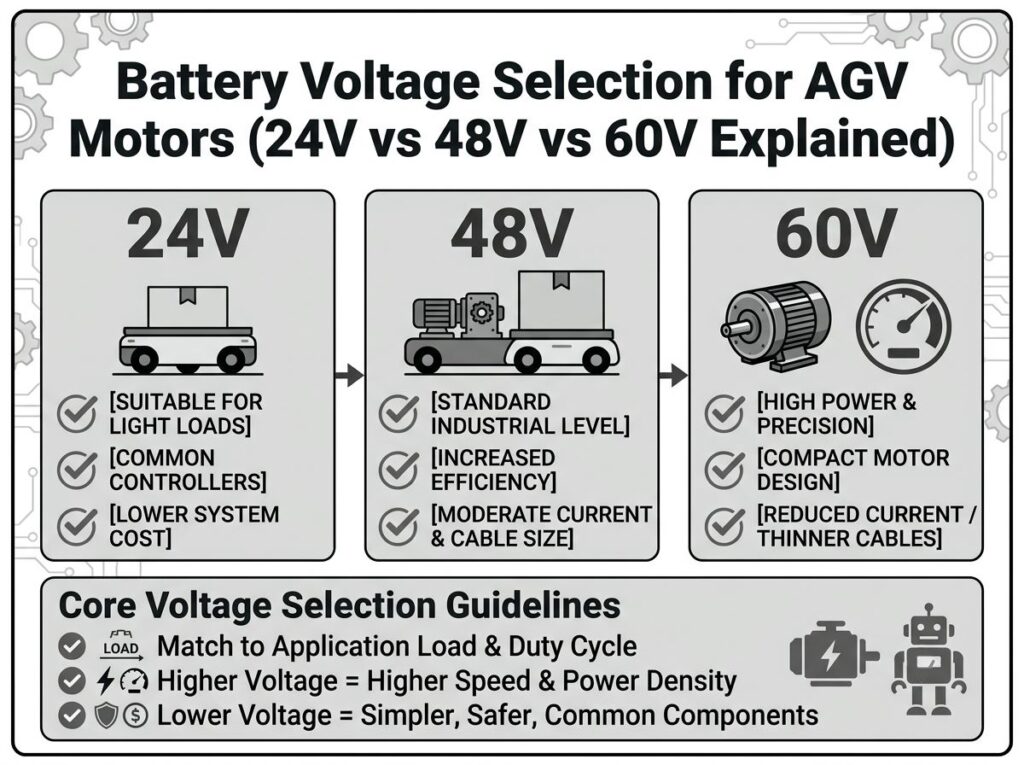
Battery Voltage Selection for AGV Motors: 24V vs 48V vs 60V Explained
Voltage is not a feature of the motor — it is a system-stability parameter for the whole AGV. This guide explains how 24V, 48V and 60V battery platforms change current, wiring, panas, safety and cost, and gives you a defensible rule for picking the right bus for your vehicle.
Jawapan Pantas
For the same power, current scales as I = P / V — so a 48V AGV motor draws half the current of a 24V unit, which quarters the I²R copper loss in the wiring, allows thinner cable and smaller connectors, and runs cooler. The practical rule: ≤500 W → 24V (small sub-300 kg AMRs), 500 W–2 kW → 48V (the warehouse default, comfortably below the 60 V DC SELV safety limit), dan ≥1.5 kW or 1.5–3 t payload → 60V/72V (forklift-class, at the SELV boundary so it needs proper isolation).
Motor efficiency itself (85–92% BLDC) is set by the winding, not the bus; higher voltage only improves sistem efficiency through lower distribution loss. Both are governed by IEC 60034-1 duty and IEC 60034-30-1 / TIADA MG 1 kecekapan, not by a mandated battery voltage.
Kandungan Halaman
TogolWhat “AGV Motor Voltage” Actually Means
An AGV is a battery vehicle. Its drive motor runs from a DC bus — almost always 24V, 48V or 60V nominal — with no connection to AC mains. The motor does not “know” the bus voltage as a quality; rather, the bus voltage sets how much semasa must flow to deliver a given power, and current is what drives wiring size, connector rating, heating and EMI. As one AGV drive supplier puts it, voltage is a system stability parameter, not a function parameter.
The three platforms in play:
| Platform | Nominal bus | Typical cell stack | Common payload / kuasa |
|---|---|---|---|
| 24V | 24 V DC (≈20–29 V operating) | 7S/8S Li-ion or 8S LiFePO4 | <300 kg, ≤500 W |
| 48V | 48 V DC (≈40–58 V operating) | 13S/14S Li-ion or 16S LiFePO4 (51.2 V) | 300–1500 kg, 500 W–2 kW |
| 60V | 60 V DC (≈50–72 V operating) | 16–17S Li-ion or 19–20S LiFePO4 | 1.5–3 t, ≥1.5 kW |
For the wider motor-selection picture, see Motor for AGV dan Cara Memilih Motor untuk Aplikasi AGV.
How Voltage Drives the Whole Powertrain — Step by Step
Step 1 — Power sets the current
Electrical power is P = V × I, so for a fixed power the current is I = P / V. A 1 kW load pulls about 42 A at 24V but only ~22 A at 48V and ~17 A at 60V. Halve the voltage, double the current.
Step 2 — Current sets the wiring loss
Copper loss in any conductor is P_loss = I² × R. Because current doubles when voltage halves, the harness loss at 24V is four times that at 48V for the same power and same wire. Higher voltage is the cheapest way to cut distribution loss — no thicker wire required.
Step 3 — Current sets wire gauge and connectors
Real product data confirms it: a 48V 1000W BLDC draws ~22 A and is happy on 14 AWG with standard connectors; the same 1000W at 24V would need roughly 42 A — 8–10 AWG and industrial connectors. A 48V 400W unit runs at ~10 A; the identical 400W at 24V needs ~20 A.
Step 4 — Voltage sets no-load speed
For a given winding, no-load speed is proportional to bus voltage: n₀ = kₙ × V. Maxon’s EC 45 flat, contohnya, has a speed constant of 121 rpm/V, so the 48V version idles near 5800 rpm while the 24V version idles near 2900 rpm. Gear ratio then maps motor speed to wheel speed.
Step 5 — Voltage meets the safety limit
IEC/UL 62368-1 defines SELV (Safety Extra-Low Voltage) as 60 V DC ripple-free. 24V and 48V sit comfortably inside; 60V is right at the boundary, so operator-accessible 60V systems need isolation, guarding and careful connector selection. Above 60V you are in low-voltage (LV) territory with full high-voltage engineering.
24V vs 48V vs 60V AGV Motor — Feature Comparison
| Parameter (untuk 1 kW drive) | 24V platform | 48V platform | 60V platform |
|---|---|---|---|
| Continuous current | ~42 A | ~22 A | ~17 A |
| Harness I²R loss (same wire) | 4× (baseline) | 1× | ~0.6× |
| Typical cable | 8–10 AWG | 14 AWG | 14–16 AWG |
| SELV safety (IEC/UL 62368-1) | Inside (safe) | Inside (safe) | At 60V boundary — design care |
| Controller cost | Lowest | Mid | Higher |
| Best payload | <300 kg | 300–1500 kg | 1.5–3 t |
| Best power band | ≤500 W | 500 W–2 kW | ≥1.5 kW |
| Battery ecosystem maturity | Good | Widest (default) | Good (heavy only) |
| EMI / heating risk | Highest current | rendah | Lowest |
Data Kejuruteraan & Formula
Current and loss math
| Quantity | Formula | Notes |
|---|---|---|
| Bus current | I = P / (V × η) | η = system efficiency (~0.8–0.92) |
| Harness copper loss | P_loss = I² × R_wire | Halving V → 4× loss at fixed R |
| Kelajuan tanpa beban | n₀ = kₙ × V | kₙ in rpm/V (Maxon 121 rpm/V) |
| Tork motor | T = Kₜ × I | Kₜ rises with voltage for same frame |
| Voltage drop on cable | ΔV = I × R_wire | Long runs need higher V or thicker wire |
| Wiring size rule | I_24 ≈ 2 × I_48 (same P) | ≈2 AWG steps thicker at 24V |
Worked example — 1 kW warehouse AGV
Diberi: 1000 W drive, η = 0.88, 48V bus, 5 m of 14 AWG cable (R ≈ 0.041 Ω/m → 0.205 Ω loop).
- semasa: I = 1000 / (48 × 0.88) = 23.7 A
- Harness loss: P_loss = 23.7² × 0.205 = 115 W (≈11.5% of power burned in cable)
- Same 1000 W at 24V: I ≈ 47.3 A; P_loss = 47.3² × 0.205 = 459 W — four times the loss, dan 14 AWG would overheat
- Kesimpulan: 48V saves ~344 W of pure cable heating and lets you keep light 14 AWG. At 24V you must jump to ~8 AWG to stay safe.
Efficiency and thermal picture
| Item | 24V | 48V | 60V |
|---|---|---|---|
| Motor efficiency (BLDC) | 85–92% | 85–92% | 85–92% |
| System loss (harness) | Highest | rendah | Lowest |
| Connector / contactor heating | Highest (double current) | rendah | rendah |
| Net battery runtime | Shortest for equal power | Longer | Longest |
Note the key point: yang motor efficiency is identical across voltages — only the distribution efficiency changes. Winding temperature is still bounded by insulation class (IEC class F = 155 °C, class H = 180 °C; Maxon caps at +125 °C, FAULHABER at +150 °C), independent of bus voltage. See AGV Motor Efficiency and Battery Runtime for the runtime impact.
Duty-cycle relevance (IEC 60034-1)
| Duty | Behaviour | Voltage note |
|---|---|---|
| S1 | Continuous, thermal equilibrium | High current (24V) worsens harness heating in S1 |
| S3 / S4 | Intermittent / frequent start | Startup current 2–3× rated; brutal on 24V wiring |
| S5 | Intermittent with braking | Regen can spike bus voltage — watch 60V headroom |
Manufacturer benchmark data
| Source | produk / note | Key figures |
|---|---|---|
| Maxon | EC 45 flat (18/24/36/48V); EC frameless 65S/65M | 48V: 1.48 A rated, gerai 13 A, Kt 78.6 mNm/A, kn 121 rpm/V; frameless 727–1190 mNm @ 48V |
| FAULHABER | BP4 / BX4 brushless (12–48V) | Up to 91% atau; −40…+125 °C; analog Hall option; 2264W048BP4 @ 48V |
| Yaskawa | Σ-7 mini (DC 24V/48V); Σ-7 standard | Σ-7 mini DC-supply for AGV/battery; 17-bit encoder; Σ-7 std 24-bit, 3.1 kHz, 350% overload 3–5 s, STO SIL3 |
Best Voltage Platform for Each AGV Type
| AGV type | Recommended | Why |
|---|---|---|
| Light shelf / latent AMR (<300 kg) | 24V | Low power ≤500W; cheapest controllers; short cable runs |
| Warehouse towing / pallet (300–1500 kg) | 48V | Default; below SELV; widest battery/controller choice |
| Forklift / heavy AGV (1.5–3 t) | 60V / 72V | ≥1.5 kW; manageable current; long cable runs |
| Outdoor / port hauler (>3 t) | 72V–96V | Very high power; LV engineering required |
| Cost-sensitive prototype | 24V | Controller BOM lowest; accept heavier wiring |
| Battery-swappable fleet | 48V | Mature 16S LFP (51.2V) packs; fast-charge ecosystems |
For platform-level guidance, see Jenis AGV yang Digunakan di Gudang Moden dan Jenis Motor Terbaik untuk AGV dan Robot Mudah Alih.
Langkah demi Langkah: Choosing 24V, 48V or 60V for Your AGV
- Compute power demand. Cruise power × 2 kepada 2.5 (startup and ramp spikes). See Panduan Pengiraan Tork Motor AGV.
- Map power to voltage. ≤500 W → 24V; 500 W–2 kW → 48V; ≥1.5 kW → 60V/72V.
- Check continuous current. I = P / (V × η). Confirm your connector and cable rating with the 2–3× startup multiplier.
- Budget voltage drop. ΔV = I × R on the longest run; if drop >3–5% at 24V, move to 48V or thicken the wire.
- Verify SELV. Keep ≤48V if the bus is operator-accessible; 60V needs isolation/guarding by IEC/UL 62368-1.
- Match the battery. 48V → 16S LiFePO4 (51.2V) or 13S/14S Li-ion; 24V → 8S LFP; 60V → 19–20S LFP.
- Rate the controller. V range must cover discharge floor to regen peak; 60V buses spike on braking.
- Derate for ambient. Hot warehouses cut permissible current 10–15% at 40 °C; specify class F/H. See Berapa Banyak Tork yang Diperlukan oleh AGV?.
Validate speed mapping with Panduan Pemilihan Kelajuan Motor dan RPM AGV.
Common Engineering Mistakes
| Mistake | Consequence | Correct approach |
|---|---|---|
| Choosing 24V to “save controller cost” | 2× current → heavy cable, hot connectors, EMI | Compare total BOM; 48V often wins on wiring+reliability |
| Ignoring voltage drop on long runs | Motor starves at end of cable | Raise V or thicken wire; budget ΔV <5% |
| Running 60V without isolation | SELV boundary violation, shock risk | Isolate/guard per IEC/UL 62368-1 |
| Mixing 24V and 48V subsystems | Bus conflict, burnt electronics | Use isolated DC-DC converters |
| Sizing wire on rated current only | Connector melt on startup (2–3×) | Size for peak current + margin |
| Forgetting ±10% / battery sag | Undervoltage trip under load | Size bus with discharge floor in mind |
| Skipping regen headroom | Controller overvoltage on braking | Add bus clamp; 60V needs more headroom |
Jadual Penyelesaian Masalah
| Masalah | sebab | Penyelesaian | Platform |
|---|---|---|---|
| Overheating connectors | Current too high for gauge | Move to 48V or upsize cable | 24V |
| Voltage sag under load | Battery C-rate / cable drop | Higher V, thicker wire, bigger cells | 24V/48V |
| Controller overvoltage on regen | Bus spikes above rating | Bus clamp; more headroom at 60V | 60V |
| EMI / comms drops | High di/dt at low voltage | Raise V, shield, filter | 24V |
| Stall at startup | Voltage too low for torque | Raise V or gear ratio; check peak current | 24V |
| Undervoltage trip | Discharge floor below controller min | Right cell count; 16S LFP for 48V | 48V |
| Shock risk on service | 60V bus exposed | Isolate/guard; training + PPE | 60V |
| Short battery runtime | I²R loss in harness | Higher V reduces distribution loss | 24V |
Frequently Asked Questions
For the same power, 48V draws half the current of 24V (P = V x I). That quarters the I-squared-R copper loss in the wiring, allows thinner/cheaper cable and connectors, runs cooler and emits less EMI. 24V only wins on controller cost and is best below ~500 W or for very small sub-300 kg AGVs. Above 500 W, 48V is the better system-stability choice.
48 V DC is the default for warehouse and factory AGVs in the 300-1500 kg payload range and 500 W-2 kW power band. It sits comfortably below the 60 V DC SELV safety limit, has the widest battery and controller ecosystem (13S/14S Li-ion or 16S LiFePO4), and avoids the high-voltage engineering needed above 60 V.
Choose 60 V (atau 72 V) when continuous power exceeds ~1.5 kW, payload is 1.5-3 t (forklift-class), cable runs are long, or peak current would be unmanageable at 48 V. 60 V sits right at the SELV DC boundary, so the design needs proper isolation and guarding; it is common on heavy transfer carts and unmanned forklifts.
No — the motor’s electrical-to-mechanical efficiency (biasanya 85-92% for BLDC) depends on the winding and magnetics, not the bus voltage. What improves with higher voltage is system efficiency: less I-squared-R loss in the harness and connectors, and lower controller conduction loss. The motor simply trades current for voltage to deliver the same power.
No. IEC 60034-1 and NEMA MG 1 govern thermal duty (S1-S10), efficiency classes (IE1-IE5 / NEMA Premium) and a rated-voltage tolerance of about +/-10%, but they do not mandate a battery bus. The 60 V DC safety limit comes from IEC/UL 62368-1 (SELV). Voltage choice is a system-design decision based on power, cable length and safety, not a code requirement.
Size the harness for the continuous current I = P / (V x efficiency), then add the starting/peak multiplier (typically 2-3x rated, sometimes 3x for servo systems). Because current doubles when you halve the voltage, a 1 kW load needs roughly 42 A at 24 V but only ~22 A at 48 V — so 24 V demands much heavier gauge and connectors for the same power.
Why Choose GreenSky Power for Your AGV Motor?
GreenSky Power has designed and manufactured BLDC and servo motion systems for AGV and AMR builders since 2011, supplying OEM customers in over 50 negara. For the battery-voltage decision and the motor itself, we provide:
- 24V / 48V / 60V platforms, engineered per role. Light sub-300 kg AMRs on 24V, warehouse fleets on 48V, and forklift-class units on 60V — each with matched controller and gearbox.
- System-level sizing, not just a motor. We compute bus current, cable drop and connector rating so your harness is safe under 2–3× startup current. Start at Motor for AGV dan Berapa Banyak Tork yang Diperlukan oleh AGV?.
- FOC traction as standard. Sinusoidal Field-Oriented Control for ~5% more continuous torque and clean low-speed motion. Pair with planetary gearboxes (see Gear Motor vs Direct Drive for AGVs dan Spur vs Planetary Gear Motor).
- Standard compliance. All motors tested per IEC 60034 dan GB/T 755 with dynamometer reports; insulation class F (155 °C) standard, H available for hot cells.
- Battery focus. IE3/IE4-capable BLDC platforms and planetary drives for maximum runtime; see AGV Motor Efficiency and Battery Runtime.
- Global supply. Experienced with EU CE/LVD/EMC and North-American compliance for OEM AGV Motor Manufacturing and export.
Rujukan & Authority Sources
- IEC 60034-1:2022 — Rotating electrical machines, duty types S1–S10 and thermal classification: webstore.iec.ch — IEC 60034-1:2022
- IEC 60034-30-1:2014 — Efficiency classes IE1–IE5 for low-voltage motors: webstore.iec.ch — IEC 60034-30-1:2014
- IEC SELV definition — Safety Extra-Low Voltage limit 60 V DC (IEC 62368-1 / IEC 61140): std.iec.ch — IEC SELV glossary (60 V DC)
- TIADA MG 1-2021 - Motor dan Penjana, efficiency classes & ±10% voltage tolerance: nema.org — NEMA MG 1-2021
- U.S. DOE 10 CFR Part 431 — Energy efficiency program for electric motors (IE4 expansion from 2027): ecfr.gov — 10 CFR Part 431
- IEEE Transactions on Automation Science and Engineering — Energy Optimization of Large-Scale AGV Systems (2021, DOI:10.1109/TASE.2019.2963285): doi.org/10.1109/TASE.2019.2963285
- IEA Energy Efficiency 2025 — industrial motor systems and IE-class policy: iea.org — Energy Efficiency 2025 (PDF)
- SKF Energy Efficient (E2) deep-groove ball bearings for motors: skf.com — E2 Electric Motors Offer Sheet (PDF)
- Siemens — industrial motor systems and digital manufacturing for electric motors: siemens.com — Motors & Sistem Pemacu
- Maxon — EC frameless brushless DC motor (24/36/48V, Hall + sinusoidal commutation): maxongroup.com — Maxon EC 45 flat datasheet (PDF)
Related: BLDC lwn Servo Motors untuk AGV · AGV Wheel Motor Design Explained · AGV lwn AMR: What’s the Difference?