
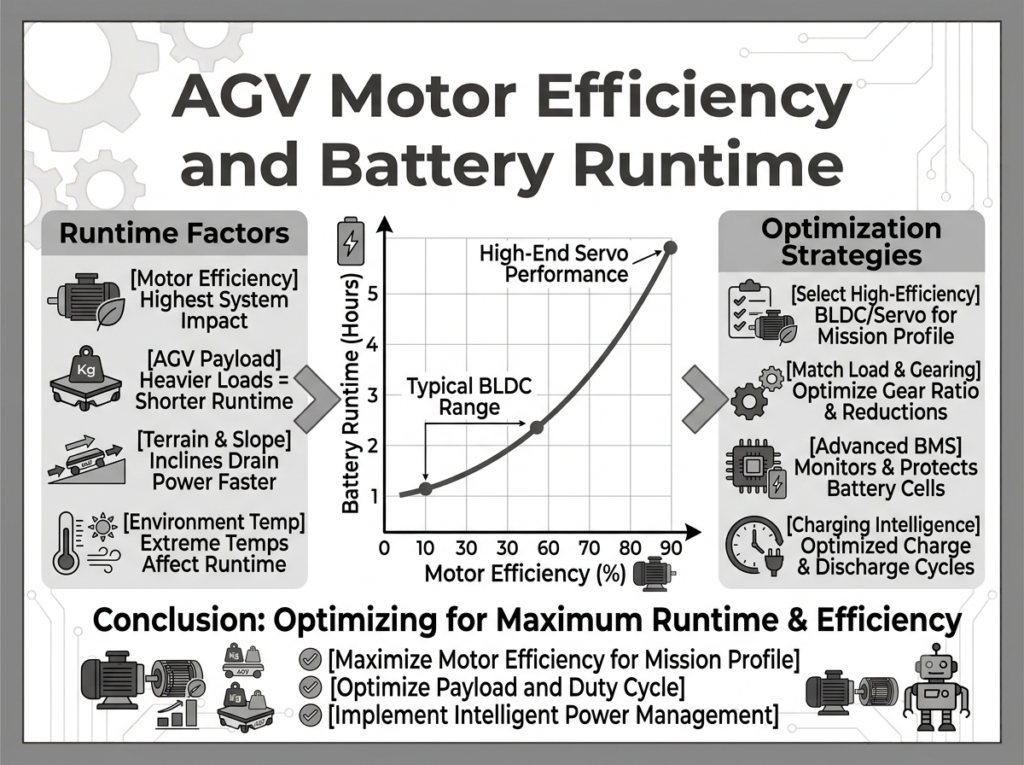
AGV Motor Efficiency and Battery Runtime: Engineering Guide & Formula
Kandungan Halaman
TogolQuick Answer
AGV motor efficiency is the single largest determinant of battery runtime after the battery itself. A BLDC motor operating at 90% kecekapan paired with a planetary gearbox at 94% yields a combined drivetrain efficiency of ~85%, meaning only 15% of battery energy is lost as heat in the power chain. By contrast, a brushed DC motor at 75% with a worm gear at 70% loses nearly half the battery’s energy before it reaches the wheel.
For a typical 48V AGV drawing 360W average, improving overall efficiency from 70% kepada 85% extends runtime from 6.7 hours to 8.1 hours on the same 100Ah battery pack—a 21% runtime gain with zero battery cost increase. Per IEC 60034-30-1, selecting IE3 or IE4-class motors ensures minimum efficiency floors that directly translate to longer AGV uptime per charge cycle.
What Is AGV Motor Efficiency and Battery Runtime?
AGV Motor Efficiency
Motor efficiency (atau) is the ratio of mechanical power output to electrical power input, expressed as a percentage. In AGV applications, this metric must be evaluated at the actual operating point—not the peak efficiency point on the datasheet—because AGVs operate across widely varying loads (empty vs. fully loaded, acceleration vs. cruise, flat vs. ramp).
| Jenis Motor | Peak Efficiency | Typical AGV Operating Efficiency | Key Loss Mechanism |
|---|---|---|---|
| BLDC (DC tanpa berus) | 85–95% | 78–90% | Copper (I²R) + iron losses |
| BLDC with FOC control | 88–95% | 82–92% | Reduced copper losses via optimal flux |
| DC berus | 60–85% | 55–75% | Brush friction + commutation losses |
| AC Induction (with VFD) | 70–90% | 65–82% | Rotor slip + magnetizing current |
| PMSM (permanent magnet synchronous) | 90–96% | 85–93% | Minimal—highest efficiency class |
Battery Runtime
Battery runtime is the duration an AGV can operate on a single charge, determined by the relationship between battery energy capacity and the AGV’s average power consumption. It is not simply a battery specification—it is a system-level outcome influenced by motor selection, gearbox type, control strategy, duty cycle pattern, environmental conditions, and auxiliary loads.
| Parameter | Symbol | Unit | AGV Typical Range |
|---|---|---|---|
| Battery capacity | C | Ah | 40–300 |
| System voltage | V | V (DC) | 24 / 48 / 72 |
| Average power draw | Pavg | W | 150–2,000 |
| Overall efficiency | atautotal | % | 60–88 |
| Usable battery energy | Eusable | Wh | 960–14,400 |
| Runtime per charge | t | Jam | 4–16 |
The Power Chain: Where Efficiency Is Lost
| Power Chain Stage | Efficiency Range | Loss Type | Impact on Runtime |
|---|---|---|---|
| Battery discharge | 95–98% | Internal resistance (IR) losses | 2–5% runtime loss |
| Motor controller/driver | 92–98% | Switching + conduction losses | 2–8% runtime loss |
| Motor (electrical → mechanical) | 75–95% | Copper (I²R) + iron + friction | 5–25% runtime loss |
| Kotak gear (torque conversion) | 70–97% | Gear mesh friction + pelinciran | 3–30% runtime loss |
| Wheel/floor interface | 85–96% | Rolling resistance | 4–15% runtime loss |
Key Insight: The cumulative efficiency of the entire chain multiplies. A BLDC motor (90%) × planetary gearbox (94%) × controller (96%) × battery (97%) = 78.5% overall. Replacing any single component with a lower-efficiency alternative degrades the entire chain multiplicatively, not additively.
Bagaimana Ia Berfungsi: Power Flow from Battery to Wheel
Step 1: Battery Energy Release
The battery pack (typically LiFePO₄ or NMC at 24V/48V/72V) stores chemical energy and releases it as DC electrical power. During discharge, internal resistance causes a voltage drop proportional to current draw: Vterminal = Voc − I × Rinternal. Higher current draw (from inefficient motors or heavy loads) increases this IR loss, reducing usable energy. At 48V and 20A draw, a battery with 30mΩ internal resistance loses 12W as heat—energy that never reaches the motor.
Step 2: Controller Conversion and Commutation
The motor controller converts DC battery power into the phased AC waveform required by BLDC or PMSM motors. Modern controllers use PWM (pulse-width modulation) at 8–20 kHz switching frequency with MOSFET or GaN switching elements. Controller efficiency depends on:
| Controller Loss Source | Typical Loss | Mitigation |
|---|---|---|
| MOSFET conduction (RDS(on)) | 1–3% | Lower RDS(on) devices, parallel MOSFETs |
| Switching losses | 0.5–2% | Optimize PWM frequency, use GaN/SiC |
| Gate drive losses | 0.1–0.5% | Efficient gate driver ICs |
| Dead-time losses | 0.2–1% | Minimize dead-time, adaptive dead-time control |
Step 3: Motor Electromechanical Conversion
The motor converts electrical power into mechanical torque via electromagnetic interaction. In a BLDC motor, the controller’s commutation logic energizes stator phase windings in sequence, creating a rotating magnetic field that interacts with the rotor’s permanent magnets. The efficiency of this conversion depends on the match between the motor’s design speed-torque characteristics and the AGV’s actual operating point.
Key motor loss components:
| Loss Category | Formula | AGV Impact |
|---|---|---|
| Copper loss (stator winding) | Pcu = I² × Rfasa | Dominant at high torque/low speed (acceleration, ramp climbing) |
| Iron loss (core) | Pfe = kh × f + ke × f² | Dominant at high speed/light load (cruise, empty travel) |
| Geseran & windage | Pfriction = Tfriction × ω | Relatively constant; bearing quality dependent |
| Stray load losses | 0.5–1.5% of rated power | Difficult to model; included in efficiency testing |
Step 4: Gearbox Torque Conversion
The gearbox trades speed for torque, matching the motor’s high-RPM/low-torque output to the wheel’s low-RPM/high-torque requirement. Gearbox efficiency is primarily determined by gear type, nisbah, and number of stages:
| Gearbox Type | Efficiency per Stage | Typical Stages for AGV | Combined Efficiency |
|---|---|---|---|
| Planetary | 90–97% | 2–3 | 81–91% |
| Spur (parallel shaft) | 85–95% | 2–3 | 72–86% |
| Helical | 92–97% | 2–3 | 85–91% |
| Worm | 40–85% | 1 | 40–85% |
| Harmonic (strain wave) | 70–90% | 1 | 70–90% |
Step 5: Wheel-to-Ground Traction
The final efficiency stage is rolling resistance at the wheel-floor interface. Polyurethane wheels on smooth concrete have a rolling resistance coefficient (Crr) of 0.008–0.015, while rubber wheels on rough surfaces can reach 0.02–0.03. The power consumed by rolling resistance is: Prr = m × g × Crr × v, where m is total AGV mass (vehicle + payload), g is gravitational acceleration, and v is travel speed.
Jadual Perbandingan: Motor and Drivetrain Configurations for AGVs
| Parameter | BLDC + Planetary Gear | BLDC Direct Drive | DC berus + Gear | AC Induction + VFD | PMSM + Planetary |
|---|---|---|---|---|---|
| Motor peak efficiency | 85–95% | 88–95% | 60–85% | 70–90% | 90–96% |
| Typical AGV operating efficiency | 78–90% | 82–92% | 55–75% | 65–82% | 85–93% |
| Gearbox efficiency | 81–91% (2-pentas) | 100% (no gearbox) | 72–91% | 72–91% | 81–91% |
| Combined drivetrain efficiency | 63–82% | 82–92% | 40–68% | 47–75% | 69–85% |
| Controller efficiency | 92–98% | 92–98% | 85–95% (simple) | 88–96% (VFD) | 92–98% |
| End-to-end efficiency (battery→wheel) | 57–75% | 72–85% | 32–58% | 38–65% | 61–76% |
| Battery runtime (relative, same pack) | Baseline (1.0×) | 1.15–1.25× | 0.55–0.75× | 0.65–0.85× | 1.05–1.15× |
| Maintenance requirement | rendah (bearing-only) | Very low | Tinggi (brush replacement) | rendah | rendah |
| kos (relative) | 1.0× | 1.3–1.8× | 0.5–0.7× | 0.8–1.2× | 1.5–2.0× |
| Best AGV application | General warehouse AGV | Precision AMR, cleanroom | Budget, light-duty AGV | Heavy-load industrial AGV | High-end AMR, long-range |
Engineering Data: Kecekapan, Temperature Limits, and Power Formulas
IEC 60034-30-1 Efficiency Classes for AGV Motors
The IEC 60034-30-1 standard defines International Efficiency (IE) classes for line-operated AC motors. While primarily designed for grid-connected motors, the classification framework is widely referenced for BLDC and PMSM motors used in AGV applications.
| IE Class | Level | Typical η (1.5 kW, 4-tiang) | Typical η (7.5 kW, 4-tiang) | AGV Relevance |
|---|---|---|---|---|
| IE1 | Standard | 77.2% | 84.7% | Obsolete; not recommended for AGVs |
| IE2 | Tinggi | 82.8% | 88.7% | Minimum acceptable for budget AGVs |
| IE3 | Premium | 85.3% | 90.4% | Standard for modern AGV BLDC motors |
| IE4 | Super Premium | 87.7% | 92.0% | Target for long-range AGVs/AMRs |
| IE5 | Ultra Premium | ~89% | ~93% | Emerging; future AGV standard |
Source: IEC 60034-30-1:2014 efficiency values for 4-pole, 50 Hz induction motors. BLDC and PMSM motors in AGV applications typically exceed these values by 3–8 percentage points due to permanent magnet rotors eliminating rotor copper losses.
IEC 60034-1 Duty Cycle Classes Mapped to AGV Operations
| Duty Class | Description | AGV Application Scenario | Thermal Impact on Efficiency |
|---|---|---|---|
| S1 | Continuous duty | 24/7 line-following AGV in distribution center | Motor reaches thermal equilibrium; efficiency stabilized at rated temperature |
| S2 | Short-time duty | Intermittent transfer AGV (cth., 30 min run, long rest) | Motor never reaches thermal equilibrium; higher short-term efficiency |
| S3 | Intermittent periodic | Warehouse pick-and-place AGV (40% on-time) | RMS torque governs thermal loading; efficiency varies per cycle |
| S4 | Intermittent with starting | AGV with frequent starts/stops at workstations | Starting current surges increase copper losses; average efficiency drops 2–5% |
| S6 | Continuous with intermittent load | AGV conveyor running continuously with varying payload | Load-dependent efficiency; motor runs cooler during empty phases |
| S9 | Non-sinusoidal varying load/speed | AMR with dynamic navigation and variable speed | Most realistic AGV profile; requires RMS calculation across full mission cycle |
NEMA MG 1 Efficiency Standards
NEMA MG 1 (Motors and Generators) is the North American equivalent of IEC 60034. Jadual 12-12 defines NEMA Premium efficiency levels, which are functionally equivalent to IE3.
| HP | NEMA Standard Efficiency (Jadual 12-11) | NEMA Premium Efficiency (Jadual 12-12) | IEC Equivalent |
|---|---|---|---|
| 1 HP (0.75 kW) | ~75.5% | ~82.5% | IE2 / IE3 |
| 5 HP (3.7 kW) | ~84.0% | ~89.5% | IE3 |
| 10 HP (7.5 kW) | ~86.5% | ~91.7% | IE3 |
| 25 HP (18.5 kW) | ~89.5% | ~93.6% | IE3 |
| 50 HP (37 kW) | ~91.0% | ~94.5% | IE3 / IE4 |
Per NEMA MG 1 Section 12.58, the nominal efficiency on the nameplate represents the average efficiency of a population of motors. The minimum efficiency (associated with 20% higher losses) represents the floor for any individual unit. This ±20% tolerance on losses means that actual AGV motor efficiency can vary by 1–2 percentage points from the nameplate value.
Manufacturer Efficiency Data
Maxon EC Motor Series
| Maxon Model | Diameter | Max Efficiency | Tork Dinilai | Speed-Torque Gradient | Thermal Resistance (housing) |
|---|---|---|---|---|---|
| EC-max 30 | 30 mm | 75–82% | 33.4 mNm | 20.6 rpm/mNm | 7.4 K/W |
| EC-max 40 | 40 mm | 76% | 89.6 mNm | 16.5 rpm/mNm | 4.63 K/W |
| EC 60 Flat | 90 mm | 87% | 76 mNm | 0.457 rpm/mNm | 1.3 K/W |
| EC-i 52 (IDX 56) | 52 mm | 86–88% | ~120 mNm | ~0.5 rpm/mNm | ~2.0 K/W |
Maxon Design Principle: The speed-torque gradient (Δn/ΔM) indicates how much speed drops per unit of torque increase. A lower gradient means the motor maintains speed better under load, reducing the current spike needed to compensate—directly improving efficiency in AGV applications with varying payloads. Maxon specifies a ±20% tolerance on this parameter per their technical documentation, which should be factored into AGV battery runtime calculations.
Faulhaber Brushless DC Motors
| Faulhaber Model | Series | Max Efficiency | Torque Constant (kM) | Thermal Resistance (Rth1) | Operating Temp Range |
|---|---|---|---|---|---|
| 2264W048BP4 | BP4 (4-tiang) | 90% | 23.6 mNm/A | 1.2 K/W | −40°C to +125°C |
| 2057S024B | B (2-tiang, ironless) | 84% | 9.46 mNm/A | 2.5 K/W | −30°C to +125°C |
| 4490H048BS | BS (4-tiang) | 88% | 75.6 mNm/A | 0.96 K/W | −30°C to +125°C |
| 1660S036BHS | BHS (2-tiang, high-speed) | 92% | 6.26 mNm/A | 2.1 K/W | −30°C to +125°C |
Faulhaber Operating Area Rule: Faulhaber specifies a thermally coupled condition (Rth2 reduced by 50%) that significantly expands the continuous torque operating area. AGV designers mounting motors to aluminum chassis plates with thermal interface material can achieve this improved thermal performance, directly extending continuous-duty runtime before thermal derating reduces efficiency.
Yaskawa Sigma-7 Servo Systems
| Parameter | Spesifikasi | AGV Efficiency Impact |
|---|---|---|
| Motor efficiency improvement | ~20% heat reduction vs. prior generation | Lower thermal derating → sustained efficiency in continuous operation |
| Speed loop bandwidth | 3.1 kHz | Tighter speed control reduces overcurrent events → less wasted energy |
| DC bus coupling (multi-axis) | Up to 30% energy savings via energy sharing | Regenerated energy from decelerating axis powers accelerating axis |
| Encoder resolution | 24-bit (16M pulses/rev) | Precise commutation → optimal current vector → reduced copper losses |
| Kapasiti beban | 350% for 3–5 seconds | No amplifier oversizing needed → lower continuous losses |
| Ambient temperature range | −5°C to +55°C (60°C with derating) | Consistent efficiency across warehouse temperature variations |
Core Power and Runtime Formulas
1. Battery Runtime Formula
t = (C × V × DoD × ηtotal) / Pavg
di mana:
t = runtime (Jam)
C = battery rated capacity (Ah)
V = system voltage (V)
DoD = depth of discharge (0.8 for LiFePO₄, 0.7 for NMC recommended)
atautotal = overall power chain efficiency (motor × gearbox × controller × battery)
Pavg = average power draw at wheel (W)
2. Average Power Draw (Weighted by Duty Cycle)
Pavg = (Pcruise_loaded × tloaded + Pcruise_empty × tempty + Paccel × taccel + Pidle × tidle) / ttotal
Where each power component:
Pcruise = (m × g × Crr × v) / ataudrivetrain
Paccel = (m × a × v) / ataudrivetrain + Pcruise
3. Overall Power Chain Efficiency
atautotal = ηbateri × ηpengawal × ηmotor × ηkotak gear
Example: 0.97 × 0.96 × 0.90 × 0.94 = 0.786 (78.6%)
4. Battery Capacity Sizing Formula
Crequired = (Pavg × tshift × kkeselamatan) / (V × DoD × ηtotal)
di mana:
kkeselamatan = safety factor (1.2 indoor flat, 1.3–1.4 ramps/frequent starts, 1.4–1.5 outdoor)
tshift = required operating hours per shift
5. Motor Copper Loss
Pcu = I² × Rfasa × 1.5
(1.5 factor for 3-phase BLDC; two phases conducting at any instant)
Example: Maxon EC-max 30 at rated current (0.738 A), R = 1.27 Ω:
Pcu = 0.738² × 1.27 × 1.5 = 1.04 W
At peak current (3.24 A): Pcu = 3.24² × 1.27 × 1.5 = 20.0 W
6. RMS Torque for Intermittent Duty (IEC 60034-1 S3/S4)
TRMS = √[(T₁²×t₁ + T₂²×t₂ + … + Tn²×tn) / (t₁ + t₂ + … + tn)]
TRMS must be ≤ rated continuous torque of the motor.
This determines the thermal-equivalent continuous load for efficiency calculation.
Worked Example: 500 kg Warehouse AGV
| Parameter | Nilai | Unit |
|---|---|---|
| Total mass (vehicle + payload) | 500 | kg |
| Travel speed (cruise) | 1.0 | m/s |
| Wheel diameter | 200 | mm |
| Rolling resistance coefficient (Crr) | 0.012 | — |
| Battery | 48V, 100Ah LiFePO₄ | — |
| Motor | BLDC, 90% kecekapan | — |
| Kotak gear | 2-stage planetary, 94% per stage | — |
| Pengawal | 96% kecekapan | — |
| Kitaran tugas | 70% loaded cruise, 30% empty cruise | — |
Step 1: Calculate ηtotal = 0.97 (bateri) × 0.96 (pengawal) × 0.90 (motor) × 0.94² (2-stage gearbox) = 0.97 × 0.96 × 0.90 × 0.884 = 0.742 (74.2%)
Step 2: Calculate cruise power (loaded):
Ploaded = (500 × 9.81 × 0.012 × 1.0) / 0.742 = 58.86 / 0.742 = 79.3 W
Step 3: Calculate cruise power (empty, 200 kg vehicle):
Pempty = (200 × 9.81 × 0.012 × 1.0) / 0.742 = 23.54 / 0.742 = 31.7 W
Step 4: Calculate weighted average power (including auxiliary loads ~30W):
Pavg = (79.3 × 0.7 + 31.7 × 0.3) + 30 = 55.5 + 9.5 + 30 = 95.0 W
Step 5: Calculate runtime:
t = (100 × 48 × 0.8 × 0.742) / 95.0 = 2,849 / 95.0 = 30.0 Jam
Result: This AGV can operate for approximately 30 hours on a single charge under these conditions. If the motor were replaced with a brushed DC motor at 70% kecekapan, atautotal drops to 0.577, and runtime falls to 23.3 hours—a 22% reduction. Conversely, upgrading to an IE4-class PMSM at 93% efficiency raises ηtotal kepada 0.767 and extends runtime to 31.0 Jam.
Application Scenarios: Best Motor-Efficiency Matches for AGV Types
Warehouse Pallet-Handling AGVs (500–2,000 kg payload)
| Parameter | Recommended Configuration |
|---|---|
| Jenis motor | BLDC with FOC, IE3+ efficiency |
| Kotak gear | 2-stage planetary (nisbah 15:1–30:1) |
| Voltage platform | 48V (optimal current/efficiency balance) |
| Battery | LiFePO₄, 80–200Ah, 3,000+ cycles |
| Kitaran tugas | S3-40% to S3-60% |
| Expected runtime | 8–12 hours per charge |
| Key efficiency driver | Gearbox ratio matching motor sweet-spot RPM to wheel speed |
Precision AMRs (100–500 kg payload)
| Parameter | Recommended Configuration |
|---|---|
| Jenis motor | PMSM with 24-bit encoder, IE4 efficiency |
| Kotak gear | Direct drive or quasi-direct drive (QDD) dengan <5 arcmin backlash |
| Voltage platform | 48V |
| Battery | NMC (high energy density), 40–80Ah |
| Kitaran tugas | S9 (variable speed/load) |
| Expected runtime | 10–16 hours per charge |
| Key efficiency driver | Eliminating gearbox losses via direct drive; regenerative braking recovery |
Heavy-Load Industrial AGVs (2,000–10,000 kg)
| Parameter | Recommended Configuration |
|---|---|
| Jenis motor | PMSM or high-efficiency BLDC, IE4+ |
| Kotak gear | 3-stage heavy-duty planetary (nisbah 50:1–100:1) |
| Voltage platform | 72V–80V (reduces cable losses at high current) |
| Battery | LiFePO₄, 200–400Ah, opportunity charging |
| Kitaran tugas | S1 or S6 (continuous with intermittent load) |
| Expected runtime | 6–10 hours per charge (with opportunity charging breaks) |
| Key efficiency driver | 72V+ platform reduces I²R losses; multi-motor coordination via DC bus coupling |
Cold Storage AGVs (−30°C to 0°C environment)
| Parameter | Recommended Configuration |
|---|---|
| Jenis motor | BLDC with Class H insulation (180°C), low-temp bearings |
| Kotak gear | Planetary with synthetic low-temp lubricant |
| Voltage platform | 48V (36V alternative if cold-weather IR losses are severe) |
| Battery | LTO (lithium titanate) for extreme cold performance |
| Key efficiency challenge | Battery internal resistance increases 2–3× at −20°C, reducing effective capacity by 20–30% |
| Mitigation | Battery heating system; oversized battery by 25%; LTO chemistry (works at −30°C) |
Panduan Pemilihan: Step-by-Step Motor Efficiency and Battery Sizing Process
Step 1: Define the AGV Mission Profile
Document the complete operating cycle including payload range, travel distances, speed requirements, ramp angles, dwell times, and shift duration. The mission profile determines the duty cycle class (IEC 60034-1 S1–S9) that governs thermal modeling.
| Profile Parameter | Example Value | Why It Matters for Efficiency |
|---|---|---|
| Loaded travel time per cycle | 45 saat | Determines copper loss duration |
| Empty travel time per cycle | 30 saat | Lower power; motor may operate below peak efficiency |
| Acceleration time per start | 2 saat | Peak current draw; highest copper losses |
| Stops per hour | 20–30 | Determines S4 duty classification; regenerative recovery potential |
| Shift duration | 8 atau 16 Jam | Sets battery capacity target |
| Charging strategy | Opportunity / shift-change / swap | Determines required runtime per charge |
Step 2: Calculate Required Wheel Power
Compute the mechanical power needed at the wheel for each operating mode:
Proda = (Ftotal × v) / ataudrivetrain
Ftotal = Frolling + Fgrade + Faccel
Frolling = m × g × Crr
Fgrade = m × g × sin(θ)
Faccel = m × a
Step 3: Select Motor Type and Efficiency Class
| AGV Requirement | Recommended Motor | Min. Kelas kecekapan | Rationale |
|---|---|---|---|
| Standard warehouse, 8h shift | BLDC + gear planet | IE3 (≥85%) | Best cost-to-efficiency ratio for mainstream applications |
| Long-range AMR, 16h shift | PMSM or BLDC DD | IE4 (≥88%) | Each efficiency point extends runtime ~1.5% |
| Budget AGV, light duty | BLDC + spur gear | IE2 (≥82%) | Acceptable efficiency at lower cost; shorter runtime acceptable |
| Cold storage AGV | BLDC, Class H insulation | IE3 (≥85%) | Compensates for battery capacity loss at low temperature |
| Heavy industrial, 24/7 | PMSM + 3-stage planetary | IE4 (≥90%) | Continuous duty maximizes efficiency gain ROI |
Step 4: Determine Gearbox Ratio for Efficiency Sweet Spot
The gearbox ratio should place the motor’s operating point near its peak efficiency RPM. Most BLDC motors achieve peak efficiency at 60–80% of rated speed. For an AGV wheel speed of 100 RPM and a motor rated at 4,000 RPM, a 40:1 ratio places the motor at 4,000 RPM—but the efficiency sweet spot may be at 2,800 RPM (70%), suggesting a 28:1 ratio with a slightly larger motor.
| Operating Point | Motor Efficiency | Implication |
|---|---|---|
| 10% of rated speed | 40–60% | Very low efficiency; avoid sustained low-speed operation |
| 30% of rated speed | 65–80% | Improving but below optimal for battery-powered AGVs |
| 60–80% of rated speed | 85–95% | Peak efficiency zone; target this range for cruise operation |
| 100% of rated speed | 80–90% | Iron losses begin to dominate; efficiency drops slightly |
| 120%+ of rated speed | 70–85% | Rapid iron loss increase; avoid for sustained operation |
Step 5: Calculate Battery Capacity
Using the formula from Section 5, compute required battery capacity with appropriate safety factor:
| Environment | kkeselamatan | Rationale |
|---|---|---|
| Indoor, flat floor, moderate starts/stops | 1.2 | Standard conditions; minimal power spikes |
| Indoor with ramps (≤5°) or frequent starts/stops | 1.3–1.4 | Acceleration power and grade resistance add 20–30% to average |
| Outdoor or harsh environment | 1.4–1.5 | Temperature extremes, surface irregularities, wind resistance |
Step 6: Evaluate Regenerative Braking Potential
Assess whether the AGV’s duty cycle includes sufficient deceleration events to justify regenerative braking hardware:
| AGV Profile | Start-Stop Frequency | Regen Recovery | ROI Justification |
|---|---|---|---|
| Long-hallway line-following | rendah (<5 stops/hour) | 2–5% | Marginal; standard braking sufficient |
| Warehouse pick-and-place | Medium (15–30 stops/hour) | 5–10% | Justified; extends runtime 30–60 min per shift |
| Dense workstation routing | Tinggi (>30 stops/hour) | 10–15% | Strong ROI; can reduce battery size by one step |
| Ramp-intensive (multi-level) | Variable | 8–15% | Essential; downhill energy recovery significant |
Step 7: Validate with 5-Year Total Cost of Ownership
| TCO Component | BLDC IE3 + Planetary | Brushed DC IE1 + Spur | PMSM IE4 + Direct Drive |
|---|---|---|---|
| Motor + gearbox cost | $400–800 | $200–400 | $1,200–2,500 |
| Battery (to meet 8h runtime) | 100Ah ($1,200) | 140Ah ($1,680) | 90Ah ($1,080) |
| Energy cost (5 yr, 16h/day, $0.12/kWh) | $3,370 | $4,490 | $3,110 |
| Penyelenggaraan (brush/sensor replacement) | $0 | $400–800 | $0 |
| Battery replacement (capacity fade) | $1,200 (1 cycle) | $1,680 (1 cycle, stress) | $1,080 (1 cycle) |
| 5-year TOT | $6,170–6,570 | $8,450–9,450 | $6,470–7,770 |
Common Engineering Mistakes in AGV Motor Efficiency Design
| # | Mistake | Consequence | Correct Approach |
|---|---|---|---|
| 1 | Selecting motor based on peak efficiency only | Motor operates at 40–60% efficiency during cruise because the AGV’s actual operating point is far from the datasheet peak | Evaluate efficiency at the actual cruise RPM and torque; map the full efficiency curve against the mission profile |
| 2 | Undersized gearbox ratio (motor runs too fast) | Motor operates in high-RPM iron-loss-dominated zone, dropping efficiency 5–10% | Calculate ratio to place motor at 60–80% rated speed during cruise |
| 3 | Oversized gearbox ratio (motor runs too slow) | Motor operates in low-RPM high-current copper-loss zone; controller heats up | Verify motor RPM stays above 30% of rated speed during normal cruise |
| 4 | Using 24V where 48V is feasible | Doubles current draw, quadruples I²R losses in cables and windings; 2–4% efficiency penalty | Default to 48V for AGVs above 300 kg payload; reserve 24V for sub-500W applications |
| 5 | Ignoring auxiliary loads in battery sizing | AGV shuts down prematurely because sensors, pengawal, komunikasi, and lighting consume 20–50W unaccounted for | Always add auxiliary power budget (typical: 30–80W) to motor power in capacity calculations |
| 6 | Specifying worm gear for efficiency-critical AGV | 30–60% of motor energy lost in gearbox; runtime reduced by 25–40% | Use planetary gears (90–97% efficiency) for all battery-powered AGV drive wheels |
| 7 | No thermal management for motor/controller | Motor temperature rises above rated, triggering thermal derating; efficiency drops 3–8% at elevated temperature | Provide heatsinking or forced air; specify Class F (155°C) or Class H (180°C) insulation |
| 8 | Disabling regenerative braking to simplify control | 5–15% energy recovery lost; battery must be oversized accordingly | Enable regen in controller firmware; ensure battery BMS supports charge acceptance during regen |
| 9 | Using nameplate efficiency without tolerance | NEMA MG 1 allows ±20% on losses (1–2% efficiency deviation); IEC 60034-1 allows −15% of (1−η) for motors ≤150 kW | Design with minimum efficiency value, not nominal; verify with manufacturer test data |
| 10 | Sizing battery for nominal capacity without DoD limit | AGV can only use 70–80% of rated capacity (LiFePO₄) before BMS cuts off; runtime falls short of calculation | Always multiply by DoD (0.8 for LiFePO₄, 0.7 for NMC) in capacity formulas |
Troubleshooting: AGV Motor Efficiency and Battery Runtime Issues
| Problem | Likely Cause | Penyelesaian | Applicable Configuration |
|---|---|---|---|
| Battery runtime 20%+ shorter than calculated | Auxiliary loads not included in power budget; or motor operating far from peak efficiency | Measure actual current draw with data logger; add auxiliary load budget; recheck motor operating point against efficiency curve | All configurations |
| Motor overheating during continuous operation | Duty cycle exceeds motor’s thermal rating (S1 vs S3); insufficient cooling | Verify IEC 60034-1 duty class matches AGV profile; add heatsinking or select larger frame motor | BLDC, PMSM |
| Efficiency drops after 2–3 hours of operation | Thermal rise increasing winding resistance; copper losses increase with temperature (R increases ~0.4%/°C) | Improve thermal management; specify Class H insulation; reduce continuous torque demand | All motor types |
| Controller thermal shutdown on ramps | Peak current sustained too long during incline climbing; controller MOSFET junction temperature exceeded | Reduce ramp approach speed; select controller with higher current rating; verify thermal interface between MOSFETs and heatsink | All configurations |
| Battery capacity degrades faster than expected | Deep discharge below BMS cutoff; high C-rate discharge stressing cells; operating temperature too high | Set SOC floor to 20%; limit peak discharge C-rate to 2C; ensure battery compartment ventilation | All battery types |
| AGV stalls on ramps it previously climbed | Battery voltage sag under high current reduces available motor torque (torque ∝ current ∝ voltage) | Check battery internal resistance; upgrade to lower-IR cells or higher voltage platform; verify cable gauge | All configurations |
| Inconsistent runtime between identical AGVs | Motor efficiency variation within tolerance band (±20% losses per NEMA MG 1); different tire wear; floor condition variations | Accept natural variation; specify minimum efficiency on purchase orders; normalize runtime by route difficulty | Fleet operations |
| Regenerative braking not recovering expected energy | BMS charge acceptance limit; battery already at high SOC; regen current limited by controller firmware | Verify BMS supports charge during regen; check if regen is current-limited; ensure SOC is below 90% when regen events occur | BLDC, PMSM with regen |
| Motor noise increases and efficiency drops over time | Bearing wear increasing friction; gearbox lubricant degradation; misalignment from mechanical shock | Schedule bearing inspection at 10,000-hour intervals; replace gearbox lubricant per manufacturer schedule | All geared configurations |
| Cold weather runtime reduction of 25–35% | Battery internal resistance increases 2–3× at −20°C; motor lubricant viscosity increases; controller MOSFET RDS(on) changes | Use LTO batteries for extreme cold; specify low-temperature gearbox lubricant; add battery heating system | Cold storage AGVs |
Frequently Asked Questions
1. How does motor efficiency affect AGV battery runtime?
Motor efficiency directly determines how much electrical energy from the battery is converted to mechanical work versus waste heat. A BLDC motor at 90% efficiency versus one at 75% extends battery runtime by approximately 20% for the same energy budget. Across the full power chain (battery → controller → motor → gearbox → wheel), each percentage point of combined efficiency loss shortens runtime proportionally. Sebagai contoh, improving overall chain efficiency from 70% kepada 85% on a 48V/100Ah system increases runtime from 6.7 kepada 8.1 hours—21% more uptime with no battery cost increase.
2. What is the formula for calculating AGV battery capacity?
The core formula is: Capacity (Ah) = Average power draw (W) × Operating hours (h) ÷ System voltage (V) ÷ Overall efficiency. Overall efficiency includes motor efficiency, gearbox efficiency, controller efficiency, and battery discharge efficiency. A safety factor of 1.2–1.5 is typically applied based on operating environment conditions (1.2 for indoor flat, 1.4–1.5 for outdoor/ramp-intensive). Selain itu, the Depth of Discharge (DoD) limit must be applied: for LiFePO₄ batteries, sahaja 80% of rated capacity is usable, so the final formula becomes C = (P × t × k) / (V × DoD × η).
3. Which motor type is most efficient for AGVs?
BLDC (DC tanpa berus) motors paired with planetary gearboxes offer the best efficiency-to-cost ratio for AGVs, achieving 85–95% motor efficiency and 90–97% gearbox efficiency per stage. PMSM (permanent magnet synchronous motor) with IE4 classification offers the highest absolute efficiency (90–96%) but at higher cost. Direct drive BLDC motors eliminate gearbox losses entirely (100% gearbox efficiency) but require higher motor current for equivalent torque. Brushed DC motors (60–85% efficiency) and AC induction motors with VFDs (70–90%) are less efficient and not recommended for new AGV designs where battery runtime is critical.
4. How much energy can regenerative braking recover in AGVs?
Regenerative braking in AGVs typically recovers 5–15% of total energy consumption. The recovery rate depends on the duty cycle profile: AGVs with frequent start-stop cycles in dense warehouse environments benefit most (10–15% recovery), while long-haul line-following AGVs see minimal benefit (2–5%). Ramp-intensive operations recover 8–15% through downhill regeneration. The recovered energy is fed back through the motor controller into the battery during deceleration. For this to work, the battery management system (BMS) must support charge acceptance during regen events, and the controller firmware must be configured to enable regenerative braking.
5. What IEC duty cycle class applies to AGV motors?
AGV motors typically operate under IEC 60034-1 S3 (intermittent periodic duty) or S4 (intermittent periodic duty with starting) classifications. Warehouse AGVs commonly use S3-40% (40% on-time per cycle). Continuous-operation AGVs in 24/7 facilities approach S1 (continuous duty) but with varying loads, making S9 (non-sinusoidal varying load) more accurate for thermal modeling. The duty class determines the RMS torque calculation method, which in turn governs the motor’s thermal loading and steady-state efficiency. Selecting a motor rated for S1 when the AGV actually operates in S4 can lead to thermal overload and efficiency degradation, while over-rating for S1 when S3 applies results in unnecessary cost and weight.
6. How does battery voltage affect AGV motor efficiency?
Higher battery voltage (48V vs 24V) halves the operating current for the same power output (P = V × I), reducing I²R copper losses in cables and motor windings by 75% (losses scale with current squared). This directly improves overall system efficiency. A 48V system typically achieves 2–4% higher end-to-end efficiency than an equivalent 24V system, extending battery runtime proportionally. For heavy AGVs (2,000+ kg), 72V or 80V platforms are recommended to keep current manageable (under 100A) and minimize cable sizing requirements. Namun begitu, higher voltage systems require appropriately rated controllers, contactors, and safety components, which add cost.
Why Choose GreenSky Power for AGV Motor Solutions?
GreenSky Power manufactures BLDC motors and gear motor systems specifically engineered for AGV/AMR applications where efficiency directly translates to battery runtime. Our motor solutions are designed with efficiency optimization at every stage of the power chain:
| GreenSky Advantage | Detail |
|---|---|
| IE3+ efficiency classification | Our 48V BLDC motors achieve 92–95% peak efficiency, certified to IEC 60034-30-1 IE3 standards. The CE-certified 48V BLDC motor series reduces heat generation by 40% versus brushed alternatives, extending LiFePO₄ battery runtime by up to 25%. |
| Matched planetary gearboxes | Pre-aligned 2-stage planetary gearboxes with 90–97% per-stage efficiency, optimized gear ratios that place motor operating points in the 60–80% rated speed sweet spot. See our planetary vs spur gear comparison for efficiency trade-off analysis. |
| FOC-enabled controllers | Field-oriented control algorithms reduce copper losses by maintaining optimal current vector alignment across the full speed-torque range, improving partial-load efficiency by 5–10% over trapezoidal commutation. |
| Thermal design | Class F (155°C) insulation with aluminum housing thermal management; motors maintain rated efficiency at 40°C ambient without derating—a critical factor in continuous-duty AGV torque applications. |
| OEM customization | Custom winding configurations for 24V/36V/48V/72V platforms; integrated encoder solutions (1,000–5,000 PPR); IP65 sealing for washdown environments. kami German AGV case study documents a 25% efficiency improvement and 30% longer battery life. |
Related resources: Explore our complete AGV motor engineering library:
- Motor for AGV: Panduan Pemilihan Lengkap
- Panduan Pemilihan Kelajuan Motor dan RPM AGV
- Berapa Banyak Tork yang Diperlukan oleh AGV?
- BLDC lwn Servo Motors untuk AGV
- Gear Motor vs Direct Drive Motor for AGVs
- AGV lwn AMR: Drive System Comparison
- Motor Pemacu Terus lwn Motor Gear
- Servo Motor vs Stepper Motor
- Atas 5 Suppliers of 36V High Efficiency BLDC Motors
Rujukan
- IEC 60034-1:2022, “Rotating electrical machines — Part 1: Rating and performance,” International Electrotechnical Commission. https://webstore.iec.ch/publication/64884
- IEC 60034-30-1:2014, “Rotating electrical machines — Part 30-1: Efficiency classes of line operated AC motors (IE code).” https://webstore.iec.ch/publication/67587
- NEMA MG 1-2021, “Motors and Generators,” National Electrical Manufacturers Association. https://www.nema.org/standards/view/motors-and-generators
- Leng, J., Peng, J., Liu, J., Zhang, Y., Ji, J., & Zhang, Y. (2024). “Profiling Power Consumption in Low-Speed Autonomous Guided Vehicles,” IEEE Robotics and Automation Letters, vol. 9, no. 7, pp. 6027–6034. DOI: 10.1109/LRA.2024.3396051. https://ieeexplore.ieee.org/document/10386420
- Hanzel, K., Grzechca, D., Ziebinski, A., Chruszczyk, L., & Janus, A. (2023). “Estimating the AGV load and a battery lifetime based on the current measurement and random forest application,” IEEE Big Data 2023, pp. 5057–5063. DOI: 10.1109/BIGDATA59044.2023.10386420. https://ieeexplore.ieee.org/document/10386420/authors
- Jia, S., Yuan, Y., Zhang, R., & Tian, K. (2025). “Research on the Health Status Assessment Method of AGV Lithium Battery,” IEEE ICCNEA 2025. DOI: 10.1109/ICCNEA66167.2025.11212194. https://vufind.katalog.k.utb.cz/SummonRecord/FETCH-LOGICAL-i93t-c9f682dd9388ae35cb1350afda4dc261f9673e50ff60444f5a942dfcfdc6ec303
- Song, X., Chen, N., Zhao, M., Wu, Q., Liao, Q., & Ye, J. (2024). “Novel AGV resilient scheduling for automated container terminals considering charging strategy,” Ocean and Coastal Management, vol. 250. DOI: 10.1016/j.ocecoaman.2023.107014. https://ui.adsabs.harvard.edu/abs/2024OCM…25007014S/abstract
- Zhejiang University of Technology (2025). “Energy-Efficient Scheduling of Multi-Load AGVs Based on the SARSA-TTAO Algorithm,” Sustainability, vol. 17, no. 16, 7353. DOI: 10.3390/su17167353. https://www.mdpi.com/2071-1050/17/16/7353
- Maxon Motor, “EC-max 30 / EC-max 40 / EC 60 Flat Brushless DC Motors — Technical Data,” Maxon EC Catalogue 2024. https://maxonjapan.com/wp-content/uploads/catalogue/EC_2024.pdf
- Faulhaber, “2264W048BP4 Brushless DC-Servomotor — 4 Pole Technology Datasheet.” https://www.faulhaber.com/en/products/series/2264bp4
- Faulhaber, “4490H048BS Brushless DC-Servomotor Series Datasheet.” https://eshop.faulhaber.com/en/4490H048BS/4490H048BS
- Yaskawa Electric Corporation, “Sigma-7 Series AC Servo Drives — Product Brochure.” https://yaskawa.eu.com/_downloads/download_d2718
- Yaskawa America, “Sigma-7 Servo Systems Catalog (BL.Sigma-7.01).” https://www.yaskawa.com/delegate/getAttachment?documentId=BL.Sigma-7.01
- EC&M (Electrical Construction & Penyelenggaraan), “How Precise Are Motor Nameplate Ratings? — NEMA MG 1 and IEC 60034-1 Tolerances.” https://www.ecmweb.com/motors/how-precise-are-motor-nameplate-ratings
- Anaheim Automation, “Gearboxes vs Direct Drive Motors: When to Use Each in Motion Control Systems.” https://anaheimautomation.com/blog/post/gearboxes-vs-direct-drive-motors-when-to-use-each-in-motion-control-systems
- Twirl Motor, “How to Select the Right BLDC Gear Motor for AMR and AGV Robots.” https://www.twirlmotor.com/how-to-select-the-right-bldc-gear-motor-for-amr-and-agv-robots
- Symotor, “What Motors Are Used in AGV Systems and How Do You Choose the Right AGV Drive Motor?” https://www.symotor-hz.com/news/industry-news/what-motors-are-used-in-agv-systems-and-how-do.html
- Retek Motion, “Industrial Brushless DC Motors 24V 48V — Efficiency and Material Selection Guide.” https://www.retekmotion.com/industrial-brushless-dc-motors-24v-48v.html
- DYDZ Motor, “BLDC Gear Motors Explained: How They Work, Where They’re Used, and How to Choose.” https://www.dydzmotor.com/news/industry-news/bldc-gear-motors-explained-how-they-work-where-they-re.html
- IEC Motores, “IE1 vs IE2 vs IE3 vs IE4 Motors: Which Efficiency Class Do You Actually Need?” https://iecmotores.com/ie1-vs-ie2-vs-ie3-vs-ie4-motors-which-efficiency-class-do-you-actually-need/
- Polinovel Power Battery, “AGV Battery Selection Guide: voltan, Kapasiti & Charging Requirements.” https://www.polinovelpowbat.com/info/agv-battery-selection-guide-voltage-capacity-103397018.html