
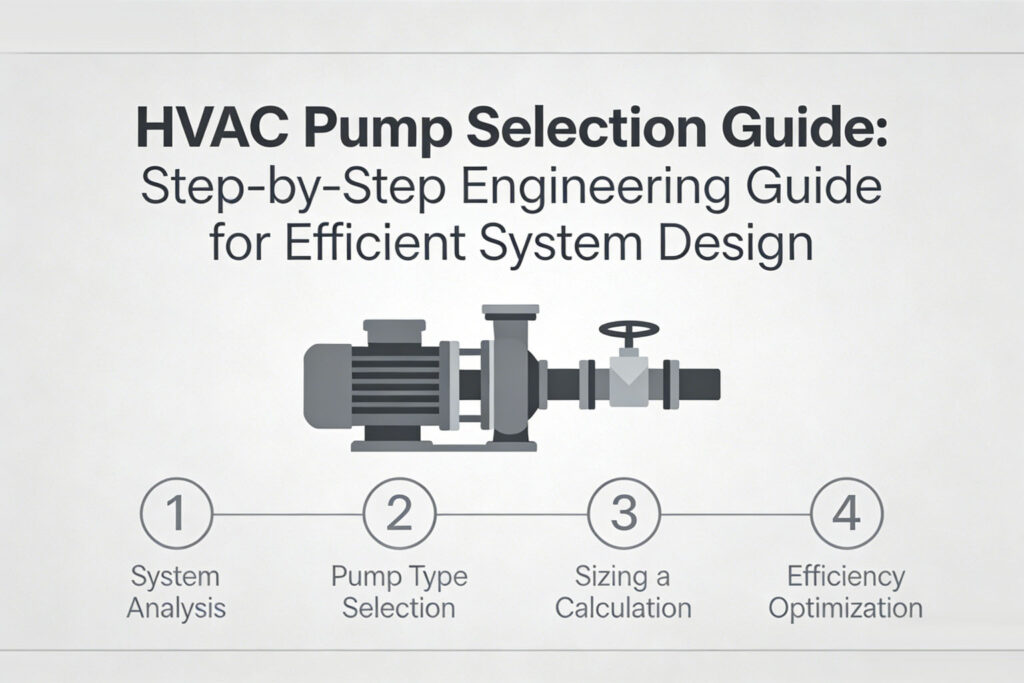
HVAC 펌프 선택 가이드: 효율적인 시스템 설계를 위한 단계별 엔지니어링 가이드
Selecting the right pump is one of the most critical decisions in HVAC system design. Whether for commercial buildings, 산업시설, or data centers, proper pump selection directly impacts system efficiency, 에너지 소비, and long-term operational reliability.
If you are searching for a complete HVAC pump selection guide, this article provides a step-by-step engineering approach, covering pump types, sizing calculations, system design considerations, and practical selection strategies.
This guide is specifically designed for HVAC engineers, 계약자, and OEM manufacturers who need to optimize system performance while minimizing lifecycle costs. It also highlights how advanced motor technologies such as BLDC motors can significantly improve pump efficiency.
추천 스니펫: HVAC 펌프 선택 가이드
To select an HVAC pump, calculate system flow rate and total dynamic head (TDH), then choose a pump that operates near its best efficiency point.
- Determine cooling or heating load
- Calculate required flow rate
- Estimate total dynamic head
- 성능 곡선을 기준으로 펌프 선택
- Choose high-efficiency motor for energy savings
Proper pump selection ensures optimal performance, 에너지 소비 감소, 그리고 긴 시스템 수명.
Why Proper Pump Selection Matters
Incorrect pump selection can significantly impact system performance and operating costs.
대형 펌프
- Excessive energy consumption
- Increased wear and maintenance
- System instability
소형 펌프
- Insufficient flow
- Poor cooling or heating performance
- Reduced system efficiency
Proper selection ensures the pump operates efficiently under real operating conditions.
Types of HVAC Pumps
Different HVAC systems require different types of pumps.
Chilled Water Pumps
Used to circulate chilled water for cooling.
Condenser Water Pumps
Transfer heat from the chiller to the cooling tower.
Hot Water Pumps
Used in heating systems.
Booster Pumps
Increase system pressure where needed.
단계 1: Determine System Load
The first step in pump selection is calculating system load.
냉각 부하
Measured in tons of refrigeration or kW.
Heating Load
Used for hot water systems.
Accurate load calculation is essential for proper system design.
단계 2: Calculate Flow Rate
Flow Rate Formula
Flow (GPM) = Load (BTU/시간) ¶ (500 × ΔT)
예
A 200-ton cooling system with ΔT = 10°F requires approximately 480 GPM.
Flow rate determines how much water the pump must circulate.
단계 3: Calculate Total Dynamic Head (TDH)
TDH represents the resistance the pump must overcome.
TDH의 구성 요소
- Pipe friction loss
- Valve and fitting losses
- 고도 차이
Accurate head calculation ensures correct pump performance.
단계 4: Select Pump Based on Performance Curve
Pump selection is based on manufacturer performance curves.
주요 선택 기준
- Flow rate and head intersection point
- Best efficiency point (BEP)
- 소비전력
Select a pump that operates close to its BEP for maximum efficiency.
단계 5: Choose Pump Configuration
Primary Pump Systems
Provide flow through chillers.
Secondary Pump Systems
Distribute water to building zones.
Primary-Secondary Systems
Offer flexibility and improved control.
단계 6: Decide Between Constant and Variable Flow
Constant Flow Systems
Operate at fixed flow rates.
Variable Flow Systems
Adjust flow based on demand, improving energy efficiency.
Variable flow systems are widely used in modern HVAC design.
단계 7: Select the Right Motor
The motor is a critical component affecting pump performance.
일반적인 모터 유형
- AC 유도 전동기
- 영구 자석 모터
- BLDC 모터
Motor Efficiency Considerations
High-efficiency motors reduce energy consumption and operating costs.
Advantages of BLDC Motors in HVAC Pump Systems
BLDC motors offer significant advantages in modern HVAC systems.
- 최대 효율성 95%
- 정확한 속도 제어
- 에너지 소비 감소
- 긴 서비스 수명
- 낮은 유지 보수 요구 사항
When combined with variable speed control, BLDC motors provide optimal system performance.
단계 8: Evaluate Control Systems
Control systems improve pump efficiency and flexibility.
가변 주파수 드라이브 (VFD)
Adjust motor speed based on load.
Smart Control Systems
Enable real-time monitoring and optimization.
Common HVAC Pump Selection Mistakes
- Incorrect load estimation
- 시스템 저항 무시
- Oversizing safety margins
- 모터 효율 무시
Avoiding these mistakes improves system reliability.
에너지 효율성 및 비용 최적화
Energy efficiency is a major concern in HVAC systems.
Proper pump selection combined with high-efficiency motors reduces lifecycle costs.
가변 유량 시스템과 고급 제어로 추가적인 비용 절감 효과 제공.
Applications of HVAC Pumps
- 상업용 건물
- Data centers
- 병원
- 산업시설
Future Trends in HVAC Pump Systems
- 스마트 HVAC 시스템
- IoT integration
- 고효율 BLDC 모터
- 에너지 최적화 기술
결론
This HVAC pump selection guide provides a structured approach to choosing the right pump for your system. 유량과 총동적양정을 정확하게 계산하여, engineers can ensure optimal performance and efficiency.
Modern HVAC systems increasingly rely on high-efficiency motor technologies such as BLDC motors to reduce energy consumption and improve reliability.
OEM 제조업체 및 시스템 설계자용, selecting the right pump and motor combination is essential for achieving long-term performance, 에너지 절약, and competitive advantage.
참조
https://www.ashrae.org/technical-resources
https://www.energy.gov/eere/buildings/articles/chilled-water-systems
https://www.sciencedirect.com/topics/engineering/chilled-water-system
https://www.engineeringtoolbox.com/pumps-d_637.html
https://www.trane.com/commercial/north-america/us/en/products-systems/chillers.html