
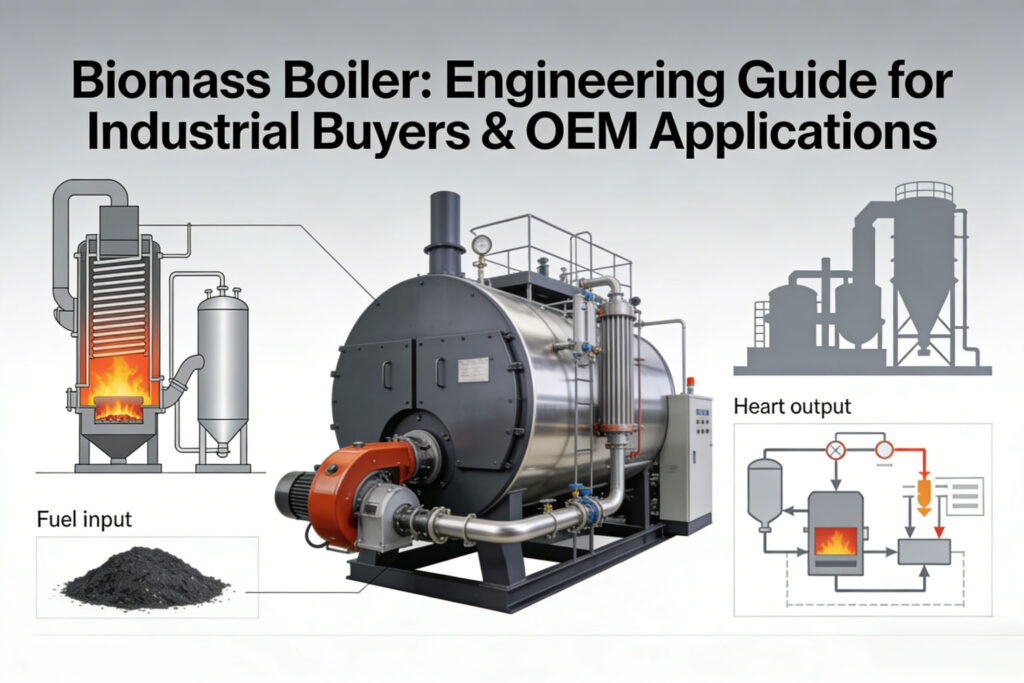
What is a Biomass Boiler? Engineering Guide for Industrial Buyers & OEM 애플리케이션
추천 스니펫:
A biomass boiler is a heating system that generates thermal energy by burning organic materials such as wood pellets, agricultural waste, or biomass residues. It is widely used in industrial, 광고, and district heating applications as a sustainable alternative to fossil fuel boilers. Biomass boilers offer high efficiency, reduced carbon emissions, and compatibility with automated control systems, making them ideal for modern energy systems. Their integration with motors, 팬, 슬리퍼, and feeding systems enables stable and continuous operation in demanding environments.
What is a Biomass Boiler and How Does It Work?
A biomass boiler is a combustion-based system that converts chemical energy stored in organic materials into heat. This heat is used to produce hot water, steam, or thermal energy for industrial processes.
주요 구성품
- Fuel feeding system (screw conveyor or auger)
- Combustion chamber
- Heat exchanger
- Flue gas exhaust system
- 제어 시스템
작동 원리
Biomass fuel is transported into the combustion chamber, where it burns under controlled conditions. The generated heat is transferred via a heat exchanger to water or air systems. Motors play a critical role in driving fans, 슬리퍼, and feeding mechanisms.
Explore motor solutions for biomass systems: 산업용 BLDC 모터
Why Biomass Boilers Are Used in Industrial Applications
The increasing demand for sustainable energy and cost control has driven the adoption of biomass boilers across industries.
주요 이유
- Lower fuel costs compared to fossil fuels
- Renewable and carbon-neutral energy source
- Reduced dependency on oil and gas
- Government incentives and carbon regulations
Engineering Perspective
Biomass systems enable energy independence while maintaining stable thermal output. With proper motor-driven control systems, combustion efficiency can be optimized for consistent performance.
Efficiency of Biomass Boilers
Efficiency is a critical parameter in evaluating biomass boiler performance. Modern systems can achieve efficiencies of 80–92% depending on fuel type and system design.
Factors Affecting Efficiency
- Fuel moisture content
- Combustion air control (fan motors)
- Heat exchanger design
- Ash handling efficiency
Motor Contribution to Efficiency
High-efficiency motors used in fans and pumps significantly improve airflow control and heat transfer, reducing energy losses across the system.
열 성능 및 열 관리
Thermal performance determines how effectively a biomass boiler converts fuel into usable heat.
Heat Transfer Process
- Combustion heat generation
- Heat exchange via tubes or plates
- Distribution through water or steam systems
Cooling and Heat Stability
Efficient cooling of auxiliary systems (모터, 문장) ensures continuous operation. Poor thermal management can reduce system lifespan and increase maintenance costs.
Control Systems in Biomass Boilers
Modern biomass boilers rely on automated control systems for optimal operation.
Control Functions
- Fuel feeding rate control
- Airflow regulation via fan motors
- 온도 모니터링
- Emission control
Integration with Motors
BLDC and AC motors are commonly used in:
- Combustion fans
- Induced draft fans
- Fuel feeding systems
- Circulation pumps
Custom motor integration: OEM 모터 솔루션
Biomass Boiler vs Gas Boiler vs Coal Boiler
| 매개 변수 | 바이오매스 보일러 | Gas Boiler | Coal Boiler |
|---|---|---|---|
| Fuel Cost | 낮은 | 높은 | 보통의 |
| 능률 | 80-92% | 85-95% | 70-85% |
| Emissions | 낮은 (carbon-neutral) | 보통의 | 높은 |
| 오토메이션 | 높은 | 높은 | 낮은 |
| 유지 | 보통의 | 낮은 | 높은 |
| 애플리케이션 | 산업용, district heating | 광고 | Legacy systems |
엔지니어링 통찰력
Biomass boilers provide a balance between cost and sustainability. While gas boilers offer higher efficiency, biomass systems are more cost-effective in long-term operation, especially in regions with abundant biomass resources.
Advantages and Disadvantages of Biomass Boilers
장점
- Renewable energy source
- Lower operating costs
- Reduced carbon footprint
- Suitable for large-scale industrial use
Disadvantages
- Higher initial investment
- Fuel storage requirements
- Maintenance complexity
Engineering Consideration
System reliability depends heavily on motor quality and control system integration. Poor motor selection can lead to inefficiencies and downtime.
How to Choose a Biomass Boiler System (Including Motor Selection)
For OEMs and procurement teams, selecting the right biomass boiler involves evaluating both thermal system design and motor-driven components.
전압 범위
- 24V~48V: Small systems and control units
- 220V–380V: Industrial motors for fans and pumps
전력 범위
- 0.5kW~5kW: 공급 시스템
- 5kW–50kW: Industrial fans and pumps
속도와 토크
Fan motors require high-speed operation, while feeding systems require high torque at low speed.
냉각방식
- Air cooling for standard applications
- Liquid cooling for high-temperature environments
컨트롤러 호환성
Ensure compatibility with automation systems (PLC, 가변 주파수 드라이브, or BLDC controllers).
애플리케이션별 고려 사항
- Fuel type (pellets, 작은 조각, 쓰레기)
- Operating hours (연속적 vs 간헐적)
- 환경 조건
CTA: Request a datasheet or contact our engineers for a customized motor solution tailored to your biomass boiler system.
Applications of Biomass Boilers
산업용 애플리케이션
- Food processing plants
- Textile manufacturing
- Chemical industries
HVAC and District Heating
- Central heating systems
- Campus energy systems
Agricultural Applications
- Greenhouses
- Drying systems
Motor Integration Example
In a biomass boiler system, multiple motors work together:
- Fan motors for combustion air
- Conveyor motors for fuel feeding
- Pump motors for heat distribution
Future Trends in Biomass Boiler Technology
The biomass boiler market is evolving with advancements in automation and efficiency.
주요 동향
- Smart control systems (IoT integration)
- High-efficiency heat exchangers
- Low-emission combustion technologies
- Integration with renewable energy systems
Motor innovation, especially in high-efficiency BLDC motors, will play a critical role in future system optimization.
FAQ: Biomass Boiler Systems
1. What fuel is used in a biomass boiler?
Biomass boilers use organic materials such as wood pellets, wood chips, agricultural waste, and other renewable biomass sources. The choice depends on availability, 비용, and system design.
2. Are biomass boilers cost-effective?
예, biomass boilers offer lower operating costs due to cheaper fuel sources, although initial investment may be higher compared to gas boilers.
3. What is the efficiency of a biomass boiler?
Modern biomass boilers typically achieve 80–92% efficiency depending on fuel quality and system optimization.
4. What motors are used in biomass boiler 시스템?
Motors are used in fans, 슬리퍼, and feeding systems. Both AC and BLDC motors are commonly used depending on efficiency and control requirements.
5. How long does a biomass boiler last?
적절한 유지 관리로, biomass boilers can last 15–25 years. Motor quality and thermal management significantly impact overall system lifespan.
결론: Why Biomass Boilers Are a Strategic Industrial Choice
Biomass boilers provide a sustainable, cost-effective solution for industrial heating and energy generation. Their integration with high-performance motors and advanced control systems ensures reliable and efficient operation.
OEM 및 산업 구매자용, selecting the right motor components is critical to achieving optimal system performance and long-term reliability.
다음 단계: Contact our engineering team to request a datasheet or develop a custom motor solution for your biomass boiler application.
참조
- 국제에너지기구 (IEA) Bioenergy Reports
- IEEE Papers on Industrial Heating Systems
- Renewable Energy Journal Publications
- Industry White Papers on Biomass Combustion Technology