
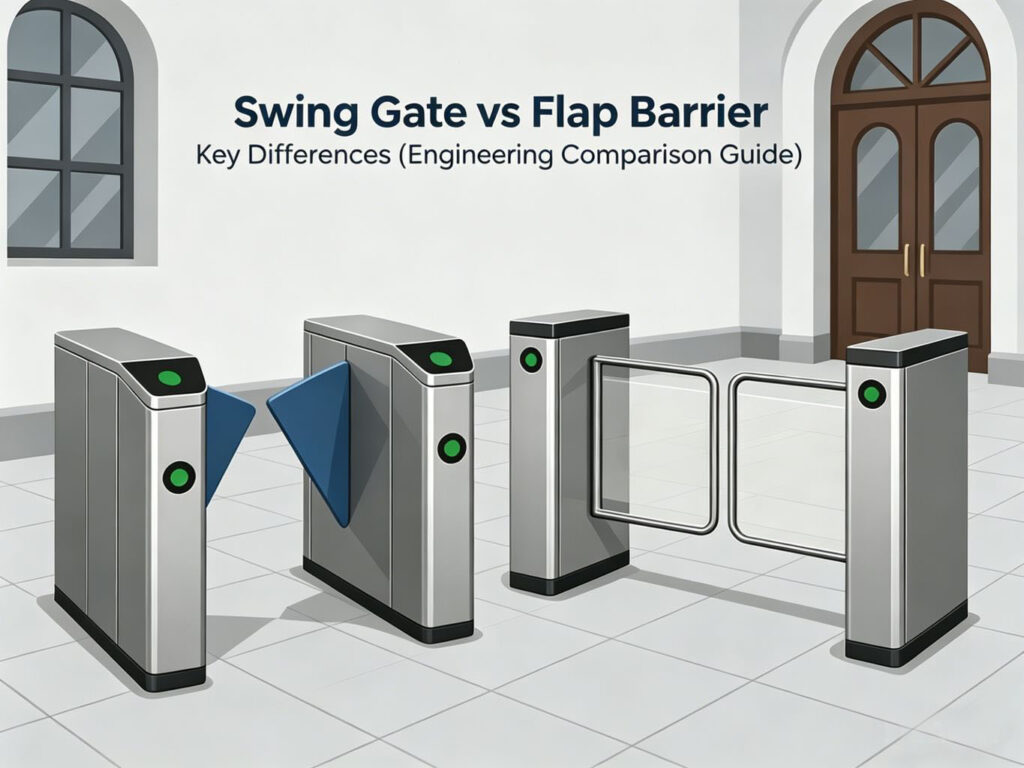
Cancello a battente contro barriera ad aletta: Differenze chiave (Engineering Comparison Guide)
Frammento in primo piano:
Swing gate turnstiles and flap barriers are two widely used access control systems, but they differ significantly in design, prestazione, e applicazione. Swing gates use motor-driven arms that rotate horizontally, offering wider passage and better accessibility, while flap barriers use retractable panels for faster operation and higher security. Dal punto di vista ingegneristico, the choice depends on throughput requirements, sicurezza, motor control complexity, e il costo del ciclo di vita. Swing gates are typically preferred for accessibility and durability, while flap barriers are chosen for high-speed, high-security environments.
Cos'è un tornello per cancelli a battente?
A swing gate turnstile is a motorized access control system that uses one or two swing arms to regulate pedestrian movement. The arms rotate horizontally to open and close, driven by an electric motor—typically a BLDC motor combined with a gearbox and encoder feedback system.
From a mechanical standpoint, swing gates are designed for smooth motion, rumore basso, e lunga durata. The system relies on torque-controlled motor operation, ensuring stable and safe movement even under variable load conditions such as crowd pressure or misuse.
Key Engineering Features
- Wide lane support (600–1200 mm)
- Bassa velocità, high-torque motor operation
- Simple mechanical structure with fewer moving parts
- High tolerance to mechanical shock
What is a Flap Barrier?
A flap barrier is a high-speed access control system that uses retractable panels (flaps) made of acrylic or glass. These flaps open and close rapidly using a high-speed motor and linkage mechanism.
Unlike swing gates, flap barriers emphasize speed and precision. The control system must coordinate motor acceleration, decelerazione, and position feedback within milliseconds to ensure safe operation.
Key Engineering Features
- Fast opening/closing cycle (0.3–0.8 seconds)
- Compact design for high-density installations
- Advanced control systems (often FOC or servo control)
- Higher sensitivity to alignment and calibration
Why Compare Swing Gate vs Flap Barrier?
For OEM buyers and system integrators, choosing between swing gate and flap barrier directly impacts system performance, cost structure, and maintenance requirements. The wrong choice can lead to:
- Higher lifecycle costs due to maintenance issues
- Reduced throughput in high-traffic environments
- Safety risks in public installations
- Integration challenges with existing access control systems
This comparison focuses on engineering-level differences to support informed decision-making.
Cancello a battente contro barriera ad aletta: Confronto delle prestazioni
| Parametro | Tornello per cancelli a battente | Barriera lembo |
|---|---|---|
| Opening Speed | 0.5–1.5 s | 0.3–0.8 s |
| Torque Requirement | Moderare (2–10 Nm) | Alto (due to rapid acceleration) |
| Controllare la complessità | Medio | Alto |
| Throughput | Alto | Molto alto |
| Livello di rumore | Basso | Medio |
| Manutenzione | Basso | Medio-alto |
| Accessibility | Eccellente | Bene |
Intuizione ingegneristica: Flap barriers require higher dynamic torque due to rapid acceleration and deceleration, which increases stress on the motor and mechanical components. Swing gates operate at lower speeds, reducing wear and improving longevity.
Cancello a battente contro barriera ad aletta: Motor and Control System Differences
Swing Gate Motor System
Typically uses BLDC motors operating in low-speed, high-torque mode. Control systems often use simpler closed-loop feedback with Hall sensors or encoders.
Flap Barrier Motor System
Requires high-speed motors with precise position control. Servo motors or high-performance BLDC motors with FOC control are commonly used.
Key Difference: Flap barriers demand higher control precision and faster response times, increasing controller complexity and cost.
Efficienza, Prestazioni termiche, e affidabilità
Efficienza
Swing gates generally achieve higher overall system efficiency due to lower acceleration demands. Flap barriers consume more peak power during rapid motion cycles.
Prestazioni termiche
Flap barrier motors generate more heat due to frequent high-speed cycles, requiring better thermal management. Swing gates operate under more stable thermal conditions.
Affidabilità & Durata
Swing gate systems typically have longer service life because of reduced mechanical stress. Flap barriers, while precise, may require more frequent maintenance.
Vantaggi e svantaggi
Swing Gate Advantages
- High durability and long lifespan
- Bassi requisiti di manutenzione
- Better accessibility (wheelchair, luggage)
- Lower noise operation
Swing Gate Disadvantages
- Slower than flap barriers
- Slightly larger footprint
Flap Barrier Advantages
- Faster throughput
- More compact design
- Higher perceived security
Flap Barrier Disadvantages
- Higher maintenance
- More complex control system
- Costo iniziale più elevato
How to Choose Between Swing Gate and Flap Barrier
Intervallo di tensione
Both systems typically operate at 24V, 48v, or 72V. Higher voltage improves efficiency and reduces current load.
Scala di potenza
Swing gates: 50–200W; Flap barriers: 100–300W depending on speed requirements.
Velocità / Coppia
Swing gates require steady torque, while flap barriers require high peak torque for rapid motion.
Metodo di raffreddamento
Flap barriers may require enhanced cooling due to higher thermal load.
Compatibilità del controller
Flap barriers often require advanced controllers (FOC or servo), while swing gates can operate with simpler BLDC drivers.
Considerazioni sull'applicazione
- High traffic → Flap barrier
- Accessibility → Swing gate
- Low maintenance → Swing gate
- High security → Flap barrier
CTA: Need help selecting the right motor or system? Contact our engineers or request a datasheet.
Ottieni un preventivo gratuito
Applications of Swing Gate and Flap Barrier Systems
Swing Gate Applications
- Office buildings
- Hospitals
- Industrial facilities
- Accessible public entrances
Flap Barrier Applications
- Metro stations
- Airports
- High-security facilities
- Stadiums
Application environment directly determines which system is more suitable.
Future Trends in Turnstile Systems
Both swing gate and flap barrier technologies are evolving with:
- AI-based access control integration
- IoT monitoring and predictive maintenance
- Higher efficiency BLDC motors
- Contactless authentication systems
Motor technology, especially in BLDC systems, will continue to improve efficiency, reduce noise, and enhance control precision.
FAQ – Swing Gate vs Flap Barrier
1. Which is better: swing gate or flap barrier?
It depends on the application. Swing gates are better for accessibility and durability, while flap barriers are better for high-speed, high-security environments.
2. Why are flap barriers more expensive?
They require more complex motor systems, faster control algorithms, and higher precision components, increasing both manufacturing and maintenance costs.
3. Which system has lower maintenance?
Swing gates typically have lower maintenance requirements due to simpler mechanics and lower operating stress.
4. Are BLDC motors used in both systems?
SÌ, BLDC motors are commonly used in both, but flap barriers often require higher-performance variants with advanced control systems.
5. What is the lifespan difference?
Swing gate systems generally have longer lifespans due to reduced mechanical stress and simpler operation cycles.
Conclusione
Choosing between swing gate and flap barrier systems requires a clear understanding of performance requirements, cost constraints, and application environment. Swing gates provide a reliable, low-maintenance solution with excellent accessibility, while flap barriers deliver higher throughput and tighter access control.
Per i produttori OEM, motor selection—especially choosing the right BLDC configuration—plays a critical role in achieving optimal system performance.
Explore Solutions:
For detailed engineering support or pricing, contact our team today.
Riferimenti
1. IEEE Transactions on Industrial Electronics – Motor Control Systems
2. Access Control System Design Guide – Security Industry Association
3. Electric Motor Handbook – H. Wayne Beaty