
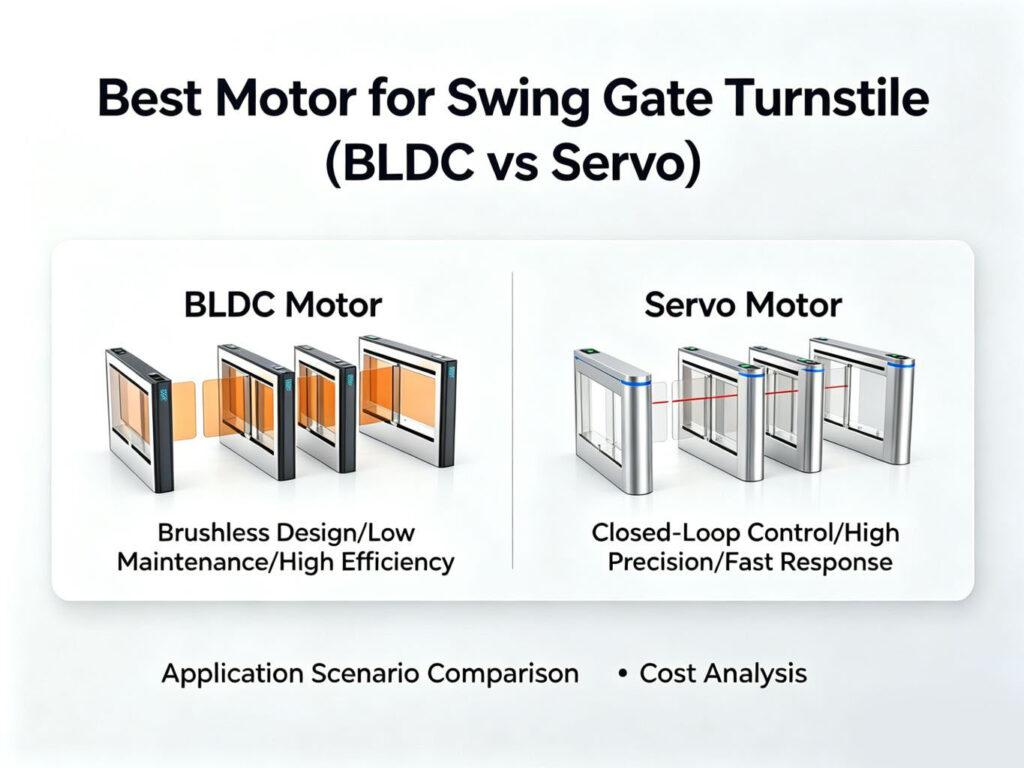
Il miglior motore per tornelli a battente (BLDC contro Servo)
Frammento in primo piano:
The best motor for swing gate turnstile depends on performance requirements, cost targets, e precisione di controllo. In most modern access control systems, BLDC (CC senza spazzole) motors are preferred due to high efficiency, bassa manutenzione, e lunga durata. Servomotori, Tuttavia, offer superior positioning accuracy and dynamic response, making them ideal for high-end or security-critical applications. Per i produttori OEM, the choice typically comes down to a trade-off between cost efficiency and control precision.
What is a Swing Gate Turnstile Motor?
A swing gate turnstile motor is the core drive component responsible for controlling the opening and closing motion of the gate arm or barrier panel. Unlike tripod or full-height turnstiles, swing gates require smooth, controlled movement with precise acceleration and deceleration profiles. This places specific demands on the motor system, including torque stability, rumore basso, and responsive control.
Dal punto di vista ingegneristico, the motor is integrated with a gearbox, codificatore (opzionale), and control system to form a complete electromechanical drive. The motor must handle intermittent loads, frequent start-stop cycles, and variable user interaction forces. These conditions make motor selection critical to overall system reliability and user experience.
👉For high-performance solutions, check our Motore BLDC per tornello
Why Motor Selection Matters in Swing Gate Turnstiles
Motor selection directly impacts system performance, lifecycle cost, and safety compliance. Inadequate torque can lead to gate stalling, while poor control response may result in unsafe or inconsistent operation. Engineers must consider not only mechanical load but also control strategy and environmental conditions.
Per i produttori OEM, the motor also affects production cost and maintenance requirements. A well-selected motor reduces failure rates, minimizes service intervals, and enhances customer satisfaction. In high-traffic environments such as metro stations or office buildings, even small efficiency gains can translate into significant operational savings.
Motore BLDC per tornello a battente: Come funziona
BLDC motors operate using electronic commutation, replacing traditional brushes with a controller-driven switching system. This design eliminates mechanical wear points and enables precise speed and torque control. In swing gate turnstiles, BLDC motors are typically paired with Hall sensors or encoders for position feedback.
The key advantage lies in efficiency and reliability. BLDC motors can achieve efficiency levels above 85%, significantly reducing heat generation. This is particularly important in compact turnstile enclosures where thermal management is limited. Inoltre, the absence of brushes reduces maintenance requirements and extends lifespan.
Servo Motor for Swing Gate Turnstile: Come funziona
Servo motors are closed-loop systems designed for high precision control. They integrate feedback devices such as encoders to continuously adjust position, velocità, e coppia. In swing gate turnstiles, servo motors enable smooth motion profiles and accurate positioning of the gate arm.
Servo systems excel in applications requiring rapid response and high accuracy. They can maintain consistent performance under varying loads and provide advanced features such as torque limiting and adaptive control. Tuttavia, these advantages come with higher system complexity and cost.
BLDC vs Servo Motor for Swing Gate Turnstile: Differenze chiave
| Parametro | Motore BLDC | Servomotore |
|---|---|---|
| Efficienza | Alto (85–92%) | Moderate to High (80–90%) |
| Densità di coppia | Good for compact designs | Very high with precise control |
| Sistema di controllo | Moderate complexity | High complexity (closed-loop) |
| Costo | Inferiore | Più alto |
| Manutenzione | Basso | Basso (but complex system) |
| Applicazione | Standard turnstiles | High-end / sistemi di sicurezza |
From an engineering standpoint, BLDC motors offer the best balance between cost and performance for most applications. Servo motors are justified when precise motion control or advanced features are required.
Efficienza, Densità di coppia, and Thermal Performance
Efficienza
BLDC motors outperform traditional solutions in efficiency due to reduced electrical and mechanical losses. Servo motors also offer high efficiency but may experience additional losses due to complex control electronics.
Densità di coppia
Servo motors typically provide higher torque density, making them suitable for compact, high-load applications. BLDC motors offer sufficient torque for most swing gate systems, especially when combined with gear reduction.
Prestazioni termiche
Thermal management is critical in enclosed turnstile systems. BLDC motors generate less heat, improving reliability. Servo motors require careful thermal design, especially in continuous operation scenarios.
Control System Comparison: BLDC contro Servo
Control strategy is a key differentiator. BLDC motors use simpler controllers with speed and position control capabilities. Servo systems employ advanced algorithms, including PID control, enabling precise motion profiles.
Per gli OEM, controller compatibility is crucial. BLDC systems are easier to integrate and cost-effective, while servo systems require specialized drivers and tuning. The choice depends on system requirements and engineering resources.
Considerazioni sull'affidabilità e sulla durata
Reliability is a major concern in turnstile applications due to high usage frequency. BLDC motors have fewer wear components, resulting in longer lifespan and reduced maintenance. Servo motors are also reliable but depend heavily on controller quality and tuning.
In real-world deployments, BLDC motors often achieve operational lifespans exceeding 20,000 ore, making them ideal for commercial installations. Servo systems can match or exceed this but at a higher cost.
How to Choose a Motor for Swing Gate Turnstile
Intervallo di tensione
Typical systems operate at 24V, 48v, or 72V. Higher voltage improves efficiency and reduces current, which is beneficial for thermal management.
Scala di potenza
Most swing gate turnstiles require motors in the 50W–200W range, depending on gate size and load.
Velocità e coppia
Torque requirements depend on gate weight and opening speed. Engineers should calculate peak torque and include a safety margin of 20–30%.
Metodo di raffreddamento
Air cooling is standard, but enclosed designs may require enhanced heat dissipation through housing design.
Compatibilità del controller
Ensure the motor is compatible with existing control systems. BLDC controllers are more flexible, while servo systems require specific drivers.
Considerazioni specifiche sull'applicazione
Consider factors such as duty cycle, condizioni ambientali, and user interaction. High-traffic environments demand robust, reliable motors with minimal maintenance.
CTA: For detailed motor specifications, you can request datasheets or get a custom OEM solution from our engineering team.
Ottieni un preventivo gratuito
Applications of Swing Gate Turnstile Motors
Swing gate turnstiles are widely used in commercial buildings, transportation hubs, and industrial facilities. Each application has unique requirements, influencing motor selection.
- Commercial Buildings: Emphasis on aesthetics and quiet operation.
- Trasporti: High durability and fast response.
- Industrial Facilities: Robust design and reliability.
Future Trends in Turnstile Motor Technology
The industry is moving toward smarter, more efficient motor systems. Integration with IoT and predictive maintenance is becoming standard. BLDC motors are expected to dominate due to their efficiency and adaptability, while servo systems will continue to serve high-end applications.
Emerging trends include integrated motor-controller units, AI-based control algorithms, and improved energy efficiency standards.
Domande frequenti: Swing Gate Turnstile Motor Selection
1. Why choose BLDC motor for turnstile?
I motori BLDC offrono un'elevata efficienza, bassa manutenzione, e lunga durata. They are ideal for most commercial applications where cost and reliability are key factors.
2. When is a servo motor better?
Servo motors are better for applications requiring precise positioning, risposta veloce, and advanced control features, such as high-security environments.
3. What is the best voltage for turnstile motors?
48V is commonly used as it balances efficiency and safety. Higher voltages like 72V are used in high-performance systems.
4. How long does a turnstile motor last?
High-quality BLDC motors can last over 20,000 ore, depending on usage and maintenance conditions.
5. What affects turnstile motor cost?
Cost is influenced by motor type, livello di potenza, sistema di controllo, and customization requirements. Servo systems are generally more expensive than BLDC solutions.
Conclusione: Which Motor is Better?
For most swing gate turnstile applications, BLDC motors provide the best balance of efficiency, costo, e affidabilità. Servo motors are suitable for specialized applications requiring high precision and advanced control. OEM manufacturers should evaluate performance requirements, cost constraints, and system integration when making a decision.
Final CTA: Looking for the best motor for your turnstile project? Contact our engineers today to discuss your requirements and get a tailored OEM solution.
Ottieni un preventivo gratuito
Riferimenti
- https://ieeexplore.ieee.org/document/BLDC-motor-efficiency
- https://www.motioncontroltips.com/servo-vs-bldc-motors
- https://www.sciencedirect.com/topics/engineering/brushless-dc-motor
- https://www.controleng.com/articles/understanding-servo-systems