
Cos'è un tornello per cancelli a battente? Come funziona (Guida tecnica completa)
Frammento in primo piano:
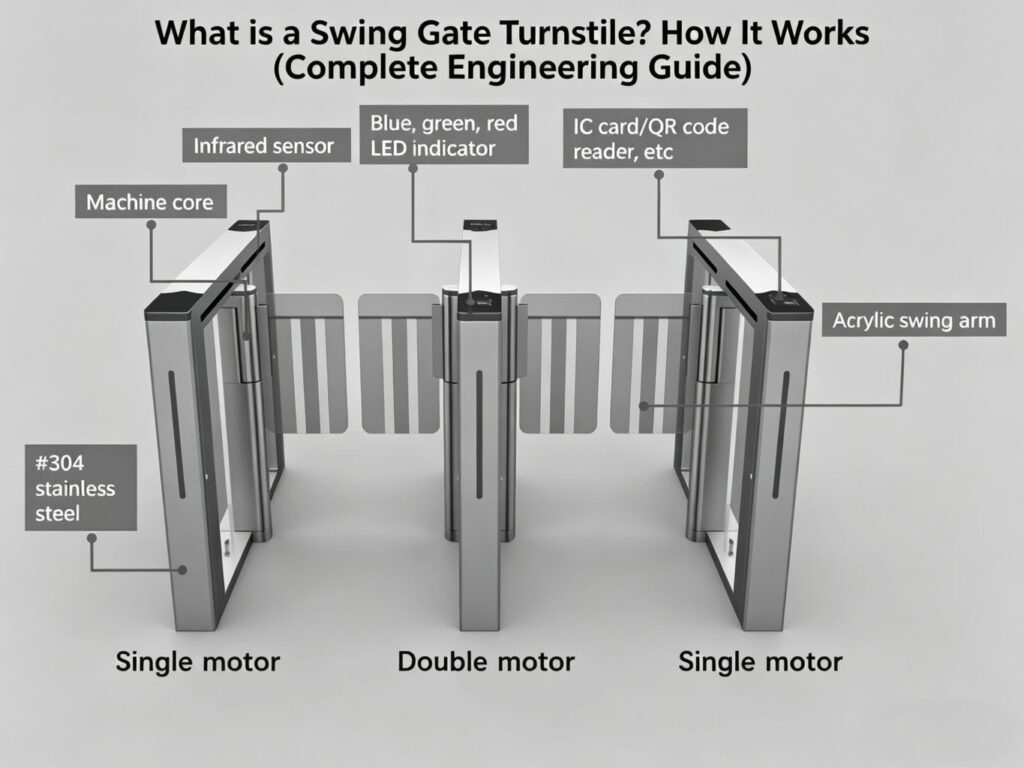
A swing gate turnstile is an access control system that uses motor-driven swing arms to regulate pedestrian entry and exit. It works by combining sensors, controllori, and an electric motor—typically a BLDC or servo motor—to open and close gate panels based on authorization signals. The system ensures controlled access, high throughput, and safety by precisely managing torque, velocità, and position feedback. Compared to traditional tripod turnstiles, swing gate systems offer wider lanes, smoother motion, and better integration with modern security systems.
Cos'è un tornello per cancelli a battente?
A swing gate turnstile is an electromechanical access control device designed to manage pedestrian flow in controlled environments such as metro stations, office buildings, aeroporti, and industrial facilities. Unlike tripod turnstiles, which use rotating arms, swing gates utilize one or two panels that open laterally.
Dal punto di vista ingegneristico, the swing gate turnstile is a mechatronic system integrating:
- Motore elettrico (BLDC / servo / DC spazzolato)
- Gear reduction mechanism
- Sensori di posizione (Hall sensors or encoders)
- Controllore (MCU or PLC-based)
- Access control interface (RFID, biometric, QR)
The design focus is not only on access restriction but also on reliability, throughput, and safety compliance.
👉For high-performance solutions, check our Motore BLDC per tornello
Key Structural Components
The system typically consists of a cabinet housing the drive system, swing arms made of stainless steel or acrylic, and embedded electronics. Mechanical tolerances and alignment are critical to ensure smooth motion and long lifespan.
How Does a Swing Gate Turnstile Work?
The operation of a swing gate turnstile follows a closed-loop control sequence involving detection, authorization, actuation, and feedback.
Step-by-Step Working Principle
1. Idle State: The gate remains closed, with the motor holding position using torque control or electromagnetic locking.
2. Authentication: A user presents credentials via RFID, biometric scanner, or QR system.
3. Elaborazione del segnale: The controller verifies access permission and sends a command to the motor driver.
4. Gate Opening: The motor rotates the shaft through a gearbox, swinging the gate open at a controlled speed.
5. Passage Detection: Infrared sensors detect user movement through the lane.
6. Gate Closing: After passage, the controller commands the motor to return to the closed position.
This process typically completes within 0.5–1.5 seconds depending on system configuration.
Why Swing Gate Turnstiles Are Preferred in Modern Access Control?
Modern infrastructure demands higher throughput, accessibility, and integration flexibility. Swing gate turnstiles address these requirements more effectively than traditional designs.
Key reasons include:
- Wider passage (ADA compliant)
- Smoother operation with low noise
- Higher aesthetic value for commercial spaces
- Better compatibility with advanced control systems
From an engineering standpoint, the ability to use closed-loop motor control significantly improves performance and reliability.
Swing Gate Turnstile vs Tripod Turnstile vs Flap Barrier
| Parametro | Tornello per cancelli a battente | Tripod Turnstile | Barriera lembo |
|---|---|---|---|
| Drive Mechanism | Il motore + Riduttore | Spring + Motor Assist | High-speed motor |
| Throughput | Alto | Medio | Molto alto |
| Accessibility | Eccellente | Limitato | Bene |
| Costo | Medio-alto | Basso | Alto |
| Precisione del controllo | Alto | Basso | Molto alto |
| Manutenzione | Basso | Medio | Medio |
Intuizione ingegneristica: Swing gates strike a balance between performance and cost. While flap barriers offer faster response, they require more complex control systems and higher maintenance.
Motor Types Used in Swing Gate Turnstiles
Motore BLDC (Recommended)
Brushless DC motors provide high efficiency, rumore basso, e lunga durata. They are ideal for high-frequency operation environments.
Motore DC spazzolato
Lower initial cost but higher maintenance due to brush wear. Suitable for low-duty applications.
Servomotore
Provides precise position control and high torque density but at a higher cost.
Typical Greensky configurations include 48V and 72V BLDC motors optimized for turnstile applications.
Engineering Performance Analysis
Efficienza
BLDC motors achieve 85–92% efficiency, reducing energy consumption in high-traffic installations.
Densità di coppia
High torque at low speeds ensures smooth gate movement without overshoot.
Prestazioni termiche
Continuous operation requires efficient heat dissipation. Aluminum housings and ventilation improve thermal stability.
Sistema di controllo
Foc (Controllo orientato al campo) enables precise torque and speed regulation.
Affidabilità & Durata
BLDC systems typically exceed 20,000 operating hours with minimal maintenance.
How to Choose a Swing Gate Turnstile Motor
This is the most critical decision point for OEM buyers and engineers.
Intervallo di tensione
Common options include 24V, 48v, e 72V. Higher voltage improves efficiency and reduces current.
Scala di potenza
Typical range: 50W–300W depending on gate size and usage frequency.
Velocità / Coppia
Torque must overcome gate inertia and friction. Typical requirement: 2–10 Nm.
Metodo di raffreddamento
Natural air cooling is sufficient for most indoor applications. Forced cooling may be required for high-duty cycles.
Compatibilità del controller
Ensure compatibility with BLDC drivers or servo controllers. POTERE, RS485, or PWM interfaces are common.
Considerazioni specifiche sull'applicazione
- Indoor vs outdoor environment
- Traffic intensity
- Security level requirements
CTA: For detailed motor matching, contact our engineers or request a datasheet.
Ottieni un preventivo gratuito
Applications of Swing Gate Turnstiles
Industrial Facilities
Used for employee access control with high durability requirements.
Transportation Systems
Metro and airports require high throughput and reliability.
Commercial Buildings
Focus on aesthetics and silent operation.
Assistenza sanitaria & Accessibility
Wide lanes accommodate wheelchairs and carts.
Vantaggi e svantaggi
Vantaggi
- Funzionamento fluido e silenzioso
- High reliability with BLDC motors
- Flexible integration
- Manutenzione ridotta
Svantaggi
- Higher initial cost than tripod systems
- Requires more complex control electronics
Future Trends in Swing Gate Turnstile Technology
Industry trends are moving toward:
- AI-based access control
- IoT-enabled monitoring
- Higher efficiency BLDC systems
- Contactless authentication integration
Motor technology is evolving toward higher torque density and smarter control algorithms.
FAQ – Swing Gate Turnstile Systems
1. What motor is best for a swing gate turnstile?
BLDC motors are the best choice due to high efficiency, rumore basso, e lunga durata. They support advanced control methods like FOC, improving performance and reliability.
2. How long does a swing turnstile motor last?
High-quality BLDC motors can operate for over 20,000 ore con una manutenzione minima, depending on usage conditions and load cycles.
3. What is the typical speed of a swing gate turnstile?
Opening and closing cycles typically range from 0.5 A 1.5 secondi, depending on motor power and control settings.
4. Are swing gate turnstiles suitable for outdoor use?
SÌ, but they require weatherproof designs, corrosion-resistant materials, and sealed motor systems.
5. What is the cost difference between BLDC and brushed motors?
BLDC motors have higher upfront cost but lower lifetime cost due to reduced maintenance and higher efficiency.
Conclusione
Swing gate turnstiles represent the modern standard in access control systems, combining mechanical reliability with advanced motor control. For OEM manufacturers and system integrators, selecting the right motor—especially a BLDC solution—is critical to achieving optimal performance, efficienza, e durata della vita.
Greensky provides 48V and 72V BLDC motor solutions specifically optimized for turnstile applications, ensuring high torque density, rumore basso, e affidabilità a lungo termine.
Passaggi successivi:
For engineering consultation or pricing, contact our team today.
Ottieni un preventivo gratuito
Riferimenti
1. IEEE Transactions on Industrial Electronics – BLDC Motor Control Systems
2. CEI 60335 Standards for Electrical Safety
3. Access Control System Design Handbook – Security Industry Association
4. Electric Motor Handbook – H. Wayne Beaty