
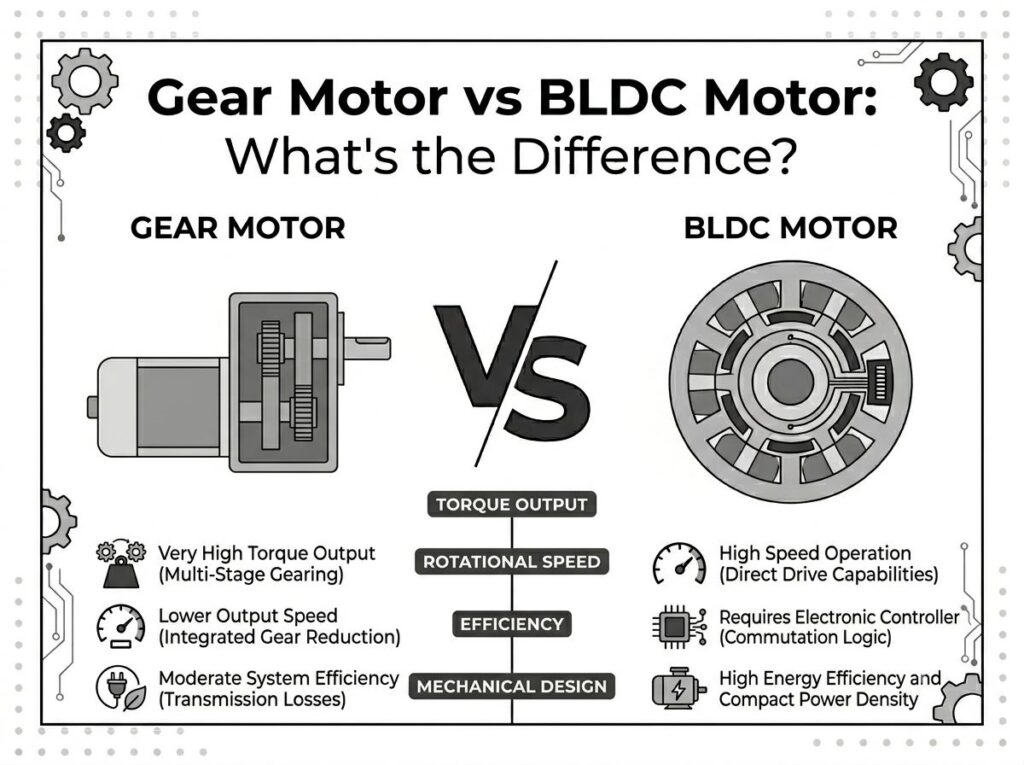
Motoriduttore e motore BLDC: Qual è la differenza??
Choosing the correct drive system is one of the most important engineering decisions in machine design. Whether you are developing a robotic platform, an AGV, an automated gate, a conveyor, or an electric lawn mower, understanding the difference between a gear motor and a CC senza spazzole (BLDC) il motore is essential for achieving the desired balance of speed, coppia, efficienza, affidabilità, e costo.
One common misconception is that a gear motor and a BLDC motor are competing motor technologies. In realtà, they describe two different concepts. A BLDC motor refers to the motor technology itself, while a gear motor refers to a complete drive assembly that combines a motor with a gearbox. In many industrial applications, these two concepts work together rather than compete with each other.
Per esempio, a planetary BLDC gear motor combines the high efficiency of a brushless motor with the torque multiplication provided by a planetary gearbox. This configuration has become the preferred solution for robotics, AGV, automated doors, attrezzature mediche, e automazione industriale.
This engineering guide explains the differences between gear motors and BLDC motors, compares their performance characteristics, and provides practical recommendations for OEM engineers and purchasing managers selecting the most suitable drive solution.
Risposta rapida
A gear motor is not a different motor type from a BLDC motor. A gear motor is an assembly consisting of an electric motor and a gearbox, while a BLDC motor refers to the motor technology itself. Many modern gear motors actually use BLDC motors combined with planetary, sperone, or worm gearboxes to achieve higher torque and lower output speed.
If your application requires high rotational speed and compact design, a BLDC motor alone may be sufficient. If it requires high torque at low speed, an integrated BLDC gear motor is usually the better engineering solution.
Cos'è un motoriduttore?
UN motoriduttore is an integrated drive unit consisting of two primary components:
- Motore elettrico
- Riduttore (Speed Reducer)
The gearbox reduces the output speed while proportionally increasing torque. This allows relatively small motors to drive heavy loads that would otherwise require significantly larger motors.
Gear Motor Structure
The basic structure of a gear motor includes:
- Motor housing
- Rotor and stator assembly
- Gear reduction mechanism
- Albero di uscita
- Cuscinetti
- Sistema di lubrificazione
- Sealing components
The motor may be a DC motor, Motore a corrente alternata, Motore BLDC, motore passo-passo, or servo motor depending on application requirements.
How Does a Gearbox Work?
A gearbox transmits mechanical power through a series of gears with different diameters. As rotational speed decreases, torque increases according to the gear ratio.
Per esempio:
| Motor Speed | Rapporto di cambio | Velocità di uscita | Coppia di uscita |
|---|---|---|---|
| 3000 giri al minuto | 10:1 | 300 giri al minuto | Approximately 10× Higher* |
| 6000 giri al minuto | 20:1 | 300 giri al minuto | Approximately 20× Higher* |
*Actual torque depends on gearbox efficiency and mechanical losses.
Main Types of Gear Motors
Motoriduttore a ingranaggi cilindrici
Spur gear motors use straight-cut gears and offer a simple, economical solution for general industrial applications. They are easy to manufacture and suitable for moderate torque requirements.
Typical applications include:
- Packaging equipment
- Trasportatori
- Office automation
- Small machinery
Motoriduttore epicicloidale
Planetary gear motors use a sun gear, ingranaggi planetari, and an internal ring gear to achieve high torque density in a compact package.
I vantaggi includono:
- Elevata capacità di coppia
- Excellent load distribution
- Compact dimensions
- Alta efficienza
- Low backlash options
Planetary gear motors are widely used in robotics, AGV, attrezzature mediche, e automazione industriale.
Motoriduttore a vite senza fine
Worm gear motors employ a worm shaft driving a worm wheel to achieve large reduction ratios.
I vantaggi includono:
- Very high reduction ratios
- Compact right-angle output
- Self-locking capability in many designs
Common applications include gates, ascensori, positioning equipment, and security systems.
Motoriduttore elicoidale
Helical gear motors utilize angled gear teeth to provide smoother and quieter operation than spur gears.
I vantaggi includono:
- Maggiore efficienza
- Vibrazioni inferiori
- Rumore ridotto
- Lunga durata
These motors are commonly found in heavy-duty industrial machinery, trasportatori, and continuous-duty automation systems.
Cos'è un motore BLDC?
Un motore CC senza spazzole (Motore BLDC) is a permanent magnet synchronous motor that uses electronic commutation instead of brushes and a mechanical commutator.
Compared with traditional brushed motors, BLDC motors provide significantly higher efficiency, durata di servizio più lunga, minori esigenze di manutenzione, and superior power density.
Struttura del motore BLDC
A standard BLDC motor consists of:
- Rotore a magnete permanente
- Stator with multi-phase windings
- Controllore elettronico
- Power inverter
- Sensori ad effetto Hall (opzionale)
- Motor housing
Permanent Magnet Rotor
Unlike induction motors, BLDC motors use high-performance permanent magnets mounted on the rotor.
This design eliminates rotor copper losses and contributes to higher efficiency and improved torque density.
Commutazione elettronica
Instead of mechanical brushes, i controller elettronici energizzano gli avvolgimenti dello statore in base alla posizione del rotore.
Electronic commutation provides:
- Manutenzione ridotta
- Maggiore efficienza
- Long operational life
- Affidabilità migliorata
- Lower electrical noise
Sensori Hall
Many BLDC motors incorporate Hall-effect sensors that detect rotor position.
These sensors help the controller determine the correct timing for phase switching, improving startup performance and low-speed operation.
Advanced sensorless BLDC systems estimate rotor position using back electromotive force (Indietro EMF), eliminating the need for Hall sensors in many applications.
BLDC Controller
The controller performs several critical functions:
- Commutazione elettronica
- Regolazione della velocità
- Current limiting
- Controllo della coppia
- Generazione PWM
- Funzioni di protezione
Because the controller is programmable, BLDC motors can support variable-speed operation, frenata rigenerativa, communication protocols, and advanced diagnostics.
Applicazioni BLDC tipiche
- Tosaerba elettrici
- Rasaerba robotizzati
- Sistemi HVAC
- Pompe dell'acqua
- Ventole di raffreddamento
- Bici elettriche
- Attrezzature mediche
- Automazione industriale
- Utensili elettrici
Can a BLDC Motor Be a Gear Motor?
SÌ. Infatti, this is one of the most important concepts engineers should understand.
A BLDC motor and a gear motor are not mutually exclusive. Invece, a BLDC motor can serve as the driving source inside a gear motor assembly.
Engineering Relationship
Motore BLDC
+
Riduttore planetario
=
Motore a marcia planetario BLDC
This integrated configuration combines the strengths of both technologies:
- High efficiency from the BLDC motor
- High torque from the gearbox
- Lower output speed
- Improved load capability
- Compact overall dimensions
Why OEM Manufacturers Prefer BLDC Gear Motors
Instead of selecting a larger direct-drive motor, many OEM manufacturers choose a compact BLDC motor paired with a precision gearbox. This approach provides higher torque while reducing system size, peso, and overall cost.
BLDC gear motors have become the preferred solution in applications such as:
- Robot mobili autonomi (AMR)
- Veicoli a guida automatizzata (AGV)
- Robot collaborativi
- Electric wheel drives
- Medical pumps
- Smart locks
- Sistemi di tornelli
- Electric actuators
For OEM projects requiring customized output speed, coppia, Configurazioni dell'albero, and mounting interfaces, integrated BLDC gear motors provide far greater design flexibility than standalone motors.
Motoriduttore e motore BLDC: Differenze chiave
Although both are frequently compared, they represent different engineering concepts. The following table summarizes their primary differences.
| Caratteristica | Motoriduttore | Motore BLDC |
|---|---|---|
| Definizione | Il motore + Riduttore | Motor Technology |
| Coppia tipica | Alto | Medio |
| Velocità tipica | Basso | Alto |
| Efficienza | Depends on Gearbox | Molto alto |
| Controllo della posizione | Depends on Motor Type | Bene |
| Costo | Higher System Cost | Lower Motor Cost |
| Complessità | Più alto | Inferiore |
| Ideale per | Coppia elevata, Bassa velocità | High Speed, Alta efficienza |
Rather than asking which technology is better, engineers should determine whether the application requires additional torque multiplication. If so, integrating a gearbox with a BLDC motor is often the optimal solution.
Confronto di coppia
Torque is one of the primary reasons engineers choose gear motors over direct-drive motors.
A standalone BLDC motor naturally operates at relatively high rotational speeds with moderate output torque. By adding a gearbox, the rotational speed is reduced while torque increases proportionally according to the gear ratio.
Why Gear Motors Produce Higher Torque
The relationship can be summarized as follows:
Gear Ratio
     ↓
Output Speed Decreases
     ↓
Output Torque Increases
Per esempio, a BLDC motor producing 0.5 N·m a 3,000 RPM can deliver approximately 5 N·m a 300 RPM when paired with a 10:1 cambio planetario, accounting for gearbox efficiency losses.
BLDC Direct Drive Advantages
- High rotational speed
- Eccellente efficienza
- Simple mechanical structure
- Manutenzione ridotta
BLDC Gear Motor Advantages
- Higher output torque
- Lower output speed
- Improved load capacity
- Better low-speed controllability
- Smaller motor size for equivalent output torque
Speed Comparison
Speed characteristics differ significantly between standalone BLDC motors and gear motors.
| Caratteristica | Motore BLDC | Motoriduttore |
|---|---|---|
| Typical Speed Range | 3,000–10,000 RPM | 10–500 RPM (depending on ratio) |
| Accelerazione | Very Fast | Moderare |
| High-Speed Operation | Eccellente | Limited by Gear Ratio |
| Stabilità a bassa velocità | Bene | Eccellente |
For applications such as centrifugal pumps, ventole di raffreddamento, and mower blade drives, the high-speed capability of a direct BLDC motor is advantageous.
Al contrario, applications requiring controlled low-speed movement—such as robotic wheels, AGV, electric actuators, trasportatori, and turnstiles—benefit significantly from gear reduction.
Continua alla parte 2: Confronto di efficienza, Confronto dei costi, Robotica, AGV, Taglia erba, Turnstile Applications, Guida alla selezione, Perché gli acquirenti OEM scelgono Greensky Power, Domande frequenti, Internal Linking Strategy, e riferimenti.
Confronto di efficienza
Efficiency is a key engineering factor when selecting between a standalone BLDC motor and a gear motor system. It directly affects energy consumption, comportamento termico, durata della batteria, and long-term operating cost.
BLDC motors are widely recognized for their high electrical efficiency due to the absence of brush friction and rotor copper losses. Tuttavia, when a gearbox is introduced, mechanical losses must also be considered.
Efficienza del motore BLDC
A standalone BLDC motor typically achieves high efficiency across a wide operating range:
- Efficienza tipica: 85%–95%
- Low rotor losses due to permanent magnet design
- Minimal maintenance losses (niente spazzole)
- High efficiency at rated speed
Gear Motor Efficiency
Gear motor efficiency depends heavily on gearbox type and design quality:
- Riduttore planetario: 95%–98% di efficienza
- Riduttore elicoidale: 96%–98% di efficienza
- Spur gearbox: 94%–97% efficiency
- Worm gearbox: 50%–90% di efficienza (highly load-dependent)
The total system efficiency of a BLDC gear motor is the product of motor efficiency and gearbox efficiency.
Per esempio:
0.92 (il motore) × 0.96 (riduttore) = 0.883 → 88.3% efficienza del sistema
Efficiency Trade-Off Summary
| System Type | Gamma di efficienza | Note |
|---|---|---|
| Standalone BLDC Motor | 85%–95% | Highest efficiency at high speed |
| BLDC + Riduttore planetario | 80%–92% | Best balance of torque and efficiency |
| BLDC + Riduttore a vite senza fine | 60%–85% | High torque but higher losses |
In most OEM applications, planetary BLDC gear motors provide the best compromise between efficiency, densità di coppia, e design compatto.
Confronto dei costi
Cost is often the decisive factor in OEM and industrial procurement decisions. Tuttavia, it is important to consider not only unit cost but also total system cost.
BLDC Motor Cost Structure
- Motor cost: Low to medium
- È richiesto il controllore: SÌ
- Sensor options: Sala / senza sensori
- Installation complexity: Basso
Gear Motor Cost Structure
- Motor cost: Similar or slightly lower
- Gearbox cost: Additional component
- Mechanical integration cost: Più alto
- Costo di manutenzione: Depends on application
Confronto dei costi totali del sistema
| Item | Motoriduttore | Motore BLDC |
|---|---|---|
| Motor Unit | Inferiore | Inferiore |
| Riduttore | Necessario | Not Required |
| Controllore | Opzionale / Dipende | Necessario |
| Mechanical Design | Più complesso | Più semplice |
| Costo totale del sistema | Più alto (in most torque-heavy applications) | Inferiore (in direct-drive applications) |
Although gear motors appear more expensive, they often reduce system-level costs by eliminating the need for larger motors, complex transmission systems, or high-current power electronics.
Che è meglio per la robotica?
Robotics is one of the most demanding application fields for motion control systems. It requires a combination of precision, torque control, design compatto, and dynamic response.
In most robotic systems, neither a standalone BLDC motor nor a pure gear motor is sufficient on its own. Invece, a BLDC gear motor system is commonly used.
Why Robotics Prefers BLDC Gear Motors
- High torque density in compact size
- Smooth low-speed control
- Precise motion via encoder integration
- Reduced inertia with planetary gear systems
- High efficiency for battery-powered robots
Typical Robotics Applications
- Robot collaborativi (cobot)
- Industrial robotic arms
- Robot di servizio
- Robot di ispezione
- Educational robotics platforms
For most robotic applications, the combination of a BLDC motor with a planetary gearbox provides the best balance between precision and torque.
Il che è meglio per AGV e AMR?
Veicoli a guida automatizzata (AGV) e robot mobili autonomi (AMR) require reliable, efficiente, and compact drive systems.
BLDC Motor in AGVs
- High efficiency for long battery life
- Smooth acceleration and deceleration
- Bassi requisiti di manutenzione
Gear Motor in AGVs
- High torque for load carrying
- Stable low-speed operation
- Improved climbing ability
Industry Practice
Most modern AGV/AMR designs use Motoriduttori epicicloidali BLDC because they provide:
- Compact wheel drive solutions
- Integrated encoder feedback
- High torque at low RPM
- Energy-efficient operation
Perciò, instead of choosing between BLDC or gear motor, engineers typically select an integrated solution combining both technologies.
Che è meglio per i tosaerba?
Lawn mower systems require both cutting power and mobility drive control, often under harsh environmental conditions.
Blade Drive System
For blade rotation, high-speed operation is essential. A standalone BLDC motor is typically preferred:
- High RPM capability
- Efficient cutting performance
- Direct drive simplicity
Wheel Drive System
For mobility, torque is more important than speed:
- BLDC gear motors provide better traction
- Planetary gearboxes improve climbing ability
- Stable low-speed control enhances navigation
Recommended Configuration
| Funzione | Best Solution |
|---|---|
| Blade System | High-speed BLDC Motor |
| Drive Wheels | Motore a marcia planetario BLDC |
This hybrid architecture is widely used in modern robotic lawn mowers.
Which Is Better for Turnstiles?
Turnstiles require controlled motion, reliable torque output, and long service life under frequent operation cycles.
In most access control systems, gear reduction is essential for smooth and controlled movement.
Why Gear Motors Dominate Turnstiles
- High torque at low speed
- Precise rotational control
- Self-locking capability (worm gear options)
- High durability for continuous use
The most common solution is a planetary BLDC gear motor, which provides both efficiency and torque stability.
How to Choose Between Gear Motors and BLDC Motors
The correct selection depends on application requirements rather than motor type preference.
| Applicazione | Soluzione consigliata |
|---|---|
| Pompa | Motore BLDC |
| Fan | Motore BLDC |
| Conveyor | Motoriduttore |
| AGV | Motoriduttore BLDC |
| Robot Arm | Motoriduttore BLDC |
| Lawn Mower Blade | Motore BLDC |
| Lawn Mower Drive | Motoriduttore BLDC |
| Tornello | Motoriduttore epicicloidale |
This table highlights a key engineering principle: modern systems rarely choose between BLDC and gear motors in isolation. Invece, they combine both to achieve optimal performance.
Perché gli acquirenti OEM scelgono Greensky Power
Greensky Power provides integrated motor and gearbox solutions designed for OEM manufacturers in global industrial markets.
Portafoglio di prodotti principali
- Motori BLDC
- Motoriduttori epicicloidali
- Motoriduttori a vite senza fine
- Spur Gear Motors
- Helical Gear Systems
Capacità ingegneristiche OEM
- Custom gearbox ratio design
- Motor-controller integration
- Encoder feedback solutions
- OEM housing customization
- Rapid prototyping and sampling
Key Application Industries
- Robotica e automazione
- AGV and AMR systems
- Apparecchiature HVAC
- Lawn and garden machinery
- Security and access control systems
- Trasportatori industriali
Domande frequenti (Domande frequenti)
Is a gear motor the same as a BLDC motor?
NO. A gear motor is a mechanical assembly combining a motor and gearbox, while a BLDC motor refers specifically to motor technology using electronic commutation.
Can a BLDC motor have a gearbox?
SÌ. Infatti, many industrial systems use BLDC motors combined with planetary, sperone, or worm gearboxes to achieve higher torque output.
Which is better, a gear motor or a BLDC motor?
Neither is universally better. BLDC motors are ideal for high-speed applications, while gear motors are better for high-torque, low-speed requirements.
Why use a planetary gearbox with a BLDC motor?
A planetary gearbox increases torque density while maintaining compact size and high efficiency, making it ideal for robotics and AGV systems.
What applications need BLDC gear motors?
Common applications include robotics, AGV, electric wheel drives, tornelli, pompe mediche, and automated industrial systems.
Riferimenti
- https://www.ieee.org
- https://ieeexplore.ieee.org
- https://www.nidec.com
- https://www.siemens.com
- https://new.abb.com
- https://www.weg.net
- https://www.energia.gov
- https://www.mathworks.com
- https://www.ti.com
- https://www.microchip.com